Views: 9
The Cathedral of the Transfiguration of the Lord in Tallinn and the Christmas Message in the Contemporary World
Located in the heart of Tallinn’s Old Town, the Cathedral of the Transfiguration of the Lord is not merely an architectural monument or a historical church building. It is a place where, over the centuries, Western and Eastern Christian traditions, political transformations, and spiritual continuity have converged. Within this historical and spiritual context, the Christmas message of Metropolitan Stephanos of the Estonian Apostolic Orthodox Church acquires particular depth, resonating beneath the cathedral’s vaults as a timeless yet profoundly contemporary proclamation.
In his Christmas message, Metropolitan Stephanos emphasizes that Christmas is not simply a remembrance of a past event but a living reality: God has become human and dwells among us. This message is deeply connected with the history and meaning of the Cathedral of the Transfiguration, where “transformation” has been both a theological truth and a historical experience.
The Meaning of the Transfiguration: Theological and Historical Dimensions
In Orthodox tradition, the Transfiguration of the Lord (in Greek Μεταμόρφωσις – metamórphōsis, “transformation” or “transfiguration”) signifies the revelation of Christ’s divine glory on Mount Tabor. This event is not merely an outward change, but a call for humanity to partake in divine light.
In Greek liturgical language, this mystery is expressed in the hymn:
«Ἐμεταμορφώθης ἐν τῷ ὄρει, Χριστὲ ὁ Θεός»
(Emetamorphṓthēs en tō órei, Christè ho Theós)
— “You were transfigured on the mountain, O Christ our God.”
The choice of the name “Transfiguration” for the Tallinn cathedral was not accidental. In Russian, Преображение likewise means “transformation” or “transfiguration,” referring both to spiritual renewal and to historical changes in conquered territories. Thus, the name of the church carries a multilayered meaning that remains relevant today.
The History of the Cathedral of the Transfiguration of the Lord in Tallinn
Origins as a Cistercian Convent Church
The church building was originally constructed in the 13th century as the main church of the Cistercian Convent of St Michael in Tallinn. Danish chronicles associate the beginning of construction with the year 1249, when King Eric IV Ploughpenny of Denmark supported the founding of the convent. The structure evolved over several centuries, and its Gothic vaults are among the oldest preserved in Tallinn.
From the Reformation to an Orthodox Cathedral
Following the Reformation, the function of the convent changed, and in 1710, after Tallinn capitulated to the Russian Empire, the church was handed over to an Orthodox congregation. In 1732, the building was consecrated as the Church of the Transfiguration of the Lord and became the spiritual center of Orthodox life in Tallinn. Until the completion of the Alexander Nevsky Cathedral in 1900, it served as the principal Orthodox cathedral of the city.
Architectural Transformation and Artistic Heritage
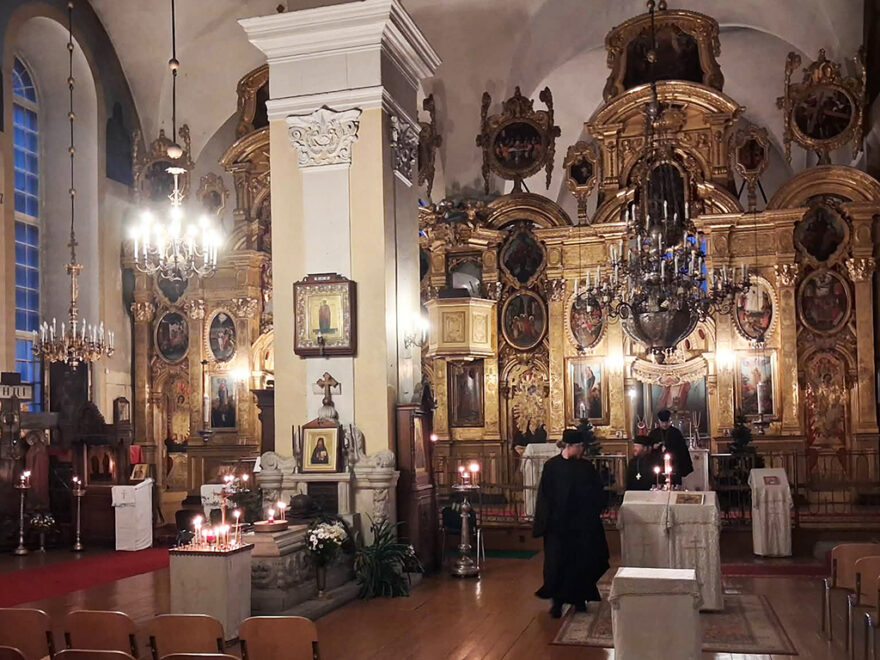
During the 18th and 19th centuries, the church underwent several reconstructions that gave it its present classical appearance. Of particular significance is the Baroque iconostasis designed by Ivan Zarudny and created with the participation of dozens of master craftsmen. The iconostasis functions as a “visual Gospel,” through which Christ’s birth, life, and glorification are revealed to the faithful by means of icons.
The Church as a Spiritual Center of Estonian Orthodoxy
At the beginning of the 20th century, after the Russian congregation moved to the Alexander Nevsky Cathedral, the Cathedral of the Transfiguration became the spiritual home of the Estonian Orthodox community. The tomb of the holy Hieromartyr Bishop Platon was placed in the center of the church, making it one of the most significant memorial sites in the history of Estonian Orthodoxy.
In Greek, a church is often called
ναός (naós) — “a sacred dwelling,”
emphasizing that it is not merely a building, but a place of God’s abiding presence.
Metropolitan Stephanos’ Christmas Message and the Meaning of the Transfiguration
In his 2024 Christmas message, Metropolitan Stephanos reminds us of the central truth of Christianity: God is neither distant nor inaccessible. Christ is born into the world to dwell with humanity — in our homes, in our joys, and in our suffering.
In Greek, this mystery is expressed in the words:
«Ὁ Λόγος σὰρξ ἐγένετο»
(Ho Lógos sárx egéneto)
— “The Word became flesh” (John 1:14).
This phrase unites Christmas and the Transfiguration into a single theological whole: Christ’s birth and His transfiguration reveal that humanity is called to communion with divine light and love. The Cathedral of the Transfiguration of the Lord, with its rich and transformative history, stands as a living witness to this message.
Conclusion
The Cathedral of the Transfiguration of the Lord in Tallinn is not merely a monument of the past, but a living spiritual space where history, theology, and contemporary faith intersect. Metropolitan Stephanos’ Christmas message, heard in this context, becomes an invitation to inner transformation — μεταμόρφωσις — which begins with Christ’s birth in the human heart and continues throughout a person’s life.

Trough all this I want to declare this is all from God and to God. All Glory to Him!