What is the Orthodox Church?
The Ancient Faith That Never Changed
Keywords: Eastern Orthodox Church, Orthodox Christianity, ancient Christian faith, Orthodox Church explained, Orthodox Church beliefs
Introduction: The Church That Has Remained Unchanged
Have you ever wondered what the original Christian Church looked like — the one Jesus Christ founded and the Apostles spread throughout the world? The Orthodox Church (Eastern Orthodox Church) claims to be precisely that Church: the unbroken carrier of apostolic tradition, preserving the Apostles’ confession of faith unchanged for over two thousand years.
Orthodoxy is not a young movement, nor a confession born from the Reformation. It is an ancient Christian tradition rooted in the first congregation in Jerusalem — at the feet of the Apostles, at the very moment of Pentecost, when the Holy Spirit was poured out. Today, the Orthodox Church numbers an estimated 225 to 300 million members worldwide, concentrated primarily in the Balkans, Russia, the Middle East, and Eastern Europe.
The History of the Orthodox Church: From the Beginning to the Great Schism
Apostolic Roots
The Orthodox Church holds that its origins trace directly to the community established by Jesus Christ. Pentecost — fifty days after the Resurrection — is celebrated as the birthday of the Church: on that day the Holy Spirit descended upon the Apostles and the Church’s mission began.
In the early centuries, Christianity spread along the roads of the Roman Empire — to Antioch, Alexandria, Ephesus, Constantinople, and Rome. These five cities became known as the Patriarchates: great ecclesiastical centres that led the Christian world together, in a spirit of conciliarity, without any single absolute authority.
The Seven Ecumenical Councils
One of the defining features of the Orthodox Church is the authority of the Seven Ecumenical Councils. These councils — from the First Council of Nicaea in 325 AD to the Second Council of Nicaea in 787 AD — convened to defend the true faith against heretical teachings and to proclaim what the Church had always believed.
These councils did not create new dogmas; they articulated the existing faith clearly and precisely, to protect the faithful from error. The Nicene Creed, formulated in 325 and 381 AD, remains to this day the central symbol of faith in the Orthodox Church.
The Great Schism of 1054
In 1054, an event took place that permanently altered the Christian world. The Great Schism — the split between Eastern Christianity and the Church of Rome — did not happen overnight. It was a process of gradual mutual estrangement spanning centuries, driven by both theological disagreements and political tensions.
The central disputes concerned the question of papal supremacy and the filioque addition to the Nicene Creed — the Eastern Church regarded this as a unilateral alteration that no one could make without the consent of the whole Church. As a result, Christianity divided into two: the Eastern (Orthodox) Church and the Western (Roman Catholic) Church.
What Does Orthodoxy Believe? The Core Teachings of the Church
The Holy Trinity
The foundation of Orthodox faith is belief in the Holy Trinity: God is one in essence, but three Persons — Father, Son, and Holy Spirit. This is not merely an abstract theological theory, but a living experience encountered in the liturgy, prayer, and sacraments.
Orthodoxy emphasises that the mystery of the Trinity exceeds the limits of human categories. The Church trusts in divine revelation rather than constructing its faith upon rationalistic frameworks.
Holy Scripture and Holy Tradition
In the Orthodox Church, Holy Scripture and ecclesiastical Tradition are not opposites — they are two dimensions of the one Truth. Scripture is written; Holy Tradition lives in the Church’s liturgy, iconography, the writings of the Church Fathers, and the sacraments.
The Old Testament of the Orthodox Bible is based on the Septuagint — the ancient Greek translation used by the first Christians and the Apostles themselves. This is a significant difference from Western Christianity, where translations based primarily on the Hebrew text are used.
Theosis — Becoming Like God
One of the most distinctive and profound Orthodox teachings is theosis, also called deification. It means that the calling of every human being is not merely the forgiveness of sins, but a real participation in the divine nature (2 Peter 1:4).
Theosis does not mean that a person becomes God — it means that by grace, a person participates ever more deeply in the fullness of God’s life and light. This is the heart of the Orthodox understanding of salvation: salvation is not a verdict, but a process of healing and transformation.
The Seven Sacraments
The Orthodox Church recognises seven sacraments (Holy Mysteries):
- Baptism — cleansing from sin and rebirth into new life through water
- Chrismation — the gift of the Holy Spirit received immediately after Baptism
- The Eucharist — receiving the Body and Blood of Christ
- Confession — the forgiveness of sins and spiritual healing
- Holy Unction — God’s grace for the sick
- Marriage — the sanctification of the union of man and woman in Christ
- Holy Orders — the transmission of ordained ministry
The Eucharist stands at the heart of Orthodox liturgy. The Divine Liturgy is not a mere memorial service — it is the true presence of Christ’s Body and Blood upon the altar, a mystery into which the faithful enter every Sunday.
The Orthodox Church and Icons
Icons (icons) are an inseparable part of Orthodox spiritual life. They are not merely works of art, nor are they idols — icons are windows towards the heavenly world, depicting Christ, the Mother of God, and the saints.
Venerating an icon is not the worship of an idol — it is an expression of honour to the person depicted, who lives in communion with Christ’s Church. The Seventh Ecumenical Council (787) declared the veneration of icons a correct and necessary Christian practice.
The Divine Liturgy — Heaven’s Mirror on Earth
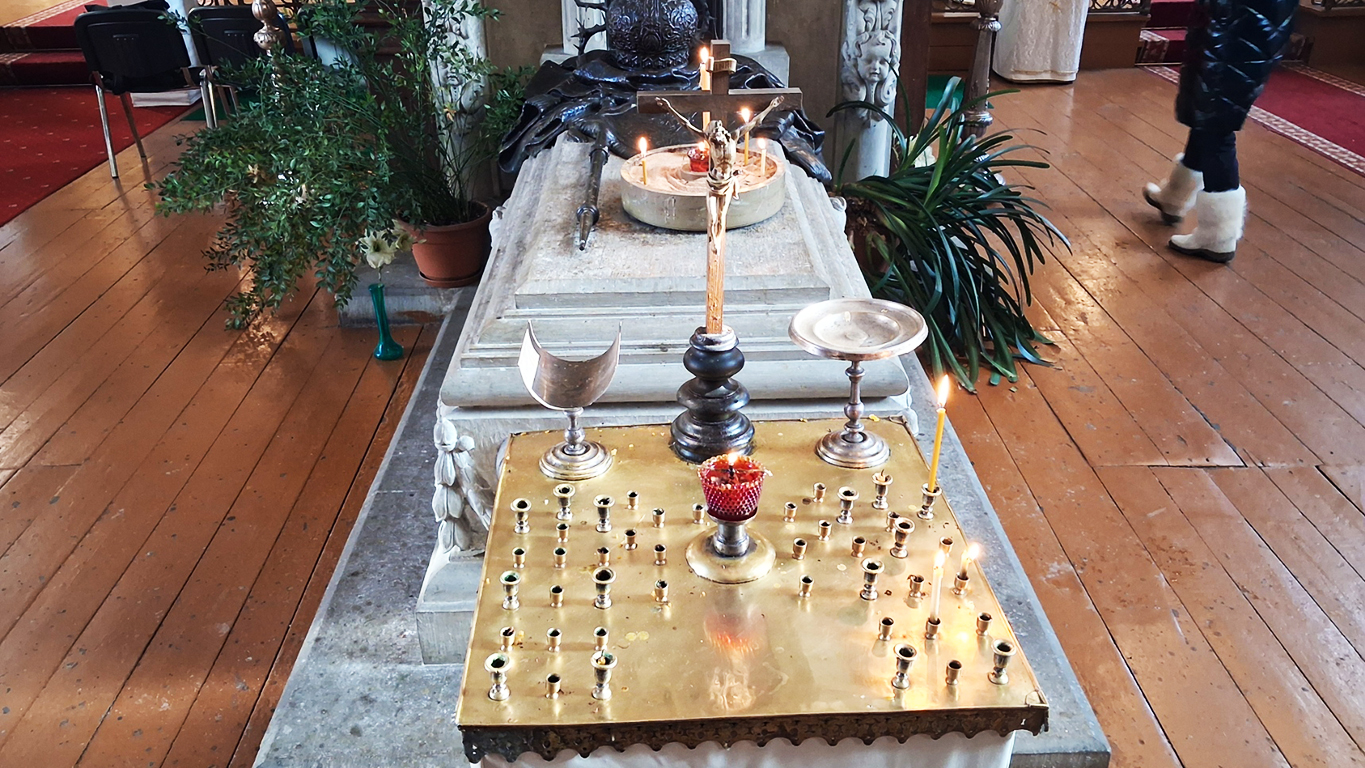
The Orthodox worship service — the Divine Liturgy — is more than a thousand years old. It is sung from beginning to end; all prayers are surrounded by choral voices and icons gaze from every direction.
The service is not merely a sermon and songs. It is participation in the heavenly worship described in the Book of Revelation: before the throne of God, surrounded by angels, resounds the cry: “Holy, holy, holy is the Lord of Hosts!”
The Orthodox Church Today
Today the Orthodox Church is a family of autocephalous (self-governing) churches. The largest of these are:
- The Russian Orthodox Church — the largest member, with over 100 million faithful
- The Ecumenical Patriarchate of Constantinople — holding the place of honour
- The Greek Orthodox Church
- The Serbian, Romanian, Bulgarian, and other national churches
- The Estonian Apostolic Orthodox Church — under the jurisdiction of the Patriarchate of Constantinople
Although the churches differ in language, customs, and culture, they are one in faith, sacraments, and apostolic tradition.
Orthodoxy in Estonia
The Orthodox community in Estonia has existed for centuries. The Estonian Apostolic Orthodox Church (EAOC) falls under the jurisdiction of the Patriarchate of Constantinople and is led by the Metropolitan of Tallinn and all Estonia. Its members celebrate the Divine Liturgy in the Estonian language and carry the ancient tradition forward to new generations.
Also present in Estonia is the Estonian Orthodox Church of the Moscow Patriarchate (EOCMP), whose best-known church is the Alexander Nevsky Cathedral in Tallinn.
Why Orthodoxy? What Does It Offer the Person of Today?
Many people come to Orthodoxy precisely because they are searching for something more than sermons and music. They are looking for:
- Spiritual depth — prayer, fasting, theosis
- Ancient tradition — the sense of standing alongside the successors of the Apostles
- Community — a church family that shares a common faith and life
- Liturgical beauty — a service that engages the whole person: body, soul, and spirit
The Orthodox Church does not alter its beliefs according to passing trends. It does not look to the surrounding culture to adapt its teaching accordingly. Instead, it calls people to return to its own source — to the unchanging God and the unchanging faith.
Conclusion
The Orthodox Church is ancient, apostolic, and unchanging. It is a Church not designed for the short term — it is designed for eternity. From Pentecost to the present day, it carries forward one and the same faith, one and the same liturgy, one and the same Christ.
If you are seeking Christianity in its original form — as the Apostles lived it, as the Church Fathers taught it, and as the Church has preserved it through all of history — then Orthodoxy is well worth exploring more closely.

Martinus Vaicarius’s mission is to:
- Provide spiritual support and guidance to people seeking peace and hope
- Create prayer texts that bring God’s peace to hearts suffering under fear and anxiety
- Promote deep understanding of the power of the
- God of Sabaoth and the protection of the heavenly hosts
- Help people enter the spiritual sphere where God’s peace reigns over all
Europe Heaven Invest 2072 Gold OÜ