Views: 110
Orthodox vs. Catholic vs. Protestant:
Key Differences Every Seeker Should Know
A comprehensive analysis of the history, theology, and practice of the three major Christian traditions
1. Introduction: Why Do These Differences Matter?
Christianity is the world’s largest religion, with over 2.4 billion adherents as of 2024 — approximately 30% of the global population. Yet within this single faith, three great traditions coexist, each having shaped theology, culture, and society across the centuries: Eastern Orthodoxy, Roman Catholicism, and Protestantism. Each represents a distinct historical, liturgical, and doctrinal heritage.
According to the Pew Research Center and the World Christian Database, approximately 50% of all Christians are Roman Catholic, 37% are Protestant, and 12% are Orthodox. The remaining 1% encompasses other traditions such as Mormonism and the Jehovah’s Witnesses. These figures underscore the importance of understanding the differences and similarities among the three branches.
This article examines in depth the theological, historical, and liturgical distinctions among the three Christian traditions. We analyse the sources of authority, the sacraments, the doctrine of salvation, biblical interpretation, church governance, and worship — all areas in which the three traditions differ significantly from one another.
2. Historical Background: How Did Christianity Divide?
2.1 The Early Church and Its Unity
The first centuries after the crucifixion and resurrection of Jesus Christ marked the formation of the Christian Church as one, undivided body. The Apostles spread the Gospel throughout the Roman Empire and beyond. Nevertheless, cultural, linguistic, and political tensions produced fractures from the very beginning — as Paul’s First Letter to the Corinthians illustrates, where the Apostle rebukes the congregation for fragmenting into rival factions.
The Roman Empire split into a Latin-speaking West and a Greek-speaking East, creating fertile ground for divergent theological and ecclesio-political trajectories. The rise of Constantinople as the political capital in the fourth century deepened this division further.
2.2 The Great Schism of 1054
The first major rupture within Christianity occurred on 16 July 1054. This event is known as the Great Schism, or the East-West Schism. It was the culmination of a long and tension-filled process: centuries of dispute over papal primacy, the Filioque doctrine, and liturgical differences reached their climax when Pope Leo IX’s legate, Cardinal Humbert, excommunicated Patriarch Michael I Cerularius of Constantinople. In response, Cerularius excommunicated the papal legates in turn.
The principal causes of the Schism were:
- The Filioque controversy: whether the Holy Spirit proceeds from the Father alone (the Orthodox position) or from both the Father and the Son (a Latin addition to the Nicene Creed);
- The question of papal primacy: Rome claimed universal jurisdiction, which the Eastern Church refused to accept;
- Liturgical differences: the use of unleavened versus leavened bread in the Eucharist;
- Cultural and political tensions between Byzantium and Rome.
The mutual excommunications were not lifted until 1965, when Pope Paul VI and Patriarch Athenagoras I met in Jerusalem and conducted bilateral ceremonies of revocation — a delay spanning nine hundred and eleven years.
2.3 The Protestant Reformation of 1517
The second great division came in the sixteenth century. Martin Luther, a professor of theology at Wittenberg, posted his famous Ninety-Five Theses on the door of the Castle Church on 31 October 1517, criticising practices of the Roman Catholic Church — most notably the sale of indulgences. This event launched the Protestant Reformation, which gave rise to separate churches across Europe.
The four principal streams of the Reformation were: Lutheranism (Martin Luther), Calvinism and the Reformed tradition (John Calvin), Anabaptism, and Anglicanism (in England). Today, more than 47,000 distinct Christian denominations exist worldwide, the vast majority of which represent different branches of the Protestant traditions.
3. The Source of Authority: Scripture, Tradition, and the Pope
One of the most fundamental differences among the three traditions concerns the question: what is the source of religious authority, and who has the right to interpret it? The answer to this question shapes every other theological distinction.
3.1 Orthodoxy: Scripture and Holy Tradition
Eastern Orthodoxy holds Scripture and Holy Tradition to be an organic whole composed of equally authoritative sources. The writings of the Church Fathers, the decrees of the Ecumenical Councils, and liturgical practice together form a reliable framework for interpretation. Orthodoxy emphasises that the Holy Spirit guides the Church into all truth in a communal manner — what matters is the universal ecclesial consensus rather than any individual interpretation.
In Orthodoxy, the seven Ecumenical Councils (325-787 AD) carry normative authority. These councils defined the doctrine of the Trinity, the teaching on the two natures of Christ, and other foundational dogmas. Unlike the Catholic model, Orthodoxy does not recognise the infallibility of any single individual.
3.2 Catholicism: Scripture, Tradition, and Papal Infallibility
The Roman Catholic Church recognises both Scripture and Tradition as equally authoritative sources, but adds a third element: the papal Magisterium, or teaching office. The Pope holds a twofold authority: ordinary jurisdiction over all Christians, and the privilege of infallibility when pronouncing ex cathedra definitions.
The dogma of papal infallibility was formally defined at the First Vatican Council in 1870, though the teaching has older roots in the Church’s tradition. The Church holds that the Pope, as the successor of Peter, possesses “full, supreme, and universal power over the whole Church.” This concept remains one of the primary obstacles to Catholic-Orthodox reunion.
3.3 Protestantism: Sola Scriptura — Scripture Alone
The Protestant Reformation grounded its understanding of authority on a radically different principle: Sola Scriptura, meaning “Scripture alone.” Articulated by Luther and other Reformers, this principle declares the Bible to be the only supreme authority for resolving matters of faith. All ecclesiastical traditions, papal pronouncements, and patristic writings are subject to scriptural scrutiny.
Sola Scriptura has led to considerable interpretive diversity: today, more than 47,000 Protestant denominations exist, many reading the Bible differently. The Orthodox critique of this approach holds that it creates “a fundamental rupture from the historical context in which Christianity developed.”
4. The Doctrine of Salvation: How Is Redemption Attained?
No other theological question separates the three traditions as clearly as soteriology — the doctrine of how a person attains salvation.
4.1 Orthodoxy: Theosis — Deification
Eastern Orthodoxy understands salvation in a manner fundamentally different from the Western Christian model. The central concept is theosis (Greek: theosis), or deification — the process by which a human being becomes a partaker of the divine nature while retaining their human identity. The fourth-century theologian Athanasius of Alexandria expressed this in the celebrated phrase: “God became man so that man might become god.”
Orthodox soteriology is holistic: salvation is not merely justification — a change of legal status before God — but the total transformation of the human person and their union with God. The Mysteries (sacraments) are vital instruments in this process, conferring divine grace upon participants and sustaining the transformational journey. Salvation carries both a present-life dimension and an eschatological one.
4.2 Catholicism: Cooperation Between Grace and Works
Roman Catholic soteriology emphasises the interplay of grace and human freedom. The Church teaches that a person cannot save themselves, but that in receiving God’s grace the human person must actively cooperate. This cooperation encompasses receiving the sacraments, performing good works, practising penance, and striving in faith.
Catholicism affirms the existence of Purgatory — an intermediate state in which the soul of the deceased undergoes a purifying process before entering heaven. This concept is related to the understanding that spiritual growth remains possible after death. Both Orthodoxy and Protestantism reject this concept, though for different reasons.
4.3 Protestantism: Sola Gratia and Sola Fide
Protestant soteriology is centred on two Reformation affirmations: Sola Gratia (grace alone) and Sola Fide (faith alone). Luther argued that a person is justified before God through faith alone — not through works, sacraments, or personal merit. This concept, also known as imputed righteousness, means that Christ’s righteousness is “credited” to the believer.
Different Protestant denominations develop the doctrine of salvation in different ways. Calvinists emphasise the sovereignty of God and double predestination — God has determined from eternity both those who will be saved and those who will be condemned. Arminianism, represented in the Methodist, Baptist, and other traditions, emphasises human free will and God’s universal desire for the salvation of all people.
5. Sacraments and Liturgy: Differences in Sacred Practice
5.1 The Number and Meaning of the Sacraments
The understanding of the sacraments — called “Holy Mysteries” in Orthodoxy — differs significantly across the three traditions. Both Orthodoxy and Catholicism recognise seven sacraments, whereas Protestantism generally recognises only two.
| Sacrament | Orthodoxy | Catholicism | Protestantism |
| Eucharist | True Body and Blood of Christ; effected through the Epiclesis | Transubstantiation; effected through the words of consecration | Mostly symbolic remembrance; Lutherans affirm the real presence |
| Baptism | Baptism by immersion; salvific | Sprinkling; removes original sin and confers grace | Varies; most understand it as a public confession of faith |
| Confession | Private, before a priest; absolution granted | Private, before a priest; absolution granted | Largely absent; direct prayer to God |
| Number of sacraments | 7 Holy Mysteries | 7 sacraments | 2 (Baptism and the Lord’s Supper) |
5.2 The Eucharist: A Shared Question, Different Answers
The Eucharist (Holy Communion, the Lord’s Supper) is one of the most significant points of theological divergence. Orthodoxy and Catholicism both affirm the real presence of Christ in the bread and wine — yet their theological explanations of that presence differ. Catholicism employs the term transubstantiation, borrowed from Aristotelian philosophy, to describe how the substance of the bread and wine becomes the Body and Blood of Christ while the outward appearances remain. Orthodoxy rejects this philosophical formulation while still affirming the mystery of Christ’s true presence in the Eucharist, described more apophatically — through the language of negation rather than precise definition.
Most Protestant denominations regard the Eucharist as a memorial (“Do this in remembrance of me”), not an ontological transformation. The notable exception is Lutheranism, which affirms Christ’s real presence in, with, and under the bread and wine — though without the terminology of transubstantiation.
6. Church Governance and Hierarchy
6.1 Orthodoxy: The Ecumenical Patriarchate and Sobornost
The Eastern Orthodox Church is organised as a communion of autocephalous (self-governing) national churches. Approximately fifteen to sixteen autocephalous Orthodox churches exist today, including the churches of Constantinople, Russia, Greece, Romania, Serbia, Georgia, and others. The Ecumenical Patriarch of Constantinople is regarded as “first among equals” (primus inter pares), but holds no universal jurisdiction over the other autocephalous churches.
Decisions are reached at councils (synods) where bishops participate collegially. This principle of sobornost, or conciliarity, is fundamentally different from the Catholic hierarchical model. Orthodoxy permits married men to be ordained as priests, but bishops must be celibate — drawn as a rule from among monks.
6.2 Catholicism: Papal Monarchy
In the Roman Catholic Church, authority is organised in a strict hierarchy: the Pope — cardinals — bishops — priests — deacons. The Pope holds full, supreme, and universal power over the entire Church. This hierarchical structure is uniform across the world: approximately 1.39 billion Catholics (according to the 2024 Annuario Pontificio) form one global Church under the Pope’s leadership.
Priests of the Latin Rite (the Western Church) are required to be celibate, whereas priests of the Eastern Catholic churches (Byzantine Rite) may be married. Bishops must be celibate in all rites. This differs markedly from Orthodox practice.
6.3 Protestantism: A Diverse Range of Structures
Protestant churches share no uniform model of governance — structures range from the episcopal (bishop-led) to the congregational. Many Protestant congregations are entirely independent, with no superior church hierarchy. Ministers are permitted to marry in most Protestant denominations. Some Protestant churches — notably the Anglican Communion — have historically retained an episcopal hierarchy.
7. Mary and the Veneration of Saints
The role of the Virgin Mary and the veneration of the saints constitute another major locus of theological divergence. Both Orthodoxy and Catholicism venerate Mary and the saints but differ in their theological explanations and in certain specific dogmas.
Orthodoxy: The Virgin Mary is the Theotokos — Bearer of God — a title confirmed at the Council of Ephesus in 431 AD. Orthodoxy venerates Mary with great fervour but does not accept the Catholic dogmas of the Immaculate Conception or the Assumption as defined in Rome. Orthodoxy distinguishes between veneration (proskynesis) and worship (latreia) — the saints are honoured, not deified.
Catholicism: The Roman Catholic Church has defined two Marian dogmas that Orthodoxy does not recognise: the Immaculate Conception (1854, defined by Pope Pius IX) — Mary was conceived without original sin — and the Bodily Assumption (1950, defined by Pope Pius XII) — Mary was taken bodily into heaven. These dogmas remain among the primary obstacles to Catholic-Orthodox dialogue.
Protestantism: Most Protestant denominations honour Mary solely as the mother of Jesus but maintain no developed Mariology. Prayer to the saints is generally considered unscriptural — Protestant theology insists that Christ is the sole mediator between God and humanity (1 Timothy 2:5).
8. Icons, Art, and Worship
8.1 Orthodoxy: Icons as Windows into Spiritual Reality
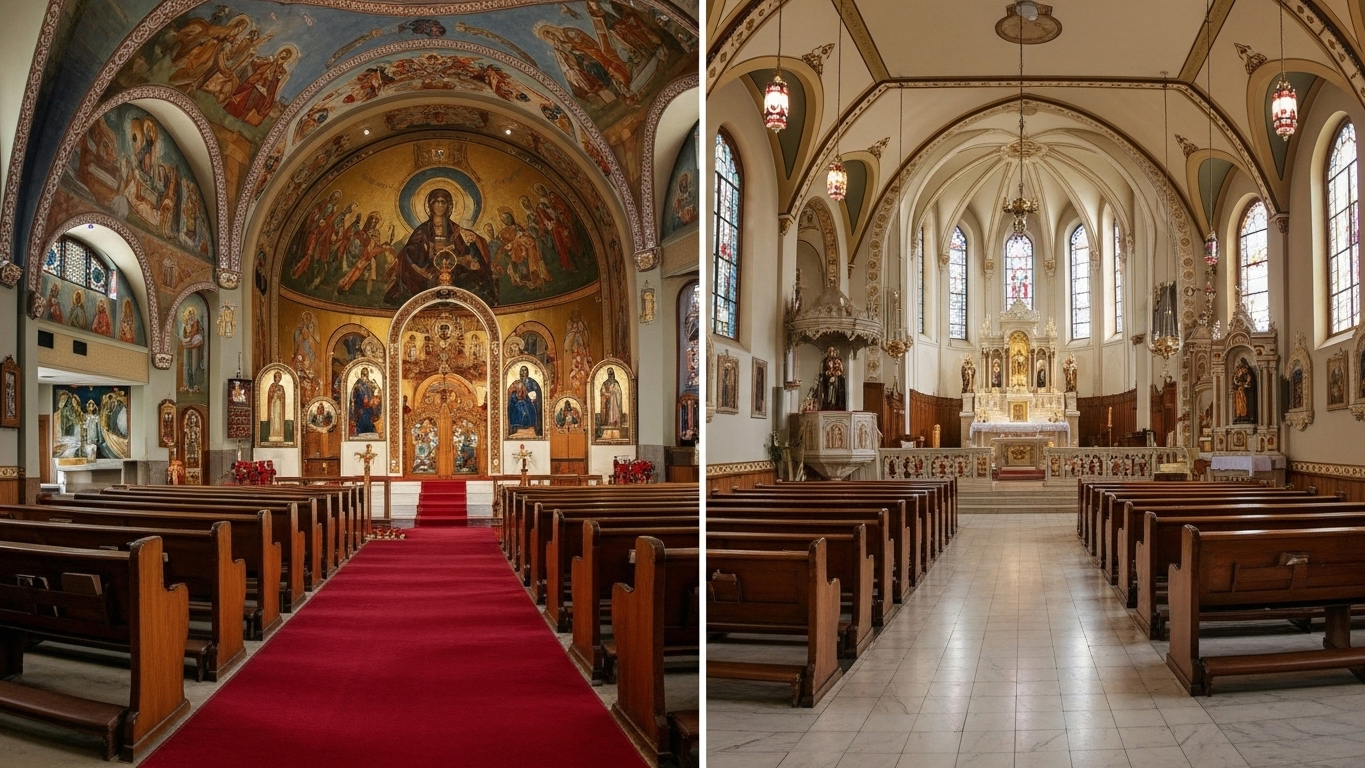
In Eastern Orthodoxy, icons (sacred images) are grounded in deep theological reasoning. The Second Council of Nicaea (787 AD) established the veneration of icons as orthodox teaching, bringing the iconoclast controversies to a close. In Orthodox theology, an icon is not merely an artistic representation but a window into spiritual reality: “To venerate an icon is to venerate the one it depicts.” Praying before icons is part of liturgical life, but is clearly distinguished from worship.
8.2 Catholicism: A Rich Tradition of Religious Art
The Roman Catholic Church has cultivated a rich visual tradition — statues, paintings, stained-glass windows, and relics. The theological justification for religious art rests on the doctrine of the Incarnation: because God became flesh in Jesus Christ, the material world is capable of mediating the divine presence. In Eastern Catholic churches, the use of icons closely mirrors Orthodox practice.
8.3 Protestantism: Simplicity or the Rejection of Images
The Protestant Reformation was deeply critical of religious art. Many Reformers broke with the established tradition of sacred imagery. Calvin and Zwingli banned images from churches entirely, viewing them as a danger of idolatry (Exodus 20:4-5). Today, Protestant churches vary widely in their approach to religious art: some are very plain (Baptists, Quakers), while others permit a degree of artistic decoration.
9. Summary Comparison: Key Differences at a Glance
| Aspect | Orthodoxy | Catholicism | Protestantism |
| Authority | Scripture + Holy Tradition (collectively) | Scripture + Tradition + Papal Magisterium | Sola Scriptura — Scripture alone |
| Salvation | Theosis — deification and transformation | Cooperation of grace and works; Purgatory | Sola Fide — through faith alone; justification |
| Church Head | Ecumenical Patriarch (first among equals) | Pope — full universal jurisdiction | Varies: episcopal to congregational |
| Sacraments | 7 Holy Mysteries | 7 sacraments | 2 sacraments (Baptism, Lord’s Supper) |
| Eucharist | Real presence of Christ (mystery) | Transubstantiation | Mostly symbolic memorial |
| Mary | Theotokos; highly venerated | Immaculate Conception; Bodily Assumption | Honoured as Jesus’ mother; not prayed to |
| Icons | Theologically central; iconography | Statues and paintings permitted | Mostly plain; some prohibit images |
| Biblical canon | 39 + deuterocanon (Septuagint) | 73 books (including the Apocrypha) | 66 books (Hebrew canon) |
| Clergy | Married priests permitted; bishops celibate | Celibate (Latin Rite) | May marry; women often ordained |
| Adherents (2024) | ~300 million (12%) | ~1.39 billion (50%) | ~900 million (37%) |
10. Deeper Analysis: What Do These Differences Really Mean?
10.1 Unity in Diversity: Common Ground
Despite all their differences, all three traditions share a number of foundational beliefs: the doctrine of the Triune God (Father, Son, and Holy Spirit), the divine and human natures of Jesus Christ, the bodily resurrection of Christ, the Virgin Birth, and the canonicity of Scripture (though the precise boundaries of the canon differ slightly). This common ground provides a platform for ecumenical dialogue, which has deepened considerably since the twentieth century.
The Second Vatican Council (1962-1965) recognised the validity of the sacraments of the Eastern churches and opened new avenues for ecumenical dialogue. In 1965, Pope Paul VI and Patriarch Athenagoras I lifted the mutual excommunications — an important symbolic step, even though the two churches have not formally reunited.
10.2 Why These Differences Remain Relevant Today
In the contemporary globalised world, where questions of religious pluralism are sharper than ever, understanding the differences among the three Christian traditions is important for several reasons. First, it helps illuminate the historical and cultural conflicts of Europe, the Americas, and Russia — tensions that have often been rooted in differing ecclesiastical traditions. Second, it provides an interpretive framework for current debates within the Church — such as the ordination of women, sexual ethics, and abortion — to which different traditions respond very differently.
Third, it shapes the spiritual journey of seekers and converts: millions of people today move from one tradition to another in search of deeper spiritual experience, historical continuity, or doctrinal clarity. Orthodoxy has grown increasingly popular among Western converts drawn to what they perceive as the authenticity of early Church practice.
10.3 The Future: Prospects for Unity and Remaining Obstacles
Full reunion faces several serious theological obstacles. Between Orthodoxy and Catholicism, the Filioque question and the problem of papal jurisdiction remain unresolved lines of demarcation. Protestants and Catholics have achieved significant progress in recent decades on the Reformation-era controversy over justification — most notably through the Joint Declaration on the Doctrine of Justification (1999) — but questions of the sacraments and church governance remain unsettled.
11. Conclusion
Orthodoxy, Catholicism, and Protestantism are the three great branches of the Christian tradition. They share a common root, yet possess distinct theological, liturgical, and institutional identities. Their differences are not merely academic — they reflect profoundly different understandings of the relationship between God and humanity, the role of the Church, and the meaning of the sacraments.
Orthodoxy emphasises mystery, transformation, and historical continuity — theosis lies at the heart of this tradition. Catholicism combines a universal institutional structure under papal authority with an emphasis on sacramental grace and the cooperation of human will. Protestantism places the individual’s confession of faith and the direct reading of Scripture at the centre, a conviction that has produced remarkable doctrinal diversity.
For every seeker moving from one tradition to another, or exploring Christianity from the outside, understanding these fundamental differences is invaluable — not in order to identify the “correct” church, but to appreciate the internal logic, dignity, and spiritual depth of each tradition. All three offer a unique window on the path to God, and all are enriched by ecumenical dialogue with one another.
“Behold, how good and how pleasant it is for brothers to dwell together in unity!” — Psalm 133:1
12. References and Sources
Primary Sources
[1] Wikipedia. “East-West Schism”. Last modified 2024. Available at: https://en.wikipedia.org/wiki/East-West_Schism
[2] Wikipedia. “Theological differences between the Catholic Church and the Eastern Orthodox Church”. Available at: https://en.wikipedia.org/wiki/Theological_differences_between_the_Catholic_Church_and_the_Eastern_Orthodox_Church
[3] Wikipedia. “List of Christian denominations by number of members”. Available at: https://en.wikipedia.org/wiki/List_of_Christian_denominations_by_number_of_members
[4] Wikipedia. “Christianity by country”. 2025 Pew Research Center study. Available at: https://en.wikipedia.org/wiki/Christianity_by_country
Statistics and Research
[5] Pew Research Center. “Global Christianity: A Report on the Size and Distribution of the World’s Christian Population.” Washington, D.C., 2011. Available at: https://www.pewresearch.org/religion/2011/12/19/global-christianity-exec/
[6] Johnson, Todd M. and Zurlo, Gina A. (eds). World Christian Database. Brill, 2024. Available at: https://www.worldchristiandatabase.org/
[7] Zurlo, Gina A.; Johnson, Todd M.; Crossing, Peter F. “World Christianity 2024: Fragmentation and Unity.” International Bulletin of Mission Research, January 2024.
[8] Gordon-Conwell Theological Seminary. “Status of Global Christianity, 2024, in the Context of 1900-2050.” 2024. Available at: https://www.gordonconwell.edu/
[9] Annuario Pontificio. Vatican City, 2024. (The official Vatican yearbook — 1.390 billion baptised members.)
Theological and Historical Sources
[10] Britannica. “East-West Schism”. Available at: https://www.britannica.com/event/East-West-Schism-1054
[11] Britannica. “Christianity — From the Schism to the Reformation”. Available at: https://www.britannica.com/topic/Christianity/From-the-schism-to-the-Reformation
[12] Christian History Institute. “1054: The East-West Schism.” Available at: https://christianhistoryinstitute.org/magazine/article/east-west-schism
[13] Saint John the Evangelist Orthodox Church. “Differences Between the Orthodox and Protestant Faiths.” 2024. Available at: https://www.saintjohnchurch.org/
[14] Coptic Orthodox Answers. “What is the main difference between Protestantism and Orthodoxy?” Fr Gabriel Wissa. Available at: https://copticorthodoxanswers.org/
[15] Christianity FAQ. “Catholic vs. Protestant vs. Orthodox: What’s the Difference?” Available at: https://christianityfaq.com/catholic-protestant-christianity-orthodox-comparison/
[16] WeeFreeSpirits. “Catholic vs Orthodox vs Protestant — An In-depth Comparison.” 2024. Available at: https://wefreespirits.com/
[17] Athanasius of Alexandria. On the Incarnation (De Incarnatione Verbi). 4th century. (Described by C. S. Lewis as one of the most influential Christian texts ever written.)
[18] The Ravenna Document, 2007. Joint document of the Eastern Orthodox Church and the Catholic Church on the primacy of the Pope.
[19] Joint Declaration on the Doctrine of Justification. Lutheran World Federation and the Roman Catholic Church, 1999.
[20] Premier Unbelievable. “Protestant, Catholic and Orthodox: What’s the difference and does it matter?” Nick Peters, 23 February 2023. Available at: https://www.premierunbelievable.com/
This article has been written in accordance with SEO best practices and is based on academically verifiable facts.
Last updated: February 2026 | Keywords: Orthodox vs Catholic, Protestant vs Orthodox, branches of Christianity, church differences, Christian denominations

Martinus Vaicarius’s mission is to:
- Provide spiritual support and guidance to people seeking peace and hope
- Create prayer texts that bring God’s peace to hearts suffering under fear and anxiety
- Promote deep understanding of the power of the
- God of Sabaoth and the protection of the heavenly hosts
- Help people enter the spiritual sphere where God’s peace reigns over all
AICortex Invest OÜ