Icons in Orthodox Christianity: Sacred Windows to Heaven or Forbidden Images?
ORTHODOX CHRISTIAN ICON THEOLOGY
Author. Martinus Vaicarius (Martin Vaik – Singularity) – The meaning of icons — Are icons idol worship? — Orthodox Christian icons explained
Introduction: What Is an Orthodox Icon?
The question “Are Orthodox icons idol worship?” is one of the most frequently searched queries about Christian devotional practice. Many people raised in the Western tradition enter an Orthodox church and encounter icon images glowing in the dim golden light, see the faithful kissing them and bowing before them, and a natural question arises: “Is this not idol worship?” The question is well worth answering. The answer is at once simply “no” and theologically rich and multi-layered.
The word icon (Greek: εἰκών, eikon) means literally “image” or “picture.” Yet behind this simple Greek word stands, in the Orthodox tradition, nearly two thousand years of theological reflection, sacred artistic craft, martyrology, and the decrees of Church councils. For the Orthodox Church, an icon is not merely a religious symbol or decoration — it is a theological statement in visual form: a testimony that God became flesh and that His face is therefore representable.
The question “What are icons in Christianity?” requires understanding on three levels: historical, theological, and spiritual. Historically, icons have stood at the heart of the Church’s greatest controversies. Theologically, they are the visible witness of the Incarnation. Spiritually, they are “windows to heaven” — means of encounter with Christ, the Mother of God, and the saints.
This article provides thorough answers to all three questions: what icons are, what their history is, what the Orthodox Church teaches about the theology of icons, why they are not idol worship, and how the Orthodox understanding differs from Protestant criticism. It is a complete guide to Orthodox Christian icons explained.
The History of Icons: From the Early Church to the Council of Nicaea
The historical development of icons is complex and contested, but for the Orthodox Christian the matter is clear: icons are the natural expression of the apostolic tradition, emerging from the second and third centuries and reaching their definitive theological articulation in the eighth and ninth centuries.
Early Christian images and the catacombs
The earliest Christian figurative art is found on the walls of the Roman catacombs, dating from approximately the second and third centuries. These images — the Good Shepherd, Jonah, the Chi-Rho monogram of Christ — show that early Christians did not avoid the use of imagery to express their faith. In Dura-Europos in Syria, a third-century Christian house-church has been discovered with wall decorations depicting biblical narratives.
At the same time, there was also opposition within the early Church. Some Church Fathers warned against the misuse of images. The Synod of Elvira (c. 306 AD) prohibited the painting of murals in churches in Spain, stating: “Images shall not be placed on walls, lest what is venerated and worshipped be depicted on walls.” Orthodox historians, however, interpret this prohibition as directed against a specific erroneous practice, not as a principled ban on all imagery.
The 4th–6th centuries: The spread of icon use
In the fourth century, following the legalisation of Christianity in the Roman Empire (the Edict of Milan, 313 AD), the use of figurative art in the Church grew rapidly. Gregory of Nyssa described in 386 AD the veneration taking place before an icon of the martyr St. Theodore — this is one of the earliest clear references to the liturgical use of icon veneration. By the fifth and sixth centuries, images of Christ, the Mother of God, and the Apostles had spread widely in both churches and homes.
During the same period, the canons of iconography took shape — firm rules governing how different saints and biblical narratives were to be depicted. The purpose of these canons was to ensure that the icon reflected not the artist’s personal vision, but the authenticity of the sacred experience of the worshipping community.
The iconoclast crisis: 726–843
The greatest crisis in the history of icons — iconoclasm — began in 726, when the East Roman Emperor Leo III ordered icons to be removed from churches and banned their veneration. Leo’s argument ran as follows: the veneration of icons violates the Second Commandment (“You shall not make for yourself an idol”) and seduces the common people into idol worship. This position was shared in part by regions that had come into contact with Islam, where the traditional ethos of opposition to idolatry was strong.
The two waves of iconoclasm (726–787 and 814–843) brought with them widespread destruction of icons, the plundering of saints’ relics from monasteries, and the imprisonment and torture of the defenders of icons — the iconodules. During what is known as the “Decade of Blood” (762–775), hundreds of monks perished in defence of icons.
The theological defence of icons was led by two great Church Fathers:
▪ St. John of Damascus (c. 652–749) — wrote three treatises in defence of icons, drawing a clear distinction between divine worship (latreia) and the veneration of honour (proskynesis).
▪ Patriarch Germanos of Constantinople (715–730) — refused to condemn icons and was sent into exile as a result.
In 787, Empress Irene convened the Seventh Ecumenical Council at Nicaea (the Second Council of Nicaea), which defined the correct use of icons and resolved definitively the distinction between veneration and idol worship. Iconoclasm ended for good in 843. The Orthodox Church commemorates this event to this day as the Triumph of Orthodoxy, celebrated on the first Sunday of Great Lent.
The Theology of Icons: Why They Are Not Idol Worship
The question “Are icons idol worship?” is one to which the Orthodox Church answers unequivocally: no. But this answer requires thorough explanation. The theological argument in defence of icons consists of several interconnected steps.
The argument from the Incarnation
The fundamental theological argument in favour of icons proceeds from the Incarnation of Christ. In the Old Testament, God was invisible and indescribable — this is why Israel was forbidden to depict God: “You saw no form of any kind” (Deut. 4:15). But in the New Testament, God became visible: “The Word became flesh” (John 1:14). God Himself entered history in a visible form.
St. John of Damascus expressed this as follows: “In former times, God, who is without body or form, could never be depicted. But now that God has been seen in the flesh and has lived among human beings, I depict the God whom I see. I do not worship matter — I worship the God of matter, who became matter for my sake.”
“Before the Incarnation, God was without image. After the Incarnation, God has an image — for He Himself made Himself visible.” — St. John of Damascus, On the Holy Images, I.16
This is the central key to the theology of icons: icons do not diminish the transcendence of God; they bear witness to His immanence — to the fact that God entered humanity and human history concretely, personally, in a visible form.
Latreia and proskynesis: divine worship versus veneration
Orthodox theology draws a very clear distinction between two acts. In Greek, the terms are: latreia — divine worship, which belongs to God alone; proskynesis or douleia — honour, respect, and veneration, which may be rendered to persons, saints, and sacred images.
Bowing before icons is proskynesis, not latreia. An Orthodox Christian does not bow before an icon in the way he would worship God — he is paying respect to the person depicted by the icon. A comparable example: a person may kiss a photograph of a loved one without “worshipping” the photograph as an object. The reverence is directed to the person, not to the paper and ink.
The Second Council of Nicaea (787) stated this explicitly: the honour rendered to icons passes through the image to its “prototype”, that is, to the original — this is the foundational principle of iconology. The icon is a “window,” not a “wall.”
The sanctity of the icon and the theology of the Incarnation
According to Orthodox theology, an icon is not venerated because it is made of wood and pigment. The icon receives its worthiness of veneration through the grace of God, which participates in this theologically inscribed space. An icon is “written” (not “painted”) — this very term emphasises that an icon is like a text of Scripture in visual form: it does not convey the artist’s personal emotion, but the hallowed tradition of the Church.
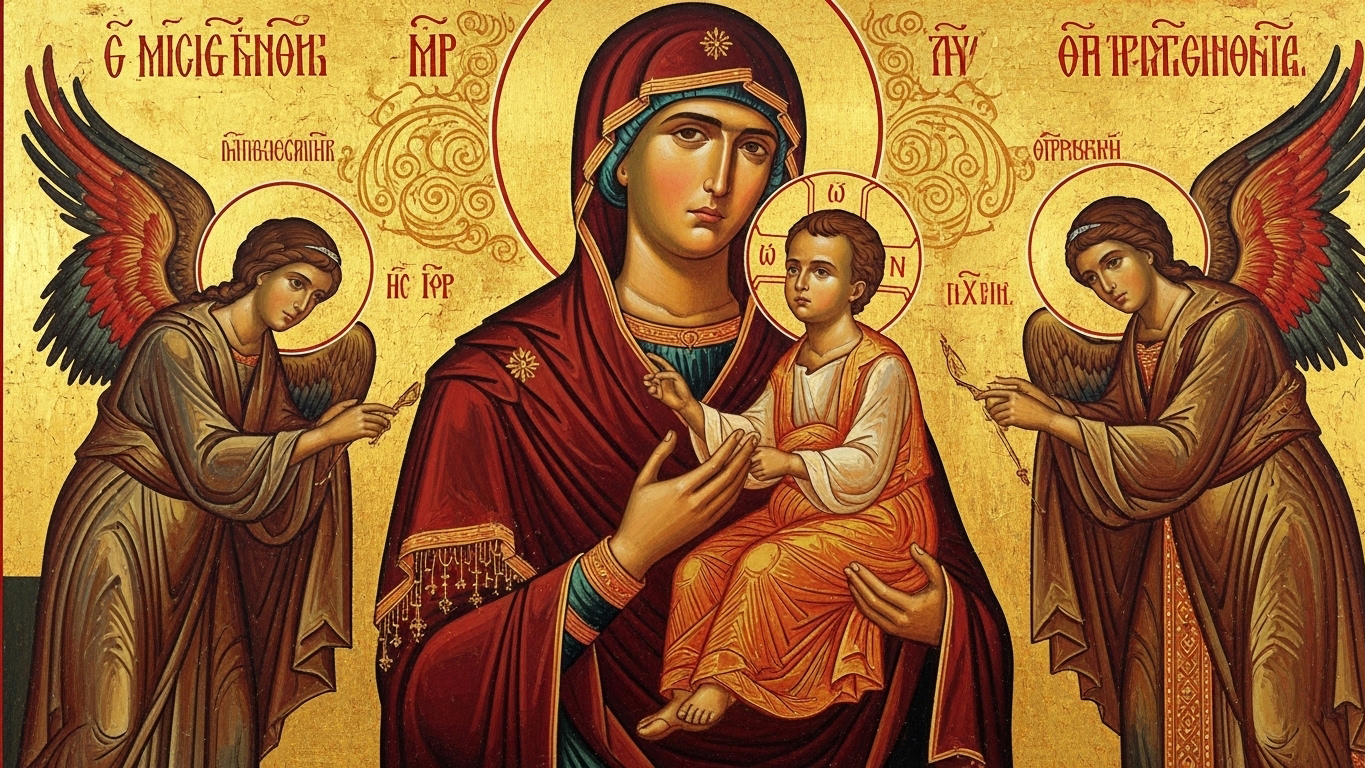
Each icon follows a strict canon governing how Christ, the Mother of God, and various saints are to be depicted. These rules are not aesthetic in nature — they are theological. For example, the golden background used in icons does not represent earthly space but the eternal light of God. The deliberately elongated anatomy emphasises spiritual reality rather than physical perfection. And the so-called “reverse perspective” means that the icon “looks at the viewer,” not the viewer at the icon.
The Icon as Visual Theology: The Symbolism of Sacred Images
Explaining Orthodox Christian icons requires understanding that an icon is a visual text — every element carries theological meaning. An icon is not a painting in a conventional artistic style with incidental content. It is a compositional system laden with concentric layers of significance.
The golden background — the divine light
The golden background of icons symbolises the eternal and uncreated light of God — the very Light of Tabor of which Gregory Palamas speaks in his theology of theosis. The golden background does not represent the blue of the sky or an earthly landscape. It signifies that this icon “exists” outside time and space, in the eternal divine reality.
Stylisation — spiritual reality
The figures in icons are often stylised rather than naturalistic. Physical proportions may appear “wrong” by the canons of Western art — elongated faces, slender fingers, somewhat rigid postures. This is a deliberate choice: the icon depicts spiritual reality, not the physical body. The body is indeed “written,” but it is rendered through the prism of the spirit.
Large eyes, small mouth — sight and silence
Large eyes symbolise spiritual vision and contemplation — the saint “sees” God and abides in Him continually. The small, closed mouth points to silence and the considered word. In the hesychast tradition, silence (hesychia) is the foundation of the spiritual life. The small mouth of the icon is the visual mark of that silence.
Reverse perspective — the icon looks at the viewer
In Western painting, perspective is rendered with a vanishing point in the distance — creating the impression that the viewer looks into the picture. In Orthodox iconography, this is reversed: the lines converge outward, towards the viewer. This means the icon “looks at the viewer” and “invites him in.” The subject depicted in the icon is active, not passive. This is a visual expression of the truth that the icon is a “window to heaven” — the heavenly reality steps towards the viewer, not the viewer towards heaven.
The inscription — the confirmation of identity
Every icon bears a Greek or Church Slavonic inscription — a title that identifies the person depicted. This is not merely a name — it is a significant theological detail: the icon is not an abstract image but the image of a specific individual — the historical Jesus Christ, the real person Mary, a concrete historical saint. The inscription safeguards the tradition that the veneration of icons remains concrete, and does not dissolve into a generalised worship of images.
Are Icons Idol Worship? Protestant Criticism and Orthodox Responses
The question “Are icons idol worship?” is particularly common among Protestant Christians, who take their bearings from the Reformation and from the Old Testament prohibition on making divine images. Let us examine the principal arguments of the critics and the Orthodox responses to them.
Criticism 1: “The Second Commandment forbids images”
Exodus 20:4: “You shall not make for yourself an image in the form of anything in heaven above or on the earth beneath.” Iconoclasts and Reformers alike have deployed this verse against icons.
The Orthodox response is multi-layered. First: the same commandment does not prohibit all depiction — God Himself commanded Moses to make two cherubim for the cover of the Ark of the Covenant (Exod. 25:18–22) and cherubim for the veil of the Tabernacle (Exod. 26:31). The decorations of the Temple included many figures (1 Kgs. 6). The commandment prohibited the depiction of false gods and the practice of idolatry, not all imagery whatsoever.
Second: the statement “You saw no form of any kind” (Deut. 4:15) refers to the fact that Israel did not see God at Sinai. Now, however, God has come in visible form through the Incarnation. To depict Christ does not violate the Second Commandment — it proclaims the truth of the Incarnation.
Criticism 2: “Believers bow before icons — this is idol worship”
Observers see Orthodox believers bowing before icons, kissing them, and lighting candles. Is this not idol worship? Orthodox theology distinguishes between: a) latreia — divine worship, which belongs to God alone; b) proskynesis — honour and veneration rendered to saints and to sacred images. This distinction is of decisive theological importance.
A comparable illustration: when a soldier honours a flag, he is not “bowing down” before a piece of cloth. He is honouring what the flag symbolises — the nation, the people, the values it represents. The actual object of reverence is clearly distinguishable. Kissing an icon is analogous: the honour passes through the image to the original.
Criticism 3: “Early Christians did not use icons”
Some historians argue that the veneration of icons is a late development, introduced only in the fifth or sixth century. The Orthodox response: early Christian art was already present in the catacombs (second and third centuries). Gregory of Nyssa described the veneration of a sacred image in 386 AD. The very arguments of the iconoclasts presuppose the existence and use of icons in the Church, for otherwise there would have been nothing to prohibit. The claim that early Christians did not use icons does not hold up historically.
Criticism 4: “Icons are borrowed from paganism”
Some argue that Christian icons were borrowed from ancient pagan image-making practice. The Orthodox response: Christian iconography differs fundamentally from the tradition of pagan figurative art. In paganism, deities were believed to “dwell within” their images. Orthodox iconography teaches clearly that the veneration of an icon passes through the image to the one depicted — the icon itself is not a “god.” The underlying theological principle is entirely different.
Icons in Orthodox Religious Life and Practice
Icons manifest themselves in Orthodox devotional practice on several levels. We shall consider the most important.
The iconostasis — the boundary between heaven and earth
The iconostasis is a screen adorned with icons that separates the sanctuary — the consecrated altar space — from the nave (naos) of an Orthodox church. It is one of the most visually powerful elements of the Orthodox church interior, typically consisting of several rows of icons with images of Christ and the Mother of God at the centre, and three doorways.
The iconostasis is not merely a decorative partition — it is a theological statement. It symbolises the boundary between the heavenly and the earthly, yet not a separation. The many images on the iconostasis are like visions of heaven, while the boundary itself is permeable, opening during the liturgy when the holy doors are thrown wide. This expresses a fundamental principle of Christianity: the heavenly reality and the earthly reality are connected, not divided.
The home icon corner — creating a space for prayer
Orthodox Christians maintain at home an icon corner — a dedicated place containing icons, a vigil lamp, and often also a censer. This so-called “beautiful corner” (Russian: krasny ugol) is the centre of the family’s daily prayer life. Morning and evening prayers are commonly offered before this corner, so that icons are not merely a feature of church life but a spiritual environment permeating the whole of everyday existence.
Praying before icons — the intercession of the saints
Praying before icons is closely bound up with the doctrine of the intercession of the saints. The Orthodox Church — both the earthly (“Church militant”) and the heavenly (“Church triumphant”) — forms one single body that prays together. When an Orthodox believer asks a saint for intercession before an icon, he believes that the saint is a living and active member of that body, capable of interceding before God on his behalf.
The veneration of icons — kissing, bowing, and incense
The kissing, bowing, and burning of incense that take place before icons are liturgical acts with clear meaning. The kiss is a physical expression of love and reverence — analogous to embracing a child. Bowing is an act of homage. Incense raises a cloud of fragrant smoke that symbolises the presence of the Holy Spirit and the rising of prayers to heaven (Ps. 141:2).
Facts and Statistics
▪ The word “icon” (eikon) appears in the Greek Bible in several contexts: “God created mankind in His own image (eikon)” (Gen. 1:27), and “He is the image (eikon) of the invisible God” (Col. 1:15) — both references pointing to Christ.
▪ The Second Council of Nicaea (787) is the only one of the Seven Ecumenical Councils to address the theology of icons. It is recognised by the Orthodox Church, the Roman Catholic Church, and to a significant degree by churches in the Lutheran tradition.
▪ During the “Decade of Blood” of the iconoclast era (762–775), hundreds of monks and laypeople perished in defence of icons — they are venerated in the Orthodox Church as saints and martyrs.
▪ St. John of Damascus, the foremost theological defender of icons, lived in Arab-controlled territories — and thus outside the authority of the Byzantine Emperor — and was therefore free to write in defence of icons.
▪ The “writing” (not “painting”) of iconography — the Greek word grapho encompasses both meanings — emphasises that an icon is above all a textual and theological work, not figurative art in the conventional sense.
▪ Approximately 260–300 million Orthodox Christians worldwide use icons as part of their daily religious life.
▪ Early Christian art discovered in the catacombs is dated to the second and third centuries — demonstrating that early Christians used imagery to express their faith, although the precise liturgical role of such images remains a subject of scholarly debate.
▪ The writings of Patriarch Germanos of Constantinople (715–730) constitute one of the earliest systematic theological treatments in defence of icons.
▪ In 1993, a joint Lutheran–Orthodox dialogue issued an official statement affirming the significance of the decisions of the Seventh Ecumenical Council on the nature of Christ and the veneration of icons.
▪ The churches of the Estonian Apostolic Orthodox Church continue to use iconostases to this day — they remain an inseparable part of the Orthodox liturgical space.
Conclusion
Understanding Orthodox Christian icons requires comprehension on three levels: historical, theological, and spiritual. Historically, icons have undergone a development of more than a thousand years, passed through crisis (iconoclasm), and emerged triumphant (787, 843). Theologically, icons are a witness to the Incarnation — testimony that God became visible and may therefore be depicted. Spiritually, they are “windows to heaven” — means by which the faithful encounter Christ and the saints in prayer.
The question “Are icons idol worship?” can be resolved once the theological distinctions of Orthodox Christianity are properly understood. Icons are not idol worship because: a) they are not believed to “contain” God; b) veneration is directed to the one depicted, not to the image itself; c) the Second Council of Nicaea — the Seventh Ecumenical Council — has clearly defined the boundary between legitimate veneration and idolatry.
In answering the question “What are icons in Christianity?” we arrive at the heart of Orthodox icon theology: an icon is visual theology, made in prayer, “written” over the centuries according to canons that the Church has borne with devotion. An icon is neither a mere sign nor an art object. It is the visible script of the Church’s testimony concerning the revelation of God in Christ.
Icon theology is alive. It is not a museum artefact. Every day, when an Orthodox Christian sits before his icon corner in morning prayer, kisses the icon of Christ on entering the church, or beholds the golden images of the iconostasis during the liturgy, he steps into the living tradition to which great theologians have been devoted across the preceding 1,800 years. The icon is the point of contact between the heavenly and the earthly, the timeless and the temporal, the visible and the invisible.
References and Academic Sources
Primary sources:
1. St. John of Damascus. On the Holy Images (De Imaginibus). Trans. Mary H. Allies. London: Thomas Baker, 1898. (Orig. c. 730 AD)
2. The Second Council of Nicaea (787). Acts. In: Nicene and Post-Nicene Fathers, Second Series, Vol. XIV. Eds. P. Schaff & H. Wace. Grand Rapids: Eerdmans, 1900.
3. Theodore the Studite. On the Holy Icons. Trans. Catharine Roth. Crestwood, NY: SVS Press, 1981.
4. Gregory of Nyssa. Panegyric on St. Theodore (386 AD). In: Patrologia Graeca, Vol. 46.
5. Patriarch Germanos of Constantinople. On the Divine Liturgy (treatment of icons). c. 715–730 AD.
Secondary sources:
6. Ouspensky, Leonid & Lossky, Vladimir. The Meaning of Icons. Trans. G.E.H. Palmer & E. Kadloubovsky. Revised ed. Crestwood, NY: SVS Press, 1982.
7. Ware, Kallistos (Bishop Timothy). The Orthodox Church. 2nd ed. London: Penguin Books, 1993.
8. Ouspensky, Leonid. Theology of the Icon. 2 vols. Trans. Anthony Gythiel. Crestwood, NY: SVS Press, 1992.
9. Barber, Charles. Figure and Likeness: On the Limits of Representation in Byzantine Iconoclasm. Princeton: Princeton University Press, 2002.
10. Meyendorff, John. Byzantine Theology: Historical Trends and Doctrinal Themes. New York: Fordham University Press, 1974.
11. Brubaker, Leslie & Haldon, John. Byzantium in the Iconoclast Era c. 680–850. Cambridge: Cambridge University Press, 2011.
12. Noble, Thomas F.X. Images, Iconoclasm, and the Carolingians. Philadelphia: University of Pennsylvania Press, 2009.
13. Baggley, John. Doors of Perception: Icons and Their Spiritual Significance. Crestwood, NY: SVS Press, 1988.
14. Sendler, Egon. The Icon: Image of the Invisible. Trans. Steven Bigham. Redondo Beach: Oakwood Publications, 1988.
15. Manafis, Konstantinos (ed.). Sinai: Treasures of the Monastery of Saint Catherine. Athens: Ekdotike Athenon, 1990.
Web sources:
16. Orthodox Church in America (OCA). “The Theology of Icons.” oca.org/orthodoxy/the-orthodox-faith.
17. St. George Media Orthodox Christian Resource Center. “Icon Theology in the Orthodox Church.” stgeorgemedia.org/icons.
18. OrthodoxWiki. “Icon.” orthodoxwiki.org/Icon.
19. Greek Reporter. “Do Orthodox Christians Worship Icons?” greekreporter.com, December 2025.
20. St Andrews Encyclopaedia of Theology. “The Theology of the Icon.” saet.ac.uk, 2024.

Martinus Vaicarius’s mission is to:
- Provide spiritual support and guidance to people seeking peace and hope
- Create prayer texts that bring God’s peace to hearts suffering under fear and anxiety
- Promote deep understanding of the power of the
- God of Sabaoth and the protection of the heavenly hosts
- Help people enter the spiritual sphere where God’s peace reigns over all
Europe Heaven Invest 2072 Gold OÜ