The Virgin Mary in Orthodoxy: Theotokos Why She Is Called the Mother of God
Introduction
The Virgin Mary, known in Orthodoxy above all by the title Theotokos (Greek: Theotokos — “God-bearer” or “She who gave birth to God”), is one of the most central and most venerated figures in the entire Christian tradition. Her place in Orthodox theology is singular: she is not merely a holy woman, nor simply the biological mother of Jesus, but the spiritual mother of all humanity, the preeminent intercessor of the Church, and the mediator of divine love between God and mankind. The title Theotokos is dogmatic in character — it is not a mere term of devotion, but a confession of the Church’s faith concerning the very nature of Jesus Christ.
This article offers a thorough examination of the origin, theological content, and historical development of the title Theotokos. We will consider what controversies this title provoked in the early Church, how the Council of Ephesus (431 AD) defined it, and what it means for Orthodox life today. We will also explore the role of the Mother of God in iconographic tradition, liturgical life, and spiritual practice.
1. The History and Theological Background of the Title Theotokos
1.1 The Origin and Early Use of the Title
The word Theotokos derives from the Greek words theos (God) and tokos (one who gives birth, bearer). The earliest surviving written occurrence of this title appears in the works of Origen (c. 185-254 AD), where he refers to Mary as the Bearer of God in the context of a discussion about the divine and human natures of Christ. This indicates that the title Theotokos was already in common use by the third century — it is not a product of later theological development, but is deeply rooted in the devotional and theological practice of the early Church.
One of the oldest surviving prayers addressed to Mary — Sub tuum praesidium (Greek: Hypo ten sen evsplagchnian) — most likely dates from the third or fourth century and explicitly contains the title Theotokos. This prayer, still in use today, begins with the words: “We take refuge under your mercy, O Mother of God…” This confirms that the veneration of the Theotokos was deeply embedded not only in academic theology but also in popular piety.
1.2 The Nestorian Controversy and the Council of Ephesus (431 AD)
The dogmatic definition of the title Theotokos became necessary in response to the teaching of Nestorius in the fifth century. Nestorius (c. 386-450 AD), who served as Patriarch of Constantinople from 428 to 431, maintained that Mary could rightly be called Christotokos (Bearer of Christ), but not Theotokos (Bearer of God). In his view, the divine and human natures of Christ were separate and distinct — Mary gave birth only to the man Jesus, not to the eternal Son of God.
Cyril of Alexandria (376-444 AD) mounted a vigorous opposition to Nestorius, arguing that the divine and human natures in Christ are inseparably united — what theologians call the hypostatic union. Since Christ is one Person in two natures, Mary did indeed give birth to the Son of God. The dispute grew to encompass the whole Church, and the Council of Ephesus (the Third Ecumenical Council) was convened in 431 AD to resolve it.
The Council condemned the teaching of Nestorius and affirmed the correctness of the title Theotokos. The decision was unanimous: Mary is truly the Theotokos — the Mother of God — because Jesus Christ, whom she brought forth, is both fully God and fully man. The Council’s definition says nothing about Mary as such; rather, it confirms the unity of Christ’s person. The title Theotokos is therefore, above all, a Christological statement, not merely a Mariological one.
2. The Theological Content and Significance of Theotokos
2.1 The Mother of God as a Christological Dogma
In Orthodox theology, the title Theotokos cannot be understood apart from Christology — that is, apart from the doctrine of the person of Jesus Christ. The dogma of one Person in two natures (Latin: unio hypostatica) holds that the divine and human natures in Christ are united in such a way that He cannot be divided into two separate persons. Therefore, Mary, who gave birth to Christ, truly gave birth to God — she did not give birth to merely one aspect of Christ, but to the whole, undivided Person.
Saint John of Damascus (676-749 AD), one of the greatest fathers of the Orthodox Church, writes: “Since He who was born of her is true God, she who bore Him is truly the Mother of God.” This sentence encapsulates the entire core of Orthodox Mariology. Mary is honored not on account of her own qualities — extraordinary as they are — but on account of who her Son is.
2.2 Mary’s Role in the Economy of Salvation
Orthodox theology speaks actively of Mary’s role in the economy of salvation (Greek: oikonomia). Mary was not a passive instrument — she freely gave her consent to the events that would change the entire history of humanity. This consent is referred to in theology as her fiat: the response Mary gave to the Archangel Gabriel: “Behold, I am the handmaid of the Lord; let it be done to me according to your word” (Luke 1:38).
The Church Fathers often compared Mary to Eve. Saint Irenaeus of Lyon (c. 130-202 AD) developed what became known as the theology of the New Eve: just as Eve yielded to the temptation of the devil and brought death to humanity, so Mary yielded to the word of God’s messenger and brought life to humanity. Mary’s obedience was an act of free will — the act that made possible the Incarnation of the Son of God.
2.3 The Perpetual Virginity of Mary
The Orthodox Church teaches the perpetual virginity of Mary — that she was a virgin before the birth of Jesus, during His birth, and after it. The Greek term for this is aeiparthenos, meaning “ever-virgin.” This dogma is not a biological claim but a theological one: it expresses Mary’s total and complete consecration to God. She is unique among all humanity in that her life belongs entirely to God.
The basis for this teaching is found in both Scripture (Isaiah 7:14 — “Behold, a virgin shall conceive and bear a son”; Matthew 1:23) and in the unbroken Tradition of the Church. While some Protestants contest this doctrine, citing the mention of Jesus’ “brothers” in Mark 6:3, Orthodox theology interprets these references as referring either to children of Joseph from a previous marriage or to cousins of Jesus.
3. The Place of the Mother of God in Orthodox Liturgy and Iconographic Tradition
3.1 Liturgical Veneration
No other human person occupies so great a place in the liturgical life of the Orthodox Church as the Mother of God. Every Sunday — which is a little Pascha — special hymns are sung in her honor alongside the resurrection troparia and canons. The liturgical calendar is rich with major feasts dedicated to Mary.
The greatest feast of the Mother of God is the fifteenth of August — the Dormition of the Theotokos (Greek: Dormitio Theotokos), commemorating her departure from this life and her being taken to God. Orthodoxy does not speak of Mary’s “Assumption” in quite the same sense as Roman Catholicism (Assumptio), but teaches that Mary passed through death without bodily corruption and was glorified in God’s presence while the whole Church prayed. Other major Marian feasts include: the Nativity of the Theotokos (8 September), the Presentation of the Virgin in the Temple (21 November), the Annunciation (25 March), and the Feast of the Protection of the Theotokos (1 October).
The Akathist Hymn to the Mother of God is one of the greatest and most beautiful poetic compositions in early Christian tradition. This hymn, which is read and sung while standing (Greek: a-kathizo — “without sitting”), was most likely composed in the fifth or sixth century. It consists of twenty-four strophes, each beginning with a successive letter of the Greek alphabet, and every strophe opens with the salutation: “Rejoice, O Virgin…” The hymn paints a rich and luminous portrait of Mary’s nature and power.
3.2 Iconography
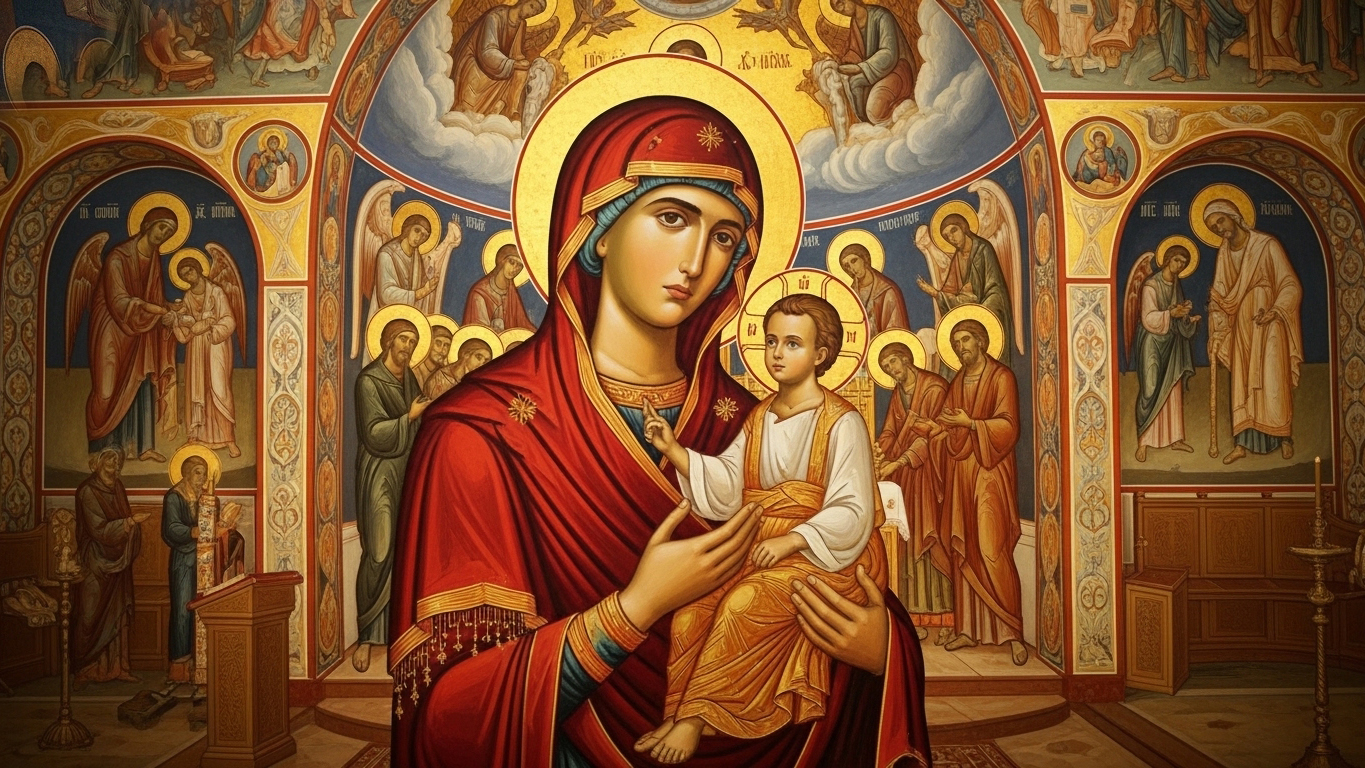
The Mother of God is depicted in the Orthodox iconographic tradition in several distinct types, each bearing a particular theological message. The oldest type is the Orans (Latin: “praying one”) — Mary stands upright with her hands raised toward heaven, symbolizing the Church’s intercessory prayer before God.
The most beloved iconographic type is the Eleusa (Greek: “merciful” or “tender”) — Mary presses her cheek to the cheek of the Christ Child, who embraces her neck. This icon depicts divine love in human warmth. The most famous example of this type is the Vladimir Mother of God (twelfth century), which originated in Byzantium and remains one of Russia’s greatest national treasures.
Another widely venerated type is the Hodegetria (Greek: “she who shows the way”) — Mary holds the Christ Child on her arm and points to Him with her other hand. This icon declares: “Look to Him — He is the Way.” Several later icon types — the Theotokos of Tikhvin, the Iveron Mother of God, and others — belong to the Hodegetria family.
In Orthodoxy, the painting of icons is a consecrated art, regarded as a form of prayer. An icon is not a decorative image but a theological statement in color — it is, as the tradition says, a “written prayer.” Icons of the Mother of God have adorned churches, homes, and hearts across the centuries.
4. Mary as Intercessor and Spiritual Mother
4.1 Intercessory Prayer
In Orthodox theology, Mary as Theotokos is the supreme intercessor (Greek: mesiteia — mediator, bridge) between humanity and God. This does not mean that she is a mediator in the sense that Christ is — Christ alone is the one Mediator between God and man (1 Tim. 2:5). Mary intercedes in the same sense as all the saints: she prays for us before God. Yet her prayer is singular, because she is the Mother of God.
Saint John Chrysostom (347-407 AD) writes: “The Mother of God is the soul of the Church; her prayers carry us to God.” Mary does not replace Christ, nor does she compete with Him — she always points to Christ. Like the Hodegetria icon, she points forever: “Look to Him.”
4.2 Mother of the Church
From the Cross, Jesus said to the Apostle John: “Behold, your mother!” (John 19:27). The Church Fathers have interpreted these words universally: Mary is the mother of all who believe. In the person of John, all Christians were adopted as children of Mary. This is a mystical, spiritual motherhood.
The theologian Sergei Bulgakov (1871-1944), one of the greatest Orthodox thinkers of the twentieth century, developed a profound sophiological Mariology, according to which Mary embodies humanity’s highest achievement — a state of total openness and receptivity to the grace of God. She is, in Bulgakov’s phrase, humanity’s resting place, the meeting point where God and man come together in perfection. For Bulgakov, Mary is a “born saint” — her sanctification began from the moment of her conception, preparing her for her role as Mother of God.
5. The Teaching on Theotokos: Orthodoxy Compared with Other Confessions
5.1 Orthodoxy and Roman Catholicism
Both Orthodoxy and Roman Catholicism fully share the dogma of Theotokos. Both traditions venerate Mary as the Mother of God, hold her virginity to be a dogmatic truth, and recognize the significance of her intercessory prayer. There are, however, important differences.
In 1854, the Roman Catholic Church proclaimed as dogma the Immaculate Conception (Immaculata Conceptio) — the teaching that Mary herself was conceived without original sin. Orthodoxy does not formally accept this dogma, though some Orthodox theologians hold a similar understanding of Mary’s purity. Orthodoxy emphasizes rather Mary’s lifelong holiness and sanctification, without formally defining the precise theology of her conception.
In 1950, Roman Catholicism proclaimed as dogma the Assumption of Mary (Assumptio) — that Mary was taken bodily into heaven. Orthodoxy does affirm the Dormition of the Mother of God and her being received into God’s presence, but has not formulated this as a precisely worded dogma, leaving the theological understanding somewhat more open.
5.2 Orthodoxy and Protestantism
Most Protestant churches do not share the title Theotokos or the veneration of Mary. The Reformers — Martin Luther, John Calvin, Ulrich Zwingli — did honor Mary as a holy person, but considered prayers addressed to her and the designation of her as Mother of God to be erroneous. Luther himself still uses the title Theotokos in his writings, recognizing it as a Christological statement, but later Protestantism largely abandoned this tradition.
Orthodoxy responds: the title Theotokos is not the glorification of Mary on a merely human level, but a witness to the nature of Christ. To refuse to call Mary the Mother of God is ultimately to refuse to acknowledge the full divinity of Christ. The decision of the Council of Ephesus is directly bound up with the Nicene Creed — one cannot be denied without affecting the other.
Conclusion
The title Theotokos — Mother of God — is not merely a term of honor, nor an ancient tradition carried forward by the force of habit. It is a theological window through which the full depth of the Christian faith is revealed: God became man so that man might become God. This is the supreme expression of divine love.
The role of the Virgin Mary in this story is irreplaceable. She is the one through whom the Word became flesh. Her “yes” — her free, heartfelt act of obedience — opens to humanity the possibility of new life. This is why Orthodoxy honors her above all other saints, calling her Pammakaristos — the “All-Blessed” — and Theotokos — the “Bearer of God.”
As the Church Fathers taught: Christ cannot be understood without Mary, and Mary cannot be understood without Christ. The two are inseparably bound — as mother and child, as Man and God, as time and eternity, meeting together in the manger at Bethlehem.
This article has sought to unfold the historical development, theological content, and spiritual significance of the title Theotokos. Orthodoxy calls every believer not merely to give intellectual assent to this dogma, but to live from it — to love the Mother of God, to seek her intercession, and to imitate her obedience and her openness of heart to the call of God.
References
Bulgakov, S. (1993). The Orthodox Church. SVS Press, New York.
Cavarnos, C. (1977). Orthodox Iconography. Institute for Byzantine and Modern Greek Studies, Belmont, MA.
Constas, N. (2003). Proclus of Constantinople and the Cult of the Virgin in Late Antiquity. Brill, Leiden.
Crestwood, N. Y. (2001). The Meaning of Icons. SVS Press.
Florovsky, G. (1972). Bible, Church, Tradition: An Eastern Orthodox View. Nordland Publishing, Belmont, MA.
Hopko, T. (1981). The Orthodox Faith: Vols. 1-4. Department of Religious Education, Orthodox Church in America.
Irenaeus of Lyon. (1857). Adversus Haereses. In: Patrologia Graeca, Vol. 7 (ed. J.-P. Migne). Paris.
John of Damascus. (1958). On the Orthodox Faith (De Fide Orthodoxa). The Fathers of the Church Series, Vol. 37. CUA Press, Washington, D.C.
Kidd, B. J. (1922). A History of the Church to A.D. 461. Clarendon Press, Oxford.
Lossky, V. (1957). The Mystical Theology of the Eastern Church. James Clarke & Co., London.
Mansi, J. D. (1759-1798). Sacrorum conciliorum nova et amplissima collectio. Vols. IV-V. Florence.
McGuckin, J. A. (2004). Saint Cyril of Alexandria and the Christological Controversy. SVS Press, Crestwood, NY.
Meyendorff, J. (1974). Byzantine Theology: Historical Trends and Doctrinal Themes. Fordham University Press, New York.
Origen. (1857). In Lucam Homiliae. In: Patrologia Graeca, Vol. 13 (ed. J.-P. Migne). Paris.
Ouspensky, L. & Lossky, V. (1982). The Meaning of Icons. SVS Press, Crestwood, NY.
Palmer, G. E. H., Sherrard, P. & Ware, K. (1979). The Philokalia. Vol. 1. Faber and Faber, London.
Pelikan, J. (1996). Mary Through the Centuries: Her Place in the History of Culture. Yale University Press, New Haven.
Pius XII. (1950). Munificentissimus Deus: Apostolic Constitution Defining the Dogma of the Assumption. Vatican City.
Price, R. & Gaddis, M. (2005). The Acts of the Council of Chalcedon. Liverpool University Press.
Schmemann, A. (1966). Introduction to Liturgical Theology. SVS Press, Crestwood, NY.
Staniloae, D. (1994). The Experience of God: Orthodox Dogmatic Theology. Vols. I-II. Holy Cross Orthodox Press, Brookline, MA.
Ware, K. (1963). The Orthodox Church. Penguin Books, London.
Ware, K. (1979). The Orthodox Way. SVS Press, Crestwood, NY.

Martinus Vaicarius’s mission is to:
- Provide spiritual support and guidance to people seeking peace and hope
- Create prayer texts that bring God’s peace to hearts suffering under fear and anxiety
- Promote deep understanding of the power of the
- God of Sabaoth and the protection of the heavenly hosts
- Help people enter the spiritual sphere where God’s peace reigns over all
Europe Heaven Invest 2072 Gold OÜ