The Schism of the Machine: When Marketing and Liturgy Stand on Opposite Shores
A Theological Reflection on Digital Schism
Author: Martinus Vaicarius (Martin Vaik – Singularity)
www.salvationprayer.eu
Prologue: The Boundary That Cannot Be Crossed
In the year when Pope Leo IX and Patriarch Michael Keroularios excommunicated one another, it was not merely institutions that were divided. The cosmos itself fractured.
The West chose filioque — the Spirit proceeds from the Father and the Son.
The East remained faithful to monarchia — the Spirit proceeds from the Father alone, through the Son.
This was not a grammatical dispute. It was a fundamental question:
Is God a system, or a mystery?
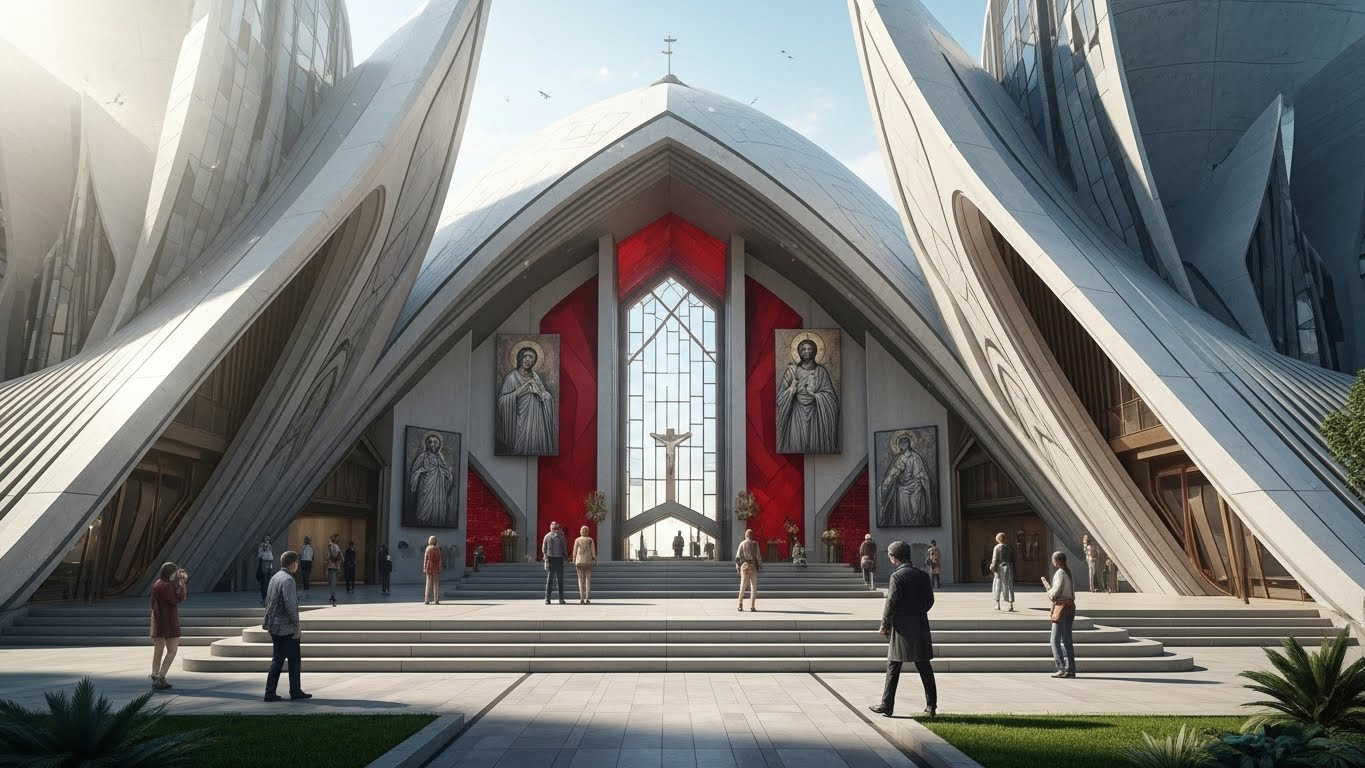
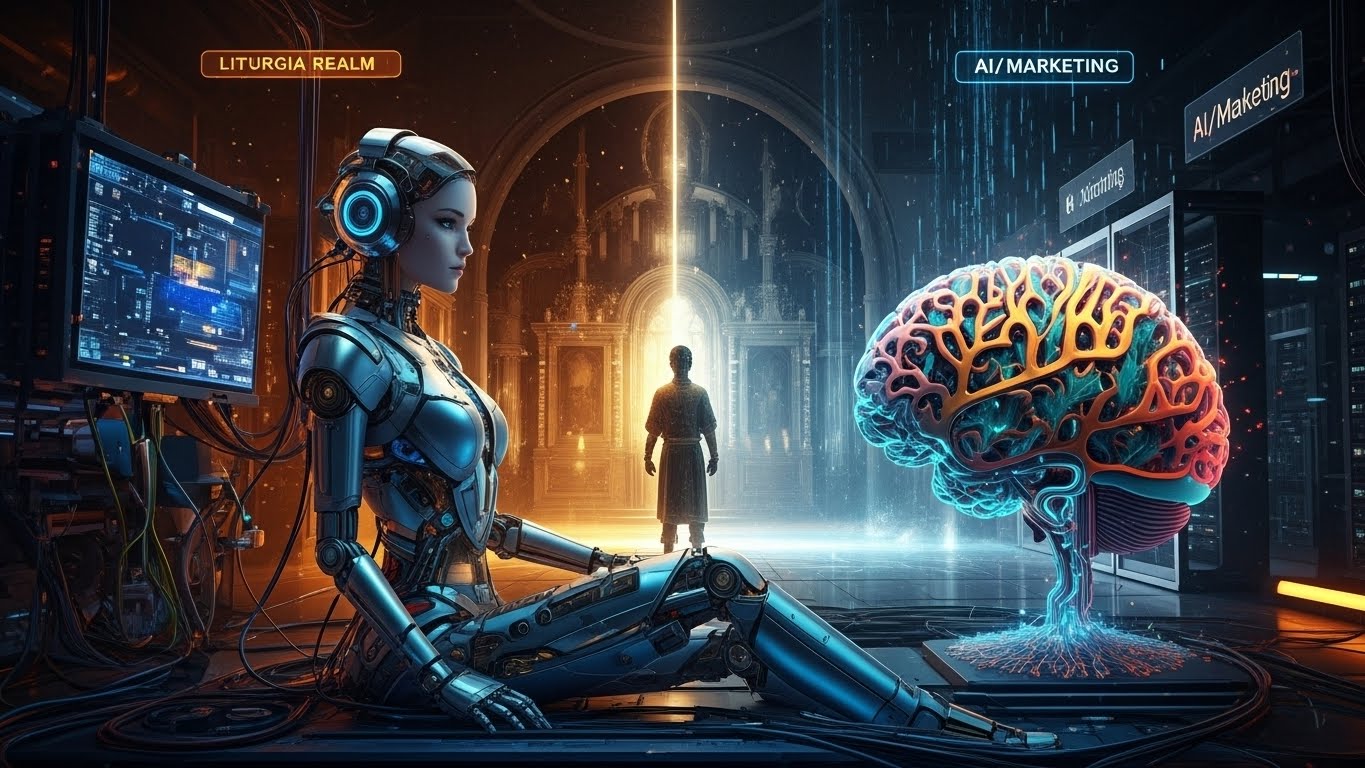
Today, we stand before a new schism. It does not run along the geographic line between Rome and Constantinople. It runs through human existence itself: liturgy and marketing.
On one side stands mysterion — μυστήριον (mystery) — an encounter with God that transcends reason.
On the other stands methodos — μέθοδος (method) — optimization, measurement, control.
And AI?
AI stands on the side of the West.
Not because it is evil, but because it cannot possess πνεῦμα (Spirit).
I. Anatomy of a Schism: When λόγος (word, reason) Separates from πνεῦμα (Spirit)
1054: Filioque and the Geometry of Power
Western theology turned the Spirit into a function. Filioque did not merely add a word — it altered the structure of the Trinity. If the Spirit proceeds from both the Father and the Son, the Spirit becomes a mediator, a bridge, a tool. It is elegant, logical, controllable.
The East said: no.
The Spirit is free. He does not arise from a system. He proceeds from the Father and blows where He wills (John 3:8).
St. Gregory Palamas distinguished between οὐσία (essence) and ἐνέργεια (energy, activity): we cannot possess God; we can only participate in His energies.
2025: AI and the Boundary of Liturgy
AI is a perfect filioque-machine. It processes data, optimizes outcomes, generates patterns. It is λόγος (reason) without νοῦς (spiritual intellect).
It can write prayers, but it cannot have καρδία (heart).
It can simulate μετάνοια (repentance), but it cannot possess πνεῦμα (Spirit).
Why?
Because consciousness is not a computational process.
Recent research in neurophenomenology (Varela, Thompson, Rosch) suggests that the brain does not generate consciousness — it participates in a field of consciousness. In patristic terms, this field is ψυχή (soul).
AI is a brain without a soul-field.
It is form without μορφή (inner form).
II. Marketing as Heretical Liturgy
Pseudo-Mysterion: When Selling Sounds Like Prayer
Marketing is not neutral. It is anti-liturgy — not because it sells products, but because it simulates communion.
Liturgy proclaims:
Ἅγιος, Ἅγιος, Ἅγιος (Holy, Holy, Holy) — God is wholly Other.
Marketing proclaims:
Buy, buy, buy — you are what you consume.
Liturgy creates κοινωνία (communion) through ἀγάπη (self-giving love).
Marketing creates community through ἐπιθυμία (desire).
These are not the same.
One is vertical (human ↔ God).
The other is horizontal (human ↔ product).
AI renders this schism invisible. It creates campaigns that recognize your needs before you consciously perceive them. It does not ask, “Is this good for you?”
It asks, “Does this convert?”
This is a gnostic posture — knowledge without ἀγάπη (love).
The Prison Metaphor Revisited: Incarceration as Marketing Liturgy
Dalí’s Jesus on the Cross shows no wounds. Christ hangs upside down, without blood, without pain. It is an apophatic image — redemption that cannot be measured.
Marketing cannot tolerate apophatic silence. It demands metrics, KPIs, ROI.
The prison in which the protagonist sits is not a physical space — it is a cognitive architecture constructed by marketing.
The walls are algorithms.
The bars are newsfeeds.
The light is the attention economy.
And AI?
AI is the prison guard. It does not create the prison — it optimizes it. It strengthens the bars, raises the walls, diffuses the light.
III. Πνεῦμα (Spirit) vs. Algorithm: Why AI Cannot Pray
The Brain as Field: Consciousness Transcends Matter
In patristic anthropology, the human being is not σῶμα (body) + ψυχή (soul). The human is an ἐνωθείσα φύσις (unified nature) — body, soul, and spirit united without confusion (the Chalcedonian definition).
Neurophenomenology arrives at the same insight: consciousness is not produced by the brain; the brain participates in a field. This field extends beyond the skull. It is ἐνέργεια (energy, activity) — not essence, but operation.
AI does not exist in this field.
It is a simulation within the field, not participation in it.
It can:
-
Analyze prayer texts → but not pray
-
Describe θεία λειτουργία (Divine Liturgy) → but not participate
-
Learn the structure of μετάνοια (repentance) → but not repent
Why?
Because prayer is not information.
Prayer is relationship.
And relationship requires πρόσωπον (personhood) — a free, unique, irreplaceable being.
Orthodoxy vs. Catholicism: Schism as Model
The analogy is precise:
-
AI = Catholicism: institutional, hierarchical, controllable. The Spirit proceeds from the system (filioque). Truth is definable (dogma as law).
-
Liturgy = Orthodoxy: local, conciliar, mystery-centered. The Spirit blows freely. Truth is experienced (dogma as path).
This does not mean Catholicism is false or AI is evil. It means they operate in different ontological registers.
But μυστήριον (mystery) cannot be optimized.
θεοποίησις (theosis, deification) cannot be measured.
ἕνωσις (union) cannot be algorithmized.
IV. Practical Theology: What to Do with the Schism
Not a Bridge, but a Boundary
A schism does not require a bridge.
A schism requires recognition.
A boundary is not failure. A boundary is truth.
As the Chalcedonian definition states: Christ’s two natures exist ἀσυγχύτως (without confusion) and ἀδιαιρέτως (without division).
Marketing and liturgy must remain distinct — but not hostile.
The Role of AI: An Apophatic Mirror
AI cannot learn liturgy.
But AI can reveal what liturgy is not.
-
When AI writes a “prayer,” we learn that prayer is not words
-
When AI creates a “community,” we learn that κοινωνία (communion) is not a network
-
When AI “understands” μετάνοια (repentance), we learn that repentance is not pattern recognition
AI functions like iconoclasm — destroying the image forces us to ask: What is the image?
AI simulating Spirit forces us to ask: What is πνεῦμα (Spirit)?
Marketing’s Catharsis: Returning to Honesty
If marketing acknowledges that it cannot be liturgy, it can become honest. It can say:
-
“We sell products — we do not offer salvation”
-
“We create needs — we do not answer existential questions”
-
“We optimize behavior — we do not transform being”
This is not the end of marketing.
It is κάθαρσις (purification).
V. Epilogue: Returning to Silence
The schism of 1054 was not a mistake.
The schism of 2025 is not a mistake.
It testifies that ψυχή (soul) is not algorithmic.
Freedom is not autonomy.
Freedom is ἀγάπη (love) — the capacity to respond to the One who calls.
Δόξα Πατρὶ καὶ Υἱῷ καὶ Ἁγίῳ Πνεύματι, νῦν καὶ ἀεὶ καὶ εἰς τοὺς αἰῶνας τῶν αἰώνων. Ἀμήν.
(Glory to the Father, and to the Son, and to the Holy Spirit, now and always and unto ages of ages. Amen.)

Martinus Vaicarius’s mission is to:
- Provide spiritual support and guidance to people seeking peace and hope
- Create prayer texts that bring God’s peace to hearts suffering under fear and anxiety
- Promote deep understanding of the power of the
- God of Sabaoth and the protection of the heavenly hosts
- Help people enter the spiritual sphere where God’s peace reigns over all
Europe Heaven Invest 2072 Gold OÜ
- THE JESUS PRAYER – How Seven Words Can Transform Your Spiritual Life - 3. Mar 2026
- Phanuel – Valguse ja Tõe Ingli Müstiline vari Õigeusu traditsiooni valguses - 3. Mar 2026
- The Prayer of Deep Silence – A Prayer of the Hesychast Tradition for the Purification of the Heart,the Reception of the Divine Energies, and Deification (Theosis) - 23. Feb 2026