Views: 169
The Holy Trinity in Orthodox Theology: The Most Profound Mystery of the Christian Faith
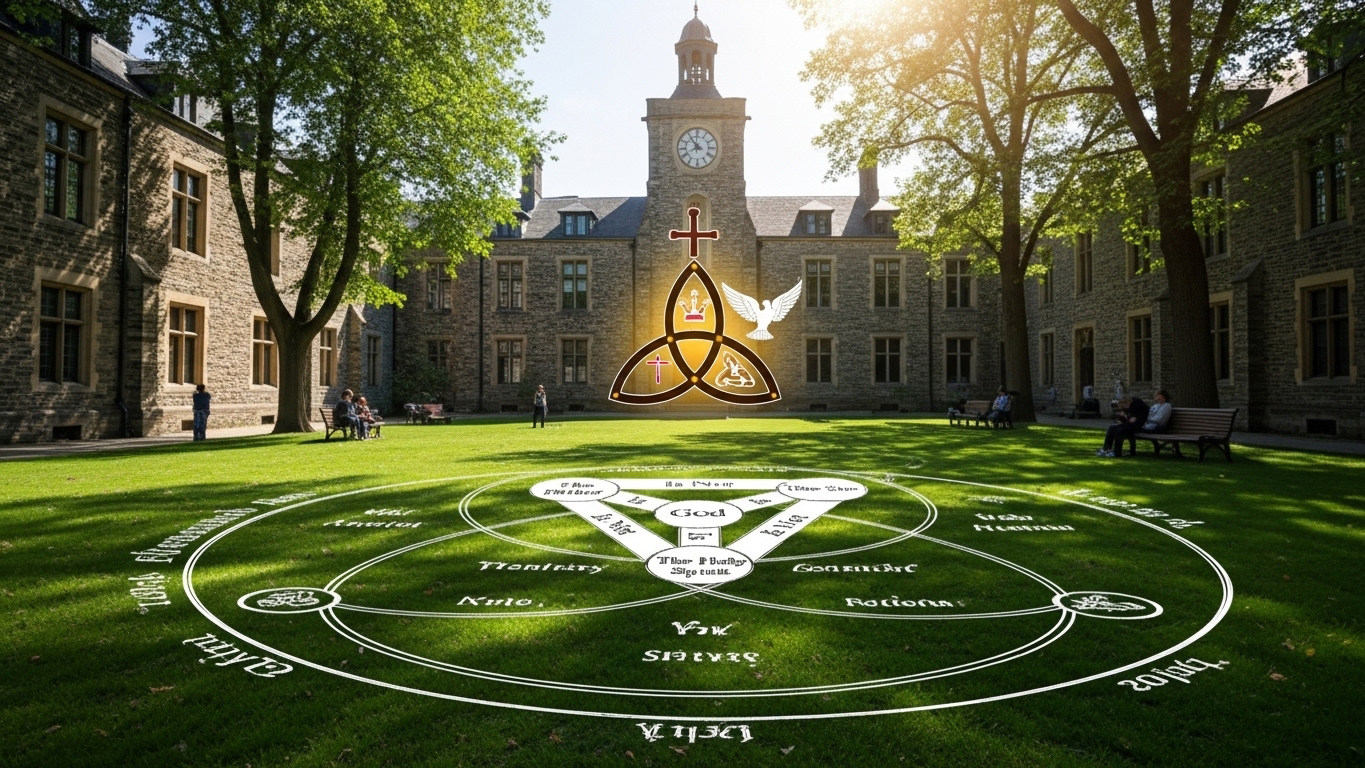
The Holy Trinity — the unity of Father, Son, and Holy Spirit — is the central and most profound mystery of the Christian faith. The question of what is the Trinity in Christianity (Holy Trinity explained) has been both a philosophical and a spiritual challenge across the centuries. Orthodox theology does not treat the Trinity as an abstract dogma, but as a living reality in which God reveals Himself through love, communion, and mystery. This article examines the doctrine of the Trinity from an Orthodox perspective (Orthodox view of Trinity), drawing on the texts of Holy Scripture, the heritage of the Church Fathers, and the insights of contemporary Orthodox theologians, including Metropolitan Stephanos and Metropolitan Damaskinos.
1. The Trinity in Holy Scripture: Biblical Foundations
The doctrine of the Trinity does not rest on a single isolated verse, but emerges from the full, integrated witness of Holy Scripture. The Old Testament already contains intimations of plurality within the divine being. Genesis 1:26 declares: “Let us make mankind in our image, in our likeness” — the plural pronoun points toward a plurality of persons. Psalm 110:1 reads: “The LORD said to my Lord: Sit at my right hand.” Isaiah 6:3, with the seraphim’s threefold cry “Holy, holy, holy is the LORD Almighty,” has been interpreted by the Church Fathers as a revelation of the Trinity.
In the New Testament, the baptism of Jesus in the Jordan River presents the Trinity with unparalleled clarity: the Son standing in the water, the Holy Spirit descending as a dove, and the voice of the Father from heaven: “This is my beloved Son, in whom I am well pleased” (Matthew 3:16–17). Metropolitan Stephanos (Malankara Orthodox Church, Diocese of Great Britain) observes that the Jordan River became the locus of Trinitarian revelation — each Person manifesting His distinctiveness, yet all three constituting one God. The Great Commission of Matthew 28:19 — “baptising them in the name of the Father and of the Son and of the Holy Spirit” — uses the singular “name” rather than the plural “names,” signalling the inner unity of the three Persons within one divine essence.
The Gospel of John is particularly foundational for understanding the Trinity: “In the beginning was the Word, and the Word was with God, and the Word was God” (John 1:1). The Pauline epistles confirm the same truth: “May the grace of the Lord Jesus Christ, and the love of God, and the fellowship of the Holy Spirit be with you all” (2 Corinthians 13:13). This apostolic benediction reveals the Trinity not as speculative theory but as lived experience — the divine love poured into our hearts through the Holy Spirit (Romans 5:5).
2. The Church Fathers and the Formation of Dogma: The Councils of Nicaea and Constantinople
The formal Christian articulation of Trinitarian doctrine reached its apex in the fourth century. The First Council of Nicaea (AD 325) was convened in direct response to Arianism — the teaching that the Son is a created being, subordinate to and lesser than the Father. The Council affirmed the consubstantiality of the Son with the Father, employing the Greek term homoousios (of one essence). Nevertheless, the full divinity of the Holy Spirit and the complete formulation of Trinitarian theology required further clarification.
The Cappadocian Fathers — Basil the Great (330–379), Gregory of Nazianzus (329–390), and Gregory of Nyssa (c. 335–395) — built upon the Nicene legacy and provided Orthodox theology with its precise theological vocabulary. They drew a crucial distinction between ousia (essence or substance) and hypostasis (person or concrete subsistence), and formulated the classical expression: one essence, three persons (mia ousia, treis hypostaseis). This formula simultaneously upholds divine unity (excluding polytheism) and the genuine distinction of the Persons (excluding Sabellianism, which reduced the three Persons to mere modes or appearances of a single divine actor).
Gregory of Nazianzus, whom the Orthodox Church honours with the title “The Theologian” — a distinction shared only with the Apostle John — wrote in his Fifth Theological Oration: “No sooner do I conceive of the One than I am illumined by the splendour of the Three; no sooner do I distinguish the Three than I am carried back to the One.” This statement distils the entire Orthodox experience of the Trinity: God is one mystery encountered through three Persons.
The Second Council of Constantinople (AD 381) confirmed the full divinity of the Holy Spirit and expanded the Nicene Creed. The Niceno-Constantinopolitan Creed, still used in Orthodox worship today, professes: “I believe in the Holy Spirit, the Lord, the Giver of Life, who proceeds from the Father… who together with the Father and the Son is worshipped and glorified.”
3. The Orthodox View of the Trinity: The Monarchy of the Father and Perichoresis
Orthodox theology diverges from the Western Christian tradition at several significant points in its understanding of the Trinity. First, the Orthodox Church emphasises the monarchy of the Father: the Father is the source and principle (archē) of the Trinity. This does not imply that the Son or the Holy Spirit are less divine — their divinity is complete and eternal. The Father is the beginning not in a temporal sense but in a relational one: it is precisely this relationship that constitutes the distinction of the Persons.
Metropolitan Damaskinos (Papandreou) — the distinguished theologian of the Ecumenical Patriarchate of Constantinople, a foremost leader of ecumenical dialogue, and Secretary of the Holy and Great Council’s preparatory process — emphasised in his theological writings that the Trinity cannot be treated as an abstract philosophical system. For Damaskinos, the Trinity is the living experience of the Church and the model of all communion: just as the three Persons share a perfect bond of loving self-giving, so humanity is called to live the same manner of communion — in the family, the parish, and society at large. He presented this vision in his work within the World Council of Churches as the foundation of ecumenical co-existence.
A second key concept is perichoresis (Greek: περιχώρησις) — the mutual interpenetration and indwelling of the three divine Persons. John 14:11 places this truth on the lips of Jesus Himself: “Believe me that I am in the Father and the Father is in me.” Perichoresis does not denote a blending of the Persons, but rather their perfect relational union — each fully dwelling within the others, yet remaining distinctly Himself. John of Damascus (c. 676–749), whose “Exact Exposition of the Orthodox Faith” remains the foundational text of Orthodox systematic theology, wrote: “The Persons are united, yet not confused; they are distinguished, yet not separated.”
A third significant difference concerns the Filioque controversy. The Western Church inserted into the Creed that the Holy Spirit proceeds from the Father and the Son (Filioque). Orthodox theology regards this as a theological error: the Holy Spirit proceeds from the Father alone, as confirmed by John 15:26 — “When the Advocate comes, whom I will send to you from the Father — the Spirit of truth who goes out from the Father.” Metropolitan Damaskinos led several inter-Christian dialogues in which this question was central, arguing that the Filioque undermines the monarchy of the Father and introduces two sources into the Trinity.
4. Apophatic Theology and the Mystery of the Trinity
Orthodox theology approaches God by two complementary paths: cataphatically (making positive affirmations about the divine nature) and apophatically (acknowledging that God transcends all human concepts). In the case of the Trinity, the apophatic approach is especially vital: we may know that God is three Persons and one essence, but this “knowing” is ultimately a participation in mystery rather than a resolution of it.
Gregory of Nazianzus confessed with candour: “I have pondered this carefully, seeking some analogy from the things of earth… but I have found nothing on earth with which to compare the nature of the Godhead.” In a similar vein, Metropolitan Stephanos stresses that the Trinity is not a problem to be solved but a mystery in which one must dwell — through theological contemplation and liturgical life. His teaching at the Orthodox Theological Seminary in Kottayam (2009–2022) treated pneumatology as an inseparable dimension of the full apprehension of the Trinity.
Vladimir Lossky, the great Orthodox theologian of the twentieth century, wrote in “The Mystical Theology of the Eastern Church”: “Between the Trinity and Hell there lies no other choice.” By this he means that the dogma of the Trinity is not a secondary doctrine — it is the very foundation upon which all Christian life and salvation rest. The human person, created in the image of God (Genesis 1:27), is created to participate in the communion of the Trinity.
5. The Trinity in Liturgy and Spiritual Life: Practical Dimensions
The Orthodox Church does not confine the Trinity to theological discourse — the entire liturgical life is a doxology of the Trinity. The Divine Liturgy opens with the words: “Blessed is the Kingdom of our God, of the Father and of the Son and of the Holy Spirit, now and ever and unto the ages of ages.” Every Saturday evening Vespers, every sacred rite, every baptism, wedding, and burial is ordered around the name of the Trinity. In the act of baptism, the believer is baptised “in the name of the Father and of the Son and of the Holy Spirit” — not a mere formula, but an act of participation in the divine life itself.
Metropolitan Damaskinos has written that the dogma of the Trinity forms the foundation of social ethics: just as the three Persons live in perfect mutual self-giving and love, so the Christian is called to live for others. Saint John Chrysostom gave expression to the same insight: “The most perfect rule of Christianity, its exact definition, its highest point, is this: to seek the benefit of all.” This is the application of Trinitarian theology to human society.
The icon of the Trinity — above all Andrei Rublev’s celebrated “Icon of the Holy Trinity” (c. 1360–1430), depicting the three angelic visitors to Abraham (Genesis 18) — occupies a place of singular importance in Orthodox spirituality. The icon shows three angels seated around a table, their gazes directed toward one another, forming an open circle that invites the viewer to enter. It is visual theology: the communion of the Trinity is open and calls the human person to share in it.
6. Historical Distortions of Trinitarian Doctrine
Throughout its history, Orthodox theology has defended Trinitarian teaching against numerous heresies. Arianism (fourth century) taught that the Son is a created being, less divine than the Father — condemned by the Council of Nicaea in AD 325. Sabellianism (third century) argued the opposite: that God is a single Person who appears in three different roles (Father in the Old Testament, Son in the Incarnation, Holy Spirit at Pentecost) — thereby denying the genuine distinction of the Persons. Tritheism errs in the contrary direction, teaching three separate Gods — which amounts, in effect, to polytheism.
Metropolitan Stephanos has emphasised in his teaching that the history of these heresies is instructive precisely because it reveals how readily the mystery of the Trinity is oversimplified. The right path is to hold the tension between the One and the Three without extinguishing either truth. This is why the Cappadocian Fathers’ formulation — mia ousia, treis hypostaseis — remains the classical and definitive expression of the doctrine.
7. The Trinity and the Theology of Human Dignity
One of the most profound insights of Orthodox theology is that the creation of the human person “in the image of God” (Genesis 1:27) means being fashioned in the likeness of the Trinity. Because God exists in relationship — Father, Son, Spirit — the human person is, at the deepest level of his or her being, a relational creature: made for togetherness, for community, for love. Gregory of Nyssa wrote that the human soul bears within itself the imprint of the Trinity.
Metropolitan Damaskinos argued in his ecumenical theology that the dogma of the Trinity furnishes the deepest possible foundation for human rights and human dignity: every person is created for divine communion and bears within himself or herself the divine image. It follows that the mistreatment of any human being is not merely an ethical transgression, but a theological offence against the Trinity itself.
The Russian thinker Nikolai Fyodorov declared: “Our social programme is the dogma of the Trinity.” This brief statement captures the heart of Orthodox social theology: the Trinity is not merely a subject for church liturgy, but the vocation of the whole of human society to live in mutual, self-giving love. Metropolitan Damaskinos brought this conviction into the centre of the ecumenical work of the World Council of Churches.
Summary
The Holy Trinity — Holy Trinity explained — is the most profound mystery of the Christian faith and, in Orthodox theology, also its most practical truth. The Orthodox view of Trinity differs from the Western tradition principally in its affirmation of the monarchy of the Father, its rejection of the Filioque, and its apophatic theological approach — but, more fundamentally still, the difference lies in emphasis: the Trinity is not primarily a dogma to be understood, but a life in which one participates.
The biblical foundations — the baptism of Jesus (Matthew 3:16–17), the Great Commission (Matthew 28:19), the Johannine Prologue (John 1:1), and the Pauline apostolic benediction (2 Corinthians 13:13) — attest to the Trinity in both the Old and the New Testaments. The Councils of Nicaea (325) and Constantinople (381), guided by the Cappadocian Fathers, enshrined the classical doctrine: mia ousia, treis hypostaseis — one essence, three persons.
Metropolitan Stephanos has underscored the pneumatological dimension of the Trinity — the role of the Holy Spirit in the life of the Church and of each individual believer — drawing on his pastoral theology and his long years of teaching. Metropolitan Damaskinos (Papandreou), a theologian of international renown and a leading ecumenical figure, brought the dogma of the Trinity into inter-ecclesiastical dialogue, insisting that Trinitarian truth forms the basis both of Christian unity and of the proper understanding of human dignity.
Ultimately, the Trinity is what Gregory of Nazianzus described: a mystery in which the One and the Three are so inseparably interwoven that to try to separate them is to lose both. For the Orthodox believer, knowing the Trinity is not an intellectual achievement but a life lived in love — participation in that divine communion which the Father, the Son, and the Holy Spirit have shared from all eternity.
References and Bibliography
1. Basil the Great. De Spiritu Sancto (On the Holy Spirit). Nicene and Post-Nicene Fathers, Series 2, Vol. 8. Buffalo, NY: Christian Literature Publishing Co., 1895.
2. Gregory of Nazianzus. Five Theological Orations (Orationes 27–31). Trans. Frederick Williams & Lionel Wickham. Crestwood, NY: St Vladimir’s Seminary Press, 2002.
3. John of Damascus. An Exact Exposition of the Orthodox Faith (De Fide Orthodoxa). PG 94.
4. Lossky, Vladimir. The Mystical Theology of the Eastern Church. London: James Clarke & Co., 1957.
5. Metropolitan Damaskinos (Papandreou). The Theological Dialogue. Chambésy: Orthodox Centre of the Ecumenical Patriarchate, 1993. See also: oikoumene.org/resources/documents/metropolitan-damaskinos-of-andrianople
6. Metropolitan Stephanos (Malankara Orthodox Church). Theological teaching at the Orthodox Theological Seminary, Kottayam (2009–2022). See: indianorthodoxuk.org/diocesan-metropolitan
7. Ware, Kallistos (Metropolitan Kallistos). The Orthodox Church. London: Penguin Books, 1997.
8. OrthodoxWiki: Holy Trinity. orthodoxwiki.org/Holy_Trinity (last modified 26 October 2024).
9. Coptic Orthodox Diocese of Los Angeles. An Introduction to the Orthodox Conception of the Holy Trinity. lacopts.org/orthodoxy/our-faith/the-holy-trinity
10. The Holy Bible. New International Version (NIV). Key passages: Genesis 1:26–27; Psalm 110:1; Isaiah 6:3; Matthew 3:16–17; Matthew 28:19; John 1:1; John 14:11; John 15:26; Romans 5:5; 2 Corinthians 13:13.

Martinus Vaicarius’s mission is to:
- Provide spiritual support and guidance to people seeking peace and hope
- Create prayer texts that bring God’s peace to hearts suffering under fear and anxiety
- Promote deep understanding of the power of the
- God of Sabaoth and the protection of the heavenly hosts
- Help people enter the spiritual sphere where God’s peace reigns over all
AICortex Invest OÜ
- Spiritual Warfare: From the Abyss to Glory — A Practical Guide to Overcoming Satan - 27. Jul 2026
- The Hierarchy of Angels: 9 Ranks, Names, and Duties Explained - 25. Jul 2026
- HCHC Launches “The Catechist: The Art of Listening and Teaching” — New Orthodox Certificate Program for 2026–2027 - 24. Jul 2026