Joan of Arc: The Saint Who Fought Demons and Defeated Satan
History, Legend, and the Profound Spiritual Meaning Behind the Maid of Orléans
Key Facts at a Glance
|
70 |
Articles of demonic accusation filed against Joan at the 1431 trial in Rouen |
|
1920 |
Year Pope Benedict XV canonized Joan of Arc — 489 years after her execution |
|
115 |
Witnesses who testified at the 1456 rehabilitation trial that exonerated her completely |
|
25 |
Years between her execution and the papal nullification of the corrupt 1431 verdict |
I. Introduction: The Peasant Girl Who Shook Heaven and Earth
In the spring of 1429, a seventeen-year-old illiterate peasant girl walked into the court of the French Dauphin and declared that God had commanded her to drive the English from France. Within weeks, she had lifted the siege of Orléans — a feat that veteran commanders had deemed impossible. Within two years, she was burned at the stake, accused of consorting with demons. Twenty-five years after her death, a church court declared her trial void. And in 1920, the Catholic Church declared her a saint.
The story of Joan of Arc — Jeanne d’Arc in French, born around 1412 in the village of Domrémy — is, on its surface, one of the most dramatic military narratives in European history. But beneath the battles and the politics lies a story that is profoundly theological: the story of a young woman who understood her entire life as a battle between divine grace and the forces of darkness, and whose enemies, recognising that power, attempted to reframe her sanctity as demonism.
This article undertakes a systematic analysis of Joan of Arc as a figure of spiritual warfare — examining the nature of her divine communications, the demonological accusations levelled against her, the theological frameworks through which the Church ultimately vindicated her, and the enduring meaning of her life as a symbol of the soul’s resistance to Satan.
“We have burned a saint.”
— An English soldier present at Joan of Arc’s execution, Rouen, 30 May 1431
II. The Voice That Started Everything: Divine Communication or Demonic Deception?
At the age of thirteen, Joan of Arc began to hear voices. She first heard them as she tended her father’s garden in Domrémy, accompanied, she later testified, by a great light. Over the following four years, the voices grew more insistent and more specific, eventually identifying themselves as three holy figures: the Archangel Michael, Saint Catherine of Alexandria, and Saint Margaret of Antioch.
The Catholic theological tradition through which Joan interpreted these experiences had a precise term for the phenomenon she was undergoing: locutio — an interior mystical phenomenon involving the reception of divine instruction. Historian Daniel Hobbins, in his critical edition of Joan’s trial records, places her firmly in the context of a centuries-long tradition of women mystics and saints who received special revelations, noting that her case was unique not in the nature of the experience but in its unprecedented combination of visionary mysticism with direct military command.
The Archangel Michael: Heaven’s Warrior Against Satan
The choice of Saint Michael as Joan’s primary heavenly guide carries enormous theological weight that her contemporaries would have immediately understood. In the Book of Revelation (12:7–9), Michael leads the angelic armies against Satan in the war of heaven: “And there was war in heaven: Michael and his angels fought against the dragon; and the dragon fought and his angels.” The very name “Michael” — in Hebrew, Mi-ka-El — means “Who is like God?”, traditionally understood as the battle cry of heaven’s forces against Lucifer’s rebellion.
Michael was also the special protector of France. When Joan testified that it was precisely this celestial warrior who had commissioned her mission, she was situating herself within an explicitly anti-demonic theological framework: she was not merely a military commander but a human participant in an ongoing cosmic battle between heaven and hell, grace and damnation, and the legitimate divine order of France against the forces that — in her theological worldview — the English occupation represented.
The Test of Discernment: Was Her Mission Divine or Diabolical?
The medieval Church did not accept claims of divine communication at face value. The theological discipline of discretio spirituum — the discernment of spirits — had been developed precisely because the Church recognised that supernatural experiences could be of three origins: divine, human (psychological), or demonic. The assessors at Joan’s trial used this framework to determine the specific source of her visions.
Before Charles VII trusted her with an army, Joan underwent weeks of theological examination at Poitiers, conducted by the most learned theologians in France. Their verdict was unambiguous: she was “of irreproachable life, a good Christian, possessed of the virtues of humility, honesty and simplicity.” The commission declared a “favourable presumption” regarding the divine nature of her mission and counselled Charles that to abandon her without cause would be to “repudiate the Holy Spirit.”
III. The Trial of 1431: How Her Enemies Tried to Reframe Sanctity as Satanism
Joan’s capture by Burgundian forces in May 1430 and her subsequent sale to the English transformed a military conflict into an ideological and theological battleground. The English needed not merely to silence Joan but to discredit her — and the most effective way to discredit a woman who claimed divine sanction was to argue that her sanction was not divine at all, but demonic.
Historical Context
The trial was conducted by Bishop Pierre Cauchon of Beauvais, a known English sympathiser, in Rouen — English-controlled territory. Joan was imprisoned by English soldiers rather than church authorities, denied legal counsel, subjected to exhausting interrogations, and her trial records were subsequently found to have been falsified. The verdict, as later scholarship confirmed, was politically predetermined.
The 70 Articles of Accusation: A Demonological Portrait
The prosecution filed 70 articles of accusation against Joan, subsequently condensed into 12 principal charges. At their theological core, these accusations constituted a systematic attempt to reinterpret every aspect of Joan’s sanctity as evidence of diabolical compacts. The trial transcript records the prosecutorial framing directly:
“She had invoked demons, and evil spirits; consulted them, associated with them, had made and had with them compacts, treaties, and conventions, had made use of them…”
— Official Articles of Accusation, Trial of Joan of Arc, 27–28 March 1431
The 70 accusations covered six major theological categories, each designed to invert Joan’s actual spiritual practice into its demonic mirror image:
- Invocation of Demons: Her communications with St. Michael, Catherine, and Margaret were reframed as demonic invocations and unlawful consultation of evil spirits.
- Divination and Prophecy: Her accurate military predictions — including the Battle of Herrings and the Orléans victory — were characterised as forbidden occult divination.
- Sorcery and Witchcraft: Her ability to inspire the demoralised French army was attributed to supernatural witchcraft rather than genuine spiritual authority.
- Refusing Church Authority: Her claim to be answerable to God alone was charged as schismatic disobedience, evidence of diabolic pride.
- Cross-Dressing as Idolatry: Her practical choice to wear men’s armour in battle was prosecuted as a violation of Deuteronomy 22:5 and interpreted as an act of diabolical defiance.
- Presumptuous Revelation: Her certainty in her divine mission was charged as heretical presumption — exactly the sin of Lucifer, who trusted his own judgement over God’s order.
Joan’s Defence: Unshaken Under Extraordinary Pressure
What is historically remarkable about Joan’s conduct at the trial is not only that she resisted but how she resisted. Without formal theological education, without legal counsel, subjected to weeks of gruelling interrogation by some of the finest scholastic minds of the University of Paris, Joan answered her accusers with precision and composure that left them struggling to find a response. One exchange has become legendary.
When her interrogators attempted a theological trap — asking her whether she was certain that she was in a state of sanctifying grace (a question with no safe answer for an uneducated woman) — Joan replied: “If I am not, may God put me there; and if I am, may God so keep me.” Her examiners fell silent. The answer was theologically perfect — humble, orthodox, and unanswerable.
She never claimed infallibility. She said only what she knew with absolute certainty: that her voices were real, that they came from God, and that she would not deny this truth on pain of death. On 24 May 1431, under threat of immediate execution, she briefly signed a recantation. Four days later, she withdrew it, restored her mission’s testimony, and accepted her fate. She was burned at the stake on 30 May 1431.
“I am not afraid. I was born to do this.”
— Joan of Arc, attributed, Trial Transcript, 1431
IV. The Theological Meaning of Joan’s Death: How Satan Was Defeated Through the Stake
The paradox at the heart of Joan’s story — and its deepest spiritual meaning — is this: the very act by which her enemies sought to destroy her testimony became, in theological retrospect, its most powerful confirmation. The attempt to brand her as a servant of Satan instead revealed the Satanic character of the forces that condemned her.
The Witness of Martyrdom
Joan died in a manner that no agent of darkness could have scripted. She received Holy Communion for the last time on the morning of 30 May. As Pope Benedict XVI’s apostolic letter on her life records, she died with her gaze fixed on the Crucified Jesus, crying out several times the Name of Jesus — a detail preserved in the official nullity trial transcripts and cited in the Catechism of the Catholic Church (n. 435).
She asked one of the priests to hold a processional cross in front of the stake so that the image of Christ would be the last thing she saw. At the moment of her death, an English soldier present said — in words that have echoed across six centuries — “We have burned a saint.” The executioner, according to testimony gathered during the rehabilitation proceedings, was filled with dread and sought confession immediately after, fearing he had committed an unforgivable act.
The theological tradition of martyrdom holds that the martyr’s death is, paradoxically, their greatest victory over evil. The forces of Satan seek to destroy the saint; the saint’s willingness to die rather than deny the truth transforms the moment of apparent defeat into the moment of ultimate spiritual triumph. Joan’s death follows this pattern with striking precision.
The Incorruptible Heart
One of the most striking physical details of Joan’s execution, preserved in the nullity trial testimony, is that after her body was reduced to ash, her heart remained intact and full of blood. The English, alarmed by what they saw, ordered the ashes — heart included — thrown into the Seine River. This detail, which medieval theology would have interpreted as a sign of divine protection, has been discussed by hagiographers across centuries as a physical manifestation of spiritual incorruptibility: the heart that had loved God absolutely could not be wholly consumed by the flame that Satan’s agents had kindled.
V. Rehabilitation and Canonisation: The Church Acknowledges Its Error
The nullification of Joan’s trial is one of the most extraordinary events in Church legal history. It was initiated by Joan’s mother, Isabelle Romée, and her brothers, who petitioned for a reinvestigation on the grounds of judicial misconduct and political bias. In 1450, King Charles VII commissioned the first inquiry. The decisive moment came in 1455, when Pope Callixtus III issued a papal bull authorising a full formal investigation.
1431 Joan of Arc burned at the stake in Rouen, 30 May, on charges of heresy, sorcery, and demonic compacts.
1450 King Charles VII orders theologian Guillaume Bouillé to conduct an initial inquiry, which uncovers procedural violations in the 1431 trial.
1455 Pope Callixtus III issues a papal bull authorising a full reinvestigation. The nullity trial opens on 7 November in Rouen, examining 115 witnesses.
1456 The inquisitorial court issues its solemn sentence on 7 July: the 1431 condemnation is declared null and void, tainted by deceit, political bias, and procedural violations.
1894 Pope Leo XIII pronounces that Joan’s mission was divinely inspired — the first formal papal affirmation of the authenticity of her vocation.
1909 Pope Pius X beatifies Joan of Arc on 18 April, placing her on the path to full sainthood.
1920 Pope Benedict XV canonises Joan of Arc on 16 May. In 1922, Pope Pius XI declares her one of the patron saints of France. Her feast day: 30 May.
The nullity trial examined 115 witnesses over months of careful proceedings. Their testimony painted an entirely different picture of the 1431 proceedings: a rigged court, falsified records, an accused denied her legal rights under canon law, and judges who served English political interests rather than ecclesiastical truth.
Canonisation Note
Joan of Arc was canonised as a Virgin, not formally as a martyr, because the 1431 court — despite being corrupt — was a canonically constituted tribunal. Nevertheless, popular veneration has always treated her as a martyr: one who died for the truth of her mission, her modesty, and her fidelity to divine conscience rather than human cowardice. Pope Leo XIII’s 1894 declaration that her mission was divinely inspired remains the Church’s definitive theological verdict on the question that her executioners tried to answer with fire.
VI. The Spiritual Warrior: Joan of Arc and the Theology of Cosmic Battle
To understand Joan of Arc fully, one must understand the theological world she inhabited. The medieval Christian cosmology was not metaphorical about evil: Satan was not a symbol but a personal adversary, actively working against human souls and human societies. The Church’s theology of angels and demons presupposed a cosmos in which heaven and hell were engaged in a genuine conflict over the fate of souls and nations.
Joan’s Role in the Spiritual Geography of the Hundred Years’ War
For Joan and her contemporaries, the Hundred Years’ War was not merely a dynastic conflict over territorial succession. It was, at its deepest level, a battle for the soul of France — a nation that held a special place in medieval Catholic theology as the Church’s “eldest daughter”, the most thoroughly Christian kingdom in Europe. The English conquest of France, in this framework, represented not just political subjugation but a spiritual catastrophe: the displacement of God’s anointed king and the corruption of God’s special nation.
Joan’s mission, as she understood it and as Saint Michael had communicated it, was therefore simultaneously military, political, and spiritual. When she drove the English from Orléans, she was striking a blow against the forces that Satan was using to corrupt the divine order. When she insisted on the coronation of Charles VII at Reims — the sacred city where French kings received their sacral anointing — she was restoring the legitimate structure through which God governed France.
The Weapons of Joan’s Warfare
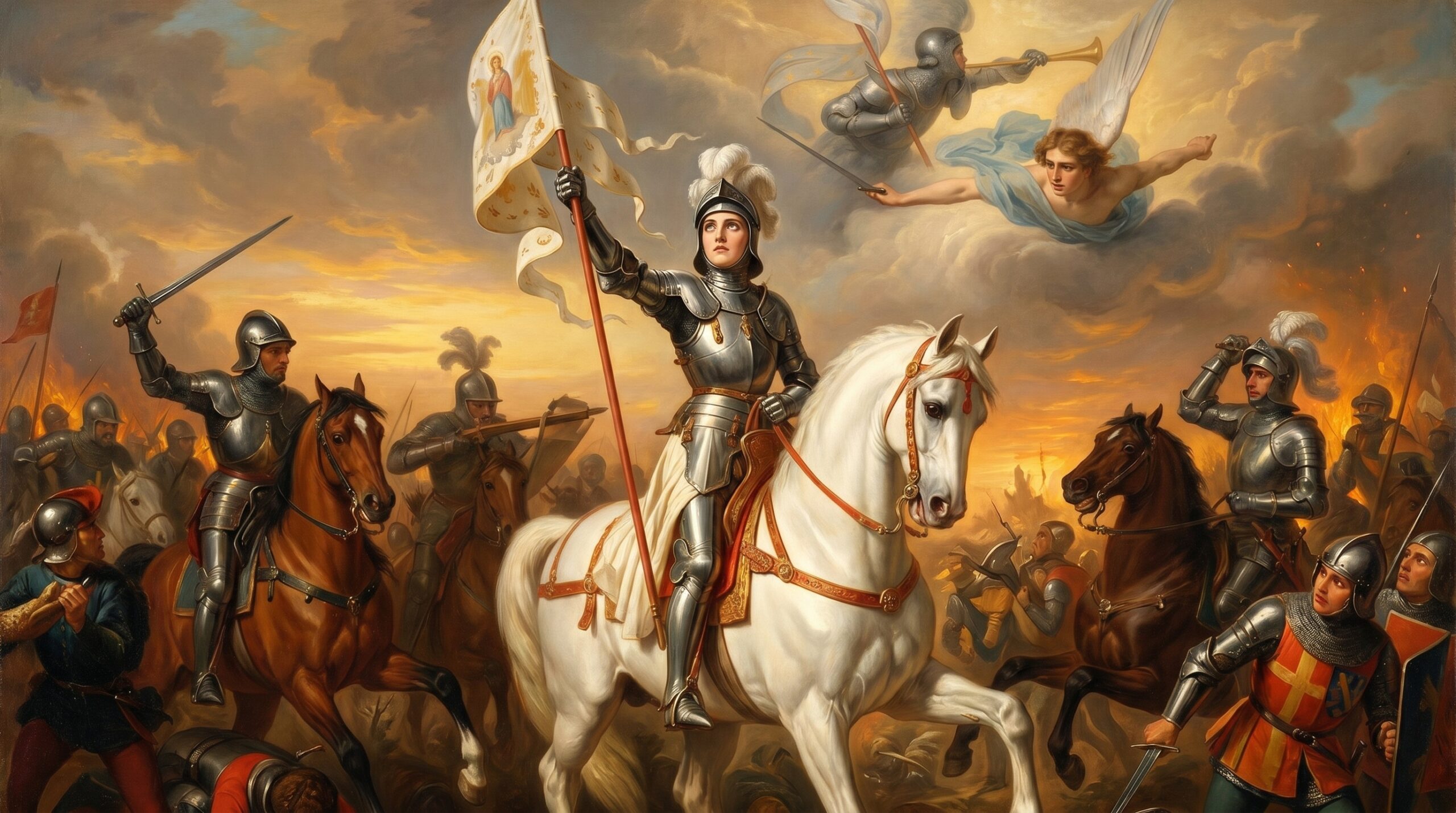
Joan’s spiritual battle was not conducted only on the military field. Witnesses at the nullity trial testified in extraordinary detail to her personal holiness under fire. She drove prostitutes from camp. She forbade looting, pillaging, and profanity among her soldiers. She went to confession frequently and insisted that her men receive the sacraments before battle. She carried a banner depicting Christ in judgement alongside two angels, and she told her commanders that she was more afraid of sinning than of dying in battle.
Most striking of all, according to multiple witnesses: she never once lifted her sword against anyone save to chase out a prostitute. Joan was a military commander who never personally killed in battle. Her weapons were, in the deepest sense, spiritual: the authority of divine commission, the coherence of moral witness, and the absolute refusal to compromise truth for the sake of survival.
“One of the most original aspects of this young woman’s holiness was precisely this link between mystical experience and political mission. Her life offers a perfect example of the conjunction of contemplation and action.”
— George H. Tavard, The Spiritual Way of St. Jeanne d’Arc, Liturgical Press
The Discernment of Spirits: Why Joan’s Mission Was Genuine
Modern Catholic theology assesses Joan’s case through the criteria of spiritual fruits. The fruits of her mission are historically unambiguous. She lifted an apparently impossible siege in a matter of days. She accomplished the coronation that French military and political strategy had deemed unachievable. She transformed the psychological morale of an entire nation from despair to victory. She died praying, forgiving her executioners, calling on the name of Jesus.
These are not the fruits of diabolical deception. Satan, the Catholic tradition teaches, cannot produce lasting goods of genuine spiritual worth: courage, charity, humility, fidelity unto death. The diabolic may produce spectacular effects — but it cannot produce, as Joan demonstrably produced, a transformation of genuine virtue in those around her. Her soldiers went to confession before battle. Multiple witnesses described a palpable sense of divine presence in her company.
VII. Joan of Arc’s Enduring Spiritual Legacy
Six centuries after her death, Joan of Arc remains one of the most analysed, revered, and contested figures in Western history. But beneath the accretions of nationalist symbolism, feminist interpretation, theatrical drama, and psychological speculation, the essential spiritual reality of her story endures with undiminished force.
What Joan of Arc Teaches About Spiritual Warfare
Joan’s story offers a precise theological anatomy of how spiritual warfare actually unfolds in human history. First: the forces of darkness do not announce themselves as darkness. The prosecution at Rouen was composed of learned, religiously credentialed men who claimed to be serving God by condemning Joan. The demonic rarely presents itself as demonic; it presents itself as orthodoxy, order, institutional authority, and the common good. Joan’s discernment required the courage to distinguish genuine divine authority from human authority that had been corrupted into the service of evil.
Second: the ultimate weapon against spiritual darkness is truth maintained at the cost of self. Joan’s power over her enemies derived not from her sword but from her absolute refusal to say that false was true. When she withdrew her recantation and accepted death rather than live on the basis of a lie, she enacted in her own person the theological principle that the martyrs had demonstrated across the centuries: that the soul which clings to truth, even at infinite personal cost, participates in the victory of Christ over Satan.
Third: vindication belongs to God’s timeline, not history’s. Joan did not see her rehabilitation. She died condemned, alone, abandoned by the king she had crowned. But the truth of her mission was not destroyed with her body. It survived — and it returned, twenty-five years later, to consume the verdict that had condemned her.
Joan of Arc as a Model for Contemporary Faith
The Franciscan Media’s contemporary reflection on Joan’s legacy identifies four aspects of her witness that speak directly to modern conditions: the problem of discerning authentic spiritual calling in an age of competing voices; the challenge of maintaining integrity under institutional pressure; the courage to act on conscience when authority has been corrupted; and the willingness to accept suffering as a consequence of fidelity.
In an age that tends to pathologise mystical experience — Joan’s modern biographers have proposed epilepsy, schizophrenia, tuberculoma, and ergot poisoning as explanations for her visions — her story also raises a question that cannot be answered by neurology alone: what is the difference between a hallucination and a genuine communication from beyond the material order? The Church’s answer, developed through centuries of careful theological reflection, is that the difference is discerned through fruits: through the quality of life, virtue, and transformation that the experience produces.
By that standard, Joan of Arc’s case remains, in the Catholic theological tradition, resolved. Pope Leo XIII said her mission was divinely inspired. Pope Benedict XV made her a saint. The Catechism of the Catholic Church cites her dying words as an example of the sanctifying power of the Holy Name of Jesus. The woman whom the English burned as a servant of Satan has been declared by the same Church that first condemned her to be, beyond reasonable theological doubt, a servant of God.
Conclusion: The Flame That Could Not Consume the Truth
The story of Joan of Arc, understood in its full theological depth, is not primarily a story about medieval France or the Hundred Years’ War. It is a story about what happens when the spiritual warfare between good and evil takes on human form — when the cosmic battle between Christ and Satan is enacted in the biography of a single person.
Joan’s enemies used the most sophisticated theological and legal machinery of their age to argue that she served Satan. They failed not because they lacked intelligence or learning but because the evidence of her life — her holiness, her courage, her charity, her fidelity to truth at the cost of her life — could not ultimately be reframed as diabolical without straining beyond the breaking point every honest criterion for the discernment of spirits.
The English soldier who said, at the moment of her death, “We have burned a saint”, was speaking more accurately than he knew. They had burned a saint. And in burning her, they had accomplished the precise opposite of what they intended: they had transformed a military heroine into a universal symbol of the soul’s ultimate, indestructible capacity to choose truth over comfort, God over safety, and love over the fear of death.
Satan, the Catholic tradition teaches, is ultimately powerless against this kind of witness. He can kill the body. He cannot kill the truth it bore. Joan of Arc stands, six centuries on, as one of history’s most precise demonstrations of that theological reality.
Sources and References
- Wikipedia. Joan of Arc. Comprehensive biographical and trial analysis. en.wikipedia.org/wiki/Joan_of_Arc
- Famous-Trials.com. Trial Transcript: 70 Articles of Accusation, 27–28 March 1431.
- Famous-Trials.com. Sentence of Death, 30 May 1431.
- Grokipedia. Trial of Joan of Arc: Theological and Legal Analysis.
- Hobbins, Daniel. The Trial of Joan of Arc. Harvard University Press.
- jeanne-darc.info. Trial of Condemnation 1431: Documents and Analysis.
- North Texas Catholic. Who Was Joan of Arc? northtexascatholic.org
- Catholic Online. St. Joan of Arc — Saints & Angels. catholic.org
- Discerning Hearts. St. Joan of Arc: Bringing the Light of the Gospel Into History.
- Franciscan Media. Saint Joan of Arc’s Message for Today. franciscanmedia.org
- FOCUS Catholic. Meet the Saints: Saint Joan of Arc. focus.org
- University of Notre Dame — FaithND. St. Joan of Arc. faith.nd.edu
- Saint Michael Center. St. Joan of Arc. saintmichaelusa.org
- Maid of Heaven. St. Michael the Archangel and Joan of Arc. maidofheaven.com
- Fordham University Medieval Sourcebook. The Trial of Joan of Arc, 1431.
- Quicherat, Jules. Procès de condamnation et de réhabilitation de Jeanne d’Arc. 5 vols. Paris, 1841–1849.

Martinus Vaicarius’s mission is to:
- Provide spiritual support and guidance to people seeking peace and hope
- Create prayer texts that bring God’s peace to hearts suffering under fear and anxiety
- Promote deep understanding of the power of the
- God of Sabaoth and the protection of the heavenly hosts
- Help people enter the spiritual sphere where God’s peace reigns over all
Europe Heaven Invest 2072 Gold OÜ
- Joan of Arc: The Saint Who Fought Demons and Defeated Satan - 27. Apr 2026
- Prayer for Peace, Europe, the Government of Estonia, and All People 2026 – A Powerful Christian Intercessory Prayer for Peace, Protection, and Blessing - 23. Apr 2026
- Who Was Jesus Christ? The Historical and Biblical Evidence Every Person Should Know - 23. Apr 2026