Views: 54
The Altarpiece of Kaarli Church
Estonian Evangelical Lutheran Church Institute of Theology
2nd Year Master’s Program in Christian Cultural History
Essay
Allan Kroll
Instructor: Ivar-Kristjan Hein
TALLINN 02.06.2020
Table of Contents
- Introduction
- JOHANN KÖLER AND THE KAARLI CHURCH ALTARPIECE
- THE CREATION OF THE ALTARPIECE
- THE THEOLOGICAL SIGNIFICANCE OF THE ALTARPIECE
- THE RESTORATION OF THE ALTARPIECE
- Conclusion
- References and Sources
Introduction
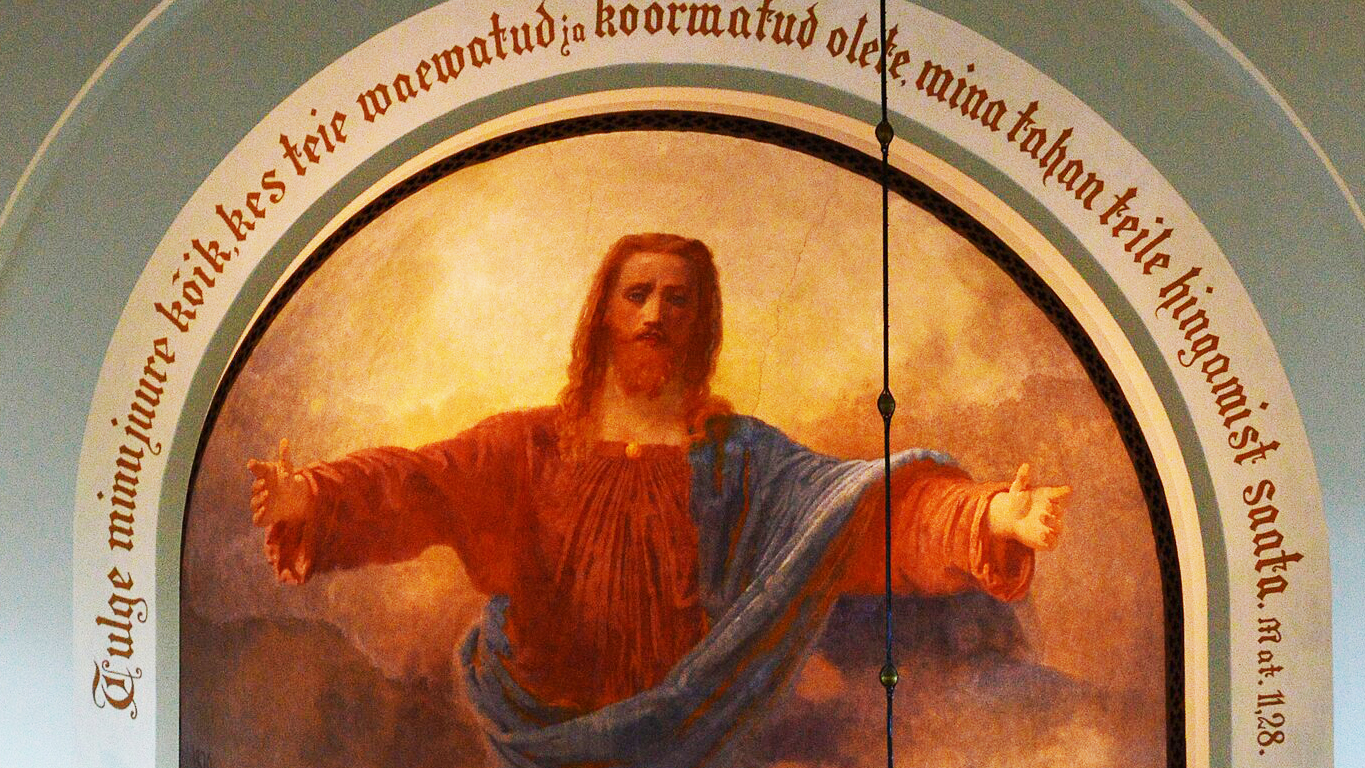
This paper examines the altarpiece of Tallinn’s Kaarli Church created by Johann Köler, which depicts Christ inviting all who are weary and burdened to come to Him, promising to give them rest.
The work is divided into four parts. The first briefly describes Johann Köler’s life and work as an artist, as well as the background of the altarpiece’s creation. The second chapter describes the technical aspects of the altarpiece’s creation, the third its theological significance, and the fourth the restoration work carried out in 2013.
The primary sources used by the author include Hilkka Hiiop’s article “The Artist’s Touch: Johann Köler’s Fresco ‘Come to Me All…’ with New Brilliance” (Horisont, 2013, No. 6, November) and art historian Eero Kangor’s article “Painter and National Figure Köler from Viljandi – Johan Köler (1826–1899)” (Kesklinna Sõnumid, 16.03.2018).
The theological section draws on commentaries on the Gospel of Matthew by Elmar Salumaa and R.T. France.
1. JOHANN KÖLER AND THE KAARLI CHURCH ALTARPIECE
Johann Köler was born on February 24 (March 8 according to the new calendar) 1826 in Viljandi County, in Vastemõisa parish at Kööbra farm, as the seventh child of Peet and Kai Köler. Due to his parents’ poverty, he was unable to complete the local district school. His drawings caught the attention of Vastemõisa estate manager Faber, for whom he briefly worked as a clerk, and Faber sent the 13-year-old boy to Võnnu to study with his brother, who was a master painter. Köler’s first serious encounter with art was at Krimulda Manor, whose art collection left a deep impression on him. After Faber’s death, Köler decided to go to St. Petersburg, where his brother Tõnis lived. In addition to painting work, he began creating more artistic pieces there, and in 1848 he had the opportunity to attend evening classes at the Academy of Arts, enrolling as a full student in 1851. During this time, Köler also began earning money independently through painting. In 1855, he graduated with honors for his painting “Hercules Brings Cerberus from the Underworld.” After receiving substantial payment from Tsar Nicholas I for a painting, he left St. Petersburg and moved to Königsberg, then to Paris and other European cities. Köler stayed longest in Italy. During his Italian period, Köler began searching more deeply for his national roots. Many of his national romantic paintings date from this time. In 1863, having returned to Russia, Köler began painting different kinds of works, such as realistic portraits of his parents. In St. Petersburg, he participated in the Estonian patriotic movement and supported, for example, C.R. Jakobson’s publication “Sakala.” Later, Köler withdrew from the national movement.
Art historian Eero Kangor sees Köler’s most enduring and symbolic contribution to the creation of Estonian national self-image precisely in the Kaarli Church apse painting discussed in this paper. The church was consecrated in 1870, and the proposal to create the altarpiece was made to Köler in 1875. Planning the painting took four years. In 1878, Köler studied the fresco painting technique, which was unfamiliar to him, in Germany, and in 1879 he created a plaster model draft of the painting. Köler decided to paint not a Christ blessing the people above the altar, as the patrons had wished, but rather a Christ inviting the weary and burdened to come to Him. The prototype was Villem Tamm, whom he had portrayed in Hiiumaa in 1863. The painting was completed in just nine days and was consecrated on July 29, 1879. The 1,000 rubles received for the painting only covered production costs, and the painting itself is Köler’s gift to the Estonian people.1
Hiiop adds that by the time the work was completed, Villem, who had been portrayed in Hiiumaa in 1863, had become a brutal manor overseer. Jaan Kross later wrote about Köler’s internal struggle over this in his novel “The Third Mountain Range.”
In the Kassari area, he was called Beautiful Villem. The man reportedly had unusually pure facial features, long and thick hair, and a short beard on his chin. Köler was struck by the man’s slightly exotic and dark complexion. The impression was apparently so strong that when painting in 1879, he chose the man he had met in 1863 as the prototype for Christ. Upon hearing of the man’s bad reputation, Köler even considered destroying the painting. As an old man, Villem himself reportedly visited Kaarli Church to view the painting and admitted, “Yes, we are all created in God’s image.” Villem Tamm died in 1915 and is buried in the Kassari chapel cemetery next to his wife Anna Tamm.
2. THE CREATION OF THE ALTARPIECE
Köler’s Kaarli Church apse painting “Come to Me All” is symbolically significant for the Estonian people not only in terms of artistic quality, but also nationally and historically. It has been extensively studied and written about, and its image has become ingrained in Estonian memory and consciousness.
Originally, a canvas painting was planned for the church, but a fresco to be placed in the apse niche was ultimately chosen. This was also reported in the press. In 1882, the supplement to “Olevik” titled “Science and Art” wrote that the church’s altarpiece was not painted on cloth, as is usually customary, “but directly on the church wall.” As already mentioned, the 1,000 rubles received for the work from the congregation’s meager resources only covered production costs, while the work itself was valued at 7,000 rubles (“Christian Sunday Paper”). Many articles were written about the painting, praising the artist’s talent. J.V. Jannsen wrote in “Eesti Päevaleht” that it was a masterpiece that many large German churches would want for themselves at great expense. “Science and Art” wrote that it was such a valuable work of art that every person who comes to Tallinn should go see it.
Since a church that is cold most of the year is not the best environment for fresco painting, this problem was solved ingeniously: it is not painted directly on the exterior wall, but on a wire-mesh construction slightly away from the wall. In this way, Köler ensured air circulation behind the plaster surface and was able to prevent damage to the fresco from moisture coming from the exterior wall. Scaffolding was erected on the church’s altar wall, and approximately 5,000 feet of nails were driven into the altar wall. The ends were covered with bitumen and tinned to prevent rusting. A wire mesh covered with bitumen was attached to these, and a 2-inch layer of plaster was applied on top. St. Petersburg’s most knowledgeable experts and professors advised on the technical execution (“Christian Sunday Paper,” August 1897). The first plaster layer was a multiple coarse layer, or arriccio, which had dried by the time of painting.
Köler himself wanted it to be a true Renaissance-style fresco, with pure watercolors, without glue-based binders, on fresh plaster, so that the paint would secrete a glaze-like substance upon drying and adhere to the painting. In 1880, he wrote to the conference secretary of the St. Petersburg Academy of Arts that he painted it from cartoons in ten days, each day on freshly plastered surface, with pure watercolors without lime mixture. Because of this, the painting retains its full freshness and strength and glows slightly when drying, he stated. Adding lime would have ruined this effect. Only water-mixed pigment without binders was placed on the lime plaster applied to the surface during the day. Upon reacting with oxygen, a crystalline calcium carbonate layer formed on the surface to bind the pigment. Painting was done from top to bottom to avoid color spatters falling on the finished painted surface. Work began at the upper left corner and finished at the bottom center section.
Since painting was done on wet plaster, even the artist’s fingernail and fingerprint marks have been preserved. This was apparently due to the need to support the hand while painting. From the blue robe falling from Christ’s left side, one can find the imprint of an entire left hand. The most fingernail marks are on Christ’s face, as painting it required the most precise execution and needed a place to support the hand. Köler likely had only the image of Christ’s face and hands drawn on paper, and more complex details were transferred to the plaster surface likely using the pouncing technique, where boundary lines drawn on paper were perforated and dabbed over with pigment powder. Elsewhere, Köler transferred the image to the plaster by pressing the imprint into the wet plaster.
Since the fresco painting tradition had been forgotten in Russia by this time, Köler learned it in Germany. In the Tsarist Empire, this was a unique work, as contemporary newspapers also emphasized.
3. THE THEOLOGICAL SIGNIFICANCE OF THE ALTARPIECE
The image of Jesus with open arms, hands stretched toward people, calling everyone to Himself, is undoubtedly atypical as a church altarpiece. More typical is the depiction of Jesus as the Savior dying on the cross. Also not uncommon is the depiction of the resurrected Jesus, the Last Supper, or Jesus as the heavenly judge. Köler’s fresco has special significance precisely in that as a Lutheran church altarpiece, it focuses on Jesus offering grace, apart from works of the law, to all who are weary. For emphasizing the Lutheran Sola Gratia, it is difficult to depict anything better on an altarpiece. Grace is offered to all, not only to the meritorious, the rich, the wise, or the especially religious.
Jesus was reproached as a friend of sinners and tax collectors (Luke 7:34) because He stretched out His hands to them. Jesus responded that the healthy do not need a doctor, but the sick, and that He came to seek and save sinners (Luke 19:10). The stories of the lost coin, the lost sheep, and the prodigal son illustrate this most vividly (Luke 15). Just as the father of the prodigal son received with open arms his sinful, filthy, starving son who had squandered a large portion of the family inheritance, so too does Jesus receive with open arms all who come to Him. “Whoever comes to me I will never drive away” (John 6:37).
The text of the altarpiece is taken from Matthew 11:28, where Jesus says: “Come to me, all you who are weary and burdened, and I will give you rest!”
R.T. France sees in these burdens the heavy loads placed on people’s shoulders by the Pharisees as the religious leaders of the time (see Matthew 23:4).
These weary and burdened are apparently the little children Jesus spoke of in the previous verses (v. 25), contrasting them with the wise and learned, from whom the secrets of the kingdom of God are hidden. Elmar Salumaa emphasizes that these people may not have been weary from heavy physical labor, but exhausted by unfulfillable commandment requirements, so that there were no prospects for blessedness. Jesus says that only He can give them rest. The Greek word denoting this is anapauō, which meant rest after hard work, but in this context apparently means spiritual or soul refreshment, in which the concept of peace prevails. Jesus does not require human effort, but gives peace, refreshment, proclaiming forgiveness of sins. This peace can be experienced only in the joy of receiving forgiveness.
4. THE RESTORATION OF THE ALTARPIECE
In 2013, the painting was technically examined and a plan was drawn up for the first comprehensive restoration and conservation work. Scaffolding was installed and material-technical studies of the painting were begun. This was a painting created using unique fresco technique in Estonia, in which the wet plaster preserved much important information about the author and his working methods.
In 2002, it was discovered that layers had crumbled in many places because the binder had disappeared from the pigment. The cause is seen as excessive haste. Köler had apparently had too large a surface area plastered during the day, and therefore it was already too dry by the time of painting. The numerous cracks in the fresco are believed to be caused by bombing during World War II. Another possibility is vibration from road work in the late 1970s. However, cracks were already discovered in 1923 photographs.
Rubber sponges were used to clean the fresco, and powdered pigment was fixed. Cracks were seen as part of the painting’s history and therefore were not repaired.
Conclusion
Johann Köler was an influencer of Estonian national awakening, and his paintings have strongly influenced Estonian national self-awareness throughout history.
Johann Köler’s altarpiece “Come to Me All You Who Are Weary and Burdened…” was unique at the time of its creation because it was made as a fresco, not as the traditional canvas-painted altarpiece in our conditions. It is also atypical in that the painting depicts neither the crucified nor the resurrected Jesus or the Last Supper, but Jesus with open arms calling the weary and burdened to Himself.
The painting’s creation process was carefully planned and executed, and the work has therefore been relatively well preserved despite unfavorable conditions in many respects. The altarpiece, thoroughly restored in 2013, has become ingrained in our people’s consciousness, possessing symbolic value in addition to religious value.
References and Sources
- Estonian Evangelical Lutheran Church Tallinn Toompea Kaarli Congregation; www.kaarlikogudus.ee
- France, R.T. The Gospel of Matthew, Logos, Tallinn, 2019.
- Hiiop, Hilkka. The Artist’s Touch: Johann Köler’s Fresco “Come to Me All…” with New Brilliance. Horisont (2013) No. 6, November.
- Kangor, Eero. Painter and National Figure Köler from Viljandi – Johan Köler (1826–1899). Kesklinna Sõnumid, 16.03.2018.
- Salumaa, Elmar. The Gospel of Matthew, Logos, Tallinn, 2001.
Footnotes
Eero Kangor, Painter and National Figure Köler from Viljandi – Johan Köler (1826–1899), Kesklinna Sõnumid, 16.03.2018.
Hiiop, Hilkka, The Artist’s Touch: Johann Köler’s Fresco “Come to Me All…” with New Brilliance, Horisont (2013) No. 6, Nov., p. 15.
Estonian Evangelical Lutheran Church Tallinn Toompea Kaarli Congregation; https://kaarlikogudus.ee/kirik/koleri-fresko/
Hiiop, Hilkka, The Artist’s Touch: Johann Köler’s Fresco “Come to Me All…” with New Brilliance, Horisont (2013) No. 6, Nov., p. 15.
Hiiop, Hilkka, The Artist’s Touch: Johann Köler’s Fresco “Come to Me All…” with New Brilliance, Horisont (2013) No. 6, Nov., pp. 16-18.
France, R.T., The Gospel of Matthew, Logos, Tallinn, 2019, p. 222.
Salumaa, Elmar, The Gospel of Matthew, Logos, Tallinn, 2001, p. 344.
Hiiop, Hilkka, The Artist’s Touch: Johann Köler’s Fresco “Come to Me All…” with New Brilliance, Horisont (2013) No. 6, Nov., pp. 19-20.
ABOUT THE AUTHOR
Allan Kroll
 Allan Kroll is a Christian teacher, preacher, and spiritual author whose writings are marked by deep biblical reflection, spiritual sobriety, and a clear call to personal repentance and dedication. At the heart of his message is a living and honest relationship with God rather than formal religiosity.
Kroll’s teaching is firmly rooted in Scripture and in the historic Christian faith. He addresses with courage themes such as the posture of the heart, spiritual lukewarmness, self‑deception, and the continual need to seek God. His style is direct, pastoral, and at the same time deeply refreshing to the soul.
Allan Kroll’s writings invite the reader not to settle for a superficial faith but to seek God with all their heart throughout their entire life.

Trough all this I want to declare this is all from God and to God. All Glory to Him!