Views: 81
What Is Mount Athos? Everything You Need to Know About the Monastic Republic of Greece
The Holy Mountain Where Time Has Stood Still for Over a Thousand Years
Introduction: The World’s Most Unique Place
Imagine a peninsula in northern Greece where 20 monasteries cling to sheer cliffs like eagles’ nests above the sea, where monks pray every day to the rhythm of Byzantium, and where no woman has set foot in over a thousand years. This is Mount Athos — the Holy Mountain, a monastic republic on the shores of the Aegean Sea, a place often called “the Garden of the Virgin Mary” and a UNESCO World Heritage Site since 1988.
Mount Athos is not an ordinary travel destination. It is a living, breathing spiritual world where Byzantine-era traditions have survived to this day in their original, unaltered form. If you want to understand what this extraordinary place truly is, how to gain entry, and why it holds such profound importance for the entire Orthodox world — you have come to the right article.
What Is Mount Athos? Geography and Overview
Mount Athos is located in northern Greece on the easternmost prong of the Chalkidiki peninsula, which extends approximately 50 kilometres into the Aegean Sea. The peninsula is narrow — between 7 and 12 kilometres wide — and covers an area of roughly 335 square kilometres. At its southern tip rises a marble peak reaching 2,033 metres above sea level. This is the Holy Mountain itself — an imposing natural monument mentioned as far back as Homer’s Iliad.
Administratively, Mount Athos is an autonomous region within the Greek state, yet it possesses its own constitution, its own government and its own laws. Spiritual jurisdiction over the entire peninsula belongs to the Ecumenical Patriarchate of Constantinople, not the Greek Orthodox Church. Although Greece is a member of the European Union, Mount Athos operates under special entry restrictions that grant the monastic community the right to limit the free movement of both people and goods.
The peninsula is home to 20 major monasteries as well as a multitude of smaller communities — sketes, kellia and hermitages. Around 2,000 monks currently live on Mount Athos, drawn from Greece, Russia, Serbia, Romania, Bulgaria, Georgia and beyond. All have taken a vow to live an ascetic life in isolation from the rest of the world.
History: From Hermit Monks to Byzantine Emperors
Early History and Legend
Before the arrival of Christians, the Athos peninsula was home to ancient cities and pagan temples. In Greek mythology, the giant Athos hurled a rock at Poseidon — and so the mountain received its name. The Persian commander Mardonius lost 300 ships near the cape in 492 BC, and in 480 BC Xerxes I ordered a canal dug through the neck of the peninsula to avoid the treacherous headland — traces of that canal are still visible today.
Christian monks arrived on Athos as early as the 4th century, though it is known with certainty that organised hermit communities existed there by the 9th century. According to monastic tradition, the Virgin Mary herself came to Athos in 49 AD: her ship was blown off course in a storm and guided by a divine sign to the shore near what is now the Iviron Monastery. Mary stepped ashore, blessed the place, and asked Jesus to grant her this mountain as a garden. From that moment on, women have been forbidden from entering Athos.
The Byzantine Golden Age
A major turning point came in 963 AD, when the monk Athanasius the Athonite founded the Great Lavra — the oldest and most venerated of all Athonite monasteries — with the support of Emperor Nikephoros II Phokas. In 972 AD, Emperor John I Tzimiskes signed Athos’s first constitution, granting the peninsula its autonomy. By the 15th century, Athos was home to as many as 40 monasteries and up to 20,000 monks.
When the Ottomans captured Thessaloniki in 1430, the monks wisely submitted to the sultan’s authority and paid an annual cizye — a tax levied on non-Muslim subjects. In return, the monasteries were left untouched and their autonomy preserved. Russian tsarist patronage in the 19th century later helped restore the monasteries’ prosperity.
The Modern Era
Athos’s current constitution dates from 1924 and is enshrined in the Greek constitution of 1975. In 1926, the Greek government formally recognised the special status of the Monastic Republic. Today, Mount Athos is celebrated both as a World Heritage Site and as a living spiritual centre that preserves Byzantine art, manuscripts and centuries-old monastic traditions.
The 20 Monasteries: A Brief Overview
Mount Athos is governed by exactly 20 “ruling monasteries”, each with its own administrative territory, history and distinct character. The most significant among them are:
The Great Lavra (Megisti Lavra) — the oldest and most senior in rank, founded in 963 AD. It houses vast treasuries of icons, manuscripts and sacred relics.
Vatopedi — one of the largest and wealthiest monasteries, renowned for its extraordinary manuscript collection. The Vatopedi library holds over 35,000 manuscripts and rare books.
Iviron — the “Georgian Monastery”, founded in the 10th century by Georgian warriors-turned-monks. It is celebrated for the Portaitissa icon — an image of the Virgin Mary venerated as miracle-working.
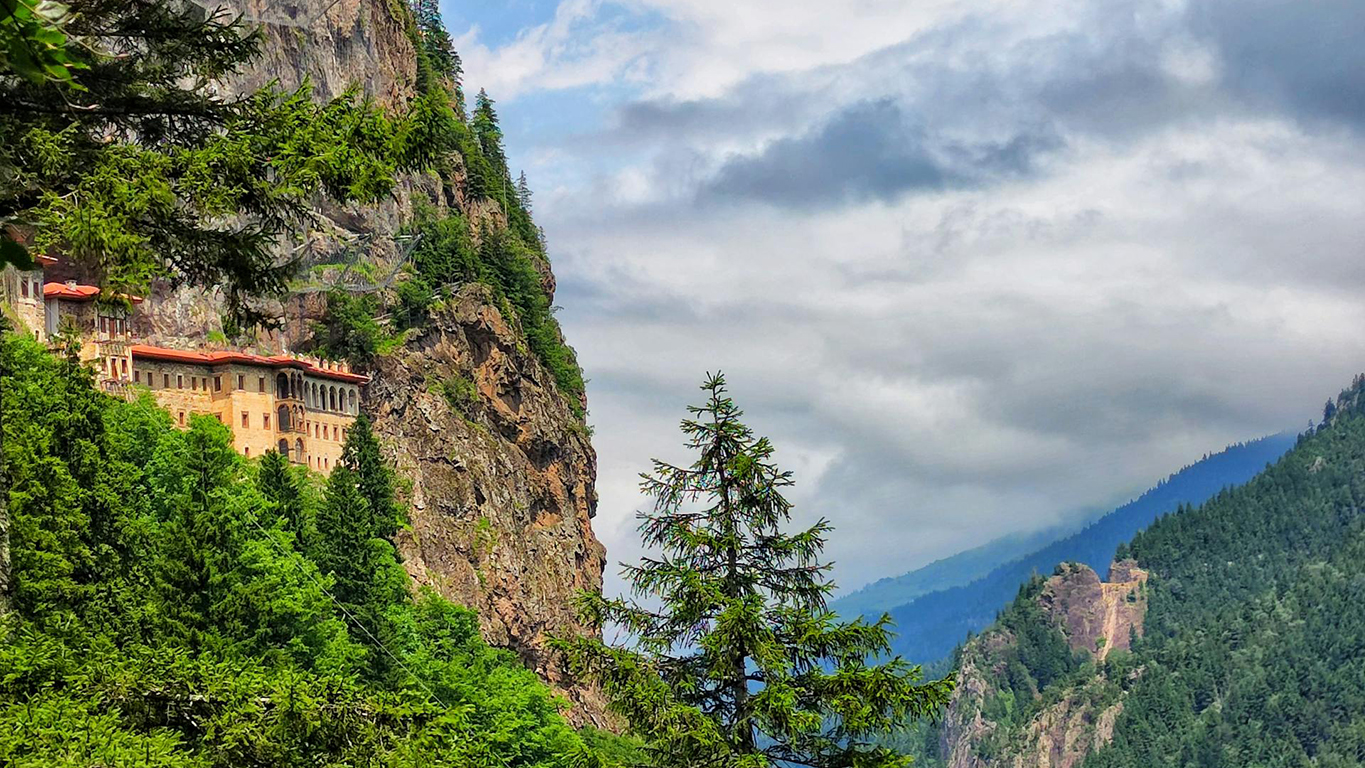
Simonopetra — a striking seven-storey monastery perched on the edge of a sheer cliff some 300 metres above the sea. It ranks among the most visually awe-inspiring structures on the entire Holy Mountain.
Hilandar — the Serbian monastery, founded in 1198 by the Serbian king Stefan and his son Saint Sava. For the Serbian people, it serves as a spiritual national sanctuary.
Beyond the great monasteries, the peninsula is dotted with numerous sketes (daughter houses), kellia (individual cells), kathismata and solitary hermits who inhabit near-inaccessible cliff ledges in the Karoulia region — some hermit dwellings literally hang from the rockface, suspended by ropes above the sea.
The Avaton: Why Are Women Forbidden?
One of Mount Athos’s most famous and controversial features is the avaton — a ban in force for over a thousand years that prohibits women from entering the peninsula. This rule is enshrined in both the Greek constitution and Athos’s own charter.
Theologically, the prohibition derives from the legend in which the Virgin Mary chose Athos as her sacred domain and does not wish to share it with other women. From the monastic perspective, the presence of women has historically been regarded as a threat to the monks’ vows of asceticism and celibacy.
The ban has been challenged on numerous occasions. The European Parliament has recommended that Greece relax the restriction in line with EU equality standards, but without success. Greece responds that Athos’s special status is explicitly protected in EU treaties, and that the avaton is a religious and cultural particularity — not discrimination.
Violations have occurred: in 1953, a group of American women briefly came ashore on the Athonite coast; in 2008, Greek women scaled the border fence during a protest. Yet the rule remains firmly in force.
How to Visit: The Diamonitirion — Athos’s Entry Permit
Entering Mount Athos requires a special permit known as the diamonitirion — in essence, a visa for the Holy Mountain. Without this document, you will not be permitted to board the ferry or pass through the gate of any monastery.
Who May Apply?
- Men aged 18 and over only
- Boys under 18 may enter only when accompanied by their father and with special permission
- Entry for women is categorically prohibited under all circumstances
Daily Quotas
Up to 120 permits are issued each day: 100 for Orthodox Christian pilgrims and up to 10–20 for non-Orthodox visitors. Non-Christians are not permitted entry. Given the limited number of available slots, bookings must often be made several months in advance — queues are particularly long during spring and autumn.
The Application Process
- Reserve your place — contact the Pilgrims’ Bureau in Thessaloniki (Address: 109 Egnatia Street, Thessaloniki; Tel: +30 2310 252578; Email: athosreservation@gmail.com)
- Submit your documents — passport, personal details, intended entry date and religious affiliation
- Travel to Ouranoupolis — the gateway town at the entrance to the peninsula, from which ferries depart for Athos
- Collect your diamonitirion in person — from the Pilgrims’ Office in Ouranoupolis; fees: €25 for Orthodox Christians, €30 for non-Orthodox, €10 for students
- Board the ferry — from Ouranoupolis to Daphni (the main port of entry), a journey of approximately two hours
What to Expect During Your Visit
A standard visit lasts up to three to four nights. Extensions may be granted with the approval of the monastic authorities. Monasteries provide guests with accommodation in the archontariki (guesthouse), food and drink — free of charge. In return, visitors are expected to respect the rhythm of monastic life: attendance at morning and evening services (voluntary but encouraged), modest dress (long trousers and long-sleeved shirts), a ban on alcohol and smoking within monastery grounds, and no photography of monks without their explicit consent.
Food on Athos is simple and ascetic. Meat is never served. Dairy products are rare. Fish, vegetables, olive oil, bread and wine form the staple of the monks’ daily diet.
Spiritual and Cultural Significance
The monasteries of Mount Athos hold a treasure of spiritual and cultural heritage often compared to the collections of the Vatican. The manuscript repositories contain over 11,000 manuscripts and 150,000 rare books, alongside thousands of Byzantine icons, liturgical vestments, silver- and gold-adorned sacred objects, imperial chrysobulls and ancient documents of immeasurable historical value.
The Athonite painting tradition — in particular the so-called Macedonian School of the 14th century — has profoundly influenced Orthodox iconography across the entire Christian East. Its stylistic influence can be traced throughout Russia, Serbia, Bulgaria and Romania.
Beyond the visual arts, Athos has always been the cradle of major spiritual movements. Hesychasm — the contemplative tradition of deep prayer centred on the “Jesus Prayer” and the “Prayer of the Heart” — reached its classical expression on Athos in the 14th century, largely through the theological work of Gregory Palamas. The influence of Hesychasm on Orthodox spirituality endures to this day.
Nature and Environment
Mount Athos is equally remarkable for its natural biodiversity. Since the peninsula has remained largely inaccessible for centuries and human activity has been strictly limited, its Mediterranean forest ecosystems have survived in an almost pristine state. Oak, pine, chestnut and boxwood cover the steep mountain slopes, while eagles nest along the coastline and migratory birds find refuge on the peninsula each season.
UNESCO has recognised Mount Athos as exceptional on both cultural and natural grounds — the site meets no fewer than seven UNESCO evaluation criteria simultaneously, a distinction that is extraordinarily rare on the World Heritage List.
Fascinating Facts About Mount Athos
- Athos observes the Julian calendar — the date in the monasteries runs approximately 13 days behind the Gregorian calendar
- Time is measured according to the Byzantine system — the day officially begins at sunset
- The monk Mihailo Tolotos (c. 1856–1938) lived his entire life on Athos and never once saw a woman — his mother had died in childbirth and he was raised by the monks
- During the Second World War, the monks of Athos personally appealed to Adolf Hitler to spare the monasteries from the conflict — Hitler agreed, and Athos emerged from the war unscathed
- The peninsula’s forest is so dense and undisturbed that it serves as a reference model for ecological research — species of trees grow here that are found nowhere else in Greece
- In classical antiquity, Pliny the Elder wrote that the inhabitants of Athos lived to the age of 400 by consuming viper skin
Conclusion: Why Visit Mount Athos?
Mount Athos is far more than a historical sight — it is a living time machine where Byzantine monastic culture continues to thrive, unchanged, to this day. Whoever steps onto this land experiences something profoundly unlike anything else: a slowing of time, a silence that settles into the bones, participation in the daily prayer life of a monastic community, and the chance to encounter world heritage treasures face to face.
If you are a man in search of a truly singular travel experience — a rare fusion of history, spirituality, nature and culture — Mount Athos is one of those rare places in the world that leaves a lasting mark. The Holy Mountain does not fade from memory.

Trough all this I want to declare this is all from God and to God. All Glory to Him!