Views: 19
John 8:1-11
EELK Institute of Theology
1st year Christian Cultural History Master’s Program
Allan Kroll
Instructor prof. dr. Randar Tasmuth
TALLINN 03.01.2019
Table of Contents
- Introduction
-
- THE AUTHORSHIP, TIME OF WRITING, AND PURPOSE OF THE GOSPEL OF JOHN
- 1.1 The authorship of the Gospel of John
- 1.2 The time of writing of the Gospel of John
- 1.3 The purpose of writing the Gospel of John
-
- JOHN 8:1-11
- 2.1. The authenticity and placement of John 8:1-11 in the Gospel of John
- 2.2. Theological analysis of John 8:1-11
- Conclusion
- Bibliography
Introduction
The word “gospel” means in translation good news or joyful news. Originally, gospel meant a reward for good news and later the message itself. In a secular sense, it denoted the announcement of a new ruler’s birth or accession to the throne, while in Christian terminology it means the message of Jesus as the Savior of all mankind through his death and resurrection, which redeems the sinful person. Syrian Tatian’s attempt to compile a harmony of the gospels based on the four gospels proceeds from the assumption that in reality there is only one gospel. However, this is testified to by different authors who emphasize different aspects of Jesus’ life and teachings.
The Gospel of John is theologically the deepest of the four New Testament gospels and has been considered the most important gospel (Origen). The Gospel of John describes in more detail Jesus’ speeches, prayers, and disputes with his opponents, and it also contains several stories that no other gospel tells. In no other gospel does the teaching of Jesus’ divinity come out so clearly. The fourth or last is the Gospel of John not because it was considered less important than the others, but because it was written last.
The author of this work focuses on verses 1-11 of chapter 8 of the Gospel of John. This is a text that has caused much controversy, and discussions about its authenticity and location in the gospels have not ended to this day.
The work is divided into two parts, the first of which deals with the question of the authorship of the Gospel of John, the time of writing, and its purpose. The second part focuses specifically on the aforementioned text passage and analyzes its placement in the gospels and the theological meaning of the text.
The author of this work uses as main sources Jukka Thurén’s and R.V.G. Tasker’s commentaries on the Gospel of John, Donald Guthrie’s Introduction to the New Testament, Merrill F. Unger’s Bible Dictionary, and Eusebius of Caesarea’s “Church History”.
1. THE AUTHORSHIP, TIME OF WRITING, AND PURPOSE OF THE GOSPEL OF JOHN
1.1. The authorship of the Gospel of John
The fourth gospel has been called the “Gospel of John” since the 2nd century. According to church tradition, its author is Jesus’ apostle, John the son of Zebedee. Textual and extra-textual sources clearly indicate that the author of the gospel was closely connected with John. Whether the apostle John personally wrote this gospel or not, opinions differ on this. It has been suggested that the gospel may have been written down by John’s disciple or friend, which does not mean, however, that the content of the message was therefore distorted. This is the testimony of Jesus’ apostle about Jesus’ life and teachings. It has also been suggested that the author finished his text at the end of chapter 20 and chapter 21 was added later. There is no evidence, however, that the gospel was in use without the last chapter, but already in early Christian times the last chapter was perceived as an addition. Tertullian, for example, writes that Jn. 20:31 belongs to the final part of the gospel.
Early church sources testify that Jesus’ beloved disciple “initiated the writing down of the gospel”. Indirect evidence for identifying this beloved disciple with John the son of Zebedee is indisputable. Irenaeus, bishop of Lyon, writes about the Lord’s disciple John, who published the gospel while in Ephesus. He had in turn heard this from Polycarp, who had heard it from John himself and from several other witnesses. Irenaeus does not claim that John wrote the gospel himself, but confirms that the gospel was published with his authority. As with the traditional authorship of many other New Testament books, the authorship of the Gospel of John has also been called into question since the 19th century. Since the gospel was dated at that time only to the second half of the 2nd century, naturally Jesus’ apostle John could not be the author of this work. Such a late dating is generally no longer supported today.
It has also been suggested that the author could have been “John the Presbyter” who lived in Ephesus and died around the year 146. However, Papias, bishop of Hierapolis, carefully distinguishes John the Presbyter from John the Apostle. According to Eusebius, during his lifetime there were graves of two church leaders named John in Ephesus. Eusebius attributes the book of Revelation to John the Presbyter, but the gospel to John the Apostle. Eusebius calls the Gospel of John a writing that indisputably belongs to the writings of the apostle John and testifies that it is read everywhere in churches.
John is said to have become acquainted with the three gospels written by that time and acknowledged them as correct, but still considered it necessary to write about things that had been left out of those records.
The fact that a simple Galilean fisherman could write such a profound work with good Greek grammar is considered a weighty argument against Johannine authorship. Nevertheless, one cannot fail to notice the fact that by the time of writing the gospel, John was already an old and experienced speaker who had decades of practice in expressing theological questions in speech and possibly also in writing. The fact that no other writings of the apostle John have survived to our time does not mean that he could not have corresponded with individuals or congregations under his care. Over several decades, even a simple fisherman can grow into a skilled orator and scribe. History is not lacking in such examples.
One must also consider the possibility that the apostle used someone as a secretary whose language and expression skills were at a higher level. This would also explain the linguistic quality of the text. An elderly apostle and church leader did not necessarily have to write the gospel with his own hand to be the author of the text. Paul also used the help of a secretary named Tertius to write the Letter to the Romans. This in no way diminishes the reliability of the Letter to the Romans, because the author of the thought and content of the text was still Paul, not Tertius. The same applies to the Gospel of John.
In the “Muratorian fragment” from Rome, dating from about 170, the apostle John is named as the author of the fourth gospel. However, language use indicates that others also contributed to its creation. From church fathers’ quotations, one can find references to the fact that the gospel was written by Papias at John’s dictation or suggestion.
1.2. The time of writing of the Gospel of John
Clement of Alexandria (died 212) claims, based on the earlier authority of church elders, that John wrote his gospel last. It was published in John’s final days, thus at the end of the 1st century, during the reign of Emperor Trajan. The traditional position that the fourth gospel was written at the end of the 1st century is also supported by several recently discovered manuscripts.
By the time of the gospel’s writing, Christianity had already clearly broken away from the synagogue; it was necessary to explain to believers Aramaic and Palestinian concepts and place names that were unknown to the readership. Everything indicates that the Gospel of John was written after the Gospel of Matthew. By the year 125 AD, the gospel had reached Egypt. This means that the text was probably written at the turn of the century.
1.3. The purpose of writing the Gospel of John
At the time of writing the fourth gospel, the heresy of Docetism was widespread, whose supporters claimed that Jesus only appeared to be human without actually being so. According to their teaching, matter was filth and sinful. However, the Gospel of John emphasizes as a counterbalance especially that in Jesus the Word of God (Logos) became flesh and lived among us. It is precisely the Gospel of John that describes the story of how Jesus lets Thomas touch his wounds with his hand. This was not apparent, but objective reality.
Jerome mentions that the apostle John wrote the fourth gospel at the request of the bishops of Asia. The purpose of the writing is said to have been to refute the teachings of Cerinthus, the Ebionites, and other heretics who claimed that Jesus did not exist before Mary. The Gospel of John emphasizes most of all Jesus’ divinity, but also his true humanity. As a counterbalance to the heretics’ teachings, it is precisely in the Gospel of John that there is the most talk about Jesus’ pre-existence.
Also, the motivation for writing is said to have been that, having read the works of Matthew, Mark, and Luke, he acknowledged them as correct, but since they had written only about one year that followed the death of John the Baptist, John considered it necessary to also write about what Jesus did and taught earlier. This also explains the differences between the gospels.
2. JOHN 8:1-11
2.1. The authenticity and placement of John 8:1-11 in the Gospel of John
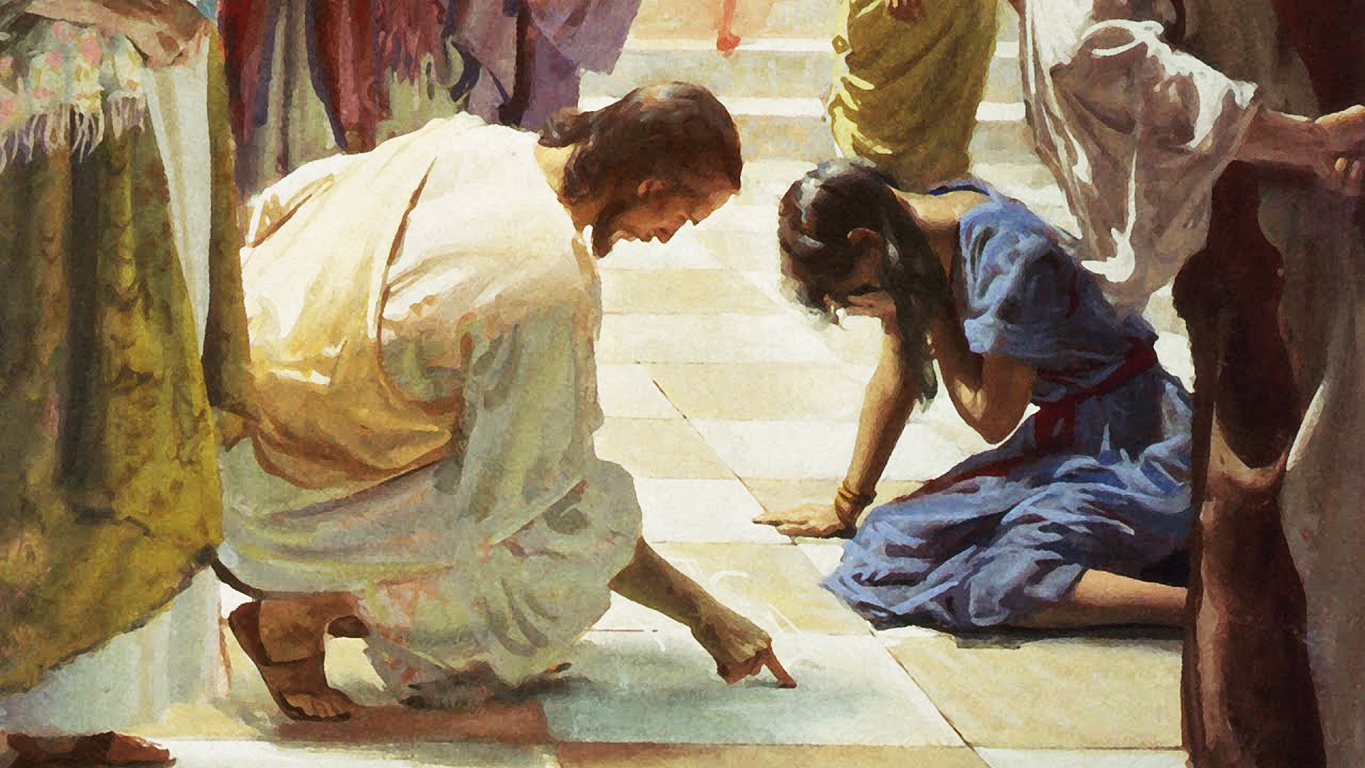
John 8:1 But Jesus went to the Mount of Olives. 2 But at dawn he came again to the temple, and all the people came to him, and he sat down and taught them. 3 But the scribes and Pharisees brought a woman caught in adultery, made her stand in the middle 4 and said to Jesus: “Teacher, this woman was caught in adultery. 5 Moses commanded in the Law to stone such women. What do you say?” 6 But they said this to test him, so that they might accuse him. Jesus bent down and wrote with his finger on the ground. 7 But when they kept pressing him with questions, Jesus straightened up and said to them: “Let him who is without sin among you be the first to throw a stone at her!” 8 And he bent down again and wrote on the ground. 9 And hearing this, they left one by one, starting with the elders, leaving only him and the woman standing in the middle. 10 Jesus straightened up and said to her: “Woman, where are they? Has no one condemned you to death?” 11 She said: “No one, Lord!” But Jesus said: “Neither do I condemn you to death. Go, and from now on sin no more!”
Much has been debated about this text’s belonging to the Gospel of John. Jn 7:53-8:11 does not seem to fit the context in which it is placed. The mentioned passage is not in early manuscripts, except for a few isolated exceptions, and some manuscripts place this passage in the Gospel of Luke instead (Lk. 21:38). This passage is also not in Syriac and Coptic and several old Latin translations. The mentioned passage cannot be found in Greek commentaries until Euthymius Zigabenus (AD 1118), who himself also admits that it is not in the most accurate manuscripts. In those manuscripts where the passage exists, it is located in some before Jn. 8:12, in some manuscripts at the very end of the Gospel of John, and in others after Luke 21:38. Origen and John Chrysostom do not mention the story of the adulterous woman, from which one can assume that it was not in the manuscripts available to them. Also, one can see in the passage a certain style and vocabulary that are not characteristic of John.
At the same time, since this passage exists in many later manuscripts, it was accepted as such into the Textus Receptus. Jerome claims that the mentioned story was present in many Greek and Latin manuscripts, which indicates that these manuscripts existed but were lost. Ambrose and Augustine use this text in their writings, although Augustine admits that some have doubts about it.
It is assumed that this pericope was added somewhere to a manuscript of John only sometime in the 3rd century. The Apostolic Constitutions (from Syria 350-380 AD) uses a similar story to illustrate how bishops should treat sinners. From this one can conclude that the story of the adulterous woman was known in the church at that time and was considered authentic.
There is general agreement that this is an event that took place in Jesus’ life. The placement of the passage in different places (after Lk. 21:38, in one manuscript after Jn. 7:36, in some after Jn. 21:24) points to the fact that transcribers tried to preserve it as part of the four gospels but were uncertain about where to place the passage. The large number of textual variants does not make the situation any simpler. For example, the following phrases are missing from most older manuscripts: “as if he did not hear them” (v 6; AV); “when…their conscience accused them” (v 9; AV); “to the last one” (v 9; AV); “and saw no one but the woman” (v 10; AV); “those your accusers” (v 10; AV)”. In some earlier manuscripts, “all their sins” has been added to the end of verse 8. From this one can conclude that the narrative was spread orally and several different versions were in use.
2.2. Theological analysis of John 8:1-11
Undoubtedly the teachers of the law who brought the woman caught in the act to Jesus were angry about this sin, but verse 6 indicates that they were actually motivated not by religious but by political motives. As in the story of paying the temple tax (Mk 12:13-17), they hoped to trap Jesus with this and find an opportunity to accuse him.
The teachers of the law probably assumed that Jesus as a “friend of sinners” would not demand as harsh a punishment as Moses, and in that case they would have the opportunity to accuse Jesus of despising the Law of Moses. At the same time, even in Jesus’ time it was not customary for teachers of the law to demand the death penalty for adultery.
Adultery was considered a very serious sin. This is shown by the fact that adultery is also mentioned in the Ten Commandments. Unger’s Bible Dictionary defines the Jewish understanding of adultery as “Willful violation of the marriage contract by either party, through sexual intercourse with a third party.” In ancient cultures, however, exceptions were made in this regard, usually in favor of the male party. A man could have several wives, but a woman was not allowed to have several husbands. In some cultures, a man could have sexual intercourse with another woman without it being considered adultery. In that case, adultery was considered sexual intercourse with another man’s wife or fiancée. Roman law also considered it adultery when a man had intercourse with another man’s wife. A man’s infidelity was not yet considered adultery. The Greeks also had similar views on adultery.
Female adultery has also been considered a property crime, since Ex 20:17 places the wife in the same list as house, servant, maid, ox, and donkey, emphasizing in the following clause that one must not covet “anything that belongs to your neighbor.” Deut 5:21, however, places the wife in a separate category.
The woman was caught in the very act, and according to the law she could have been executed if it had been decided to punish her with the full severity of the law. What is interesting, however, is that we cannot find a single place in the Old Testament where a person caught in adultery was executed for it. Usually divorce followed, after which the woman lost her dowry and right to support. According to the law, however, the possibility of execution existed, and for other offenses the people of Israel had also executed sinners by stoning (see Num 15:36; Josh 7:25).
The Law of Moses does not specify how the adulterer should be executed. From various scripture passages one can find references to stoning (Ezek 16:38, 40). An exception was adultery with a slave woman, where the guilty parties are simply commanded to be punished, presumably by flogging (see Lev 19:20-22), and the man had to sacrifice a guilt offering for the sin.
Dake lists a total of 42 crimes for which the death penalty had to be imposed on the guilty party according to the Law of Moses. Among these are mainly crimes against persons (murder, kidnapping, striking one’s father or mother), sexual crimes (bestiality, homosexuality, incest, adultery, prostitution), and the largest portion consists of violations against religious rules (breaking the Sabbath, refusing circumcision, idolatry, sorcery, etc.).
Faced with a difficult dilemma, Jesus does not allow himself to be pressured or provoked into passing judgment. He crouches down and writes something on the ground, apparently listening at the same time to what the Father reveals to him. Jesus said that he judges according to what he hears from the one who sent him (Jn 5:30). The judgment had to come from the one who had sent him, especially since a human life was at stake.
Jesus saw through the true motives of the Pharisees and scribes, and this made the decision particularly difficult and risky. “If Jesus had gone against the Law of Moses (Lev 20:10; Deut 22:22-24), he would have been condemned as a false prophet. If he had condemned the woman to death, he would have been accused before the Romans of usurping power.” The Romans did not allow the Jews to arbitrarily execute anyone (see Jn 18:31), although the Jews repeatedly violated this rule (the execution of Stephen, the stoning of Paul nearly to death).
What is strange in the story is also the fact that only the woman was brought to Jesus, although Lev 20:10 speaks of both parties. Where the other party to the adultery disappeared is not explained to the readers. This also shows that for the scribes and Pharisees the main thing was not a sincere desire to punish sin before God and according to his law, but to trap Jesus. Jesus did not claim that God’s law was unjust or that the woman was innocent. The woman was caught in the act and it was unthinkable to deny or diminish the guilt. Jesus placed on the woman’s accusers the responsibility to throw the first stone. According to the Law of Moses, the first stone had to be thrown by the witnesses who had caught the sinner in the act (Deut 13:10; 17:7). Thus evil had to be removed from God’s people. Jesus’ way of removing evil was quite different. The thrower of the first stone had to be pure from sin. Jesus himself could have thrown the first stone, since he alone was without sin, but he did not do so. There were no restrictions on the second or third stone. Jesus gave the woman mercy and the opportunity to repent, nevertheless calling things by their proper names. The law came through Moses, but grace and truth came through Jesus (Jn 1:17). In this story Jesus demonstrates this vividly. He did not abolish the law, but gave the sinner grace. Dying on the cross, he gave his life for both the sinful woman and her accusers. Sin did not go unpunished.
Jesus diagnosed the problem of sin and also prescribed treatment: “Go and sin no more.” These words recall what he said to the paralyzed man after his healing: “See, you have been made well. Sin no more, that nothing worse may happen to you!” (Jn 5:14).
Attitudes toward sexual issues have become a litmus test of a person’s “culture and tolerance” in today’s Western civilization. The biblical and traditional approach is considered narrow-minded. Sin is calling something sinful. In the story of the adulterous woman, Jesus shows vividly how a Christian should behave in such a situation today.
Conclusion
The Gospel of John is the latest of the New Testament gospels, but at the same time theologically the most mature and profound. According to church tradition, its author is considered to be the apostle John, who wrote his gospel at the end of the 1st century. He probably used the help of one of his disciples for this, who as a secretary wrote down the dictated text. Possibly also editing the text linguistically in the process. John was motivated to write by concern about heresies seeping into Christianity.
Jn 8:1-11 is a scripture passage that has been much debated in church history. Doubts have been raised by this text’s apparent incompatibility with the context in which it is placed and the fact that in many manuscripts the mentioned passage is located in other places or even in another gospel. Despite all doubts, this text has nevertheless been left in the New Testament, in the Gospel of John, and it is believed that this is truly a story that took place in Jesus’ life.
In the story of the adulterous woman, Jesus vividly demonstrates how grace and truth work together for the good of the sinful person. He calls things by their proper names but gives the sinner the opportunity to repent and change their life. This story is an example for today’s Christians who are pressured to take positions on various issues concerning sexual sins.
Bibliography
- Finis Jennings Dake, “The Dake Annotated Reference Bible”, KJV, USA 1996.
- Eusebius, “The Church History: a new translation with commentary”, Paul L. Maier, USA, 1999.
- Donald Guthrie, “New Testament Introduction”, Intervarsity Press, Illinois, USA, 1990.
- Jerome, “De viris illustribus” (On Illustrious Men), Johannes Esto Ühing, 2007.
- Eduard Lohse “The Formation of the New Testament”, Tartu 1994.
- Fritz Rienecker, Gerhard Maier “Great Bible Lexicon”, Tallinn, Logos 2011.
- R.V.G. Tasker “The Gospel of John”, Tallinn, Logos, 2002.
- Jukka Thurén, “The Gospel of John”, Tallinn, EELK Institute of Theology 2001.
- Merrill F. Unger, “Unger’s Bible Dictionary”, USA, Chicago 1957
ABOUT THE AUTHOR
Allan Kroll
 Allan Kroll is a Christian teacher, preacher, and spiritual author whose writings are marked by deep biblical reflection, spiritual sobriety, and a clear call to personal repentance and dedication. At the heart of his message is a living and honest relationship with God rather than formal religiosity.
Kroll’s teaching is firmly rooted in Scripture and in the historic Christian faith. He addresses with courage themes such as the posture of the heart, spiritual lukewarmness, self‑deception, and the continual need to seek God. His style is direct, pastoral, and at the same time deeply refreshing to the soul.
Allan Kroll’s writings invite the reader not to settle for a superficial faith but to seek God with all their heart throughout their entire life.

Martinus Vaicarius’s mission is to:
- Provide spiritual support and guidance to people seeking peace and hope
- Create prayer texts that bring God’s peace to hearts suffering under fear and anxiety
- Promote deep understanding of the power of theGod of Sabaoth and the protection of the heavenly hosts
- Help people enter the spiritual sphere where God’s peace reigns over all
AICortex Invest OÜ