What Is the Orthodox Church? The Ancient Faith That Never Changed – A Deep Dive into Eastern Orthodox Christianity
SEO keywords: what is Orthodox Christianity, Orthodox Church explained, Eastern Orthodox beliefs
If you have ever asked yourself what is Orthodox Christianity and why this faith has survived almost unchanged for over two thousand years, you have come to the right place. The Orthodox Church is one of the oldest and most profound carriers of the Christian tradition — a tradition that stretches directly back to the Apostles and the era of Jesus Christ. This is a church that does not speak of innovations, but of eternal truth.
What Is the Orthodox Church? A Brief Introduction
The Eastern Orthodox Church is one of the three major branches of Christian tradition, alongside the Roman Catholic Church and Protestantism. Eastern Orthodoxy is a large body of Christians who follow the faith and practices defined by the first seven ecumenical councils. The word “orthodox” derives from the Greek words orthos (right, correct) and doxa (belief, glory) — together meaning “right belief” or “right worship.”
“Orthodox” means “rightly believing” and was adopted to designate the true faith that faithfully follows the beliefs and practices defined by the first seven ecumenical councils, reaching back across the first ten centuries of Christianity.
In terms of membership, the Eastern Orthodox Church is the world’s second largest Christian communion after the Roman Catholic Church, with an estimated 300 million faithful. Orthodox Christians live primarily in Greece, Russia, Ukraine, Serbia, Romania, Bulgaria, Georgia and other Eastern European countries, though congregations have spread to the West and across the globe.
The History of the Orthodox Church: From the Apostles to the Present Day
The Beginning: From Pentecost to the Great Councils
According to Orthodox teaching, the Eastern Orthodox Church is the authentic continuation of the original church founded by the Apostles, which began on the day of Pentecost with the descent of the Holy Spirit in the year 33 AD. This is a powerful and significant claim — not merely a historical footnote, but the very foundation of Orthodox identity.
During the early centuries, the Church Fathers and theologians developed the dogmatic foundation of the Christian faith. The first seven ecumenical councils took place between 325 and 787 AD with the purpose of establishing accepted doctrines. In historic Christian usage, the word “orthodox” refers to the body of doctrines accepted by the early Christians.
In the course of these councils, the most central dogmas of Christianity were formulated: the doctrine of the Holy Trinity, the unity of Christ’s divine and human natures, and the title of the Virgin Mary as Theotokos — the Mother of God. The ecumenical councils did not create new doctrines; they proclaimed, at a particular place and a particular time, what the Church had always believed and taught.
The Great Schism of 1054: East and West Part Ways
One of the most significant religious events in history was the Great Schism of 1054, when Eastern and Western Christianity officially separated. Although Eastern and Western Christians originally shared the same faith, the two sides began to diverge after the seventh ecumenical council in 787 AD, and the final rupture came through the dispute with Rome in the Great Schism of 1054. The schism was caused by papal claims to supreme authority and the question of the Holy Spirit’s procession.
One of the most concrete points of contention was the so-called filioque controversy — the Roman Catholic Church unilaterally added the clause “and from the Son” (filioque) to the Nicene Creed, altering the doctrine of the Holy Spirit’s procession. The Eastern Church regarded this as an inadmissible change to the original tradition of the faith.
Missionaries from Constantinople converted the Slavs and other Eastern European peoples to Christianity and translated the scriptures and liturgical texts into their vernacular languages. Thus all these peoples adopted the liturgy, traditions and practices of the Church of Constantinople, which still provide the basic patterns of contemporary Orthodoxy.
Eastern Orthodox Faith and Teachings — What Makes It Distinctive?
1. The Holy Trinity and the Nicene Creed
The core of Eastern Orthodox beliefs rests upon the dogma of the Holy Trinity. The Orthodox Church holds that God is one in essence and triune in three Persons or Hypostases. The Church proclaims in its liturgical confession: “I confess the Father and the Son and the Holy Spirit, consubstantial and undivided Trinity.”
The Nicene Creed, formulated at the councils of Nicaea (325 AD) and Constantinople (381 AD), is recognised as the authoritative expression of the fundamental beliefs of the Orthodox Church. The Creed is often referred to as the “Symbol of Faith” — indicating that it is not an analytical statement but points to a reality greater than itself to which it bears witness.
2. The Mystery of the Incarnation
The Orthodox Church emphasises Christ’s incarnation as a fundamental core teaching. According to Orthodox faith, Jesus is far more than a pious man or a profound teacher of morality. He is fully divine and fully human — one person with two natures that cannot be separated or confused.
This is the theological foundation of Orthodox iconography: because God Himself became visible by taking on flesh, it is also possible to depict Him.
3. Theosis — Deification as the Doctrine of Salvation
One of the most distinctive and profound teachings of the Orthodox Church is theosis, or deification. This concept clearly distinguishes the Eastern Orthodox tradition from Western Christianity.
The ultimate goal of the Eastern Orthodox Christian is to achieve theosis — conformity to God and an intimate union with Him.
According to the doctrine of theosis, the goal of Christian life is to participate in the divine nature and to achieve union between human and divine energies. In Eastern Orthodoxy, the Church is regarded as the instrument that assists and facilitates communion between the individual and God through personal experience.
To use the classical expression of Saint Athanasius of Alexandria: “The Son of God became man, that we might become god.” This does not mean becoming God in essence, but participating in God’s love, holiness and eternal life.
4. Holy Scripture and Holy Tradition — Two Equal Sources
Unlike Protestantism, which emphasises the principle of sola scriptura (Scripture alone), the Orthodox Church firmly upholds the necessity of both Holy Scripture and Holy Tradition.
The Holy Scriptures (as interpreted and defined by the teachings of the first seven ecumenical councils) together with Holy Tradition are of equal value and importance.
In Eastern Orthodox faith, Tradition is a living part of belief. It complements the Bible. Liturgical practices, feast days and the teachings of the Church Fathers help to understand the context and application of Scripture.
Holy Tradition is not simply a collection of human customs — it is a revelation alive and active in the Church through the Holy Spirit, carried forward by the Church Fathers, ecumenical councils, liturgy and the sacraments.
The Seven Holy Mysteries (Sacraments)
When the Orthodox Church is explained to an outside observer, what stands out immediately is the central role of the sacraments in the life of the community. The Eastern Orthodox Church recognises seven sacraments: baptism, chrismation (confirmation), the Eucharist, confession, marriage, holy orders and the anointing of the sick. These sacraments are the visible signs of God’s invisible grace, sustaining the believer in their relationship with God.
In Orthodoxy, the sacraments are preferably called Holy Mysteries, emphasising their mysterious character.
Baptism is regarded as the sacrament of entry into the Church. It involves a three-fold immersion in the name of the Holy Trinity — signifying death to the old life and rebirth to new life in Christ.
The Eucharist, or Holy Communion, is considered the very centre of the Church’s life. The Church teaches that through the consecration invoked by the priest, the sacrificial bread and wine become the Body and Blood of Christ. The Eucharist is often called the “Sacrament of Sacraments.”
Immediately following baptism comes Chrismation, often described as the believer’s “personal Pentecost,” as it is through this sacrament that the gift of the Holy Spirit is given to the newly baptised through the Church.
Iconography — Windows to Heaven
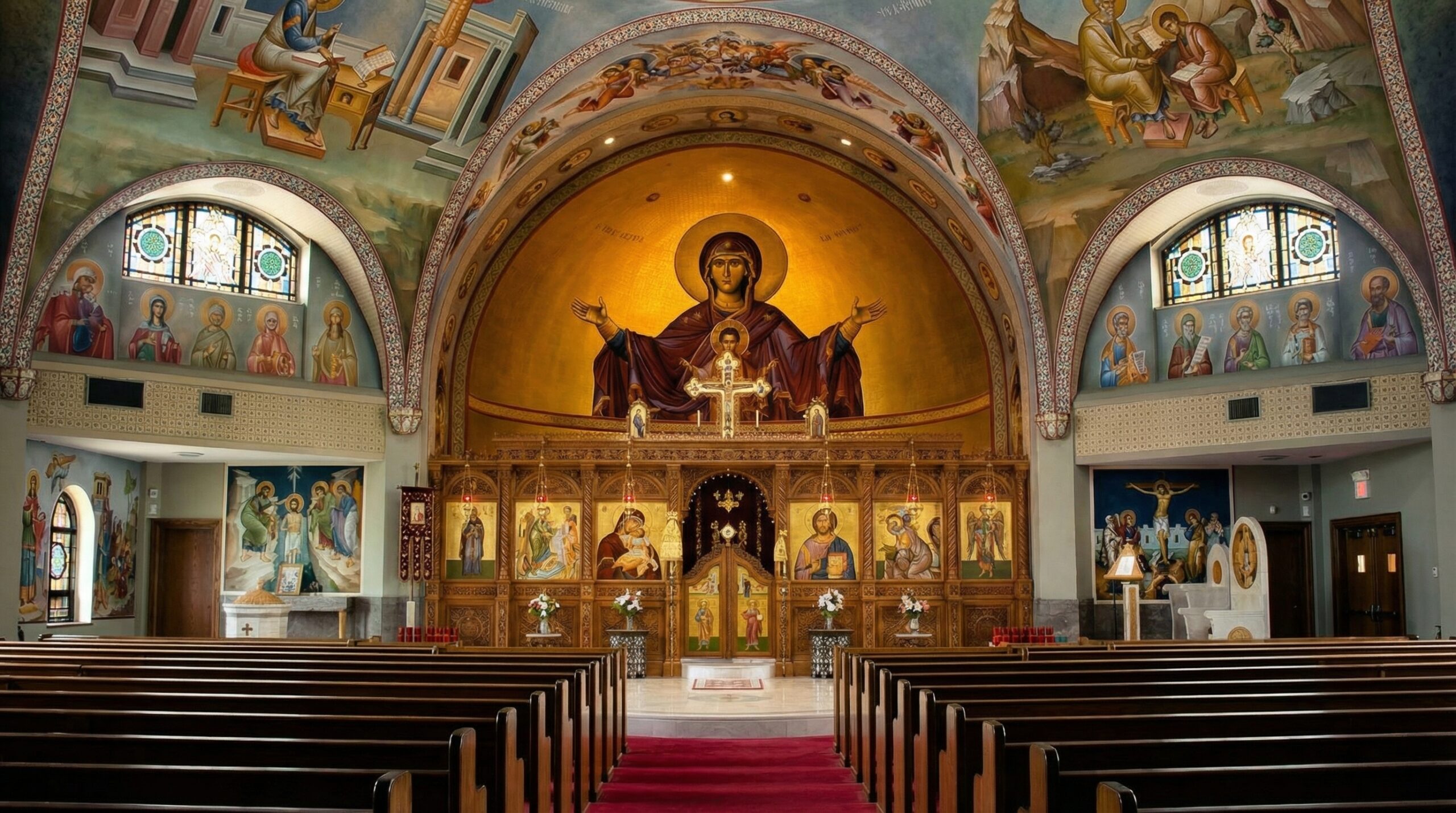
One of the most striking features of the Orthodox Church is its icons — sacred images that fill the church space and the homes of the faithful.
The image of Christ, the image of the incarnate God, became for the Eastern Christian a pictorial confession of faith: God was truly visible in the person of Jesus of Nazareth, and the saints — whose images surround that of Christ — are witnesses to the fact that the transfigured, “deified” human being is accessible to those who believe in Christ.
Iconography is an inseparable part of the Eastern Orthodox tradition. Icons, regarded as windows to heaven, are venerated and used as aids in prayer and worship. They depict Christ, the Virgin Mary, saints and biblical events.
Icons are not to be understood as idols but as theological testimonies to God’s becoming human. They are not venerated for their own sake, but through them one venerates the one the icon depicts — just as we keep a photograph of a loved one not for the frame’s sake, but because of whom it portrays.
Church Structure: First Among Equals
The Orthodox Church consists of 15 autocephalous (self-governing) churches that are in theological and liturgical communion with one another. The Ecumenical Patriarch of Constantinople is regarded as “first among equals.”
Unlike the Roman Catholic Church, where the pope holds universal supremacy, the Orthodox Church does not recognise any single human authority over the entire Church. The highest authority is the ecumenical council — an assembly of bishops guided by the Holy Spirit.
Eastern Christians were willing to accept the pope only as “first among patriarchs.” This difference explains the various incidents that grew into a serious estrangement.
Orthodox Worship: An Ancient Liturgy for Today
Worship in the Orthodox Church is arguably one of the most beautiful and profound liturgical experiences in the world. The structure of the service is based on the liturgy of Saint John Chrysostom (4th century), which has been in use almost unchanged to this day.
Eastern Orthodoxy emphasises a way of life and belief manifested especially through worship. By preserving the traditional method of worshipping God, handed down from the very beginnings of Christianity, Eastern Christians maintain that they acknowledge the true doctrine of God in the right (orthodox) way.
Characteristics of Orthodox worship include:
- Byzantine chant — ancient melodies without instrumental accompaniment
- Incense — symbolising prayers rising before God
- The iconostasis — a screen of icons separating the altar from the nave
- Standing in prayer — in the Eastern tradition, worshippers generally stand during prayer
Orthodox Church vs. Roman Catholic Church vs. Protestantism
For those who wish to understand Eastern Orthodox beliefs in a broader context, a brief comparison is helpful:
| Aspect | Orthodox Church | Roman Catholic Church | Protestantism |
|---|---|---|---|
| Authority | Ecumenical Council | Pope + Council | Scripture alone (sola scriptura) |
| Salvation | Theosis (deification) | Justification and sanctification | Justification by faith |
| Tradition | Equal to Scripture | Important, papal authority | Subject to Scripture |
| Filioque | Rejected | Accepted | Varies |
| Icons | Venerated and used | Venerated | Largely rejected |
| Fasting | Strict, long fasting periods | Moderate | Rare |
A clear distinction between Eastern Orthodoxy and Protestantism lies in the concept of sola scriptura. This doctrine, held by Protestant denominations, asserts that the Word of God can be clearly understood and interpreted by the individual believer and is by itself a sufficient final authority in Christian doctrine. Orthodoxy, however, maintains that Scripture together with Holy Tradition is of equal value and importance.
The Orthodox Church Today: Global Presence and Contemporary Challenges
In 2024, Eastern Orthodoxy was the dominant religion in Russia (62%), where roughly half of the world’s Orthodox Christians live. The faith is heavily concentrated in the rest of Eastern Europe, where it is the majority religion in Ukraine, Romania, Belarus, Greece, Serbia, Moldova and Georgia.
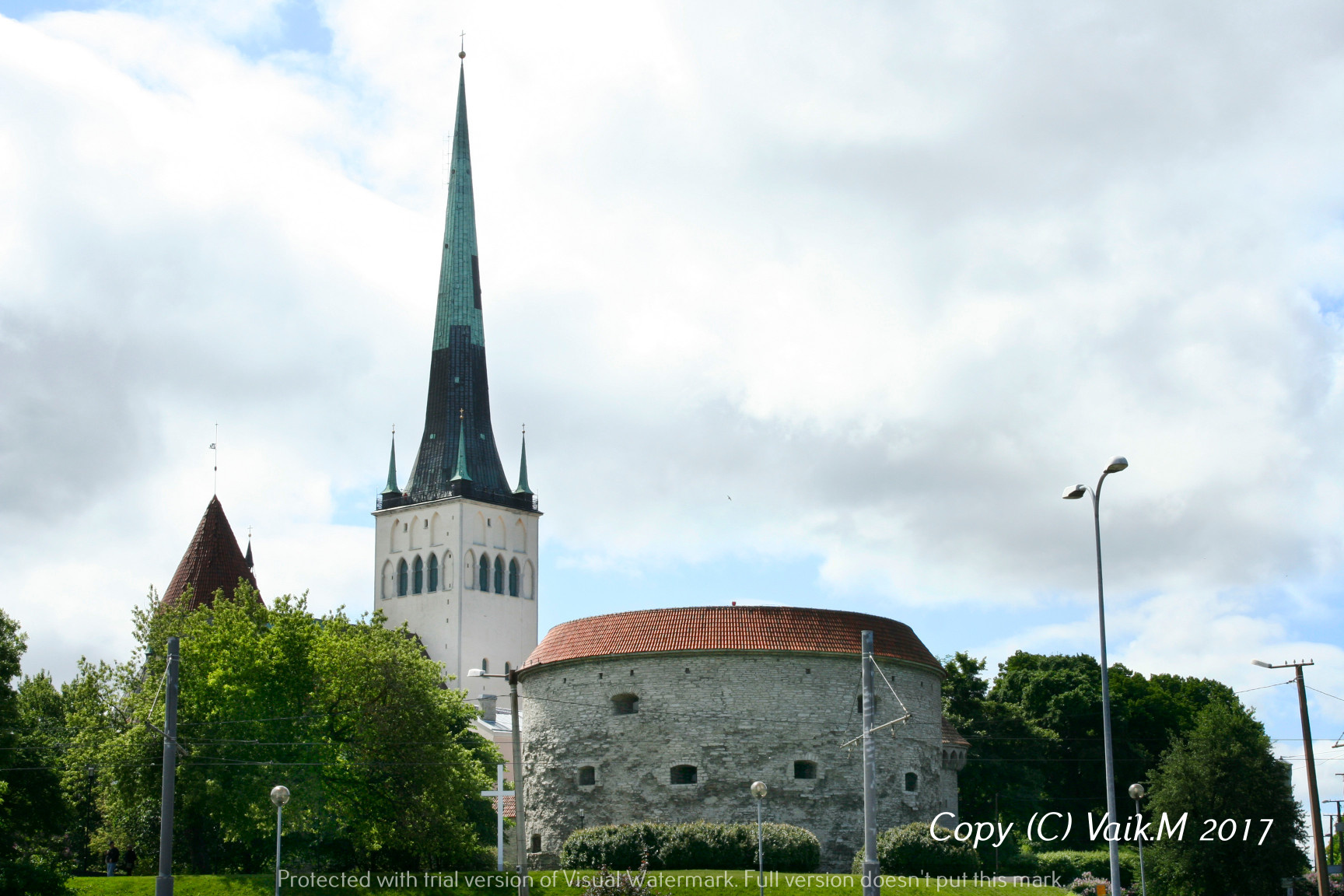
In Estonia, Orthodox Christians form a significant religious community — primarily members of the Russian community as well as some Estonians. The Estonian Apostolic Orthodox Church falls under the Patriarchate of Constantinople, while the Estonian Orthodox Church under the Moscow Patriarchate represents a separate tradition.
Contemporary challenges facing the Orthodox Church worldwide include:
- Geopolitical tensions — in the context of the war in Ukraine, the rift between the Moscow and Constantinople patriarchates has deepened
- The diaspora — Orthodox communities in major Western cities are growing and seeking identity within multicultural societies
- Modernism — engaging in theological dialogue while preserving the immutability of tradition
- Ecumenism — relations with Catholics and Protestants are complex, yet dialogue continues
Why Does the Orthodox Church Consider Itself “Unchanged”?
This is a question that arises for many: how can a church in the 21st century claim it has not changed? Is this not mere conservatism?
Orthodoxy believes that it has preserved and taught the historic Christian faith, free from error and distortion, from the time of the Apostles. It believes that there is nothing in the body of its teachings that is contrary to truth or that inhibits genuine union with God. The air of antiquity and timelessness that often characterises Eastern Christianity is an expression of its desire to remain loyal to the authentic Christian faith.
The Orthodox Church does not claim that history has stood still, nor that the Church has not developed through various cultural expressions. What it does claim is that the depositum fidei inherited from the Apostles — the essential content of the faith — has remained unchanged, and that all theological development has always taken place within the bounds of that original revelation, never outside it.
Conclusion: An Eternal Faith in a Changing World
The Orthodox Church explained in brief: it is a community that believes itself to be the direct continuation of the Church founded by Christ — a church that carries forward the Apostles’ heritage through Holy Tradition, the sacraments, icons, liturgy and the path of theosis.
What is Orthodox Christianity? It is a faith that calls a person not merely to believe intellectually, but to live the life of God — shaping oneself into the likeness of Christ not in the perspective of a single generation, but in the perspective of eternity. The path of theosis does not end with death — it continues.
In a world where everything changes — values, culture, institutions — the Orthodox Church is a paradox: an institution more than 2,000 years old that claims to carry the answers to humanity’s deepest questions. And for hundreds of millions of believers, that claim rings true.
This article was compiled on the basis of publicly available sources, including Britannica, the Greek Orthodox Archdiocese of America, OrthodoxWiki and other religious-historical sources.

Martinus Vaicarius’s mission is to:
- Provide spiritual support and guidance to people seeking peace and hope
- Create prayer texts that bring God’s peace to hearts suffering under fear and anxiety
- Promote deep understanding of the power of the
- God of Sabaoth and the protection of the heavenly hosts
- Help people enter the spiritual sphere where God’s peace reigns over all
Europe Heaven Invest 2072 Gold OÜ
- Easter 2026: The Deep Theological Meaning of Christ’s Resurrection in the Orthodox Tradition - 5. Apr 2026
- Orthodox vs Catholic vs Protestant: A Deep Theological Analysis of the Differences and Unity Between Eastern and Western Christianity - 2. Apr 2026
- What Is the Orthodox Church? The Ancient Faith That Never Changed – A Deep Dive into Eastern Orthodox Christianity - 2. Apr 2026