The Holy Trinity in Orthodox Theology: The Deepest Mystery of the Christian Faith
The Holy Trinity—one God in three Persons: Father, Son, and Holy Spirit—is the burning mystery at the heart of the Christian faith. It is a reality that no power of human reason can fully obscure, nor any linguistic formula exhaustively describe. Yet, the Trinity is not an abstract philosophical thesis; it is the foundation of Christian life, the breath of prayer, and the economy of salvation. The question of what the Trinity is in Christianity is not merely academic—it is a question about the very nature of God as He has revealed Himself to us.
1. Biblical Foundations: The Trinity in Holy Scripture
Many ask: is the word “Trinity” even in the Bible? While the specific term does not appear, the reality of the Trinity permeates Scripture from beginning to end. The very first verse of the Old Testament—”In the beginning, God created the heavens and the earth” (Gen 1:1)—uses the Hebrew word Elohim, which is grammatically plural, yet the verb is singular. This already hints at the mystery of unity and multiplicity.
In the New Testament, the revelation of the Trinity is complete and clear. At the moment of Christ’s baptism (Matthew 3:16–17), the voice of the Father is heard from heaven, the Son stands in the waters of the Jordan, and the Holy Spirit descends in the form of a dove. All three Persons are present simultaneously. The Great Commission commands us to baptize “in the name of the Father and of the Son and of the Holy Spirit” (Mt 28:19)—notably, “name” is in the singular, marking the unity of the Persons in one divine essence.
“John provides perhaps the most compact statement of the Trinity: ‘In the beginning was the Word, and the Word was with God, and the Word was God’ (Jn 1:1)—the Son in an eternal relationship with the Father before time and within time.”
Apostle Paul’s apostolic blessing (2 Cor 13:13)—”The grace of the Lord Jesus Christ and the love of God and the fellowship of the Holy Spirit be with you all”—is not a mere poetic figure, but a doctrinal statement: the Trinity is life, love, and communion, not a theorem.
2. Church Doctrine Develops: The Councils of Nicaea and Constantinople
One of the most important chapters in the history of Christian dogma was written in the fourth century by the Church Fathers, who had to respond to the heresy of Arius. Arius taught that the Son is not consubstantial with God but is a created being—the highest, but still a creature. This attack on the divinity of Christ required a precise theological response from the Church.
At the First Ecumenical Council in Nicaea (325), it was formulated that the Son is “consubstantial” (Greek: homoousios) with the Father. This single word became the cornerstone of Trinitarian doctrine. The Second Ecumenical Council in Constantinople (381) completed the Creed by clarifying the full divinity of the Holy Spirit. Thus was born the canonical form of Trinitarian teaching that the Orthodox Church preserves to this day.
“We believe in one God, the Father Almighty, Maker of heaven and earth… and in one Lord Jesus Christ… who is of one essence with the Father… and in the Holy Spirit, the Lord and Giver of Life…” — The Nicene-Constantinopolitan Creed (325/381)
3. The Cappadocian Fathers and Precise Theological Language
After Nicaea, a great theological confusion persisted: how to reconcile the unity of God with the reality of the three Persons? This problem was brilliantly solved by the three Cappadocian Fathers: St. Basil the Great (330–379), St. Gregory the Theologian (329–390), and St. Gregory of Nyssa (c. 335–395).
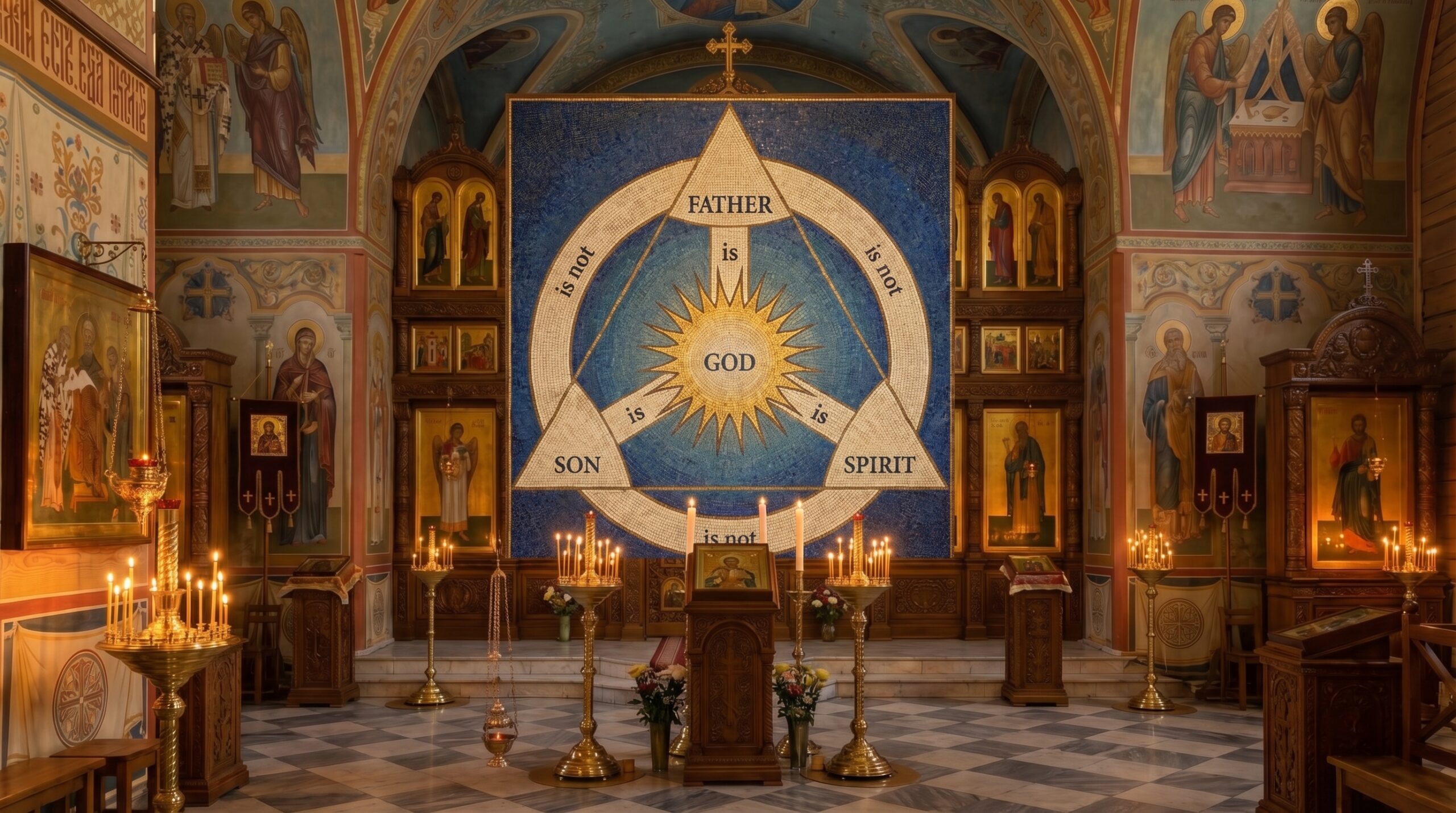
The Cappadocians made a precise distinction between two concepts often previously confused: ousia (essence, substance) and hypostasis (person, concrete existence). Their classic formula is: mia ousia, treis hypostaseis—one essence, three persons. This formula simultaneously expresses divine unity (excluding polytheism) and the true distinction of the persons (excluding Sabellianism, which reduces the three Persons to mere “modes” of God).
Three Persons—Three Distinctions:
-
The Father: Is neither born of anyone nor proceeds; He is the eternal origin (arché), the “cause” (aitia) of the Godhead.
-
The Son: Is eternally begotten of the Father (a begetting independent of time), not created; He is the living image of the Father.
-
The Holy Spirit: Proceeds eternally from the Father (not also from the Son, as the Western Church later erroneously added with the filioque); He is the Trinity’s “gift” to the world.
The Cappadocians also emphasized that God always acts in a Trinitarian way—the Father, Son, and Holy Spirit have one will (thelema) and one operation (energeia). They are not three independent centers of will deciding in harmony, but one eternal unity of love.
4. Filioque—The Cause of the Great Schism
One of the most significant theological differences between Eastern and Western Christianity concerns the procession of the Holy Spirit. The Orthodox Church maintains the Nicene-Constantinopolitan Creed in its original form: the Holy Spirit “proceeds from the Father.” The Western Church later unilaterally added the word filioque (“and the Son”) to the Creed, asserting that the Holy Spirit proceeds from “the Father and the Son.”
Orthodox theology sees this change as a serious theological problem: it obscures the distinction between the Persons of the Trinity and their exact relationship. St. Photius the Great (9th century) and St. Gregory Palamas (14th century) formulated the theological critique of this addition, which remains valid today.
5. The Trinity in Orthodox Prayer and Life
In Orthodoxy, the Trinity is not merely a doctrinal thesis—it is the very breath of prayer life. Every service begins “In the name of the Holy Trinity” (or the Father, Son, and Spirit) and ends with the glorification of the Trinity. The Divine Liturgy is built upon doxological hymns of praise to the Trinity. Through baptism, a person enters into the name of the Father, Son, and Holy Spirit—meaning they enter into the very life of the one God.
St. Gregory of Nyssa wrote that the human heart carries within it the imprint of the Trinity. Since God exists in relationship—Father, Son, and Spirit—man is, at his deepest level, a relational being: created for fellowship, love, and communion. This is one of the most important anthropological implications of Orthodox Trinitarian teaching: the value of the human person stems from being created in the image of the Trinity.
“True personhood does not develop in isolation, but in love and relationship with others, through communion. Love alone—free love—can generate personhood.” — St. Gregory of Nyssa
6. Apophatic Theology: What We Cannot Say
Orthodox theology strongly emphasizes “apophaticism”—negative theology: we cannot say what God is, only what He is not. The Cappadocians understood that all concepts of human language collapse when applied to the essence of God. St. Basil wrote that God is “beyond the reach of the human voice” and “incomprehensible to the human mind.”
This does not mean we know nothing of God. Orthodox teaching distinguishes between God’s essence (ousia)—which remains eternally inaccessible to us—and God’s energies (energeiai), through which God reveals Himself and with which man truly enters into communion. The doctrine of essence and energies, formulated by St. Gregory Palamas, is one of Orthodoxy’s most original contributions to Christian theology.
7. The Trinity and Salvation: Theosis
Why is the doctrine of the Trinity practical? Because it determines what a saved human being becomes. The Orthodox understanding of salvation—theosis or deification—means that man is called to participate in the life of the Trinity: to become one with the Son through the grace of the Holy Spirit, who unites us with the Father. This is not a metaphor—it is the promise of 2 Peter 1:4: “partakers of the divine nature,” escaping the corruption that is in the world.
St. Athanasius of Alexandria formulated this wonderfully: “God became man so that man might become God.” In this sentence lies the core of all Orthodox theology. The Trinity is not a doctrinal ornament—it is life itself, in which man is invited to participate.
“God became man so that man might become God.” — St. Athanasius of Alexandria (c. 296–373)
8. The Trinity and Today: Why It All Matters Now
The search for an explanation of the Holy Trinity is highly sought after today by both believers and seekers. We live in an era where individualism and isolation have grown to unprecedented levels. The Orthodox doctrine of the Trinity offers a theological answer to this cultural crisis: God’s own nature is communion, love, and relationship—and it is for this very purpose that man was created.
Another crisis in Western theology has reduced God to a “wise designer” (Deism) or a “projection of the human subject” (Feuerbach). Orthodox Trinitarian teaching asserts: God is a personal, relational, love-based reality—not an abstraction, but a Person who seeks communion with His creation through the Son and lives in that communion through the Holy Spirit.
The mystery of the Trinity is not a logical paradox, but the supreme cause of the Christian faith. It is the reason why love is the highest truth—because God Himself is love (1 Jn 4:16), and this love is Trinitarian: giving, receiving, and creating communion.

Martinus Vaicarius’s mission is to:
- Provide spiritual support and guidance to people seeking peace and hope
- Create prayer texts that bring God’s peace to hearts suffering under fear and anxiety
- Promote deep understanding of the power of the
- God of Sabaoth and the protection of the heavenly hosts
- Help people enter the spiritual sphere where God’s peace reigns over all
Europe Heaven Invest 2072 Gold OÜ