Views: 37
What Does It Mean to Be a True Christian in 2026? An Honest Guide
An essay on the foundations of Christian doctrine, the writings of the saints, and what it means to live a genuinely Christian life in today’s world
Introduction: A Word That Has Lost Its Edge
By 2026, the word “Christian” has become strangely blurred. It can signal a cultural background, a political identity, a general moral leaning, or simply the fact that someone was baptized at some point. As the word’s usage has broadened, its content seems to have thinned. This essay asks the question honestly and directly: what actually makes a person a Christian — not culturally, but at the core? And what must a Christian life actually contain, if it is more than a label?
The answer does not begin with our own era but with Scripture and nearly two thousand years of testimony left by the Church Fathers, ascetics, and saints. They did not live in a simpler world than ours — they lived amid persecution, heresy, and moral confusion. Precisely for that reason their testimony can be trusted: they had to ask the same question we are asking today, and their answers have been tested by time.
The Foundations of Christian Doctrine: What Makes Someone a Christian
Christian doctrine does not begin with moral rules but with a single event: God became man, died, and rose again to save humanity. The apostle Paul states the core of the Christian faith simply: if you confess with your mouth that Jesus is Lord, and believe in your heart that God raised him from the dead, you will be saved (Romans 10:9). Becoming a Christian, then, begins not with moral effort but with trust — the confession that Jesus Christ is who he said he was, and surrender to his lordship.
But this confession is not an endpoint; it is a beginning. The first letter of John warns that a faith bearing no fruit is not genuine: those who claim fellowship with God while walking in darkness are lying and not living the truth (1 John 1:6). Christian doctrine therefore binds faith and life inseparably together — not to turn salvation into a wage earned by works, but because authentic faith inevitably transforms a person.
The letter of James states this most sharply: faith without works is dead in itself (James 2:17), and even more directly: just as the body without the spirit is dead, so faith without works is dead (James 2:26). For Orthodox and the wider Christian tradition, this is not a contradiction of Paul’s teaching on grace — Paul speaks of the beginning of salvation, James of its living expression. A person does not make themselves divine through faith by their own strength, but genuine faith inevitably shows itself in works, because it is communion with a living God, not agreement with dead propositions.
What a Christian Life Must Actually Contain
Taken as a whole, Scripture points to one core, recurring demand at the heart of Christian life: love that is not a feeling but an action.
Jesus himself gives his disciples a “new commandment” at the Last Supper: love one another; as I have loved you, so you must love one another. By this everyone will know that you are my disciples, if you love one another (John 13:34–35). This is a radical claim: not doctrine, not ritual, not even correctness of belief itself is what the world will recognize Christians by — but a love that is visible.
The apostle Paul expands on this in 1 Corinthians 13, describing love in terms that become a kind of mirror every Christian must stand before: love is patient, love is kind, it does not envy, it does not boast, it is not proud, it does not dishonor others, it is not self-seeking, it is not easily angered, it keeps no record of wrongs. Love does not delight in evil but rejoices with the truth. It always protects, always trusts, always hopes, always perseveres (1 Corinthians 13:4–7). And before that, a stark warning against any religious achievement that lacks love: if I speak in the tongues of men and of angels but do not have love, I am only a resounding gong or a clanging cymbal (1 Corinthians 13:1).
Such love is not a natural quality a person simply finds within themselves — it is a fruit of the Spirit that grows through communion with God: the fruit of the Spirit is love, joy, peace, patience, kindness, goodness, faithfulness, gentleness, and self-control (Galatians 5:22–23). A Christian life must contain this fruit not as isolated virtuous moments but as the gradual transformation of character — a process the Church Fathers called metanoia, a change of mind and heart.
Jesus goes further still, demanding love even toward those hardest to love: love your enemies and pray for those who persecute you, that you may be children of your Father in heaven… Be perfect, therefore, as your heavenly Father is perfect (Matthew 5:44–48). This is where Christian ethics diverges most sharply from ordinary morality: not good returned for good, but a love that transcends the natural logic of reciprocity.
The Witness of the Saints: Christianity as a Lived Truth, Not a Theory
The Church Fathers and saints help us understand how these principles actually bear on real life.
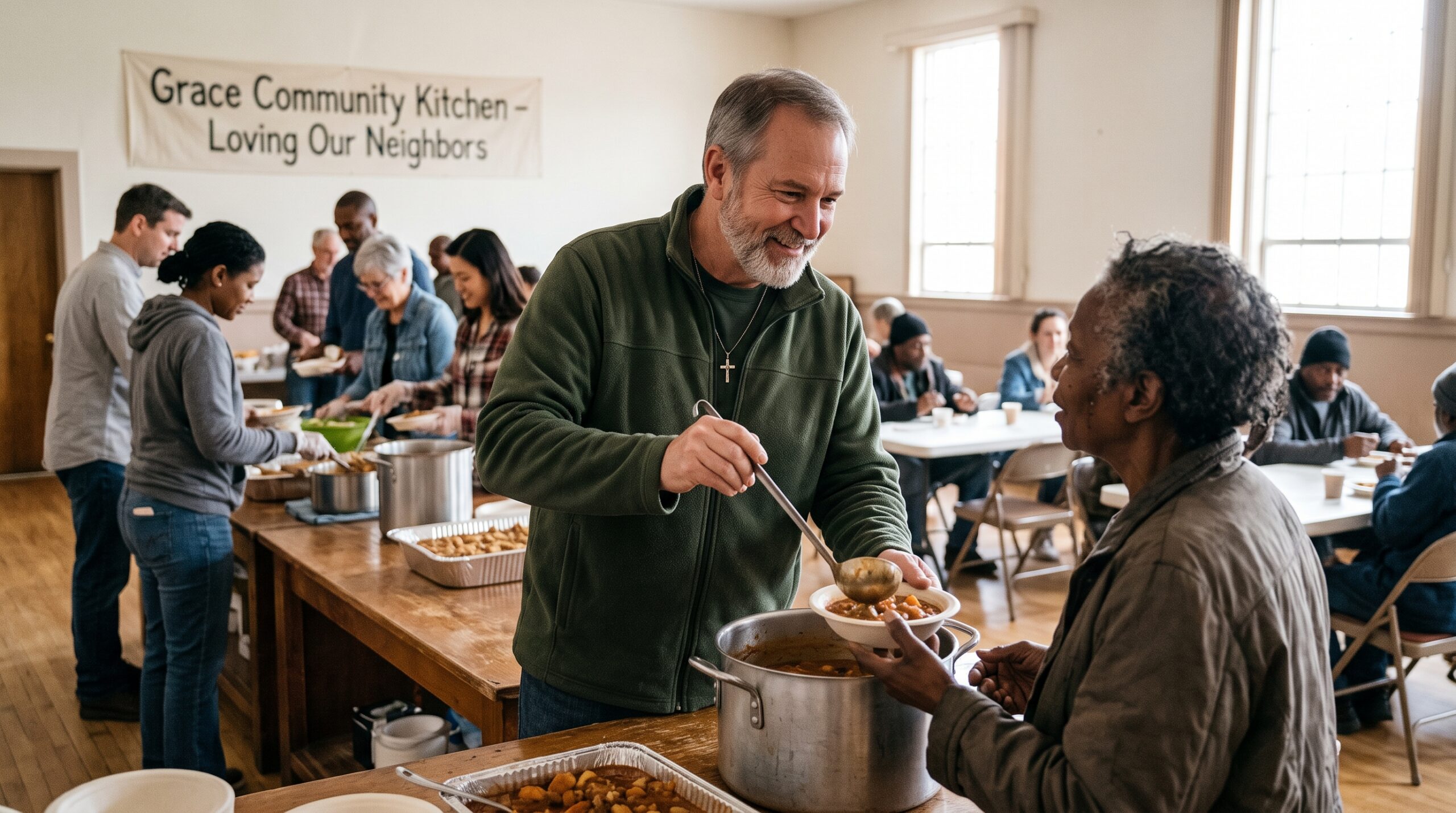
John Chrysostom repeatedly insisted that true worship does not end at the church door — his famous teaching that feeding the poor is as sacred an act as what happens at the altar remains a challenge today to Christians who separate the “spiritual” from the “practical.” For him, neglecting a poor neighbor was, in substance, neglecting Christ himself.
Augustine of Hippo taught that love is the measuring rod of all Christian ethics: “Love, and do what you will” — a line that sounds permissive but is in fact extremely demanding, since genuine love, as Augustine understood it, never wills anything that would harm another person or separate us from God.
Ephrem the Syrian and the desert fathers emphasized humility as the foundation of Christian life — not self-deprecation, but honest self-knowledge before God. In their teaching, it is pride, more than any single sin, that poses the greatest hidden danger to a Christian life, because it distorts everything else, including seemingly pious acts.
The prophet Micah, who lived long before Christ but whom the Christian tradition has always claimed as part of its heritage, put the same truth more simply than almost anyone: God has shown you, O mortal, what is good; and what does the Lord require of you but to do what is right, to love goodness, and to walk humbly with your God (Micah 6:8). This verse joins three elements that the saints of the New Testament era echo again and again: justice, mercy, and a humble walk with God.
How to Be a Better, More Genuine Christian in 2026: An Honest Analysis
Bringing the above together, several concrete, honest observations emerge about what a genuinely Christian life demands in our own time.
First, confession of faith without a corresponding life is insufficient — but that does not mean works replace faith. A Christian does not make themselves good by their own effort; they let the Spirit do a work within them whose fruit becomes visible. This is a subtle but decisive difference between moralism and genuine spirituality.
Second, love has to be concrete, not abstract. It is easy to “love humanity” as an idea and hard to love a specific irritating neighbor, an unfair colleague, or a political opponent. It is precisely here, according to the teaching of Jesus and Paul, that the question of whether faith is alive or dead gets decided.
Third, the digital age makes hypocrisy both easier and more visible at once. Social media allows public piety to be performed without any inner transformation — exactly what Jesus warned against in the Sermon on the Mount (Matthew 6:1–6). A true Christian in 2026 needs to be especially alert to whether their faith is meant to be seen or is genuine regardless of whether anyone is watching.
Fourth, humility remains as necessary as it has ever been. Our culture rewards self-assertion and visibility; Scripture and the saints reward the opposite — a humble walk with God that does not require constant validation.
Fifth, Christian life is not a private project. It expresses itself in community, in mercy, in the pursuit of justice, and in a readiness to suffer for love’s sake, just as Christ himself taught and lived.
Conclusion: An Honest Guide Without Easy Answers
True Christianity in 2026 is not radically different from what it has been in every century — but each era presents its own tests. Scripture and the testimony of the saints agree: being a Christian begins with trust in Christ and expresses itself in a love that is concrete, patient, humble, and willing to suffer. It is not an achievement that can be completed, but a path walked anew each day, often falteringly and imperfectly.
An honest guide offers no formulas or quick fixes. It simply points back to what Christ and his saints have always taught: faith that does not turn into love is dead faith; and love that is not grounded in trust in God sooner or later loses its strength. A true Christian is someone who, each day, chooses again in favor of both — faith and love — knowing that the choice is never made once and for all.
A Long Prayer for Understanding Christianity
Lord Jesus Christ, source of truth and life, I come before you with a question I am almost afraid to ask directly: do I truly know you, or have I only grown used to the words spoken about you? Open my mind and my heart to understand who you really are — not a cultural figure or a distantly respected teacher, but the living God who became man, suffered, died, and rose again for my sake.
Give me the understanding to grasp the whole of your teaching: that faith in you is not merely a confession made with the mouth, but a surrender that transforms my entire life; that your grace is not a reward for my goodness but a gift to which I respond with a grateful life. Never let me reduce Christianity to a set of rules, nor faith to a feeling without substance — show me that these two, faith and works, faith and love, are one whole, just as your apostles Paul and James both taught, each from his own vantage point.
Teach me to understand what it means to walk humbly with you, as the prophet Micah proclaimed long before your coming. Give me the courage to love not only those who love me, but also those I find difficult, those who wound me, those I disagree with — for you yourself taught that this is where perfection lies, a perfection that mirrors your own love for all. Help me understand that Christian life is not separate from my everyday life but lives within it — in my work, my relationships, my silence, and my words.
Grant me honesty before myself: show me where my faith has remained shallow, where I seek to be seen more than to be true, where I speak of love but do not live it out. And when you show me these places, give me also the strength to change them, not merely to feel ashamed at seeing them. Just as your saints before me — John Chrysostom, who let no one separate the altar from the street, and Augustine, who learned to love rightly only after a long journey — teach me too to understand you not as a theory, but as a living truth that transforms everything.
This I ask in the name of the Father, of you yourself, and of the Holy Spirit, now and forever. Amen.
A Shorter Prayer of Salvation
Lord Jesus Christ, Son of God, I believe in my heart that God raised you from the dead, and I confess with my mouth that you are Lord. Forgive my sins and cleanse my heart. Come into my life and live in me, so that my faith may bear fruit in love and my life may bear witness to you. Amen.

Trough all this I want to declare this is all from God and to God. All Glory to Him!