Views: 79
Mount Athos Monk Life Revealed: 7 Strict Rules That Define Orthodox Monasticism
The Holy Mountain of Athos, also known as Agion Oros, is an autonomous monastic republic located on a peninsula in Greece. For over a thousand years, it has served as the spiritual heart and stronghold of Orthodox monasticism. This UNESCO World Heritage Site encompasses 20 major monasteries along with numerous hermitages and sketes, housing approximately 1,400–2,000 monks. The monks of Athos preserve Byzantine-era traditions almost unchanged, devoting themselves entirely to prayer, asceticism, and the purification of the soul. This article delves deeply into the essence of Athonite monastic life, examining 7 of the strictest rules that form the foundation of Orthodox monasticism through the lens of the Bible, the teachings of the Church Fathers, ancient sources, and archaeological evidence. These rules are not mere disciplinary restrictions but a radical path to spiritual perfection.
1. Complete Separation from the World and Strict Adherence to Monastery Boundaries
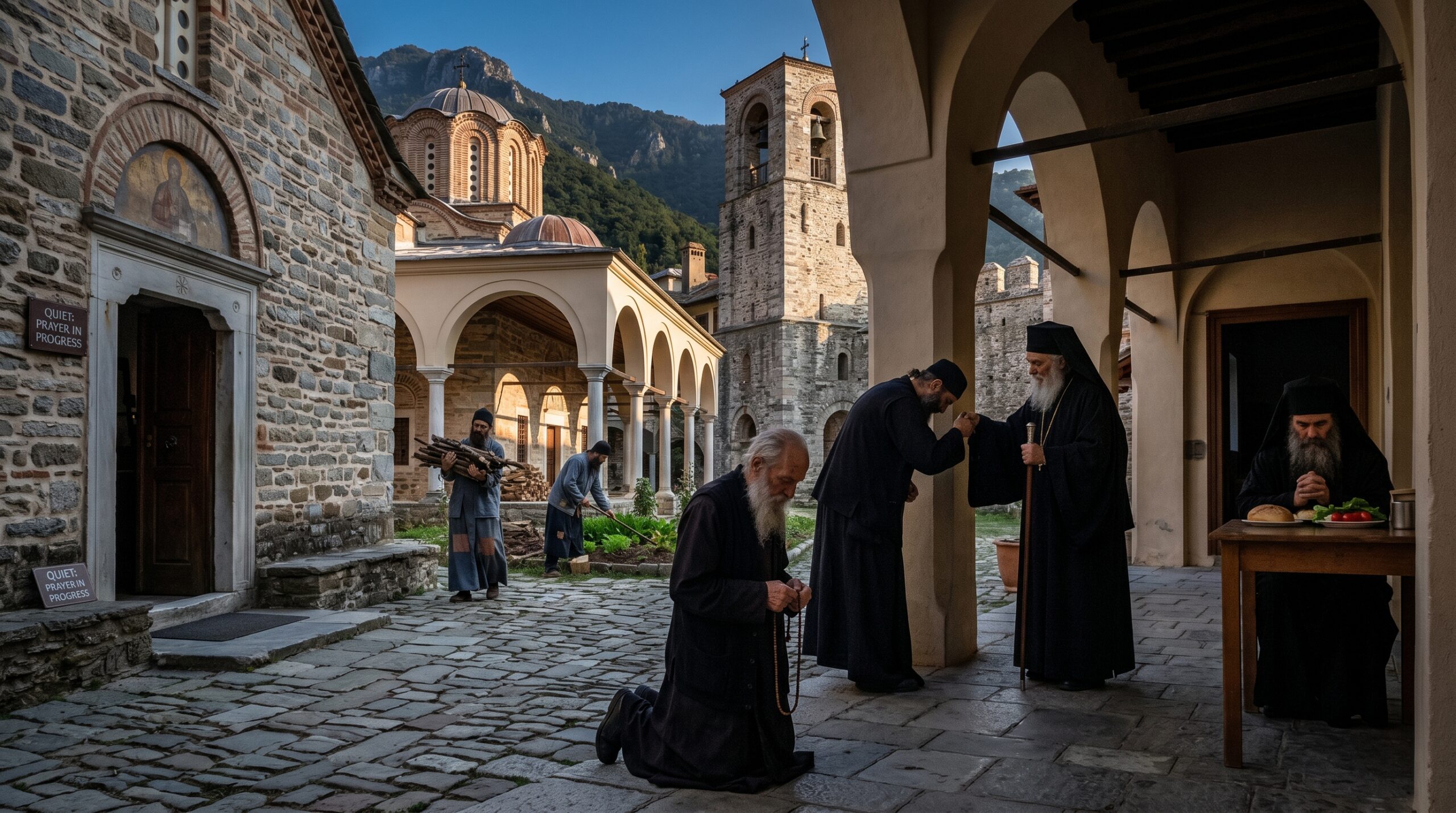
Athonite monks live in strict seclusion from secular society. Entry to the Holy Mountain is permitted only for men who have received special permission, and life is directed toward complete commitment to the monastery’s rules.
Biblical Foundation: Jesus Christ Himself often sought desert solitude for prayer (Luke 5:16; Matthew 14:23). The Apostle Paul admonished: “Do not be conformed to this world, but be transformed by the renewal of your mind” (Romans 12:2). Among the Church Fathers, St. Basil the Great in his monastic rule emphasizes that monks must be “separated from the world in order to be closer to God.” St. Gregory Palamas, the great defender of Athonite hesychasts, taught that separation enables deep inner peace (hesychia).
Historically, Byzantine imperial decrees (from the 10th–11th centuries) confirm Athos’s autonomy. Archaeological findings, including the remains and preserved seals of the Megisti Lavra monastery (founded in 963 by St. Athanasios the Athonite), demonstrate how fortified walls and strict vigilance have protected the purity of monastic life for centuries.
2. Complete Obedience to a Spiritual Father (Geronda) or Abbot
A monk renounces his personal will and submits fully to his spiritual guide. This is the foundation of monastic growth.
Biblical Foundation: “Obey your leaders and submit to them, for they are keeping watch over your souls” (Hebrews 13:17). Jesus Christ fully obeyed the will of the Father: “Not my will, but yours, be done” (Luke 22:42). From the Church Fathers, St. John Climacus in The Ladder of Divine Ascent writes that obedience is “the mother of all virtues and the death of one’s own will.” Athonite elders, such as Elder Paisios of Mount Athos, emphasized: “True freedom is born from complete obedience.”
This practice has for centuries prevented individualism and pride on Athos, allowing monks to grow through collective spiritual struggle.
3. Unceasing Prayer and Daily Liturgical Rhythm
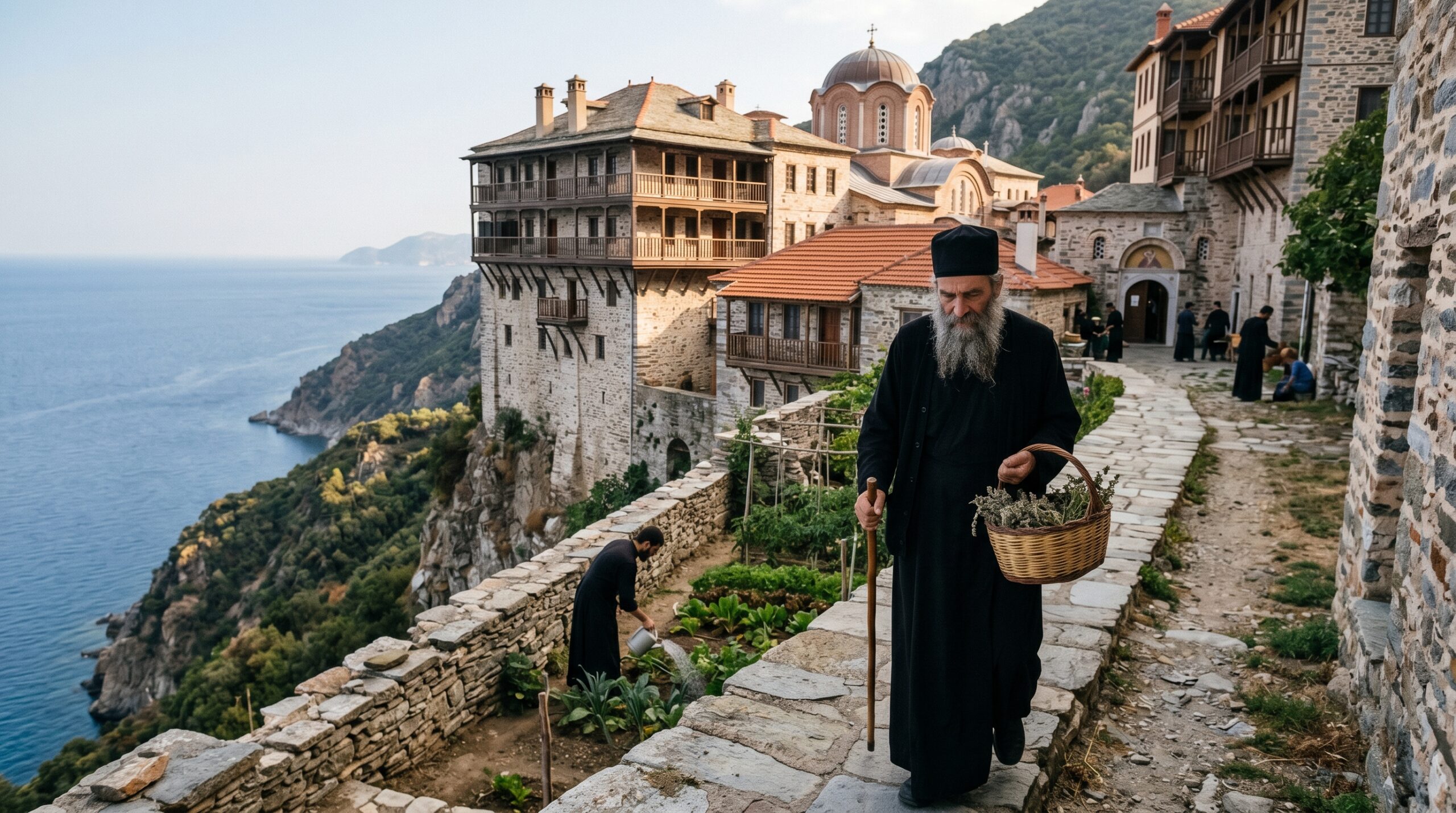
Monks follow strict prayer times, with services often lasting 8–12 hours a day, with special focus on the Jesus Prayer.
Biblical Foundation: “Pray without ceasing” (1 Thessalonians 5:17). Psalm 119:164 states: “Seven times a day I praise you for your righteous rules.” Acts 2:42 describes the early Christian community that devoted themselves to “prayers.” From ancient sources comes Evagrius Ponticus’s teaching on prayer as the purification of the soul.
Church Fathers such as St. Gregory Palamas developed the hesychast tradition, in which the Jesus Prayer — “Lord Jesus Christ, have mercy on me” — becomes synchronized with breathing and heartbeat. Archaeological evidence from frescoes and manuscripts in Athonite monasteries (such as Iviron and Vatopedi) confirms that this liturgical life has continued uninterrupted since the 10th century.
4. Strict Fasting and Ascetic Diet
Nutrition is extremely modest: often one or two plant-based meals per day, with rigorous fasting on Wednesdays, Fridays, and during long fasting periods.
Biblical Foundation: “This kind does not come out except by prayer and fasting” (Matthew 17:21). Jesus fasted for 40 days (Matthew 4:1–11). The Prophet Elijah lived in the desert while fasting (1 Kings 19). St. John Chrysostom taught fasting as the taming of the body and liberation of the soul.
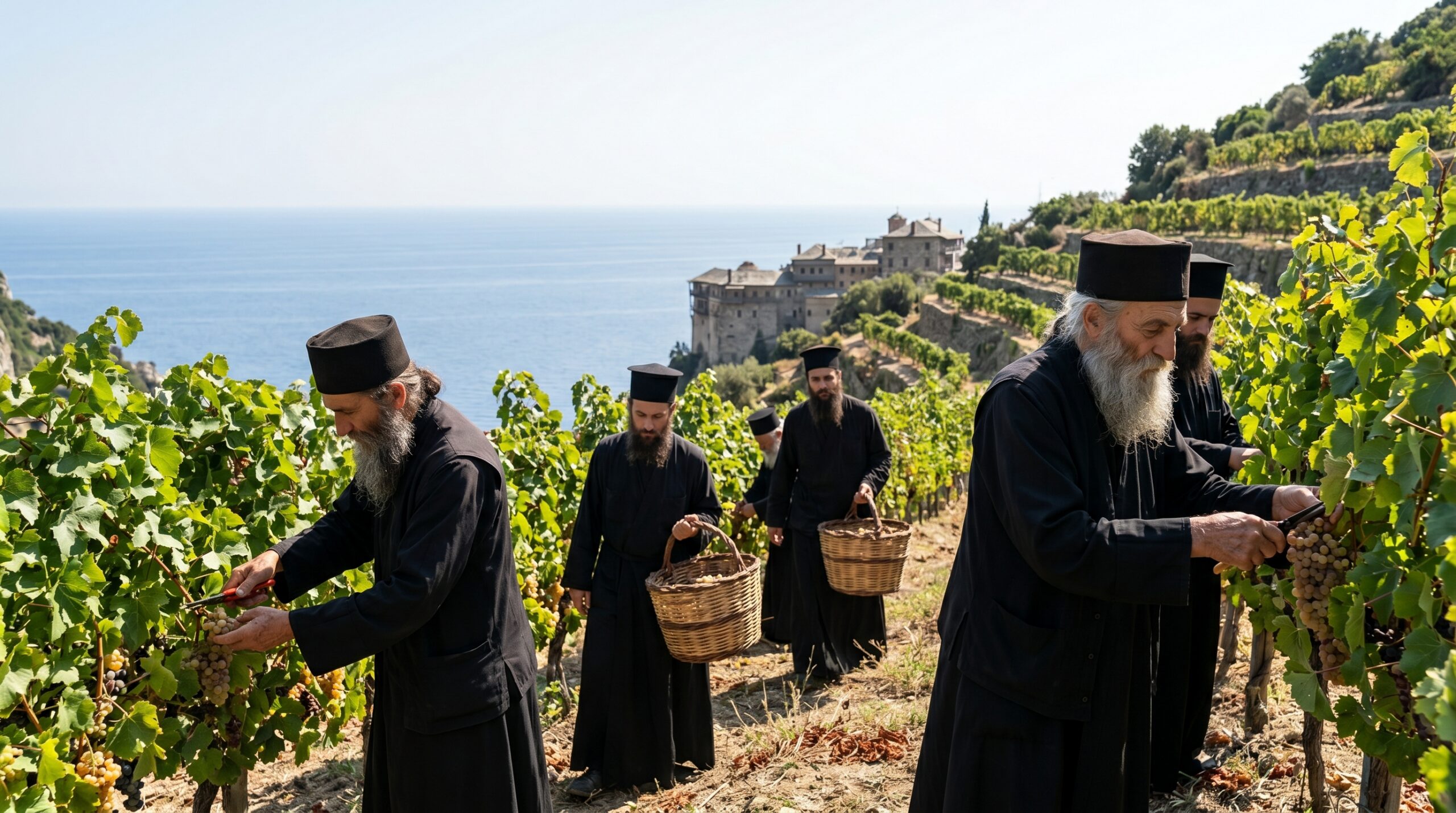
Athonite monks follow a tradition originating from the Desert Fathers of Egypt, such as St. Anthony the Great. Archaeological discoveries show that monasteries have cultivated olives, grapes, and herbs for centuries, supporting a sustainable ascetic diet.
5. Poverty and Complete Renunciation of Personal Property
Monks renounce all personal possessions, living in common ownership in cenobitic monasteries.
Biblical Foundation: “If you would be perfect, go, sell what you possess and give to the poor… and come, follow me” (Matthew 19:21). The early Church lived in such a way that “no one said that any of the things that belonged to him was his own, but they had everything in common” (Acts 4:32). Paul wrote: “I count everything as loss because of the surpassing worth of knowing Christ Jesus” (Philippians 3:8).
St. Basil the Great in his Monastic Rule and St. Ephrem the Syrian emphasized poverty as freedom. While Athonite monasteries have amassed great artistic treasures, the monks themselves live in simple cells. Archaeological excavations have uncovered Byzantine economic systems that supported communal life.
6. Silence, Hesychia, and Inner Peace
Unnecessary talk is forbidden; monks practice silence to achieve deep inner contemplation.
Biblical Foundation: “Be still, and know that I am God” (Psalm 46:10). “Keep your heart with all vigilance” (Proverbs 4:23). Church Fathers such as St. Isidore of Pelusium and St. John Climacus praised silence as an “angelic virtue.”
The hesychia tradition on Athos, which reached its peak in the 14th century, allows monks to experience God’s presence through silence. It serves as protection from worldly noise.
7. Humility, Repentance, and Remembrance of Death (Memento Mori)
Daily confession of sins, humility, and constant awareness of death prepare the monk for eternity.
Biblical Foundation: “If anyone would come after me, let him deny himself and take up his cross and follow me” (Luke 9:23). “God opposes the proud but gives grace to the humble” (James 4:6). From the Church Fathers: “Humility is the highest virtue” (St. Ephrem the Syrian). Athonite monks practice daily repentance.
The Deep Historical and Spiritual Context of Athonite Monastic Life
The monastic tradition of Athos traces back to the early Desert Fathers in Egypt and Palestine (4th–5th centuries). In the 10th century, it became the main center of this movement thanks to St. Athanasios the Athonite. Archaeological evidence — Byzantine frescoes, preserved manuscripts, coins, and architecture — confirms continuous habitation since the early Middle Ages. The monastery libraries contain thousands of manuscripts preserving the works of ancient Church Fathers.
Fathers such as St. Athanasius the Great, St. Basil the Great, and St. Gregory Palamas viewed monasticism as “white martyrdom” — daily death to the world. This life is not an escape but an intense spiritual battle (pneumatikos polemos), in which the monk fights temptations to achieve union with God.
In today’s world, the strictly regulated life of Athos offers a sharp contrast to consumer culture and digital distraction. It is a living testimony to the radical nature of the Gospel (Matthew 5:48 — “You therefore must be perfect, as your heavenly Father is perfect”).
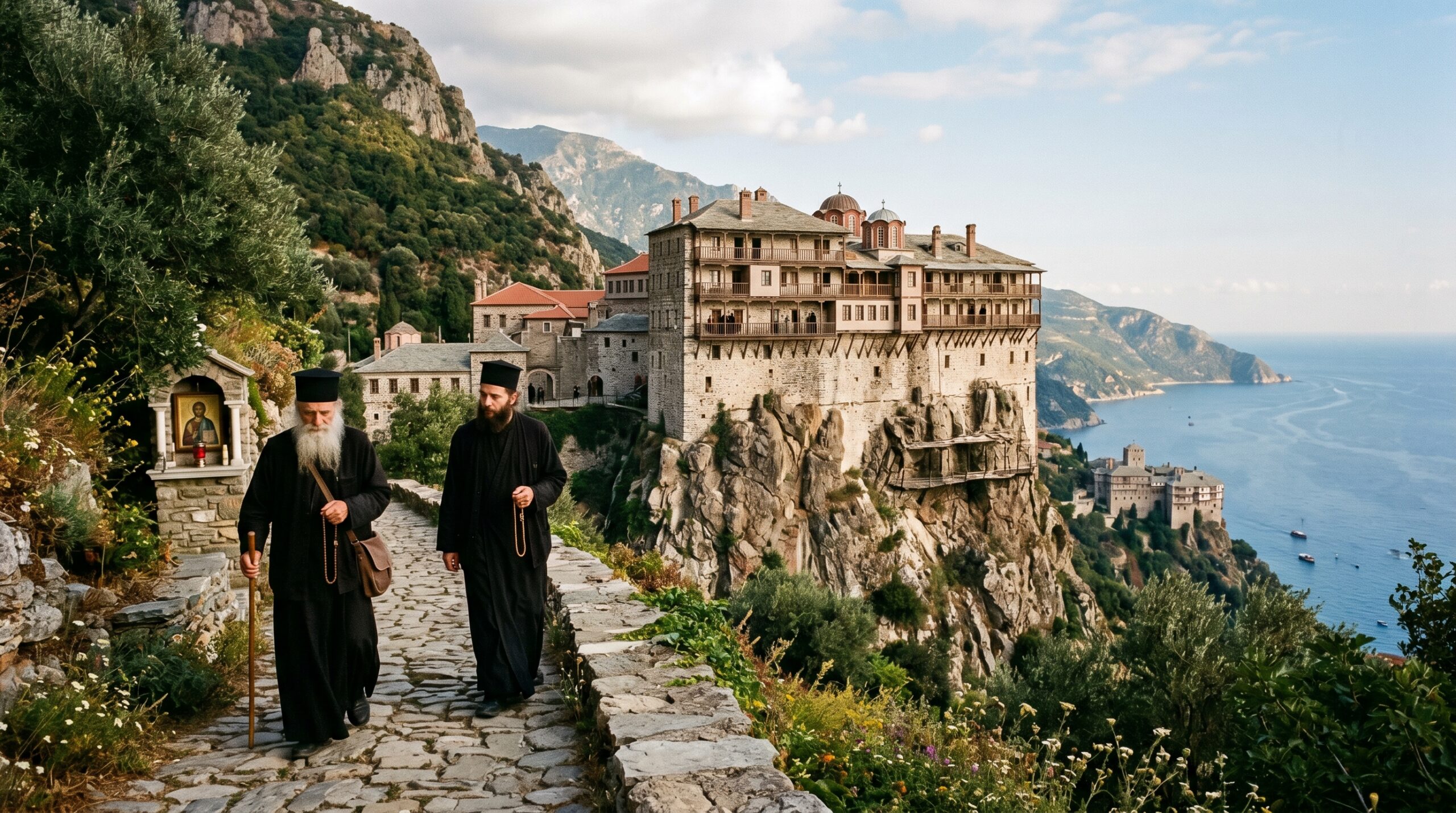
Conclusion: These seven rules — separation from the world, obedience, prayer, fasting, poverty, silence, and humility — form a complete system that has shaped Orthodox monasticism for centuries. Athos is not a museum but a living spiritual laboratory where monks embody the Christian ideal of perfection. This heritage calls all Christians to deeper commitment, regardless of their vocation.

Martinus Vaicarius’s mission is to:
- Provide spiritual support and guidance to people seeking peace and hope
- Create prayer texts that bring God’s peace to hearts suffering under fear and anxiety
- Promote deep understanding of the power of the
- God of Sabaoth and the protection of the heavenly hosts
- Help people enter the spiritual sphere where God’s peace reigns over all
AICortex Invest OÜ
- Dormition Fast 2026: When It Begins, When It Ends, and How to Fast Rightly - 2. Aug 2026
- The Nevsky Cathedral on Toompea: A Century-Old Dispute Over a Symbol of Russification - 1. Aug 2026
- The Meaning and Power of Prayer in Christianity: Biblical Teaching and the Wisdom of the Church Fathers - 29. Jul 2026