Views: 265
Orthodox vs. Lutheran – Key Differences You Need to Know (2026)
An In-Depth Analysis of Two Major Christian Traditions | 2026
Introduction: Two Paths, One Source
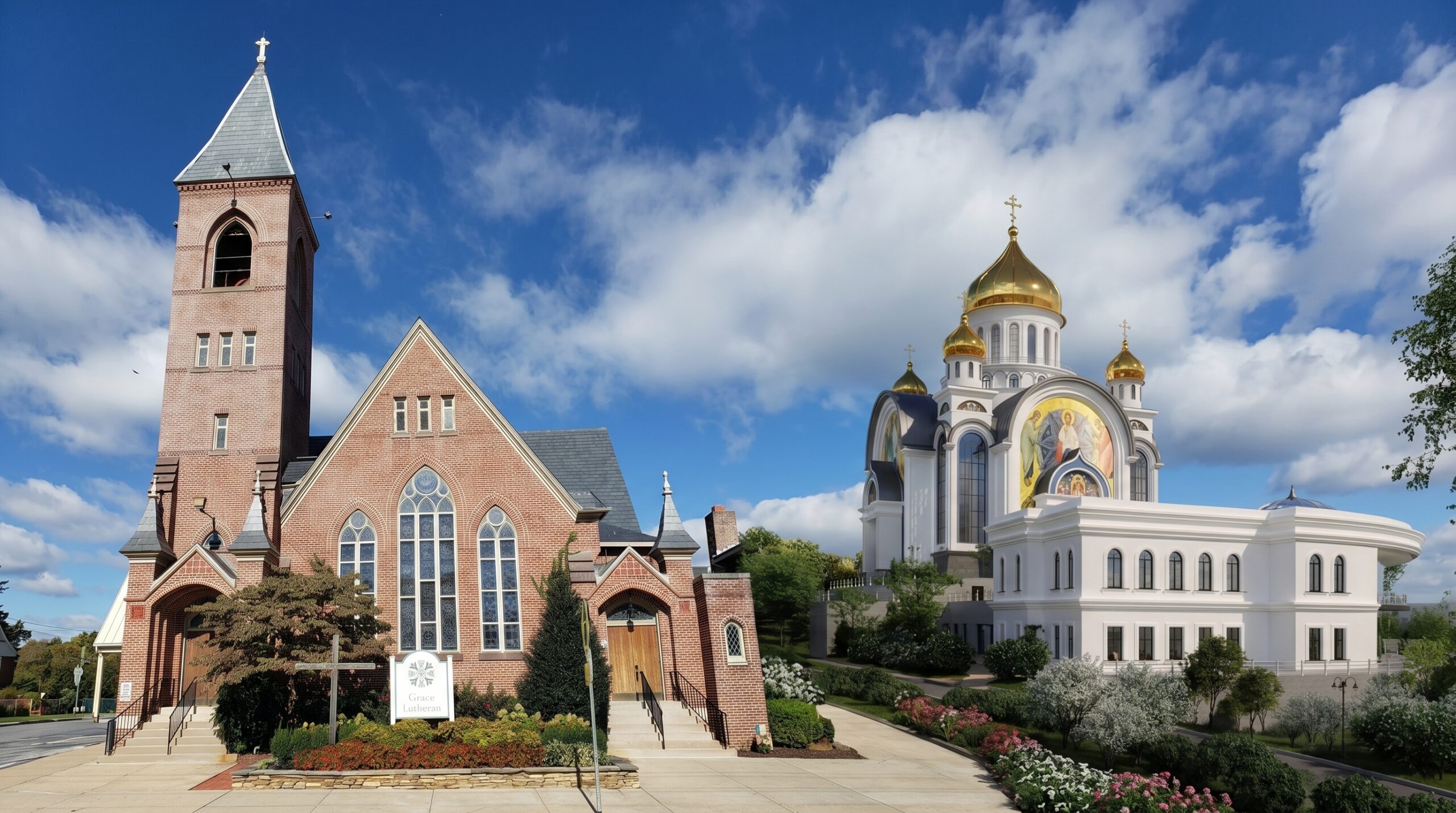
The Christian world is rich and diverse. When one person steps into an Eastern Orthodox church — where icons gild the walls and incense-laden smoke rises with the prayers — and another enters a Lutheran church resonating with Luther’s hymn “A Mighty Fortress Is Our God,” both may feel worlds apart. Yet at their core, both traditions speak of the same reality: Jesus Christ as Lord and Redeemer.
This article examines the theological, liturgical, and ethical differences and similarities between Eastern Orthodoxy and Lutheran Christianity, drawing on in-depth theological research, the outcomes of ecumenical dialogues, and primary source material from both traditions. The aim is not to favour one tradition over the other, but to foster an atmosphere of understanding and openness to dialogue, in which two confessions may come to know each other more deeply.
1. Historical Background: Where Do We Come From?
Eastern Orthodoxy
Eastern Orthodoxy is one of the oldest Christian traditions, with roots in the early Christian communities of Constantinople, Alexandria, Antioch, and Jerusalem. Its formal separation from Western Christianity is reckoned from the Great Schism of 1054, when the churches of Rome and Constantinople mutually excommunicated each other. Eastern Orthodoxy considers itself the direct continuation of the apostolic tradition, keeping alive the teaching of the patristic Fathers — Saint Basil the Great, John Chrysostom, and Gregory the Theologian.
Lutheranism
Lutheranism was born in 1517, when the Augustinian monk and theology professor Martin Luther nailed his 95 Theses to the door of the Wittenberg church. Luther’s aim was not to found a new church — he sought to reform the Roman Church from within. His central concern was the question: how can a sinful human being stand righteous before God? Luther’s answer — by faith alone, by grace alone, on the basis of Scripture alone (sola fide, sola gratia, sola scriptura) — became the cornerstone of Protestant Christianity. Lutherans hold the Book of Concord, compiled in 1580 and containing the Augsburg Confession, both catechisms, and other Lutheran confessional documents, as the standard of their faith.
2. The Doctrine of Salvation: Justification vs. Theosis
One of the most fundamental theological divergences lies in how each tradition understands salvation.
The Lutheran Perspective: Justification by Faith
Luther taught that a person is righteous before God by faith alone — not through works, sacraments, or the intercessions of saints. Sin is so deeply rooted in human nature (“totus homo est peccatum” — the whole person is sin) that the human will is incapable of turning toward God on its own. Grace is an initiative that comes entirely from God. Luther’s famous teaching “simul iustus et peccator” — simultaneously righteous and sinful — means that the believer is at once righteous (through the righteousness imputed by Christ) and sinful (by nature). This is a forensic — judicial — understanding of salvation: God declares the sinner righteous on account of Christ.
The Orthodox Perspective: Theosis, or Deification
Eastern Orthodoxy proceeds from an entirely different paradigm. Salvation is understood as a process called theosis, or deification. Athanasius of Alexandria expressed this with characteristic precision: “God became human so that humanity might become divine.” This does not mean that a person becomes God in essence, but that they participate in the divine energies (not the divine essence), as Gregory Palamas wrote in the fourteenth century. Salvation is a dynamic journey through stages of purification (katharsis), illumination (theoria), and glorification (theosis). Free will plays a significant role: a person may cooperate with God’s grace or refuse it — this is the doctrine known as synergism.
Common Ground: The Kiev Breakthrough of 1977
A landmark moment in the history of ecumenical dialogue is the so-called Kiev Breakthrough of 1977, when the Evangelical Lutheran Church of Finland and the Russian Orthodox Church discovered to their mutual astonishment that their deepest common ground lay in the parallel between justification and theosis. Helsinki professor Tuomo Mannermaa demonstrated that for Luther, the real presence of Christ in faith — “in ipsa fide Christus adest” — provided a reliable foundation for a mode of thinking analogous to theosis. Both traditions affirm that salvation is a genuine participation in the nature of God through Christ.
“Lutherans and Orthodox together affirm that salvation is a real participation in the divine nature, as Peter writes: ‘that you may become partakers of the divine nature.’ This takes place through our participation in the death and resurrection of the Lord in His body, in Whom all the fullness of God dwells.” — Lutheran-Orthodox Joint Commission, 1998
3. The Sacraments: Mysteries and Means of Grace
The Number of Sacraments
Eastern Orthodoxy recognises seven sacraments, or mysteries: baptism, chrismation (myron/chrism), the Eucharist, repentance, holy orders, marriage, and the unction of the sick. Lutherans are not dogmatic about the number of sacraments: traditionally three are recognised — baptism, the Eucharist, and confession/absolution — though some Lutheran churches acknowledge only two (baptism and the Eucharist). Luther himself noted that a wise person has no cause to dwell at length on the number of sacraments; what matters is that they contain God’s command and promise.
The Eucharist
Both traditions believe in the real presence of Christ in the Eucharist, though they explain it differently. Lutherans speak of sacramental union (unio sacramentalis): the body and blood of Christ are “truly, really, and substantially” present in, with, and under the consecrated bread and wine. This teaching is close to what is called consubstantiation, though Lutherans themselves prefer not to use that term, favouring instead the concept of “real presence” (Realpräsenz). Eastern Orthodoxy speaks of eucharistic transformation (metabole), but refuses to systematise it scholastically — it is a mystery that surpasses human understanding. Both traditions reject transubstantiation, which is the dogmatic formulation of the Roman Church.
Baptism
Both traditions baptise infants, and both believe in the saving power of baptism. For the Lutheran, “baptism works forgiveness of sins, delivers from death and the devil, and gives eternal salvation to all who believe” (Luther’s Small Catechism). In the Orthodox Church, baptism is immediately followed by chrismation with holy myron, through which the gift of the Holy Spirit is bestowed, and the infant is already admitted to the Eucharist. In Lutheran practice, confirmation takes place later, in adolescence.
4. Church and Authority: Scripture, Tradition, Office
Sola Scriptura vs. Scripture-Tradition as a Whole
Luther established Holy Scripture as the sole and final authority in all matters of faith (sola scriptura). Tradition is valuable — it helps one understand and proclaim Scripture — but it does not carry equal authority to Scripture itself. Eastern Orthodoxy does not draw such a sharp distinction between Scripture and tradition: the Bible is part of the holy tradition borne by the Church. The Church Fathers, the seven Ecumenical Councils, and liturgical life form the inseparable interpretive framework of Scripture.
The Papacy and the Patriarchate
Both traditions reject the authority of the Bishop of Rome together with his claim to infallibility. Luther called the papacy the Antichrist outright. Eastern Orthodoxy likewise rejected papal supremacy following the Schism of 1054. The Orthodox Church operates through a system of patriarchates, in which the Ecumenical Patriarch of Constantinople holds the position of “first among equals” (primus inter pares), but without absolute authority over the other autocephalous churches. Lutheran churches have no supranational ecclesiastical government — each church operates with congregational or ecclesiastical autonomy.
5. Worship and Liturgy
An Orthodox divine service is a rich sensory experience: the iconostasis separates the altar from the congregation, icons cover the walls, incense is burned continuously, the clergy wear magnificent vestments, and the service often lasts two to three hours. The liturgy is based primarily on the Divine Liturgy of Saint John Chrysostom. Eastern churches follow the Julian calendar, which means that feast days do not always coincide with those of the Western church.
The form of Lutheran worship varies considerably — conservative LCMS congregations celebrate a high liturgy with icons, incense, and vestments, while many evangelical Lutherans prefer a simple and culturally contemporary order of service. Luther preserved the beauty of early Christian liturgy, removing only those elements which he believed contradicted the Gospel.
6. Common Ground and Interconfessional Dialogue
Despite their differing theological emphases, the Lutheran-Orthodox Joint Commission has, since 1981, identified a substantial number of significant areas of common ground. In 1998, the joint statement “Salvation: Grace, Justification and Synergy” was signed, and in 2004, the statement “Baptism and Chrismation as Sacraments of Initiation into the Church.” The current phase of dialogue, which began in 2019, addresses the role of the Holy Spirit in the life of the Church.
In Luther’s own early writings there are noteworthy convergences with the Eastern Church. He referred repeatedly to the “Greek Church” as evidence that his Reformation was not an innovation, but a restoration of the early Christian Church. The authors of the Augsburg Confession assumed that Eastern Christianity had preserved the apostolic faith intact — untainted by the distortions of the Roman Catholic Church.
“Lutherans and Orthodox affirm that on the cross died the Word made flesh — our Lord Jesus Christ — for our sins, and that He rose for our justification. Both traditions hold this mystery of the cross at the centre of their spiritual life.” — Joint Commission Statement, 1998
Beyond their theological common ground, both traditions share a common concern: secularisation, the protection of family and life, the affirmation of human dignity, and the defence of the Christian cultural heritage in Europe. These practical areas of agreement provide a basis on which the confessions may work together — even though full sacramental unity remains a distant prospect.
7. Conclusion: One Lord, Two Emphases
Eastern Orthodoxy and Lutheranism are not opposites — they are two different windows through which the same light shines. Orthodoxy emphasises salvation as a journey toward holiness, as deification, and as liturgical experience. Lutheranism emphasises salvation as God’s free gift, given by faith alone, and proclaims the good news of the complete forgiveness of sinners on account of Christ.
Both speak of the Triune God; both hold to the Nicene Creed; both baptise those who turn to faith and celebrate the Lord’s Supper. The disputes between them — such as the question of free will, the number of sacraments, and ecclesiastical authority — are serious, but they must not be allowed to overshadow what the two traditions share: faith in the crucified and risen Jesus Christ, who is the only way, truth, and life.
The ecumenism of the future does not consist in erasing doctrinal differences, but in deepening mutual understanding — so that each tradition may be enriched by the treasures of the other. As the Kiev encounter of 1977 showed, the two paths — theosis and justification — are both directed toward the same destination: the heart of God.
© 2026 — All rights reserved. This article has been compiled for the purpose of ecumenical dialogue.

Martinus Vaicarius’s mission is to:
- Provide spiritual support and guidance to people seeking peace and hope
- Create prayer texts that bring God’s peace to hearts suffering under fear and anxiety
- Promote deep understanding of the power of the
- God of Sabaoth and the protection of the heavenly hosts
- Help people enter the spiritual sphere where God’s peace reigns over all
AICortex Invest OÜ
- Spiritual Warfare: From the Abyss to Glory — A Practical Guide to Overcoming Satan - 27. Jul 2026
- The Hierarchy of Angels: 9 Ranks, Names, and Duties Explained - 25. Jul 2026
- HCHC Launches “The Catechist: The Art of Listening and Teaching” — New Orthodox Certificate Program for 2026–2027 - 24. Jul 2026