
Views: 30
The Historical Jesus Christ: Examining Ancient Sources, Biblical Accounts, and Archaeological Evidence of His Life and Ministry
Introduction
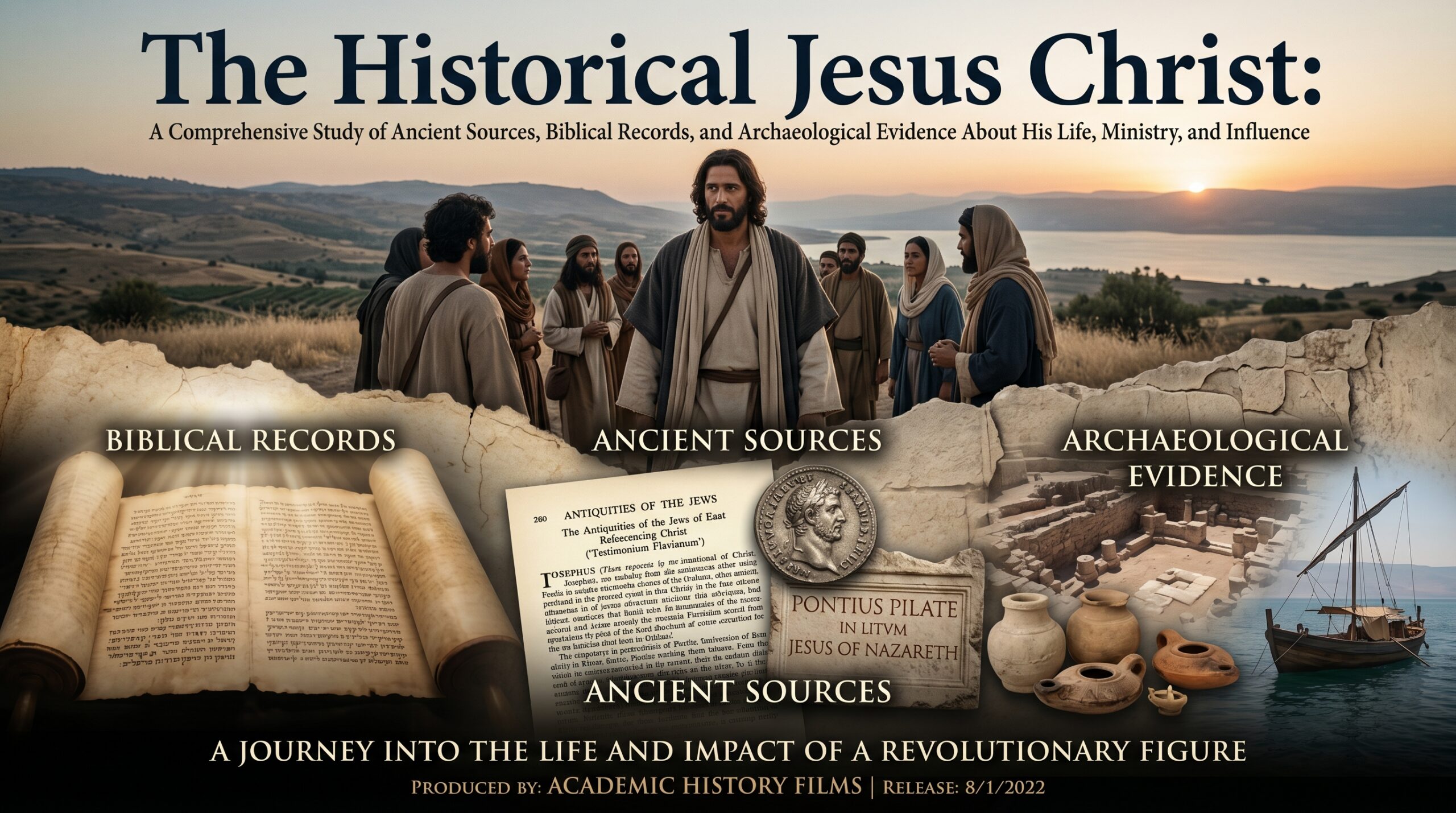
Jesus Christ is one of the most influential figures in human history. His life and teachings have shaped Western culture, ethics, art, and philosophy for over two thousand years. This article provides a deep analysis of the historical Jesus, drawing not only from the Bible but also from independent ancient sources and archaeological findings. We explore Jesus as a historical figure — a wise teacher, miracle worker, and a man who faced suffering — who left a profound impact. We critically analyse the biblical texts, include specific scripture references, expand on Jesus’ personality, and examine both the Bible and ancient sources. We also present quotes from the Church Fathers and archaeological evidence presented as established facts.
Non-Christian Ancient Sources on Jesus
Although the Bible is the primary source, Jesus’ existence is also confirmed by Roman and Jewish historians who were not Christians and had no motivation to promote Christianity.
Flavius Josephus (37–100 AD), the Jewish historian, mentions Jesus twice in his work Antiquities of the Jews. The famous Testimonium Flavianum (Book 18, chapters 63–64) states in part:
“About this time there lived Jesus, a wise man, if indeed one ought to call him a man. For he was a doer of wonderful works… He was the Christ. And when Pilate, at the suggestion of the principal men among us, had condemned him to the cross, those that loved him at the first did not forsake him… He appeared to them alive again the third day…”
The second reference (Book 20) speaks of the execution of James (Jesus’ brother): “…he assembled the Sanhedrin and brought before them the brother of Jesus, who was called Christ…” This confirms Jesus’ existence and family connections.
Tacitus (56–120 AD), the Roman historian, writes in Annals (15.44) about Nero’s persecution:
“Christus, from whom the name had its origin, suffered the extreme penalty at the hands of our procurator Pontius Pilatus during the reign of Tiberius.”
This confirms Jesus’ execution by Pontius Pilate under Roman authority in Judea.
Pliny the Younger (112 AD) describes Christians gathering and singing hymns to Christ “as to a god.” These sources show that Jesus was a real figure in the early 1st century whose movement spread rapidly despite persecution.
Biblical Analysis: Jesus’ Life, Ministry, and Personality
The Bible, especially the four Gospels, offers the most detailed account. Jesus appears as a complex figure: fully human (hungry, tired, weeping) and yet divine (miracle worker, forgiver of sins).
- Birth and Early Years: Matthew 1–2 and Luke 2 describe the birth in Bethlehem. Luke 2:52: “And Jesus grew in wisdom and stature, and in favour with God and man.”
- Ministry: Jesus began his public ministry around the age of 30 (Luke 3:23). Mark 1:15: “The time has come… The kingdom of God has come near. Repent and believe the good news.” He taught love (Matthew 22:37–39 – the greatest commandment), forgiveness (Matthew 6:14–15), and righteousness (Matthew 5–7, the Sermon on the Mount).
Jesus’ personality is revealed in his compassion: he touched lepers (Mark 1:40–45), spoke with women (John 4), and forgave sinners (John 8:1–11). At the same time, he was radical: “Do not suppose that I have come to bring peace to the earth. I did not come to bring peace, but a sword” (Matthew 10:34) — referring to spiritual struggle against the existing order.
- Miracles and Teaching: John 11:25–26: “I am the resurrection and the life.” The raising of Lazarus (John 11) is one of the most powerful examples.
- Death and Resurrection: 1 Corinthians 15:3–4: “Christ died for our sins… he was buried, and he was raised on the third day…” Matthew 27–28, Mark 15–16, Luke 23–24, and John 19–21 describe the events in detail. The resurrection is the core of Christianity — it transforms Jesus from a mere teacher into the Messiah.
The Bible portrays Jesus as the perfect man who suffered for humanity while remaining faithful to his mission.
Quotes from the Church Fathers
Early Church Fathers confirm the apostolic tradition:
Ignatius of Antioch (c. 35–107 AD), in his Letter to the Ephesians:
“There is one Physician who is possessed both of flesh and spirit; both made and not made; God existing in flesh; true life in death; both of Mary and of God; first passible and then impassible — Jesus Christ our Lord.”
Justin Martyr (c. 100–165 AD) emphasises Jesus’ divinity and humanity in his apologetic works, referring to prophecies in Daniel and Isaiah.
These quotes demonstrate that the early Church already viewed Jesus as the divine Saviour in the 1st–2nd centuries.
Archaeological Evidence
Archaeology supports the biblical context as historical facts:
- Pontius Pilate Stone (discovered 1961 in Caesarea): The inscription confirms “Pontius Pilate, Prefect of Judea.” This verifies the existence of the Roman governor mentioned in the Bible at the time of Jesus’ crucifixion.
- Caiaphas Ossuary (discovered 1990 in Jerusalem): An ornate bone box inscribed “Joseph, son of Caiaphas.” Caiaphas was the high priest involved in Jesus’ trial (John 18). The bones belong to a man about 60 years old, matching the historical period.
- Other finds, such as the crucified heel bone of Yehohanan, confirm the practice of crucifixion in 1st-century Judea.
These discoveries do not directly prove miracles, but they establish the historical framework: the people, places, and customs in the Bible are real.
Broader Analysis of Jesus’ Personality
Jesus was not merely a moral teacher. He presented himself as the Son of God who came to seek the lost (Luke 19:10). His personality combines humility (the Canaanite woman’s daughter – Mark 7) with authority (cleansing the temple – John 2). He changed history by inspiring a movement based on the ethics of love that grew despite persecution.
In today’s world, his teachings offer answers to individualism, injustice, and existential crisis. Loving one’s enemies (Matthew 5:44) remains a radical call.
Conclusion
The historical Jesus Christ is strongly attested through the Bible, ancient sources (Josephus, Tacitus), and archaeology (Pilate, Caiaphas). He was a 1st-century Judean teacher who proclaimed the Kingdom of God, performed miracles, suffered, and through his resurrection changed the world. This in-depth analysis shows that faith in Jesus rests on a solid historical foundation that invites every person to a personal encounter with Him.

Martinus Vaicarius’s mission is to:
- Provide spiritual support and guidance to people seeking peace and hope
- Create prayer texts that bring God’s peace to hearts suffering under fear and anxiety
- Promote deep understanding of the power of the
- God of Sabaoth and the protection of the heavenly hosts
- Help people enter the spiritual sphere where God’s peace reigns over all
AICortex Invest OÜ
- Dormition Fast 2026: When It Begins, When It Ends, and How to Fast Rightly - 2. Aug 2026
- The Nevsky Cathedral on Toompea: A Century-Old Dispute Over a Symbol of Russification - 1. Aug 2026
- The Meaning and Power of Prayer in Christianity: Biblical Teaching and the Wisdom of the Church Fathers - 29. Jul 2026