
Views: 20
The Hypostasis of the Holy Spirit – Meaning, Theology, and the Trinity
I. The Spirit in Byzantine Theology
In Byzantine theology, the Holy Spirit has held a more personal role, treated as a person — both from a soteriological standpoint (the theology of redemption) and from that of the creative power and sanctifying hypostasis of the Triune God. The Spirit of God participates in the world as the executing force, glorifying the Son within us and imparting to us what belongs to Christ. In the teachings of the Byzantine Church Fathers and saints, the Holy Spirit has been expressed in more personal terms than was customary in the West for centuries. The Byzantine theological and patristic conception of the Spirit of God and the Trinity holds similarly true today, both in the West and in the East.
With the Pentecostal movement that began in the West in the twentieth century, the Spirit has come to be treated more as a personified being, and it is misleading to describe Him solely as an executing force rather than as a person. This treatment concerns the person, essence, and activity of the Holy Spirit alike. The Holy Spirit is enthroned together with the Father and the Son. He proceeds from the Father through the Son and glorifies the Son; taking from Christ as the Logos, the Spirit reveals to us the light of Mount Tabor and the glory of the Lord’s Transfiguration. The end of the soul’s salvation process is the sanctification of the soul, through which one attains grace and, through striving, reaches Eternal Life. “It is the Spirit that giveth life” (John 6:63).
The experience of the Spirit was emphasized more forcefully during the Byzantine period than in the West during the same era. The emphasis on and personification of the Spirit that accompanied the Pentecostal movement, beginning in the twentieth century, took hold more intensely and drew great multitudes, standing in contrast to the earlier Eastern conception of the monastic acquisition of the Spirit. Yet the task of the Holy Spirit remains the same — to reveal the Son. The Spirit Himself remains one of the hypostases of the Trinity — a Person of Power. He is uncreated, invisible, almighty, an incomprehensible God, and at the same time the executing Power that works through the Son, who baptizes and glorifies creation.
The personal existence of the Holy Spirit, and His role as the Voice of God and mediator of the gifts of the Spirit, have remained undefined throughout the history of religion. In the twenty-first century, personal revelation continues. At this present moment, a phenomenon is emerging in which the Spirit spreads like a network among the nations, illuminating the will of the Triune God within each person’s individual consciousness. He descends and fills a new generation of believers with baptizing and sanctifying power. Just as the development and evolution of consciousness occur through the stimulation of the higher regions of the brain toward improved function, so too does the Holy Spirit illuminate new perspectives in the substantive development of theology and religion. The Spirit carries out God’s plan on earth, participating as a powerful and creative Person and revealing the presence of God in reality.
This is the anointing of the Spirit, which liberates those who are bound — it is the presence of the Trinity through the Holy Spirit, which transforms both the person and reality.
The Spirit cannot be approached with religious conservatism — He is always new and fresh, like the wind. The existence of the Spirit’s hypostasis within a person is the existence of the Triune God Himself, realized through Christ-Logos-Messiah. The revelation of the Byzantine Church Fathers and the mystical theological imperative address a similar interpretation. The hypostasis of the Spirit (one Person of God) is a personal revelation within the human being. The Trinity cannot ultimately be comprehended — the Spirit reveals and illumines Himself through consciousness. Understanding illumination opens to us broad and analyzable pneumatological perspectives. The Spirit is not treated here as an energy; rather, this follows the teaching of the Desert Fathers on the energies. Faith is a substance that allows the boundaries of spiritual and theological development to be expanded, and let this be the manifestation of the Eternal Spirit’s own Person within us, through sanctification.
II. The Spirit in Creation
Since the Spirit’s activity gives life in Christ, He cannot be a created being — He is truly of one essence with the Father and the Son. This argument was used as a foundation both by Athanasius in his Letters to Serapion and by Basil in his treatise On the Holy Spirit. The personal power of the Holy Spirit is the existence of God Himself, working and made effective through Christ, that is, the Messiah. Through Christ, the Word of God, and the Spirit, rebirth takes place: “Except a man be born of the Spirit, he cannot enter into the kingdom of God” (John 3:5). The Trinity creates through the Son and brings to perfection through the hypostatic power of the Holy Spirit: “That which is born of the Spirit is spirit” (John 3:6).
The Spirit was present at creation — Scripture writes: “the Spirit of God moved upon the face of the waters” (Genesis 1:2) — and continues to sanctify creation, bringing forth the logical order of the universe through the Son, that is, Christ (the Logos). “In the beginning was the Word, and the Word was with God, and the Word was God; all things were made through him” (John 1:1–3). The Holy Spirit’s original, creative function has remained the same even after the act of creation, in which the Light and the Word, who is Christ, proceeded from the Triune God. Through this, the hypostasis of Christ was distinguished from that of God the Creator Father, and the hypostasis of the Spirit, through Christ, carried out the act of creation. The Holy Spirit is manifest after creation in ordering the universe and participating in the sanctification of matter. In personal faith, the Holy Spirit acts as a corrective and executing power, granting rebirth and bestowing gifts through the Son and Christ, sanctifying the believing soul.
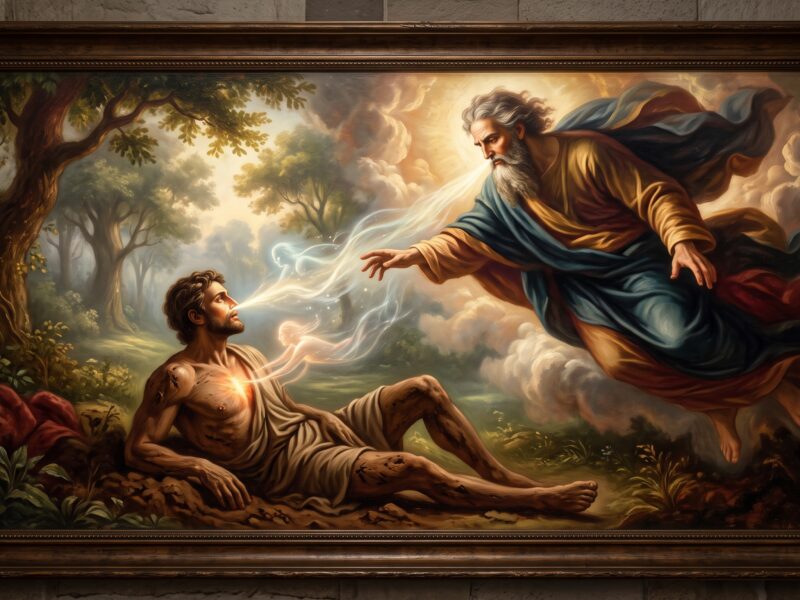
Under the influence of the Septuagint, the breath of God was identified with the Holy Spirit, which makes the human being the image of God and a hypostatic dwelling place. The Holy Spirit purifies us and brings the Kingdom to fulfillment in the world. He comes upon us and “dwelleth with you, and shall be in you” (John 14:16–17), and preserves creation from decay (see Gregory of Nyssa). The original paradisiacal relationship with God is proclaimed anew, which is possible only through the sanctifying aspect of the Spirit, in a person’s rebirth, redemption, and purification. This may be regarded both as a divine act and as a process by which the Spirit leads toward complete salvation in illumination. No one before has described redemption as a process. The Spirit baptizes and, through the Son, bestows rebirth, yet after the moment of salvation a person is passively justified through faith, while the soul continues to sin. The Spirit redeems the human soul through a process of progress and purifies it through the Blood of Christ and the Word of God. As purification is a process, so too is the salvation of the soul. A person’s spirit is saved through rebirth, while the soul remains within the process of salvation. Through the hypostatic presence and power of the Spirit within a person’s spirit, the original and natural relationship between God, humanity, and creation is restored.
III. The Spirit as Redemption
According to John of Damascus, the Spirit of God is “direct, ruling; the source of wisdom, holiness, and life; God existing, to whom, together with the Father and the Son, worship is directed; uncreated, complete, creative, ruling over all, effecting all, almighty, of infinite power, Lord over all creation and Himself subject to nothing; deifying, not deified; fulfilling, not fulfilled; distributing, not distributed; sanctifying, not sanctified” (De fide orthodoxa I, 8; PG 94:821BC).
In the sacrament of baptism, the Holy Spirit, through the anointing with chrism, tears a person away from the devil, and He, as the Person enthroned with the Father and the Son, baptizes the human spirit unto rebirth with fire: “I indeed baptize you with water; he shall baptize you with the Holy Ghost” (Mark 1:8; Matthew 3:11), “He shall baptize you with the Holy Ghost, and with fire” (Matthew 3:11). The unbegotten Father brings the process of salvation and repentance to its completion.
The hypostases of Christ and the Holy Spirit both participate in the complete transformation of every person’s nature into a new creation. Christ continues to exist as a hypostasis within the person, and, according to the understanding of the Pentecostal movement, these inner persons exist dually — they are always present, to whom one may turn. It must not, however, go unmentioned that the Father is revealed to us through the Spirit, who is in turn revealed through the hypostatic nature of the Son within us — a nature that becomes our own at the moment of salvation. The Holy Spirit is the bond between us and the Trinity, through which we may draw near to all three Persons, though all three are made manifest through the grace-power and energy of the Spirit, by way of the Son. The personal, hypostatic functions of Christ and the Spirit are not identical. Tradition holds that one should distinguish, within God, a single indivisible and inaccessible essence, three hypostases, and the grace, power, and energy through which the Triune God enters into communion with creation.
In Orthodoxy and Catholicism, the Holy Spirit is addressed in much the same eloquent manner as the Redeemer is addressed. The prayer canon calls Him “Heavenly King,” “Thou who art everywhere present and fillest all things… the Giver of Life,” and “the divine being”; Symeon the New Theologian likewise describes Him as “unmingled…”
(The text breaks off here in the original document.)
Translator’s notes:
- Scriptural quotations follow the King James Version (KJV), matching the register of the source text’s biblical citations.
- Latin/Greek theological terms (De fide orthodoxa, PG reference) retained in their standard scholarly form.
- Patristic names rendered in their standard English forms (Athanasius, Basil, Gregory of Nyssa, John of Damascus, Symeon the New Theologian).
- Sentence structure occasionally reorganized for natural English flow, without altering theological content or argumentation.

Trough all this I want to declare this is all from God and to God. All Glory to Him!
- God-Man – The Bible Reveals: The Secret of Human Creation No One Talks About - 23. Aug 2026
- September 1: The Beginning of the Ecclesiastical New Year, or the Indiction — The First Day of the Orthodox Liturgical Year - 21. Aug 2026
- Mother of God, September 8, 2026: The Nativity of the Theotokos — Celebrating the Birth of the Virgin Mary - 20. Aug 2026