Views: 667
The Ethiopian Bible: The Tewahedo Canon of 88 Books – History, Lost Texts, and Differences from Western Bibles
The biblical canon of the Ethiopian Orthodox Tewahedo Church is the most expansive collection of scripture in the history of Christianity. This article traces its formation, unpacks the 81-versus-88-book question, examines lost texts such as the Book of Enoch and the Book of Jubilees, and explores its profound differences from Western Bibles.
Introduction: The Scripture of Christianity’s Forgotten Branch
When a Western Christian first hears that the Ethiopian Orthodox Tewahedo Church has a Bible containing more books than the Catholic or Protestant traditions, the reaction is usually twofold: disbelief and curiosity. Disbelief, because in the standard narrative of Western church history the biblical canon feels like a question that was settled once and for all — the Council of Trent for Catholics, the Reformation for Protestants. Curiosity, because the fact itself is historically striking: the Ethiopian church, established as early as the fourth century in the Kingdom of Aksum, has preserved a collection of scripture that exceeds anything known in the West, both in volume and in content. Where the Protestant Bible contains 66 books and the Catholic, Vulgate-based canon 73, the Ethiopian Tewahedo Church speaks of 81 books — and the number 88 is frequently mentioned as well, raising still more questions.
This article sets out to offer a balanced, source-grounded, and analytical overview of what the Ethiopian Bible actually is, how it took shape, why both the numbers 81 and 88 appear in connection with it, which of its “lost” texts are best known, and what all of this means for a broader understanding of Christian scripture. This is not an exotic detour into the margins of Christian tradition — it is a mirror that reveals something important about how the biblical canon came to be at all: a process far more complex, far slower, and far more regionally varied than is commonly assumed.
The Aksumite Legacy: Christianity’s Roots in the Horn of Africa
The story of Ethiopian Christianity does not begin with a late missionary effort; it is one of the oldest continuous Christian traditions in the world. According to tradition, Christianity was brought to the Kingdom of Aksum in the fourth century by Frumentius, who was consecrated as Aksum’s first bishop by Athanasius, Patriarch of Alexandria. This tie to Alexandria is decisive: the Ethiopian church remained under the jurisdiction of the Coptic Orthodox Church for centuries and did not gain its own independent patriarchate until 1959. This Alexandrian connection explains why the Ethiopian canon shares much in common with the Coptic tradition and the wider Eastern churches, while nonetheless developing along its own isolated path — one that the theological debates and councils of the Mediterranean world (Nicaea, Constantinople, Chalcedon) did not shape in the same way they shaped the Byzantine or Roman churches.
It is precisely this geographic and political isolation that holds the key to understanding the Ethiopian canon. While Western European Christianity moved gradually toward a more unified canon — a process that only reached its final form at the Council of Trent in 1546 — the Ethiopian church continued to shape its own body of scripture independently, drawing on texts translated into Ge’ez that derived both from the Septuagint and from Jewish pseudepigraphal literature that other churches had long since set aside. Ge’ez, which today functions as a liturgical language much as Latin does in the Catholic tradition, became the sole surviving complete version for many of these texts — a fact of enormous significance for modern biblical scholarship.
81 Versus 88: Untangling the Confusion Over Numbers
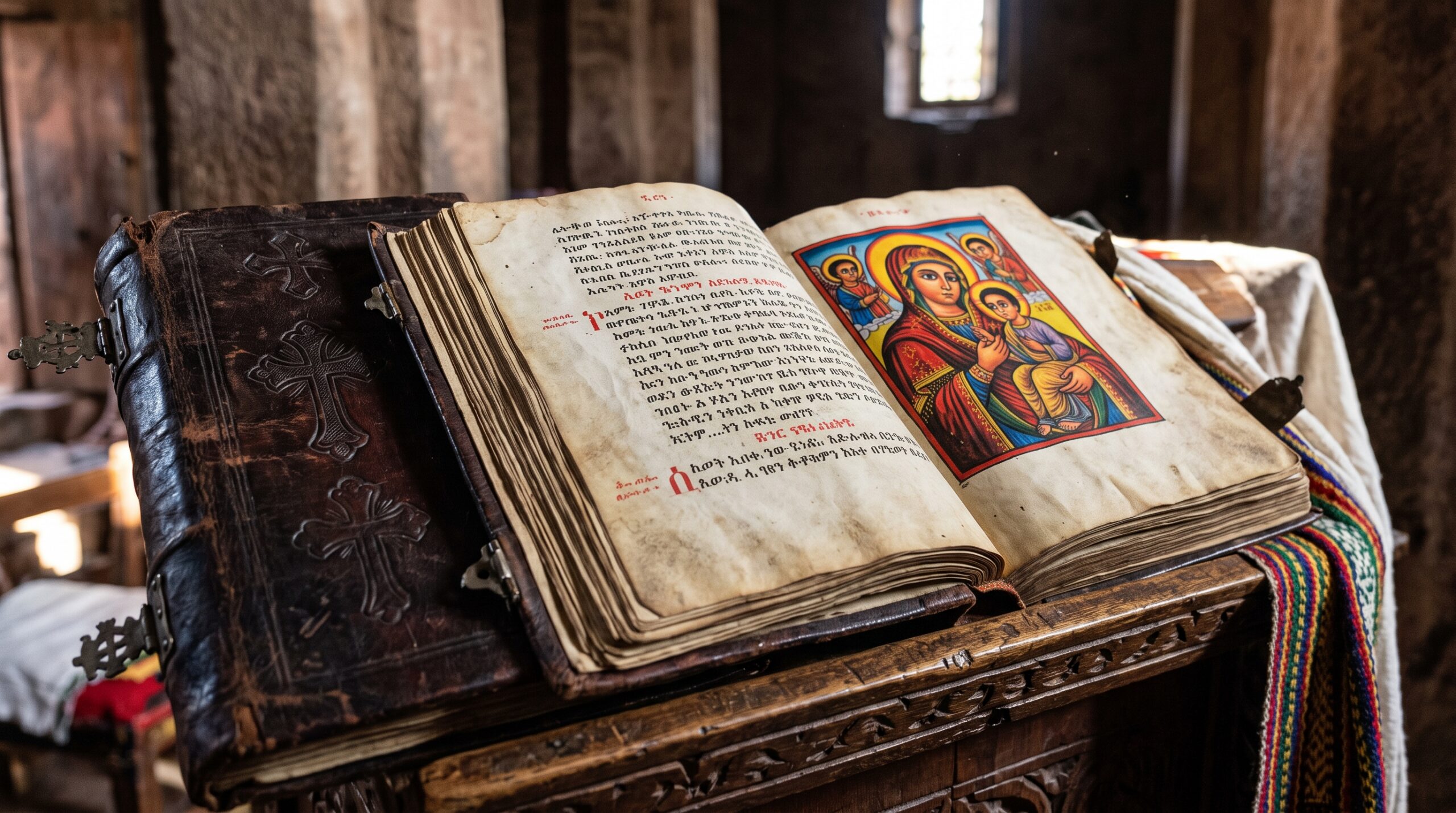
The question asked most often about the Ethiopian Bible is simply one of arithmetic: are there 81 books, or 88? The answer is more nuanced than headlines usually allow. The officially recognized canon of the Ethiopian Orthodox Tewahedo Church consists of 81 books: 46 in the Old Testament and 35 in the New Testament. This is the figure the church itself uses in its catechesis and liturgy, and it makes the Ethiopian canon the largest actively used biblical canon in all of Christianity — surpassing the Catholic canon of 73 books and the Protestant canon of 66.
The number 88 arises from an entirely different logic. Western scholars have classified the Ethiopian canon into two categories: a “narrower canon,” containing books more familiar to Western readers, and a “broader canon,” which adds further texts. When church-order texts are counted alongside the 81 — the Sinodos (a collection of apostolic canons), the Epistles of Clement (Clementos), and the Didascalia (an early Christian instructional handbook) — the total frequently reaches 88 or higher. These texts are deeply revered within the Ethiopian church and studied extensively by its clergy, but their formal status differs from that of the “canonical” books proper: they function more as ecclesiastical-legal and liturgical texts than as scripture in the narrower sense. This distinction matters. The Ethiopian church itself has never formally ratified the number 88, whereas the number 81 has been repeatedly confirmed in official canon lists and in the Fetha Nagast — a thirteenth-century code of ecclesiastical and civil law that also contains a canon list and remains one of the most important institutional sources for the Ethiopian canon to this day.
The figure of 88 circulates so widely online partly because several commercial English-language editions — such as “The Complete Ethiopian Bible in English (88 Books)” — have popularized the number, even though scholars and the Ethiopian Orthodox Bible Project have repeatedly warned that many such “complete” editions are in fact incomplete, padding out untranslated books with filler material or offering uneven translation quality. For the analytical reader, there is an important lesson here: popular web sources and commercial editions tend to simplify numbers and facts in ways that do not accurately reflect the church’s own official position.
Lost Texts: The Book of Enoch, the Book of Jubilees, and Meqabyan
The most fascinating part of the Ethiopian canon, for a Western reader, is undoubtedly the set of books that exist elsewhere in Christianity only as fragments, or not at all, but which the Ethiopian church has preserved in full in Ge’ez.
The most famous of these is the Book of Enoch (1 Enoch), a Jewish apocalyptic text most likely dating from the last centuries before Christ. In the West it was known for a long time only through quotations in the Church Fathers and fragments found at Qumran, until the Scottish traveler James Bruce brought back three manuscripts containing the complete text from Ethiopia at the end of the eighteenth century. The Book of Enoch is theologically significant for several reasons: it develops in detail the myth of the “Watchers,” or fallen angels (briefly mentioned in Genesis chapter 6), offers an elaborate cosmology and astronomy, and contains vivid imagery of the Day of Judgment and a messianic “Son of Man” figure that clearly influenced New Testament writings — the Epistle of Jude quotes the Book of Enoch directly (Jude 1:14–15), which grants the text a unique authority within the Ethiopian tradition, even though other churches set it aside precisely because it fell outside the Jewish Tanakh’s canon.
The Book of Jubilees (also known as “Lesser Genesis”) is another important text — a retelling of the events of Genesis and part of Exodus, structured around 49-year “jubilee periods,” offering a detailed calendrical system and expanded narratives about the patriarchs. This text, too, was found at Qumran only in fragments, while its complete form survived solely in Ge’ez.
Third, the Meqabyan I–III deserve mention. These are often mistakenly called the “Ethiopian Books of Maccabees,” though they differ substantially in content from the Greek Books of Maccabees known in the Catholic and Orthodox traditions. The Meqabyan books recount an entirely different, later conflict, and their historical connection to the actual Maccabean revolt is indirect — a matter of shared naming rather than shared content.
Alongside these, the Ethiopian canon also includes 4 Baruch (the Paralipomena of Jeremiah) and additional versions of the books of Ezra and Baruch that differ from the texts known in the West in both length and detail. On the New Testament side, the canonical 27 books are joined by eight books of Church Order, bringing the Ethiopian New Testament to a total of 35 books.
Theological and Christological Differences
The differences between the Western and Ethiopian Bibles are not confined to the number of books — they reflect deeper theological emphases. The Ethiopian Tewahedo Church belongs to the Oriental Orthodox family and holds to a miaphysite Christology, according to which the divine and human natures in Christ are united into a single nature (“mia physis” in Greek) without confusion or separation — a position that differs from the formulation of the Council of Chalcedon (451), which was adopted by both the Roman Catholic and Eastern Orthodox churches. This Christological separation, which occurred as early as the fifth century, meant that the Ethiopian church did not take part in the later Western and Byzantine theological debates that went on to shape the Catholic and Orthodox canons further.
In addition, Ethiopian religious tradition carries a strong connection to the Old Testament and to Jewish practice that is considered unusual in the West: it includes dietary laws, the observance of the Sabbath alongside Sunday, and a tradition holding that the Ark of the Covenant resides in the Church of Our Lady Mary of Zion in Aksum — every Ethiopian church keeps a symbolic replica of it, called a tabot, which occupies a central place in the liturgy. This “Old Testament” character is no accident: it reflects a canon that retained more layers of Jewish heritage than the later Western theology that developed intertwined with Greco-Roman philosophy.
The Broader Lesson of Canon Formation
From an analytical standpoint, the Ethiopian canon serves as an important reminder that the formation of the biblical canon was not a single event but a process spanning centuries and varying by region. In the West, “the Bible” is often spoken of as though it were a fixed, universal quantity, but history reveals something more complicated: early Christian communities in Syria, Egypt, Armenia, and Ethiopia arrived at their own bodies of scripture along different paths, drawing on local manuscript traditions, liturgical practice, and the authority of the Church Fathers. Augustine and other Western church fathers debated the boundaries of the canon for centuries before the Council of Trent finally settled the matter for Catholics; the Eastern churches, for their part, still have not adopted a single uniform canon across all their branches to this day. The Ethiopian case is the most extreme expression of this diversity, but far from the only one.
This knowledge should not weaken trust in scripture — rather, it should deepen our understanding of how God has spoken through different peoples and cultures throughout history, and of how the Church, in its broader, global sense, has had to distinguish across history between what is spiritually valuable and worth reading and what carries full canonical authority as a foundation for faith and doctrine. Church Fathers such as Origen and Jerome were already debating, as early as the third and fourth centuries, which texts should be considered “canonical” and which merely “ecclesiastical” — useful, but not a foundation of faith — a distinction that is directly reflected in Ethiopia’s own division between narrower and broader canon.
Practical Application: What This Means for Believers Today
What should an ordinary Christian outside the Ethiopian tradition make of all this? First, it calls for humility before biblical scholarship. The history of the canon teaches that scripture reached us through a human, historical process that God guided but that was neither simple nor straightforward. This does not undermine the authority of scripture — on the contrary, it shows just how carefully and seriously the early Church weighed the question of which texts carry the authority of God’s Word.
Second, texts such as the Book of Enoch and Jubilees can be valuable as historical and theological context, helping us understand the background of the New Testament — for instance, what Jewish apocalyptic thought looked like in Jesus’s own time — without needing to be treated as equal to canonical scripture. Even those Church Fathers who knew and quoted the Book of Enoch, such as Tertullian, approached it with caution, and the later Church, in most traditions, did not admit it into the canon.
Third, the survival of Ethiopian Christianity across the centuries — in isolation, surrounded by the expansion of Islam and later by colonial pressures — is itself a testimony to the resilience of faith. It is the story of a community that held fast to its scripture and its identity even as the world around it changed radically.
Conclusion
The Ethiopian Tewahedo Bible is not a strange departure from the “proper” scripture of Christianity, but a window onto how rich and varied the early Christian world was before later councils and the printing press froze canons into their modern shape. The number 81 is the church’s own official position; the number 88 reflects a broader tradition that includes church-order texts, one that Western scholars and publishers have popularized. The Book of Enoch, Jubilees, and Meqabyan offer a rare window into a Jewish and early Christian world of thought that has largely been lost elsewhere. And this entire tradition reminds us that the Word of God has spoken throughout history through many languages, cultures, and church communities — and that humble, honest inquiry into how scripture reached us ultimately strengthens, rather than weakens, our trust in it.
A Prayer for Wisdom in Understanding Scripture
Lord, all-knowing God, who has spoken to us across the ages through different peoples and languages — grant us wisdom to grasp the depth of Your Word and humility before its history. Help us to treasure the richness Your Church has preserved through the centuries, and to discern truth from error, without losing respect for those brothers and sisters who have carried the faith forward along different paths than our own. Open our hearts and minds before Your truth. Amen.
A Prayer for the Unity of the Church
Triune God, Father, Son, and Holy Spirit, who are one, though Your Church has divided across history into many branches and traditions — call us to see our brothers and sisters in Ethiopia, Egypt, the East, and the West as members of the one Body of Christ, despite our differences in canon, language, and custom. Grant us the grace to seek unity in truth and love, not in uniformity, and strengthen our faith that Your Word bears fruit in every language it has reached. Amen.

Trough all this I want to declare this is all from God and to God. All Glory to Him!