Views: 2
What Is Orthodox Christianity? The Unchanging Ancient Faith Explained: History, Teachings, and Why Millions Are Converting
A theologically and historically evidence-based article grounded in deep research
“What is the purpose of the Church? To be the Body of Christ in the world — not an institution, but a living organism that carries divine life through history.” — Alexander Schmemann, the greatest Orthodox theologian of the 20th century
Imagine walking into a church filled with billowing clouds of incense, icons gleaming with gold, ancient chants repeating in a rhythm more than a thousand years old, and a liturgy unchanged since the time of the apostles. Not merely aesthetically — but theologically, dogmatically, spiritually. This is Orthodox Christianity (Orthodoxia, in Greek: Ὀρθοδοξία — right belief, right worship).
In the 21st century, as Western Christianity loses members faster than ever before, Orthodoxy is growing globally. In the United States, the New York Times has written of “an unprecedented generational wave of conversions”; across Europe, young people are seeking the authenticity of the ancient Church. Why?
This article is your complete guide: what Orthodox Christianity is, where it comes from, what it teaches — and why it speaks to people who have lost their spiritual home in the modern world.
1. What Is Orthodox Christianity? — The Answer Hidden in the Greek
The word “Orthodox” is the translation of the Greek word Ὀρθοδοξία (Orthodoxia). It is composed of two words:
-
ὀρθός (orthos) — right, straight, true
-
δόξα (doxa) — belief, understanding, but also glory, splendour, worship
Thus Orthodoxia literally means two things simultaneously: right belief and right worship. This duality is not accidental — in the Orthodox tradition, theology and worship are inseparable. You cannot truly understand your faith outside of the liturgical community.
Orthodoxy is one of the three great families of the Christian faith, alongside the Roman Catholic Church and the Protestant tradition. Approximately 260–300 million people worldwide consider themselves Orthodox. They live primarily in Greece, Russia, Serbia, Romania, Bulgaria, Ethiopia, Egypt, and the Middle East — but increasingly also in Western Europe and America.
The Orthodox Church identifies itself as the Church that Jesus Christ founded, that the apostles built, and that the Church Fathers defended through the councils of the early centuries.
2. History: How Orthodox Christianity Came to Be — From the Apostles to the Present Day
2.1. The Beginning: Apostolic Communities (1st–4th Centuries)
Orthodoxy does not see itself as a “new movement” or a community born of the Reformation. It believes itself to be the apostolic Church — the Church that Christ founded through the 12 apostles. There is concrete evidence for this conviction: apostolic succession (apostoliki diadokhi, in Greek: ἀποστολικὴ διαδοχή) — an unbroken chain of bishops stretching from the apostles to the present day.
The earliest church centres — Constantinople, Alexandria, Antioch, Jerusalem, and Rome — formed the Pentarchy (Πενταρχία), a system of five patriarchates, each preserving a precious portion of the apostolic inheritance.
2.2. The Seven Ecumenical Councils: The Crystallisation of Dogma (4th–8th Centuries)
Orthodoxy recognises the absolute authority of the seven Ecumenical Councils (Οἰκουμενικὴ Σύνοδος). These were gatherings of the whole Church at which the Church Fathers formulated the truths of the faith:
|
Council |
Year |
Main Decision |
|---|---|---|
|
First Council of Nicaea |
325 AD |
Established the full divinity of Jesus (against the Arian heresy) |
|
First Council of Constantinople |
381 AD |
Confirmed the divinity of the Holy Spirit and completed the Nicene Creed |
|
Council of Ephesus |
431 AD |
Confirmed the title of the Virgin Mary: Θεοτόκος (Theotokos — God-bearer) |
|
Council of Chalcedon |
451 AD |
Defined the doctrine of Christ’s two natures — divine and human |
|
Second and Third Councils of Constantinople |
553, 680 AD |
Refined the subtler questions of Christology |
|
Second Council of Nicaea |
787 AD |
Confirmed the lawfulness of venerating icons after Iconoclasm |
These seven councils form the dogmatic foundation of Orthodoxy. What distinguishes Protestants is that they regard only the Bible as authoritative; Catholics add later papal decisions. Orthodoxy stops at the Seventh Council — as far as the ancient Church decided together, no further.
2.3. The Great Schism of 1054: The Eastern Church Separates from the West
One of the most dramatic ecclesiastical moments in history took place on 16 July 1054. As the Cathedral of Hagia Sophia in Constantinople was preparing for the Divine Liturgy, the legates of Pope Leo IX marched in under the leadership of Cardinal Humbert — not to pray, but to deliver a decisive blow.
They placed upon the altar a bull of excommunication — a document of ecclesiastical expulsion directed against Patriarch Michael Cerularius of Constantinople. They then turned and departed, shaking the dust from their feet. A deacon ran after the Cardinal, begging him to return — in vain. The Patriarch responded with his own excommunication.
The unity of the Church, which had lasted a thousand years, was shattered. Thus arose what we now call the Eastern Church (Orthodoxy) and the Western Church (Roman Catholicism).
Why did this happen? The principal causes were:
Theological disputes:
-
Filioque (Lat. — “and from the Son”): The Western Church unilaterally added to the Nicene Creed that the Holy Spirit proceeds from the Father and the Son. The Eastern Church regarded this as a heretical addition that altered something fundamental in the inner relations of the Trinity.
-
Papal supremacy: Rome demanded absolute authority over the whole Church; the Eastern Church considered every patriarch equal — primus inter pares (Lat. — first among equals), not a universal superior.
Cultural and linguistic differences: The West spoke a Latin theology, the East a Greek one. Western thinking was juridical and practical (shaped by Roman law); Eastern thinking was mystical and contemplative. In the Western view, Christ died as a sacrifice over evil; in the Eastern view, Christ rose to celebrate victory over death.
2.4. Byzantium, Missionaries, and the Spread of Orthodoxy
After the Schism, Orthodoxy survived and expanded considerably. Two Greek missionaries — Cyril and Methodius — brought the Gospel to the Slavic peoples in the 9th century. In the course of this mission, they invented the Cyrillic alphabet so that Slavic languages could be written down. This is one of the greatest linguistic gifts in all of history.
In the 10th century, Russia was baptised through Prince Vladimir — and with this, Russian Orthodoxy was born. In the 15th century, Constantinople fell to the Ottomans, but the Orthodox Church endured.
3. The Heart of Orthodox Theology: What Does Orthodoxy Actually Teach?
Here lies what makes Orthodoxy distinctive. It is not merely another “Christian denomination” — it is a differently structured theological world.
3.1. Theosis — Deification: The Great Goal of Salvation
The Orthodox understanding of salvation differs fundamentally from Western Christianity. Where Western Protestantism speaks of “redemption” and “justification” (juridical concepts), Orthodoxy speaks of theosis (θέωσις — deification).
This concept is grounded in a famous sentence formulated by Athanasius the Great (296–373 AD): “God became man so that man might become divine.” (Αὐτὸς γὰρ ἐνηνθρώπησεν, ἵνα ἡμεῖς θεοποιηθῶμεν.)
What exactly is theosis? It is the human being’s growing participation in God’s divine life. Not a merging with God — the human remains human. But through divine grace, the person becomes ever more what God intended: filled with peace, love, and divine light.
Gregory Palamas (1296–1359), one of Orthodoxy’s greatest theologians, explained this through the essence–energies distinction (οὐσία–ἐνέργεια): God’s essence is forever inaccessible to human beings, but God’s energies — His life, grace, love, divine light — are real and open to human participation. Theosis is the process of participating in these divine energies.
3.2. The Holy Trinity: The Mystery of the Persons
Orthodoxy regards the doctrine of the Holy Trinity — ἡ Ἁγία Τριάς (Hagia Trias) — as the absolute heart of the Christian faith. One God in three Persons: Father, Son, and Holy Spirit — they neither merge into one, nor divide into three. They are one essence (οὐσία, ousia) in three Persons (ὑπόστασις, hypostasis).
Western theological thinking began with God’s unity and arrived at the Trinity; Eastern thinking began with the three Persons and perceived their unity. This different starting point explains much — including the Filioque controversy.
3.3. The Divine Liturgy — The Meeting of Heaven and Earth
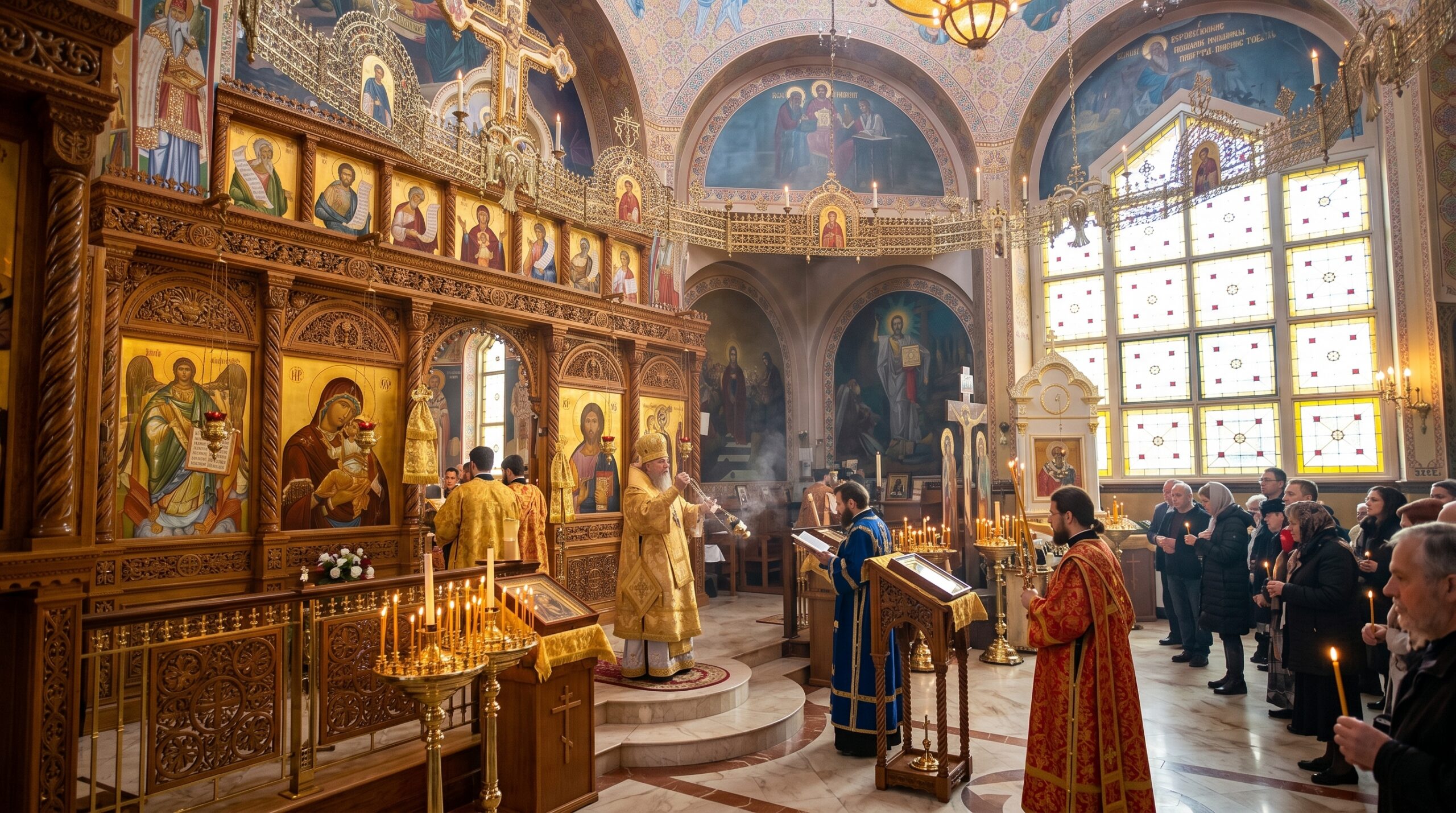
The Divine Liturgy (Θεία Λειτουργία, Theia Leitourgia) is the supreme worship service of the Orthodox Church. The liturgy in use derives primarily from Basil the Great (4th century) and John Chrysostom (4th–5th century) — and it has remained virtually unchanged for over 1,600 years.
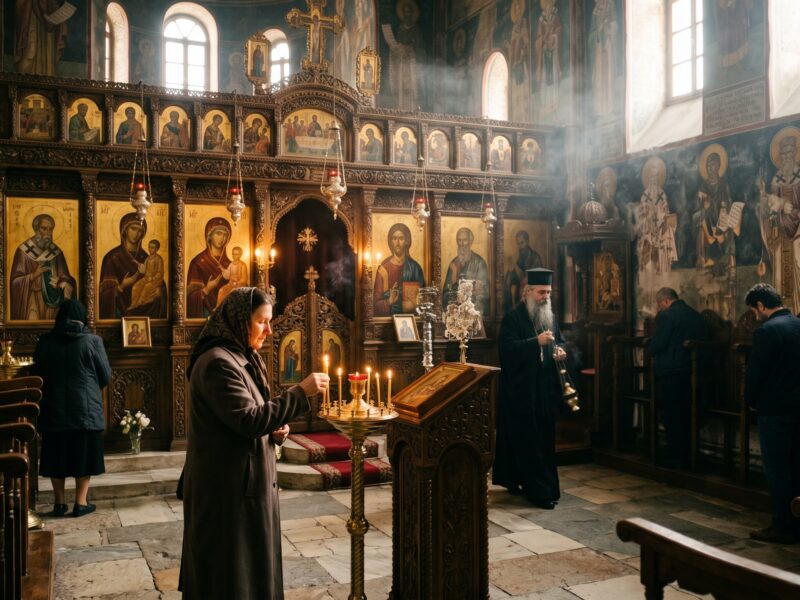
The Liturgy is a multidimensional experience: icons, incense, chanting, light, liturgical colours, bodily posture, the sign of the cross — all of this together creates a fully sensory act of worship. Orthodoxy holds that in the Liturgy, the events of Christ’s life are not merely remembered — the faithful participate in those events in reality, for Christ’s crucifixion and resurrection are an eternal reality that breaks through time.
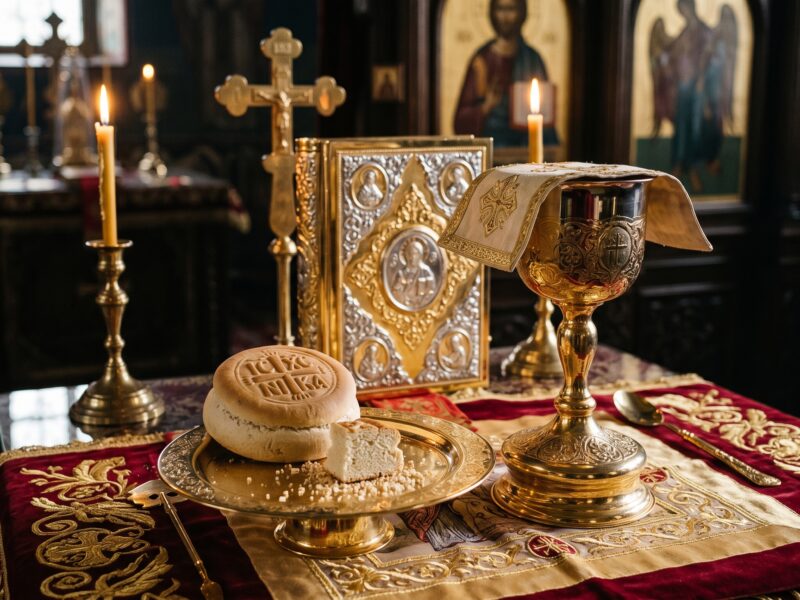
One of the supreme moments of the Liturgy is the Eucharist (Εὐχαριστία — thanksgiving): the transformation of bread and wine into the true Body and Blood of Christ. Orthodoxy believes this to be real, not symbolic.
3.4. Icons — Windows into Heaven
The icon (εἰκών, eikon — image, likeness) is one of the most frequently misunderstood elements of Orthodoxy. An icon is not an idol — it is not worshipped. An icon is a theological image that honours the holiness of the person depicted.
The Second Council of Nicaea (787 AD) clarified this precisely: what is depicted on an icon is venerated (τιμή, time), but only God is worshipped (λατρεία, latreia). The distinction is fundamental.
Theologically, icons are grounded in the Incarnation — the fact of God the Son becoming human. Because God himself took a visible, material form in Christ, he can also be depicted. Whoever would forbid the making of icons would in effect be denying the reality of the Incarnation.
3.5. Holy Tradition and the Bible
Orthodoxy holds that Holy Tradition (Ἱερὰ Παράδοσις, Hiera Paradosis) and the Bible form one whole, not opposites. The Bible was born within the Church — the Church was not born from the Bible. For this reason, the Bible cannot be understood apart from the living ecclesiastical tradition, which encompasses:
-
Holy Scripture (from the Old and New Testaments)
-
The writings of the Church Fathers (Πατερικὴ γραμματεία, Paterike grammateia)
-
The decisions of the Ecumenical Councils
-
Liturgical tradition
-
Iconography
4. Prayer and the Spiritual Life: How Does an Orthodox Christian Live?
4.1. The Jesus Prayer — The Mystery of Seven Words
The most well-known expression of Orthodox spiritual life is a brief yet profound prayer:
“Lord Jesus Christ, Son of God, have mercy on me, a sinner!” (Κύριε Ἰησοῦ Χριστέ, Υἱέ τοῦ Θεοῦ, ἐλέησόν με τὸν ἁμαρτωλόν.)
This is the so-called Jesus Prayer (Ἰησοῦ εὐχή), which Orthodox Christians repeat thousands of times a day — rhythmically, united with the breath. The Hesychast tradition (ἡσυχασμός, hesychasmos — stillness, silence) has built an entire mystical theology upon this prayer.
Maximus the Confessor (580–662) writes in his Chapters on Love: “Love toward God in no way tolerates hatred toward one’s neighbour.” This brief principle, distilled into a single sentence: theosis is not merely an individual spiritual exercise — it manifests itself in love toward others.
4.2. Fasting — The Body as Prayer
Orthodoxy practises rigorous fasting. The year-round fasting calendar contains four extended fasting periods plus additional individual fast days. Approximately 180 days of the year are fast days. Why?
Fasting unites spirit and body — for God created both. Fasting is not self-torment, but askesis (ἄσκησις, askesis — practice, training), which disciplines the body to serve the spirit. An athlete trains the body; an ascetic trains the whole person — body, soul, and spirit.
4.3. Confession — The Healing of Salvation
Orthodoxy views confession (ἐξομολόγησις, exomologesis) in a medical rather than juridical context. Sin is not primarily a legal transgression — sin is a disease that separates the human being from God. In confession, the priest does not pronounce guilt or grant release from punishment — he is a witness and an intercessor while God himself heals the sick.
5. Why Are Millions Converting to Orthodoxy in the 21st Century?
This is the question being written about by the New York Times, studied by Pew Research Center surveys, and asked by journalists across the Western world. The answer is multi-layered.
5.1. Historical Continuity: “I Want the Church the Apostles Founded”
The most common answer is historical continuity. People come to Orthodoxy because they want the Church that the apostles founded — not a denomination that began in 1517 or last year.
A convert who has read the Church Fathers — Ignatius of Antioch, Athanasius the Great, Basil the Great — recognises that today’s Orthodox liturgy is essentially the same worship service that was celebrated in the 4th century. This is no small thing: to experience that you are participating in something that connects you directly to the community of the earliest Christians.
5.2. Mystery and Beauty: An Alternative to the “PowerPoint Service”
The beauty and transcendence of the Liturgy draws people who have spent years in beige fellowship halls with a praise band and a projector screen. Icons, incense, chanting, vestments — these are not decorations. They are windows into heaven.
Contemporary Western Protestant worship has in many ways adapted to the culture of media consumption: brief, entertaining, emotionally stimulating. Orthodoxy offers the opposite — something ancient, unchanging, and demanding.
5.3. Demanding Seriousness: A Faith That Costs Something
People are also drawn by the fact that Orthodoxy is demanding. There is fasting. There are prayer rules. The Church expects something from its members. In a culture that markets religion as “Jesus is your buddy and church should be fun,” Orthodoxy offers something harder and more serious.
Several researchers have noted in particular the wave of conversions among young men. Orthodoxy offers structure, purpose, and a sense of meaning in a world where questions of masculinity and tradition have become acute.
5.4. The Numbers: What Do the Studies Show?
Pew Research found that 1% of young adults aged 18–24 identify as Orthodox, having grown up in another faith or in no faith at all. Some projections suggest that American Orthodoxy could grow by nearly 70% by 2040 if current trends continue.
Orthodox parishes in St. Louis are a telling example: the Archangel Michael parish in the southern part of the city had 15 members four years ago — today it has over 100.
The median age of Orthodox participants is 42, with 62 percent of participants between 18 and 45. This is markedly younger than in other major traditions, where median ages are 58 for Catholics, 59 for Evangelical Christians, and 63 for mainline Protestants.
5.5. The Internet and an Ancient Faith: A Paradoxical Alliance
The internet plays an important role here. YouTube has made all Christian traditions “accessible.” Wings of the Church that young men never knew existed came into view — and the internet enabled stories of conversion to an “unchanging” tradition, through the most changeable medium of all.
6. Orthodoxy Today: 260–300 Million People, One Church
Today there are approximately 260–300 million Orthodox Christians in the world. They are divided into autocephalous (self-governing) churches, which recognise one another as parts of the same Church:
-
The Ecumenical Patriarchate of Constantinople — Istanbul, Turkey (holding spiritual primacy)
-
The Patriarchate of Moscow — Russia (the largest by membership)
-
The Patriarchate of Alexandria — Egypt (the African mission is growing rapidly)
-
The Patriarchate of Antioch — Syria and Lebanon
-
The Patriarchate of Jerusalem — the Holy Land
-
The autocephalous churches of Greece, Serbia, Romania, Bulgaria, Georgia, Cyprus, and others
In Estonia, there are two Orthodox churches: the Estonian Apostolic Orthodox Church (under the jurisdiction of the Patriarchate of Constantinople) and the Estonian Orthodox Church (under the jurisdiction of the Patriarchate of Moscow). Estonia has one of the largest proportional Orthodox communities in the Western European context.
7. Orthodoxy vs. Catholicism vs. Protestantism: Three Great Paths
Many people ask: “What is the difference?” Here is a brief but clear comparison:
|
Question |
Orthodoxy |
Catholicism |
Protestantism |
|---|---|---|---|
|
Authority |
Seven Councils + Holy Tradition |
Pope + Councils + Tradition |
The Bible alone (Sola Scriptura) |
|
Goal of Salvation |
Theosis (deification) |
Redemption and eternal life |
Justification by faith |
|
Eucharist |
The true Body and Blood of Christ |
The true Body and Blood of Christ |
Symbol (in most traditions) |
|
The Pope |
Does not recognise supremacy |
Absolute supremacy |
Does not recognise |
|
Change |
Dogmatically unchanging since 787 AD |
Continuing developing doctrine |
Continuous reformation |
|
Filioque |
No |
Yes |
Yes (in most traditions) |
8. Conclusion: An Ancient Faith, a Contemporary Answer
Orthodoxy is a paradox: the most ancient and the most contemporary.
It is ancient because it transmits untouched the faith of the apostles, the theology of the Church Fathers, and their liturgy, which has been celebrated for over two thousand years. It does not change — and that is not a weakness. It is its strength.
It is contemporary because it is precisely this unchangingness that speaks to a generation that has grown up in constant flux — amid digital acceleration, moral shifts, and spiritual emptiness. People are seeking something old in a world that will not stop changing. They want a faith given once for all to the saints — semel tradita sanctis.
Theosis is not an abstract theological concept — it is an invitation. An invitation to become what God created you to be: a human being who bears the image of God (imago Dei) and grows toward the fullness of that image.
This is how Orthodoxy answers one of the most profound human questions: What is the purpose of a human being? — To become a participant in the divine life. Together. In the Church. In the Liturgy. In prayer. In love.
Χριστὸς Ἀνέστη. Christ is Risen.
Sources and References
-
Assembly of Canonical Orthodox Bishops of the USA: On Converts to Orthodoxy (2025)
-
St. Michael Antiochian Orthodox Church: Why Are So Many Americans Converting to Orthodox Christianity? (December 2025)
-
The Gospel Coalition: Is Eastern Orthodoxy the Next Big Thing for Young Men? (January 2025)
-
Greek Orthodox Metropolis of Chicago: New Converts — St. Louis Orthodox Christian Churches Grow (May 2025)
-
The National Herald: Rising Number of Converts Featured in the New York Times (November 2025)
-
Orthodox Studies Institute: American Orthodoxy Today: Pew and CES Survey Results (July 2025)
-
JesusBYS: Global Orthodox Churches 2026: Demographic Trends (March 2026)
-
Wikipedia: East–West Schism (updated April 2026)
-
Orthodox Church in America: The Orthodox Faith — Church History: The Great Schism
-
Athanasius the Great, De Incarnatione (325–328 AD)
-
Gregory Palamas, Triades (14th century)
-
Maximus the Confessor, Chapters on Love (7th century)
-
Niceno-Constantinopolitan Creed (381 AD)

Martinus Vaicarius’s mission is to:
- Provide spiritual support and guidance to people seeking peace and hope
- Create prayer texts that bring God’s peace to hearts suffering under fear and anxiety
- Promote deep understanding of the power of the
- God of Sabaoth and the protection of the heavenly hosts
- Help people enter the spiritual sphere where God’s peace reigns over all
AICortex Invest OÜ
- Holy Communion or the Altar Sacrament: The Body and Blood of Jesus in Bread and Wine – In-Depth Orthodox Theological Analysis - 4. Jun 2026
- Orthodox Christianity 101: Key Doctrines, the Trinity, Salvation, and Christian Freedom in Christ - 3. Jun 2026
- The Holy Spirit: Who He Is, What He Does, and How to Experience Him Today – A Complete Biblical Guide - 2. Jun 2026