
Views: 35
Brain Changeability: God-Man (Theanthropos)
Introduction
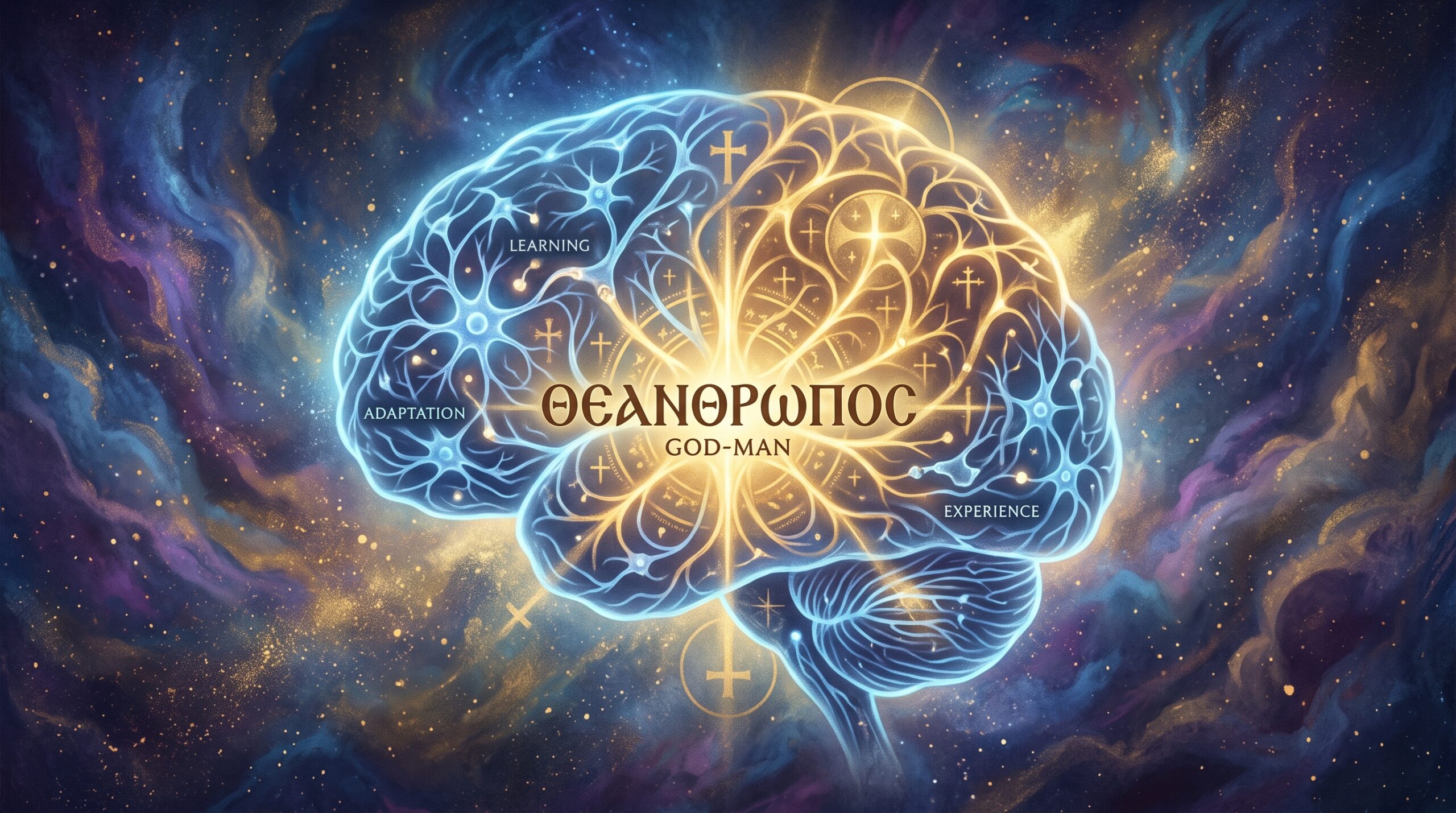
The human brain is a plastic and changeable organ that enables not only adaptation to the external environment but also profound inner transformation. This text connects neuroscientific knowledge about brain modularity and plasticity with mystical theology, especially the Christian concept of deification (theosis). The original idea is preserved: information, including supernatural and mystical information, does not only change the brain — through the brain, change can extend to the level of the soul and spirit, allowing a person to approach the ideal of the God-Man.
Brain Modularity and Neural Networks
The brain consists of functional modules, each specialized for certain tasks, yet always working in cooperation with others through extensive neural networks.
- The frontal lobe (especially the prefrontal cortex) directs executive functions: decision-making, emotion regulation, logical and abstract thinking, planning, task switching, and moral judgment.
- The occipital lobe is primarily involved in visual processing.
- The temporal lobe participates in memory storage, language processing, and hearing.
- Other areas regulate motor movement, somatosensory sensations, and attention.
Each module can function to a certain extent independently, but real capability arises from the connections between them. Although the brain’s general architecture is similar across humans, individual neural networks are unique. Repeated information and experiences strengthen these connections, leaving physical traces — this is the basis of neuroplasticity.
Analytically, it is important to emphasize: the brain is not a static hardware-software system. Information is not merely input but an active shaper. Previously, the view dominated that the brain changes information, but modern research shows the opposite — information changes the brain’s structure simultaneously.
Prefrontal Cortex and Rational Control
The prefrontal cortex is the region that allows humans to rise from purely instinctive reactions (fight-or-flight) to the level of rational, logical, and ethical decision-making. Damage in this area can cause impulsive behavior, speech disorders (aphasia), migraines, or epileptic phenomena.
At the same time, the brain is restorative. Through stem cells, there is limited generation of new neurons and optimization of existing cells. This plasticity is especially pronounced in early life but continues throughout life. Here lies the analytical core: if ordinary experiences change the brain, why should deep mystical or spiritual experiences not do the same?
Mystical Information and the Sanctification of the Brain
Mystical experiences — the sense of God’s presence, sublime inner illumination, expansion into the transcendent, or holy synergy — are not mere by-products of the brain. They enter consciousness as higher-level information that reorganizes neural networks. Repeated mystical practices (prayer, contemplation, asceticism) leave a lasting trace in the brain, similar to intense learning or emotional experiences, but in a positive direction.
Analytical view: Information is here a more fundamental category than energy or matter. Science can describe the brain’s physiological changes but cannot fully explain the emergence of meaning or spiritual exaltation. This is where theology enters: the Spirit of God (Logos) can use created structures — neurons, energy fields, and information networks — to manifest in a person. This is not “brainwashing” but sanctification through natural plasticity.
Such an approach theoretically allows connecting science and faith: if a mystical experience leaves a measurable trace in the brain (e.g., changes in the prefrontal cortex, improved emotional regulation), it becomes possible to speak of empirical correlations of supernatural information without reducing the mystical purely to the biological.
Deification – Becoming God-Man
In Christian tradition (especially in Orthodox mysticism), theosis means a person’s participation in Divine life through God’s energies. It does not mean the human becomes God in essence, but becomes like God through grace.
On the brain level, this manifests as the strengthening of higher functions, achieving emotional balance, and opening new layers of consciousness. A person is not passive here but an active participant: will, attention, and openness allow mystical information to shape neural networks. Thus, matter becomes sanctified — the brain is not merely a biological substrate but a place where Eternal Light can meet time.
Summary and Deeper Meaning
The brain’s changeability shows that humans are created for development. Neural networks formed through information allow us to preserve individuality while we change. The mystical and supernatural dimension is not against the brain but complements it, opening the door to the reality of the God-Man.
Analytically, this perspective is powerful: science describes the mechanisms (plasticity, modularity, information processing), theology gives the purpose (sanctification and union with the Creator). A human being is therefore neither merely a biological machine nor solely a spiritual being, but a holistic entity whose brain, soul, and spirit can together participate in Divine creativity.
This path requires human will, openness, and discipline, but the ultimate goal is sublime: to live in union with that which is eternal.

Trough all this I want to declare this is all from God and to God. All Glory to Him!