Views: 68
Christian Creeds: The History and Development of the Apostles’ Creed, the Nicene-Constantinopolitan Creed, and the Athanasian Creed
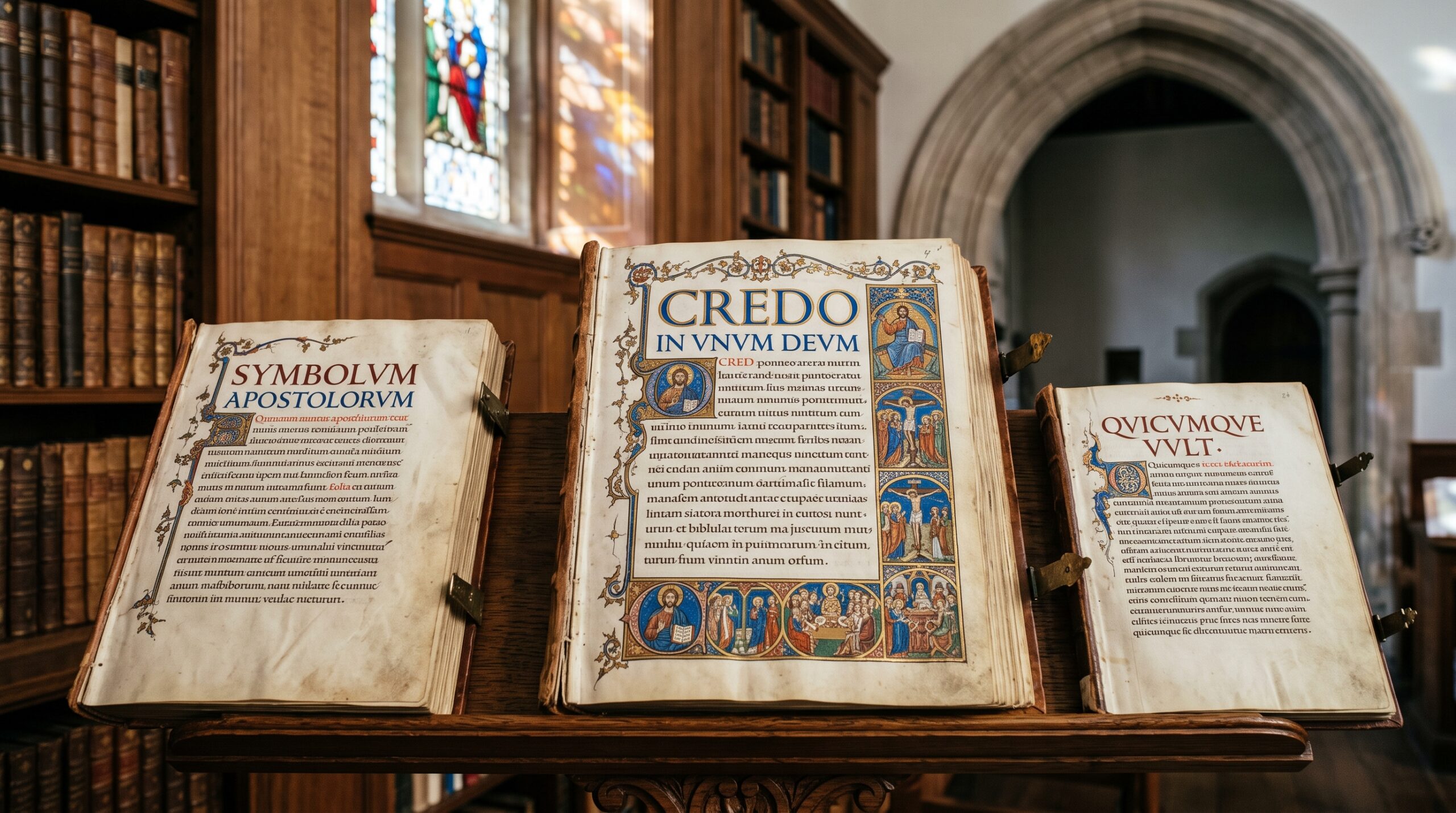
Christian creeds (from the Latin credo – “I believe”) have served as important summaries of biblical teaching throughout church history. They are not documents placed above the Bible but helpful tools that clearly express faith, defend against heresies, and unite the church. This article examines the three main early church creeds: the Apostles’ Creed, the Nicene-Constantinopolitan Creed (also known as the Nicene Creed), and the Athanasian Creed. It covers their historical development, context of origin, content, and significance for Christianity today. The full texts in English are also included.
General Background and Importance of the Creeds
In the early Christian community, there were initially no formal creeds. Faith was confessed through living proclamation, baptism, and the life of the congregation. However, short “rules of faith” (regula fidei) emerged already in the 2nd century to protect apostolic tradition against Gnosticism, Marcionism, and other deviations. Creeds developed at church councils and in local congregations in response to theological crises. They emphasize the Trinity (Father, Son, Holy Spirit) and the person and work of Christ.
These three creeds are ecumenical—they are recognized by most Christian traditions (Catholic, Orthodox, Lutheran, Anglican, and many evangelical churches). In the Lutheran Church, they form part of the Book of Concord (1580) alongside Reformation confessions.
1. The Apostles’ Creed
History and Development: This is the oldest of the three but does not originate directly from the apostles (the legend is medieval). Its roots go back to the 2nd-century Old Roman Creed (Symbolum Romanum), used in baptism in Rome. The earliest descriptions come from Marcellus of Ancyra (c. 341) and Rufinus (c. 404). The present expanded form developed in Gaul (modern France) between the 5th and 8th centuries, with additions such as “Maker of heaven and earth,” “descended into hell,” “the communion of saints,” and “the life everlasting.” These additions defended against heresies (e.g., Docetism, which denied Christ’s humanity) and emphasized the reality of Christ’s death and the hope of resurrection. In the 8th–9th centuries, Charlemagne standardized it for liturgical use.
Content and Significance: Short, simple, and catechetical (teaching-oriented). It emphasizes the Trinity and the events of Jesus’ life. It is widely used in Western Christianity in morning and evening prayer and at baptism.
Text in English: I believe in God, the Father almighty, Creator of heaven and earth.
I believe in Jesus Christ, his only Son, our Lord, who was conceived by the Holy Spirit and born of the virgin Mary. He suffered under Pontius Pilate, was crucified, died, and was buried; he descended to the dead. On the third day he rose again; he ascended into heaven, he is seated at the right hand of the Father, and he will come to judge the living and the dead.
I believe in the Holy Spirit, the holy catholic Church, the communion of saints, the forgiveness of sins, the resurrection of the body, and the life everlasting. Amen.
2. The Nicene-Constantinopolitan Creed
History and Development: This is one of the most influential documents in Christian history. The original Nicene Creed was adopted in 325 at the First Council of Nicaea (convened by Emperor Constantine) in response to Arianism. Arius (a presbyter from Alexandria) taught that the Son was a created being, not the eternal God. The council (approximately 318 bishops) affirmed that the Son is “of the same substance” (homoousios) as the Father. In 381, the Council of Constantinople expanded the text regarding the Holy Spirit (in response to the Macedonians, who denied the Spirit’s divinity). The result is the current Nicene-Constantinopolitan Creed.
It is the only fully ecumenical creed, used by both Eastern and Western Christians (with the filioque addition—“and the Son”—in the West). It shaped the foundation of Christian orthodoxy for centuries.
Content and Significance: A profound explanation of the Trinity and Christology. It emphasizes Jesus’ eternal divinity, incarnation, death, resurrection, and the divinity of the Holy Spirit. It is used as the centerpiece of liturgy (e.g., in the Eucharist). It is considered the best for understanding the Trinity because it balances unity and threeness on a biblical basis.
Text in English (standard version): We believe in one God, the Father almighty, Maker of heaven and earth, of all things visible and invisible.
And in one Lord Jesus Christ, the only-begotten Son of God, begotten of the Father before all ages, God of God, Light of Light, true God of true God, begotten, not made, of one substance with the Father; through him all things were made. For us men and for our salvation he came down from heaven, and by the Holy Spirit was incarnate of the Virgin Mary, and became man. For our sake he was crucified under Pontius Pilate; he suffered death and was buried. On the third day he rose again in accordance with the Scriptures; he ascended into heaven and is seated at the right hand of the Father. He will come again in glory to judge the living and the dead, and his kingdom will have no end.
We believe in the Holy Spirit, the Lord, the giver of life, who proceeds from the Father (and the Son), who with the Father and the Son is worshiped and glorified, who has spoken through the prophets. We believe in one holy catholic and apostolic Church. We acknowledge one baptism for the forgiveness of sins. We look for the resurrection of the dead, and the life of the world to come. Amen.
3. The Athanasian Creed (Quicumque vult)
History and Development: Named after Athanasius (c. 296–373, defender at Nicaea), but likely of Western origin from the 5th–6th century (Gaul or Spain). It did not come from a church council but is a theological treatise. It became popular in the Middle Ages. It provides a detailed emphasis on the Trinity and Christ’s two natures (divine and human).
Content and Significance: The most detailed explanation of the Trinity. It begins: “Whosoever will be saved…” It stresses that the Trinity is a mystery: one God in three Persons, equal yet distinct. Christ is one Person in two natures, unconfused. It is used less frequently but remains an important theological document.
Text in English (excerpt; the full text is quite long): Whosoever will be saved, before all things it is necessary that he hold the catholic faith. Which faith except every one do keep whole and undefiled, without doubt he shall perish everlastingly. And the catholic faith is this: That we worship one God in Trinity, and Trinity in Unity; Neither confounding the Persons nor dividing the Substance. For there is one Person of the Father, another of the Son, and another of the Holy Ghost. But the Godhead of the Father, of the Son, and of the Holy Ghost, is all one; the Glory equal, the Majesty coeternal… (continues with detailed statements on the Trinity and the Incarnation). … This is the catholic faith, which except a man believe faithfully he cannot be saved. Amen.
Conclusion: The Legacy of the Creeds Today
These creeds shaped Christian thinking in response to heresies and united the church. The Apostles’ Creed offers a simple foundation, the Nicene a profound affirmation of the Trinity, and the Athanasian a more detailed exposition. The Reformation (including the Lutheran tradition) adopted them while emphasizing the supreme authority of Scripture. Even in free churches, the same truths are reflected in Statements of Faith. Today, they help navigate relativism and preserve “the faith once for all delivered to the saints” (Jude 3). They remind us that faith is not a private opinion but a shared confession of one Lord.
The creeds call us not only to believe but to live accordingly—in love, hope, and unity. They are bridges across the centuries, connecting the early Christians with today’s congregations.

Trough all this I want to declare this is all from God and to God. All Glory to Him!