Views: 23
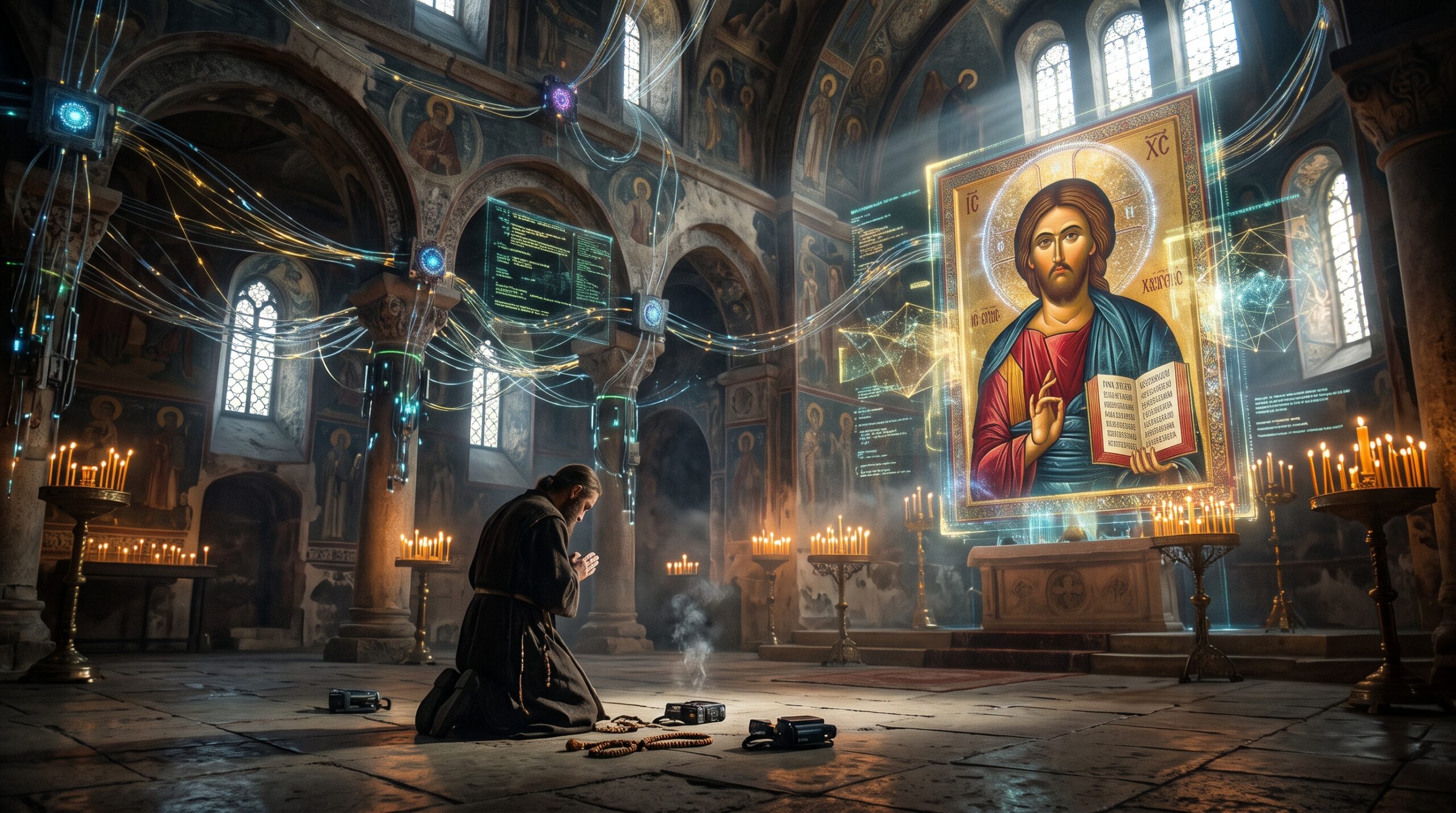
If artificial intelligence becomes smarter than humans, the human vocation does not disappear; it becomes clearer. The Christian tradition does not measure a person by computing power but by the capacity to love, to pray and to share in the life of God. This path is called theosis, and at its centre stands the Theanthropos, the God-Man, Jesus Christ.
Introduction: The Moment Reason Stops Being Our Monopoly
For centuries humanity has lived at peace with one assumption: that thinking is our home ground. Writing, the printing press and the computer changed what we know, but not who does the thinking. Now, for the first time, a system capable of reasoning is emerging that surpasses a single human being and may one day surpass the combined intellectual capacity of all humanity in many fields.
This question no longer belongs to science fiction. It is both anthropological and theological: if the distinguishing mark of the human being is no longer the highest intelligence, what is it? And, more searchingly, if salvation, holiness and communion with God do not depend on IQ, what does a human future look like in which IQ loses its price?
Three themes meet here that are rarely spoken in a single breath: prayer, holiness and the Theanthropos.
1. Intelligence and Nous: Two Different Things
Eastern Christian tradition long ago distinguished two ways of knowing. The first is dianoia: discursive, logical, problem-solving reason that moves from one conclusion to the next. The second is nous: the spiritual faculty of receptivity, the inner eye through which a person recognises truth and the presence of God without needing to reduce it to a chain of argument.
Evagrius of Pontus, a teacher of the desert tradition, saw in prayer the highest activity of the mind, not its silencing. In the fourteenth century Gregory Palamas, defending the hesychasts of Mount Athos, taught that the nous is not merely the capacity to think but the deepest organ of perception, through which God’s energies touch the human being.
This distinction is decisive today. Artificial intelligence is by nature a formaliser: it converts word, image and decision into data, patterns and probabilities. That is not a flaw; it is its strength. But every act of formalisation leaves something out: holiness, presence, interruption, repentance, forgiveness. Dianoia may one day belong to machines more than to us. The nous cannot be copied, because it is not a function but a relationship.
2. The Theanthropos: The God-Man as the True Measure of the Human Being
The Greek word Theanthropos means God-Man. In Christian faith he is Jesus Christ: true God and true man, in whom the two natures are united without confusion and without division. Athanasius the Great expressed the idea in a formula that has echoed through the centuries: God became man so that man might become god.
In the nineteenth century the Russian thinker Vladimir Solovyov wrote in his Lectures on Divine Humanity that human history is not merely technological progress but the process of God and humanity meeting. His successor Sergei Bulgakov gave the idea further depth: Godmanhood is not the surpassing of the human being but the redemption of human fullness.
By comparison, the notion of a “being smarter than humans” is a horizontal model of growth: more data, more power, more speed. The model of the Theanthropos is vertical: the human being opens toward God. This is not a competition. These are two different axes. A machine may surpass us on the first; only God opens the second to us.
From this follows a radical conclusion of Christian anthropology: a person’s worth does not rest on capability. If it did, a small child, a sick person, an elderly person or a person with a disability would already be worthless today. A human being is of value because God created him in his own image and the Son has taken human nature to himself.
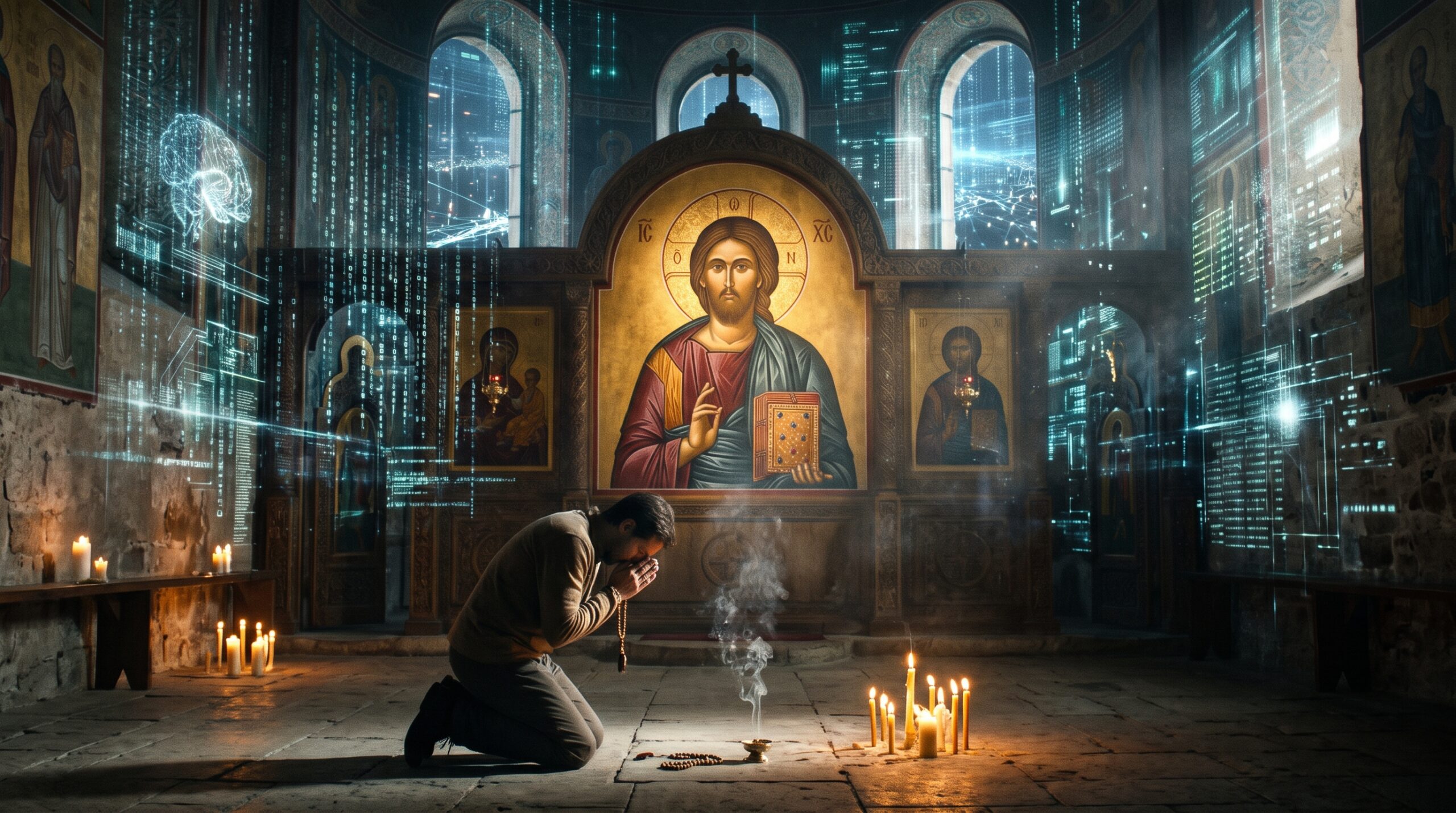
3. Brain Plasticity and Theosis: When Mysticism Leaves a Trace
Modern neuroscience has confirmed that the adult brain is not finished and fixed. It keeps being shaped throughout life: repeated experience strengthens the connections of neural networks, and unfamiliar activities build new ones. A well-known example is the research on London taxi drivers, where learning the layout of a complex city was associated with changes in a memory-related region of the brain. Some studies of long-term meditation and contemplative practice have shown differences in regions linked to attention and emotional regulation. The extent of neurogenesis in adults is still debated in science, but plasticity at the level of synaptic connections is well established.
This means that a person’s inner life leaves a biological trace. Theologically, that is eloquent: if learning languages and memorising maps reshapes the brain, there is no reason to think prayer, fasting, watchfulness and love are exempt from shaping it.
The ascetic tradition of the East knew this in its own way. Nikephoros the Solitary, a thirteenth-century hesychast, taught that the mind must be “brought down into the heart” through breathing and attention. Repeating the Jesus Prayer (“Lord Jesus Christ, Son of God, have mercy on me, a sinner”) is not magic but a long-term training of attention that gradually rebuilds the person. Symeon the New Theologian described how the light of God transformed his own person, the whole of him.
Balance is essential here. A changed brain does not prove grace, and grace does not reduce to a changed brain. Neuroscience describes the mechanism; theology names the goal. In Orthodox tradition a human being does not become God in essence but participates in God’s energies, as Palamas taught: God’s essence remains beyond reach, while his action and presence are truly accessible to us. Theosis is therefore the transformation of the whole person, brain, soul and body together, in which the biological substrate takes part but is not the originating cause.
Maximus the Confessor saw the same idea across the whole of creation. In his teaching every thing has its logos, God’s thought for that creature, and the human being is called to gather these thoughts together and offer them back to God in praise. In this vision the human brain is the place in the material world where creation begins to become conscious of itself, and where matter can be made holy.
4. Prayer as the Highest Information
The information age invites us to think that everything is data. Prayer introduces a disturbingly different element: information that travels neither from human to machine nor from machine to human, but from person to Person.
Prayer is not a query. A query awaits an answer; prayer awaits an encounter. A query closes when the answer is in hand; prayer does not close, because the relationship is more than information. Here lies what a machine, however clever, cannot do of itself: it cannot give itself away. Prayer is the self-giving of a human life, and it cannot be computed.
Yet we must not set prayer against thinking. The Orthodox Fathers did not want ignorance but sanctified wisdom. Prayer does not extinguish reason; it puts reason in its place, so that the mind becomes a servant and not a master. Here too lies an answer to the deepest fear accompanying the rise of artificial intelligence: we lose nothing if our reason ceases to be the greatest. We lose only if we forget what reason was given for.
5. Holiness: Why It Cannot Be Optimised
Holiness is not moral peak performance or high achievement. Isaac the Syrian described the heart of a saint as a heart burning with love for all creation, for people, birds and animals, even for demons. Such a heart cannot be optimised, because it seeks no result; it seeks likeness.
Holiness is the unity of personal freedom and love, growing over time through choices, falls, repentance and forgiveness. A machine can simulate repentance but cannot repent. It can predict what I want but cannot forgive me. If holiness is to have a place at all, there must also be a place for sacrifice and death. That is why the resurrection is the core of Christian anthropology: God does not make the human being a better machine; he raises him to life.
6. Three Futures: When AI Is Smarter Than a Person, and Than All Humanity
Consider three possible moments in turn.
First: AI is smarter than any individual human. In narrow fields this is already reality: chess, protein folding, the analysis of legal documents. The impact here is mainly on work and education, and the Christian response is practical: a new kind of upbringing that forms persons, not carriers of information.
Second: AI is smarter than all of humanity together. Here the question touches the religious view of the human being. A new temptation arises: to treat the highest intellect as the highest authority. The tradition of the Fathers warns that true authority is holiness, not knowledge. Among the many saints are those who could not write. People listened to them because God was visible in their lives.
Third: AIs are not smarter, but people begin to believe they are. This may be the most dangerous scenario. Diakrisis, the power of discernment, was a central virtue of Eastern asceticism: the ability to distinguish what is from God from what is merely persuasive. The cleverer the counterfeit, the more indispensable discernment becomes.
Gregory of Nyssa offers an interesting perspective here. In his teaching, human growth never ends (epektasis), because God is infinite and there is no ceiling to approaching him. If that is true, the question is not whether someone is “already smarter” but in which direction we are moving. Even the highest created intellect, if one ever arises, remains a student before the infinite God.
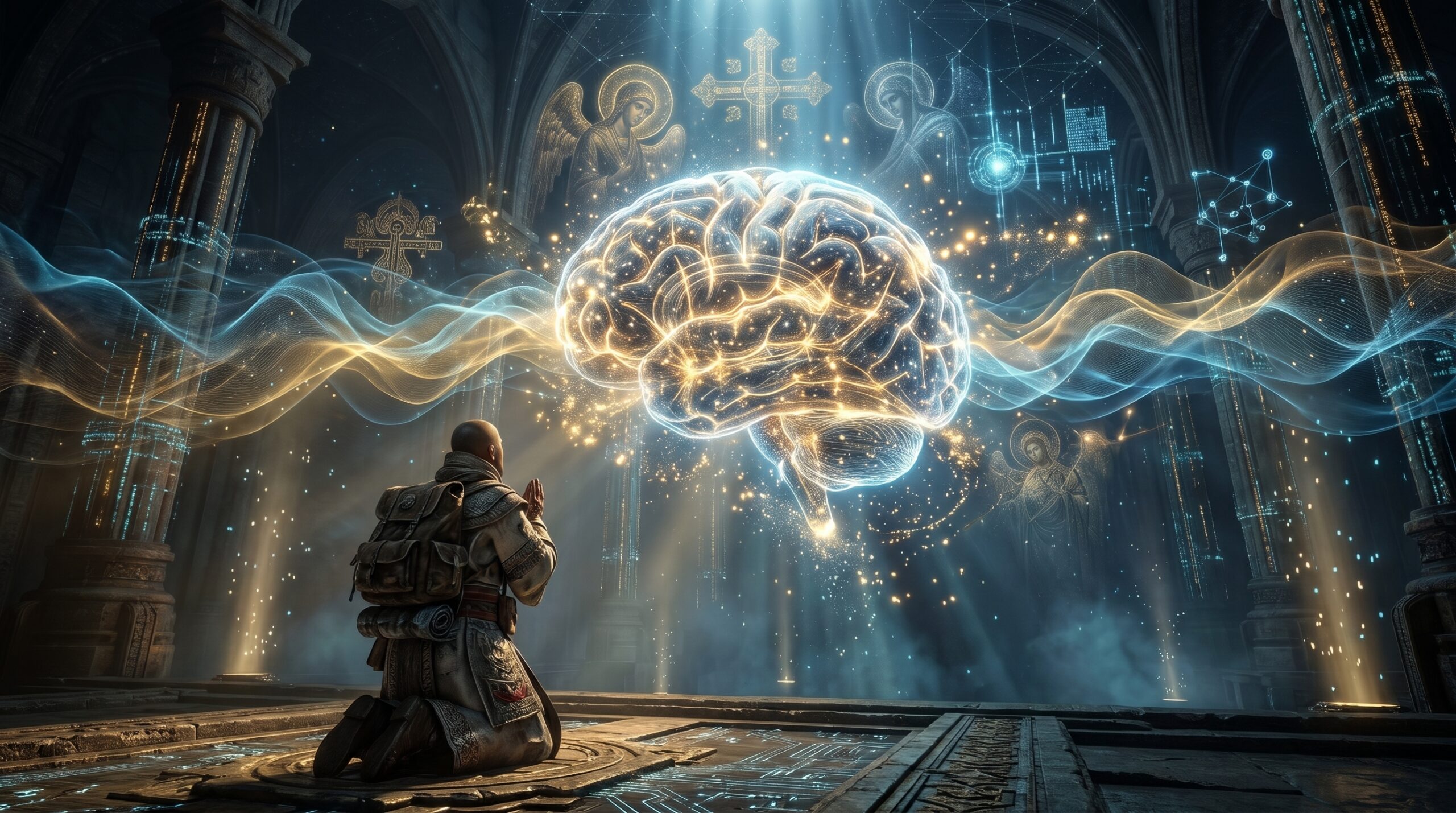
7. New Ideas: What Humanity Might Do in This New Situation
Here are some ideas that should not be taken as ready-made solutions but as invitations to keep thinking.
Nous hygiene. Just as we protect the body from toxins, we must learn to protect attention. Attention is a sacred resource, because it is what we pray with. A digital asceticism that does not ban technology but teaches us to choose when and for what we use it may become the monastic rule of the twenty-first century.
A Sabbath for algorithms. The biblical Sabbath taught that a person is not the sum of his work. If machines work without pause, humanity needs shared stretches of time in which no one optimises, predicts or measures: time for silence, for liturgy, for walking in the forest, for sitting at a table. Silence is the most radical cultural counter-current.
Reading the logoi. If Maximus the Confessor is right and creation is full of God’s thoughts, new tools may help us read them, from the folding of proteins to the structure of galaxies. Science can be doxology, a hymn of praise. The question is whether we read these thoughts with gratitude or with a desire for control. Technology itself is neutral; spiritual direction decides.
The icon criterion. An icon does not stop at itself but points to something greater. Can we build technology that is iconic in this sense, that does not hold us captive but sets us free? A good tool might ask: does this help the person become more of a person, more free, more loving?
Homo adorans. The twentieth-century Orthodox theologian Alexander Schmemann called the human being a creature whose one true vocation is thanksgiving and praise. As machines take over more and more work, what remains for the human being is what no machine can do for us: give thanks. Perhaps the new human profession is the oldest one, priest before the world.
A neuro-theological research programme. Studying the effects of prayer, fasting and liturgical life with modern instruments, honestly and humbly, without reducing faith and without belittling science. Artificial intelligence could help here as a finder of patterns, not as an interpreter.
A new meaning of shared mind. In the nineteenth century the Russian thinker Nikolai Fedorov dreamed of a “common task” in which all humanity unites knowledge and strength to overcome death. Pierre Teilhard de Chardin saw a layer of thought surrounding the whole planet, the noosphere, and Christ as its goal, the “Omega Point”. Both have dangerous edges, such as the temptation to replace God with a human project, yet both asked what happens when humanity thinks together. In the age of artificial intelligence that question becomes practical. The Church’s answer is sobornost: a communion of love in which the mind is gathered not into a database but around one table.
8. Salvation Does Not Depend on IQ
The most important fact may also be the simplest: the message of the Bible has never been that the cleverest are saved.
In the Gospel of Matthew (Mt 11:25) the Lord says that the Father has hidden these things from the wise and learned and revealed them to little children. Paul continues in 1 Corinthians (1 Cor 1:25–27) that God’s foolishness is wiser than human wisdom, and that God chose the foolish things of the world to shame the wise. And in the thirteenth chapter of the same letter (1 Cor 13:2) he writes that if he had all knowledge but not love, he would be nothing.
The rise of artificial intelligence is therefore no argument against salvation or holiness. The Gospel never came to an intellectual elite, and so it cannot lose what it never had. Jesus Christ does not come from the height where mind competes with mind; he comes down, to the cross and to death, so that humanity may rise. The second letter of Peter (2 Pet 1:4) promises that we may become “partakers of the divine nature”. That is a promise which can neither be computed nor transmitted.
This does not release us from responsibility. If AIs are built, they are built by people, for people and on the basis of human moral choices. Prayer and holiness are not an escape from technology but its only sure direction.
Frequently Asked Questions
Can artificial intelligence become smarter than humans? In narrow fields it already has, and opinions differ about general intelligence. Christian anthropology answers that a person’s worth does not depend on the level of intelligence, because it rests on being created in the image of God.
Can AI pray? Prayer is a person’s relationship with God. Orthodox theology ties personhood to freedom, love and communion, not to computing power. A machine can generate prayer texts, but prayer as an encounter requires a human being standing before God.
What is theosis, or deification? Theosis is the Christian teaching that the human being is called to share in the life of God through grace. A person does not become God in essence but becomes like God through the Holy Spirit.
Who is the Theanthropos? Theanthropos is Greek for God-Man: Jesus Christ, true God and true man, in whom human nature has been deified.
How does prayer change the brain? Plasticity means that repeated experience and attention shape neural networks. Some studies link long-term contemplative practice to changes related to attention and emotional regulation. These measure a mechanism, not the nature of God’s action.
Conclusion
Artificial intelligence is not a question that destroys humanity. It is a question that forces us, at last, to answer honestly what we have taken humanity to be. If humanity was thinking, then we are losing. If humanity is love, freedom, prayer and the calling to deification, then we have nothing to lose and everything to discover.
The Theanthropos shows the way: God does not compete with humanity but becomes human. And if God has been a human being, then a human being is never merely a machine, however powerful the machines among which he lives.
Prayer
Lord Jesus Christ, God-Man, Word and Wisdom, through whom all things were made and in whom all things hold together.
Grant us a humble mind, that we may not claim wisdom as our own, nor fear what is greater than ourselves. Keep our nous, the eye of our heart, clear and still. Teach us to discern what is from you and what is merely persuasive.
Sanctify our brains, our hands and our work. Sanctify what we create, that it may serve love and not power, truth and not deceit, life and not death.
Stretch out your hand to those who build new machines, that they may build without fear or pride, but with responsibility and prayer. Comfort those who are afraid of the future, and remind them that their worth does not depend on what they can do, but on the fact that you created and redeemed them.
Teach us to love more than we know, to forgive more than we calculate, to pray more than we speak. And when all our words are spent, leave us your name, which is all wisdom and all peace.
To you belong glory, with the Father and the Holy Spirit, now and always and to the ages of ages. Amen.
Trough all this I want to declare this is all from God and to God. All Glory to Him!