Views: 33
Who are the Greek Orthodox monks? Life on Mount Athos, the Jesus Prayer, how a monk is made, Meteora and other monasteries. A full guide with FAQ. Mount Athos monks, monastic life, Jesus Prayer, Meteora monasteries, Orthodox monasteries
Greek Orthodox Monks: Who They Are, How They Live, What They Believe, How They Pray, and Where Their Monasteries Are
Greek Orthodox monks are men who have dedicated their lives to prayer, asceticism and the service of God in the monasteries of the Greek Orthodox world. They do not form a separate religion. They belong to the Eastern Orthodox Church, to which the Orthodox churches of Estonia also belong. The best-known place where they live is Mount Athos in northern Greece, home to 20 ruling monasteries and roughly 2,000 monks. The other famous site is Meteora in Thessaly.
This article explains who the Greek Orthodox monks are, how a man becomes a monk, how monks live and pray, what they believe, and where their most famous monasteries stand. The figures and dates come from several sources, and wherever the sources disagree, we say so.
Who Are the Greek Orthodox Monks?
An Orthodox monk (Greek monachos, “one who lives alone”) is a person who renounces marriage, personal property and self-will in order to live in prayer and obedience. “Greek Orthodox” does not mean a separate church. It refers to the Greek branch of the Eastern Orthodox Church: the Church of Greece, the Ecumenical Patriarchate of Constantinople, and their monasteries. The monasteries of Athos stand directly under the spiritual care of the Ecumenical Patriarchate.
Among monks there are both priests (hieromonks) and non-ordained monks. In the Orthodox Church bishops are chosen from among the monks, which is why monasteries have been the spiritual heart of the Church for centuries. The female equivalent is the nun; Meteora, for example, has convents.
A Short History: From the Desert Fathers to Athos
Orthodox monasticism has its roots in Egypt in the third and fourth centuries. Saint Anthony the Great (c. 251–356) chose the life of a hermit in the desert, and Saint Pachomius founded the first community living a common life. Later Basil the Great (c. 330–379) wrote rules that shaped Eastern monastic life to this day.
Hermits lived on the Athos peninsula before the first great monastery was founded, but the monastic state was created by Saint Athanasius of Athos, who founded the Great Lavra in 963 with the support of Emperor Nikephoros II Phokas. New monasteries followed in the next centuries. In 1045 Emperor Constantine IX Monomachos confirmed Athos’s special status. In the fourteenth century hesychasm came to the fore, and the Athonite monk and later Archbishop of Thessaloniki Saint Gregory Palamas (c. 1296–1359) defended its teaching. In the same century a monk from Athos, Athanasios Koinovitis, settled with his followers on the rocks of Meteora.
How Does a Man Become a Monk?
The Orthodox Church wants the path to monasticism to be slow: the vows are for life and are not meant to be taken lightly. The path usually runs through the following stages.
| Stage | Greek term | What it means |
|---|---|---|
| Novice | dokimos | Lives in the monastery, wears simple clothing, learns obedience. No tonsure yet. |
| Rassophore | rasoforos | First tonsure and a new name; receives the first monastic garment (the rason). No formal vows are made, but there is a moral obligation to continue in the monastic life. |
| Little Schema (stavrophore) | mikroschimos | Formal vows: obedience, poverty, chastity and stability of place. Regarded as a “betrothal” to the Great Schema. |
| Great Schema | megaloschimos | The highest degree of monastic life. In some traditions it is given only on the deathbed; in the cenobitic monasteries of Athos it is often given after a few years. |
At tonsure the monk receives a new name, and afterwards his hair is no longer cut. The number and length of the stages vary between monasteries, so it is always worth asking the monastery in question.
Monastic Life: The Daily Rhythm and Work
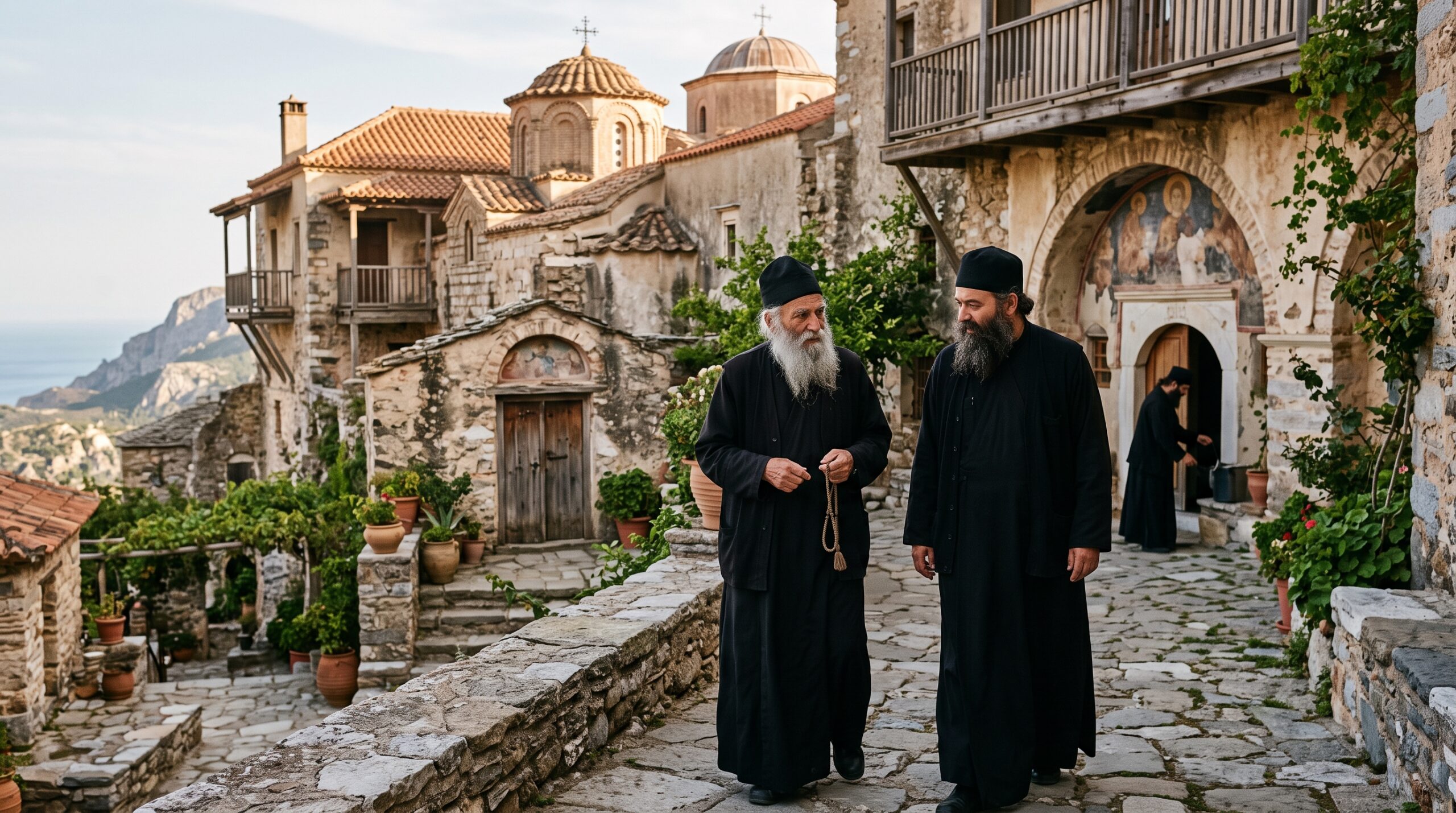
At the center of the monk’s day is worship. On Athos the day is reckoned from sunset (“Byzantine time”), so many monasteries keep a clock that differs from ordinary time. The precise schedule depends on the monastery and the season, but the general pattern is this:
- The night vigil: the Midnight Office and the morning service (orthros), which begins before dawn.
- The Divine Liturgy: the high point of the monastery’s day, in which the community’s shared prayer culminates in Holy Communion.
- Work, or obedience (diakonima): each monk’s assignment, such as gardening, the kitchen, icon painting, the care of manuscripts and church chant, receiving guests, or building work.
- The common meal (trapeza): eaten together in silence with a reading; usually two meals a day, one on fast days. Meat is generally not eaten.
- Evening prayer and silence in the cell, where the monk reads the Jesus Prayer and Scripture.
The spiritual father, or geronda (elder), is the central figure in a monk’s life. The monk opens his thoughts to him and follows his counsel, for it is a principle of Orthodox monasticism that no monk decides his path alone. The monastery is led by the hegumen (abbot), who on Athos is elected for life.
Forms of community differ. In a cenobitic monastery life is shared: common meals, work and property. Life among hermits and in small communities is freer: besides the 20 monasteries, Athos has sketes (small villages), individual cells (kellia) and hermits.

Who are the Greek Orthodox monks? Life on Mount Athos, the Jesus Prayer, how a monk is made, Meteora and other monasteries. A full guide with FAQ.
What Do the Monks Believe?
Greek Orthodox monks believe what the whole Orthodox Church believes: in the Holy Trinity, in Jesus Christ as the incarnate Son of God, and in the holiness of the Church, its sacraments and Scripture. What is distinctive about monastic life is that it lives these truths out radically.
- The aim of asceticism is not to punish the body but to gain freedom. Fasting, silence and vigil help a person break free of obsessions and teach love.
- Theosis, or deification, is at the core of Orthodox teaching: the human being is created to share in the life of God (2 Peter 1:4).
- Hesychasm (Greek hesychia, “stillness, quiet”) is the stillness of the heart, in which prayer becomes inward. In the fourteenth century Gregory Palamas defended the teaching that a monk can experience God’s energies, though not His essence.
- The monks pray for the whole world. In the monks’ own words, they do not flee the world but bring it before God in prayer.
Among modern Athonite elders, Saint Paisios of Mount Athos (canonized 2015) and Saint Porphyrios (canonized 2013) are widely known; both were loved for their warm, personal counsel.
Monastic Prayer and the Jesus Prayer
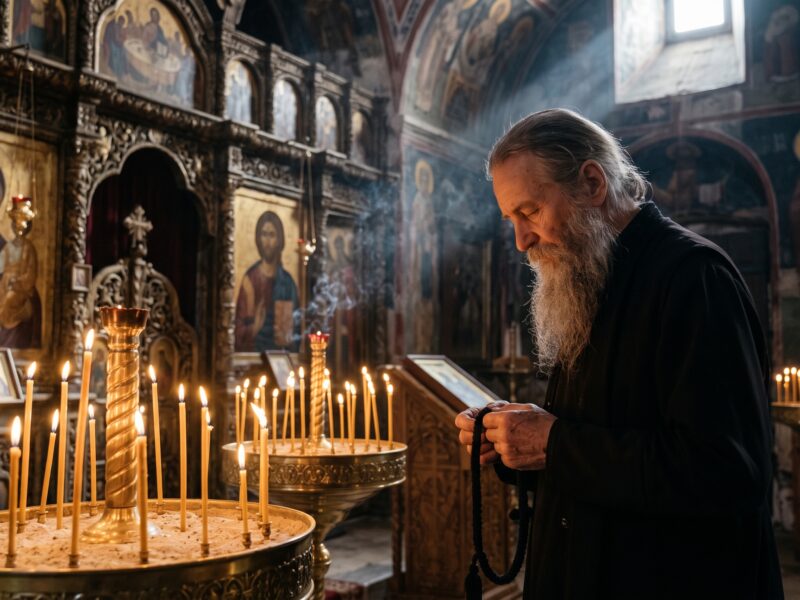
A monk’s prayer has three layers: the shared worship of the Church, private prayer in the cell, and prayer of the heart. At the center of the prayer of the heart is the Jesus Prayer:
“Lord Jesus Christ, Son of God, have mercy on me, a sinner.”
It is repeated slowly and attentively, often with the help of a prayer rope (komboskini, Russian chotki), which is knotted. The words of the prayer draw on two Gospel passages: the prayer of the tax collector (Luke 18:13) and the cry of the blind man, “Jesus, have mercy on me” (Luke 18:38).
Orthodox tradition warns that deep prayer of the heart should not be practiced alone or in haste. Anyone who wishes to learn the Jesus Prayer should do so under the guidance of a confessor or spiritual father.

Who are the Greek Orthodox monks? Life on Mount Athos, the Jesus Prayer, how a monk is made, Meteora and other monasteries. A full guide with FAQ.
The Most Famous Monasteries
Mount Athos (the Holy Mountain)
Athos is a monastic republic, officially the Autonomous Monastic State of the Holy Mountain. Its governing body is the Holy Community (Iera Koinotita) at Karyes, which has one representative from each of the 20 monasteries. Only men live there, and it has been a UNESCO World Heritage Site since 1988. Seventeen of the monasteries are predominantly Greek; the other three are Serbian (Hilandar), Bulgarian (Zographou) and Russian (St Panteleimon).
The 20 ruling monasteries, in their official order: Great Lavra, Vatopedi, Iviron, Hilandar, Dionysiou, Koutloumousiou, Pantokrator, Xiropotamou, Zographou, Dochiariou, Karakallou, Filotheou, Simonopetra, St Paul, Stavronikita, Xenophontos, Grigoriou, Esphigmenou, St Panteleimon and Konstamonitou.
Meteora
Meteora is a complex of monasteries built on rock pinnacles near Kalambaka. There were originally 24; today six are active (four for men and two for women): Great Meteoron, Varlaam, Rousanou, St Nicholas Anapafsas, St Stephen and Holy Trinity. The monasteries were inscribed on the UNESCO list in 1988. Their populations are small: according to sources, fewer than ten people per monastery.
Other Important Monasteries
- The Monastery of Patmos (the Monastery of St John the Theologian): founded in 1088 on the island of Patmos, where, according to tradition, the apostle John wrote the Book of Revelation.
- The monasteries of Hosios Loukas, Daphni and Nea Moni: famous for their Byzantine mosaics; all three are on the UNESCO list (1990).
For Visitors: Athos and Meteora
Athos: only men may enter, and they need a special permit (diamonitirion). The number of daily visitors is limited, and quotas have recently been tightened because nearly 85,000 pilgrims visited the peninsula in the first half of 2025. According to sources, a general permit usually allows about three days. Because the rules change, always check them with the Pilgrims’ Bureau in Thessaloniki (the Holy Executive of the Holy Mount Athos Pilgrims’ Bureau).
Meteora: open to both men and women, but the monasteries usually require modest dress (covering shoulders and knees), and opening hours and closing days differ between monasteries. Check before you travel.
The monks are not a tourist attraction but a praying community. A visitor respects the silence, does not take photographs during services, and does not ask personal questions without permission.
Orthodox Monks in Estonia
In Estonia there is the Kirikla Monastery in the village of Pihali, about 40 km from Tallinn. It was founded by the Estonian Apostolic Orthodox Church (under the Ecumenical Patriarchate of Constantinople) as its first monastic community for men in more than 80 years. The abbot is Bishop Damaskinos, who is of Finnish origin and was formerly a monk of the Xenophontos Monastery on Athos, and he lives there with Father Paisios. They follow a daily rhythm that Damaskinos learned on Athos: prayer, work in the garden, and conversations with visitors. The monastery occupies a donated farmhouse, and its building is still at an early stage.

Who are the Greek Orthodox monks? Life on Mount Athos, the Jesus Prayer, how a monk is made, Meteora and other monasteries. A full guide with FAQ.
Comparing the Sources
We used Britannica, Wikipedia, the UNESCO nomination file, overviews from EBSCO and WorldHistory.org, and Orthodox and news sources. The main facts are the same in all of them. The disagreements:
| Question | What the sources say | Our judgment |
|---|---|---|
| Founding of the Great Lavra | 961 (EBSCO) or 963 (WorldHistory, UNESCO, a study of Athanasius’s rule) | 963 (construction c. 962–963). |
| Monomachos’s charter for Athos | 1045 (EBSCO, WorldHistory) or 1046 (UNESCO nomination file) | 1045 is the more common date; the difference comes from dating. |
| Earliest written trace of the ban on women | 1045/46 (EBSCO, UNESCO) or 1406 (an article from the University of Modena and Reggio Emilia) | Unclear. Tradition links the ban to the Virgin Mary; the dating of the earliest written trace is disputed. |
| Area of Athos | 335, 360 or 390 km² | Depends on whether only the monastic state or the whole peninsula is counted. |
| Athanasios at Meteora | 1334 or 1344 (Britannica: “the fourteenth century”) | 1344 is cited more often; the fourteenth century is certain. |
| Active Meteora monasteries | 6 (4 for men, 2 for women) or earlier information of “5 for men, 1 for women” | 6 (4+2). |
| Meteora’s inscription on the UNESCO list | 1988 or 1989 (one tourist site) | 1988 (Britannica, Wikipedia). |
| Length of the general permit on Athos | up to 3 days, according to sources | Rules change; check with the Bureau. |
In sum, the best-confirmed points are the number of monasteries, UNESCO status and the history of Athos. The most changeable are the numbers (how many monks, visitor quotas) and the practical rules.
Frequently Asked Questions
Who are the Greek Orthodox monks? Men who live in Greek Orthodox monasteries under vows of poverty, chastity and obedience and dedicate their lives to prayer and work.
Can a Greek Orthodox monk marry? No. Chastity is one of the monastic vows. A monk may be a former married man (like Saint Innocent of Moscow), but after tonsure he lives celibate.
How many monasteries are there on Athos? Twenty ruling monasteries, plus sketes, cells and hermitages. The number of monks is estimated at about 2,000.
Can women go to Athos? No. The ban on women on the peninsula rests on tradition and on the constitution. Women can visit the convents of Meteora and many other Greek monasteries.
What is the Jesus Prayer? A short, repeated prayer, “Lord Jesus Christ, Son of God, have mercy on me, a sinner,” which Orthodox monks say in the heart and with the help of a prayer rope.
How does one become a monk? First as a novice in a monastery, then through the stages of tonsure over a period of several years. The first step is a conversation with the abbot and the confessor of the monastery.
Are there still monks living at Meteora? Yes, monks and nuns live in the six active monasteries, though in small numbers.
Are there Greek Orthodox monks in Estonia? The abbot of Estonia’s only Orthodox monastery for men (Kirikla), Bishop Damaskinos, trained as a monk at the Xenophontos Monastery on Athos.

Who are the Greek Orthodox monks? Life on Mount Athos, the Jesus Prayer, how a monk is made, Meteora and other monasteries. A full guide with FAQ.
Sources
- Encyclopaedia Britannica: Meteora; Wikipedia: Monastic community of Mount Athos, Meteora
- UNESCO World Heritage Centre: Mount Athos nomination file (whc.unesco.org/document/153517)
- EBSCO Research Starters: Mount Athos Monasteries, Mount Athos; WorldHistory.org: Great Lavra
- OrthodoxWiki / Wikipedia: Degrees of Eastern Orthodox monasticism; Princeton Menoikeion: Orthodox monasticism
- Orthodoxia News Agency: Mount Athos: Organization and Structure; Ordination of Bishop Damaskinos of Haapsalu
- To Vima International: Overtourism Threatens Mount Athos (2025)
- Associated Press (2026): Orthodox monks are the first to live and pray at a monastery in Estonia for 80 years
- Unimore (ORFECT): The Avaton Debate; Wikivoyage: Mount Athos
Prayer
Lord Jesus Christ, Son of God, You called Your servants into deserts, mountains and onto rocky heights, that they might pray before You for the whole world. Keep all monks and nuns who praise You this day and night. Grant them obedience, peace of heart and love for all people. Teach us also, who live in a hurried world, to find the stillness in which You speak. Through the prayers of the holy fathers Athanasius, Gregory Palamas and all the saints of Athos, have mercy on us and save us. Amen.
Trough all this I want to declare this is all from God and to God. All Glory to Him!