Views: 47
Spiritual Warfare: From the Abyss to Glory — A Practical Guide to Overcoming Satan
A practical guide to putting on the armor of God in prayer and daily life, in the light of Scripture and the Church Fathers.
Introduction: Why Spiritual Warfare Is Reality, Not Metaphor
The New Testament leaves no doubt that the Christian life is a battlefield. The Apostle Paul writes to the Ephesians: “For we do not wrestle against flesh and blood, but against the rulers, against the authorities, against the cosmic powers over this present darkness, against the spiritual forces of evil in the heavenly places” (Eph 6:12, ESV). This single verse frames the whole of this practical guide: a person’s inner state — whether in the abyss, on the plateau, or in glory — is always bound up with an invisible but entirely real spiritual dynamic.
The Church Fathers, especially the Desert Fathers (the Apophthegmata Patrum), described this struggle as an “invisible war” (πόλεμος ἀόρατος). John Climacus compared the soul’s ascent toward God to a ladder, on each rung of which temptation and grace collide. This guide traces three states — Abyss, Plateau, Glory — as a dramatic map of spiritual warfare, and shows how the armor of God (Eph 6:10–18) is the equipment applied precisely within these three conditions.
Part I. The Armor of God: Six Practical Steps
Ephesians 6:10–18 describes six pieces of armor. Each corresponds to a specific spiritual aspiration and a practical step that can be applied in one’s prayer life.
1. The Belt — Truth
“Stand therefore, having fastened on the belt of truth” (Eph 6:14, ESV). The belt secures every other piece of armor — without it, the garments hang loose and the soldier loses mobility. In practice, this means an honest illumination of oneself and one’s situation before God’s face. Augustine wrote in his Confessions that receiving the truth about oneself is the first step toward freedom — one cannot stand before God on a lie. Practical step: begin each day’s prayer with honest self-disclosure, without excuses.
2. The Breastplate — Righteousness
“…and having put on the breastplate of righteousness” (Eph 6:14, ESV). Righteousness here does not mean human perfection, but the righteousness of Christ imputed to the believer (cf. Rom 3:22). Chrysostom emphasized that this breastplate covers the heart — the place where temptation strikes most painfully. Practical step: remember that identity is not grounded in failure, but in the righteousness given in Christ.
3. The Shoes — Readiness of the Gospel of Peace
“…and, as shoes for your feet, having put on the readiness given by the gospel of peace” (Eph 6:15, ESV). Shoes give a firm footing even on rocky and slippery ground. This is a readiness to move — not to remain frozen in fear. Practical step: whenever fear tempts you to retreat, take a deliberate step forward in faith instead.
4. The Shield — Faith
“…taking up the shield of faith, with which you can extinguish all the flaming darts of the evil one” (Eph 6:16, ESV). The shield is mobile — it protects wherever the attack comes from. Isaac the Syrian taught that faith is not a static conviction but a continual, active turning toward God in the moment of assault. Practical step: in the moment of temptation, do not argue with the temptation — turn immediately to prayer.
5. The Helmet — Salvation
“…and take the helmet of salvation” (Eph 6:17, ESV). The helmet protects the mind — the place where the subtlest spiritual attack occurs: doubt, despair, false identity. Gregory of Nyssa wrote that the assurance of salvation illumines the mind, so that the “darkness” of evil thoughts can no longer overtake it. Practical step: explicitly reaffirm to yourself the assurance of salvation, especially in moments of despair.
6. The Sword — the Word of the Spirit, and Prayer in All Things
“…and the sword of the Spirit, which is the word of God, praying at all times in the Spirit, with all prayer and supplication” (Eph 6:17–18, ESV). The sword is the only offensive weapon in this list of armor — the Word of God, which Christ himself used against temptation in the wilderness (Matt 4:1–11). Basil the Great taught that the Word without prayer remains mere knowledge, but the Word joined to prayer becomes power. Practical step: know specific passages of Scripture by heart and use them in prayer as a direct answer to temptation — just as Christ answered every temptation: “It is written…”
These six steps are not a theoretical list — they are the equipment a person actually carries through the three conditions that follow: the abyss, the plateau, and glory.
Part II. Three States in Spiritual Warfare
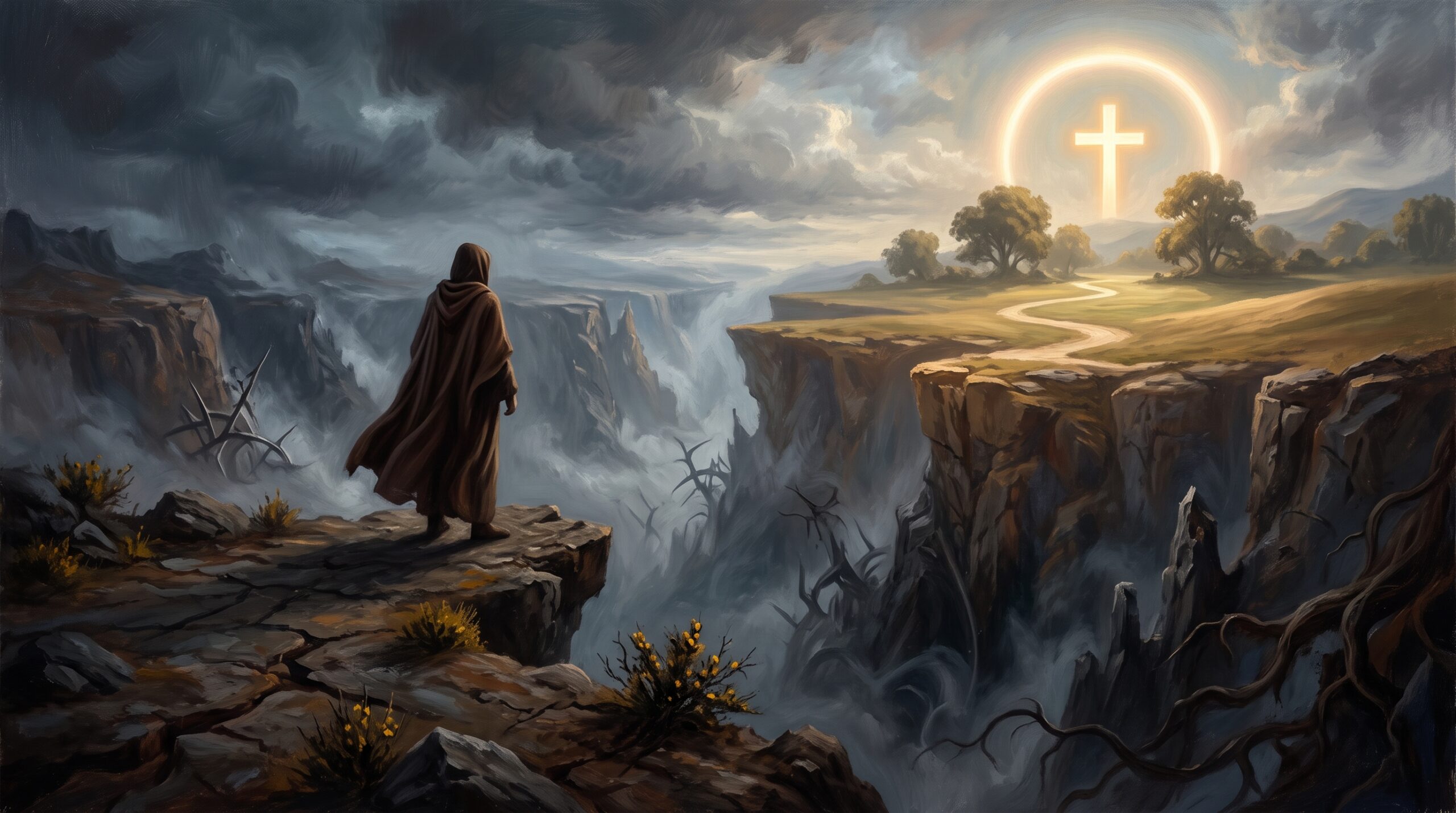
1. The Abyss — a State of Collapse and Darkness
The abyss is a state in which a person feels cut off from God, surrounded by darkness, powerless. David describes it: “Deep calls to deep at the roar of your waterfalls; all your breakers and your waves have gone over me” (Ps 42:7, ESV). Likewise Psalm 23:4: “Even though I walk through the valley of the shadow of death, I will fear no evil” — in the valley, in the abyss, yet not alone.
What happens to a person in the abyss? Spiritually speaking, this is an assault on the mind and on identity — despair (what the Desert Fathers called acedia, the “noonday demon”) whispers a lie: God has abandoned you, your situation is hopeless, you are alone. Isaac the Syrian wrote that such “wilderness darkness” is often precisely the place where God works most deeply, even though the soul cannot perceive it — this is kenosis, a place of emptying and humiliation that mirrors Christ’s own descent into death and into hell.
Which weapons help a person come out of the abyss? Above all, the helmet (assurance of salvation) and the shield (faith) — grounded not in feeling but in promise. In the abyss a person cannot pull themselves out by feeling; they must grasp the sword — the Word — as a real anchor: “The Lord is my light and my salvation; whom shall I fear?” (Ps 27:1, ESV). The aspiration here is a simple, repeated cry for help — not elaborate theology, but a Jesus-Prayer-type petition: “Lord Jesus Christ, have mercy on me.” The Desert Fathers taught that in the abyss one must not fight thoughts by arguing with them, but by turning by name to Christ — just as Peter, sinking beneath the waves, cried out: “Lord, save me” (Matt 14:30, ESV).
2. The Plateau — a State of Sustained Prayer-Struggle
Once the first steps out of the abyss have been taken, a person arrives on the plateau — a level ground where the immediate chaos of the abyss is gone, but the breakthrough has not yet come. This is the terrain of sustained, often dry and repetitive prayer-struggle. Scripture depicts this in Jacob’s wrestling: “And Jacob was left alone. And a man wrestled with him until the breaking of the day” (Gen 32:24, ESV). The night in Gethsemane has the same structure: “And being in agony he prayed more earnestly; and his sweat became like great drops of blood falling down to the ground” (Luke 22:44, ESV).
What happens to a person on the plateau? This is a school of endurance and trust. Here one no longer experiences the abyss’s sudden terror, but the trial is subtler: fatigue, monotony, the temptation to give up before the breakthrough. John Climacus called this the stage of “patient resistance” — the soul is already moving, but the enemy tries to persuade it to stop halfway. Here the combined action of the shoes (readiness) and the sword (the Word) is critical: a person must keep walking, continually anchoring themselves in Scripture rather than waiting for emotional confirmation.
On the plateau, one also learns to distinguish one’s own will from God’s will — just as Christ did in Gethsemane: “Nevertheless, not my will, but yours, be done” (Luke 22:42, ESV). This is where the breastplate (righteousness) guards the heart against self-accusation in weariness, and the shield (faith) beats back the thought that the struggle is pointless.
3. Glory — a State of Breakthrough and Transforming Presence
Glory is the state reached after the abyss and the plateau — not the absence of struggle, but its transcendence in the presence of God, a presence that transforms. Paul writes: “And we all, with unveiled face, beholding the glory of the Lord, are being transformed into the same image from one degree of glory to another. For this comes from the Lord who is the Spirit” (2 Cor 3:18, ESV). The Mount of Transfiguration (Matt 17:1–2) is the icon of this state: Christ’s face begins to shine like the sun — a presence that leaves no observer unchanged.
What is experienced in glory? The Church Fathers — especially Gregory Palamas in the later Byzantine tradition, but already Gregory of Nyssa before him — described this as theosis, deification: a person does not become God in essence, but participates in God’s energies, in his light. This is not emotional excitement but a peace that “surpasses all understanding” (Phil 4:7, ESV) — a presence that uproots fear entirely, for “perfect love casts out fear” (1 John 4:18, ESV).
In practice, glory means that a person who has passed through the abyss and the plateau now experiences the helmet and the shield no longer merely as defenses against attack, but as a source of joy and confidence — the battle has not vanished, but the enemy’s weapons have lost their power (cf. Rom 8:37, ESV: “in all these things we are more than conquerors through him who loved us”).
Part III. The Cross and the Resurrection — the Power That Leads from the Abyss to Glory
This whole journey — from the abyss, through the plateau, into glory — rests on only one reality: the power of Christ’s cross and resurrection. Patristic theology calls this Christus Victor — Christ as Victor. First Peter states that Christ, “being put to death in the flesh but made alive in the spirit… went and proclaimed to the spirits in prison” (1 Peter 3:18–19, ESV) — this underlies the teaching of Christ’s descent into the realm of death, where he “harrowed hell” and shattered the power of death from within. This is precisely the theology to which the following Prayer to the Life-Giving Cross points.
Prayer to the Life-Giving Cross
“Let God arise, and let his enemies be scattered; let those who hate him flee before his face. As smoke vanishes, so let them vanish; as wax melts before the fire, so let the evil spirits perish before the face of those who love God and sign themselves with the mark of the Cross, and say with joy: Rejoice, most precious and Life-Giving Cross of the Lord, for you drive away evil spirits by the power of our Lord Jesus Christ, who was crucified upon you, who descended into hell and trampled down the power of Satan, and who gave you, his own precious Cross, to us for the driving away of every enemy. O most glorious and Life-Giving Cross of the Lord, help me, together with the Holy Sovereign Lady, the Virgin Mother of God, and all the saints, throughout all ages. Amen.”
Or, in short form: “Protect me, O Lord, by the power of your precious and Life-Giving Cross, and keep me from all evil.”
Analysis of the Prayer’s Theology
Rooted in the Eastern Christian (Orthodox) tradition, this prayer draws together the theological foundation of the whole present guide:
- “Let God arise” — a quotation of Psalm 68:1, “God shall arise, his enemies shall be scattered” (ESV). The prayer opens at once with authority — this is not a human petition offered from a position of weakness, but the proclamation of God’s own action.
- “As smoke vanishes… as wax melts” — images drawn from Psalm 68:2. These figures show that evil is not a force equal to God, but something that simply vanishes before his presence — much as darkness does not “fight” light, but recedes before it.
- “The Cross… who descended into hell and trampled down the power of Satan” — this is direct Christus Victor theology. Here the cross is not merely a symbol of sacrifice but an instrument of victory: patristic tradition, from John of Damascus back to Gregory of Nyssa, described Christ’s death as a “trap” into which Satan himself had to fall, since he did not understand that hidden within death lay a divine life that would shatter death from within.
- “together with the Virgin Mother of God and all the saints” — the prayer does not leave the individual alone in spiritual warfare, but places them within the whole communio sanctorum, the communion of saints — spiritual warfare is never a solitary project, but takes place within the Body of the Church.
- The short form — “Protect me… keep me from all evil” — condenses the same theology into a form for daily use: a continual, simple cry for help that can be repeated at any moment spiritual pressure is felt — much like the Jesus Prayer.
This prayer is also a practical answer to the question of what a person in the abyss must do: not to analyze temptation intellectually, but to name the power of Christ’s cross and resurrection aloud or silently, in faith that this power is already a historical fact — Christ has triumphed (cf. Col 2:15, ESV: “He disarmed the rulers and authorities and put them to open shame, by triumphing over them in him”).
Part IV. Practical Guide: Steps in Prayer from the Abyss to Glory
In summary, this practical guide offers the following path:
- In the Abyss: a cry for help, calling on the Name (Helmet + Shield), short Scripture passages for repetition (Ps 23, Ps 27, Matt 14:30), a focus on Christ’s presence rather than on feelings.
- On the Plateau: sustained, repeated prayer (Shoes + Sword), recalling Scripture in moments of fatigue, submitting one’s will to God’s will (Luke 22:42).
- In Glory: thanksgiving and praise (Breastplate + Belt of truth), the knowledge that the struggle continues, but the enemy’s weapons have lost their power — a transforming presence (2 Cor 3:18).
Each stage is bound to the same reality: the cross, which humbled itself unto death, and the resurrection, which shattered death from within. Just as Christ descended into the abyss (death and hell), passed through a “plateau” (the silence of the tomb), and rose into glory (resurrection and ascension), so a person’s spiritual journey mirrors this same structure — not as repetition, but as participation in Christ’s own path (cf. Rom 6:5, ESV: “For if we have been united with him in a death like his, we shall certainly be united with him in a resurrection like his”).
Closing Prayer for Overcoming Satan
Almighty God, Father, Son, and Holy Spirit,
I, your poor child living only by grace, stand today before your face on the path through the abyss, the plateau, and glory. Give me the belt of truth, that I would not lie to myself or to you in the hour of my weakness. Clothe me in the righteousness of Christ, that the enemy’s accusations may find no place in me. Give me feet that will not turn back when the path leads through wilderness and silence. Give me the shield of faith, that extinguishes every fiery dart before it reaches my heart. Cover my mind with the helmet of salvation, that despair may not rule over my thoughts. And place in my mouth the sword of the Spirit — your Word — that I may answer every temptation as your Son answered in the wilderness: “It is written.”
Christ, who descended into the depths of death and hell, and rose victorious on the third day, shatter within me all that belongs to darkness. Just as you broke open the gates of death, break open the gates of my heart from everything that is not of you. Give me a share in your cross, not as a burden, but as a power that drives away every enemy — visible and invisible. As smoke vanishes before the wind and wax melts before the fire, so let every spirit that is not your Spirit vanish from me.
Virgin Mother of God, who stood unshaken beneath the cross, and all the saints who have walked before me through the abyss, the plateau, and glory — intercede for me. Help me, that I would not stop halfway, but reach that very light where the Lord himself said: “I am with you always, to the end of the age” (Matt 28:20, ESV).
Lord Jesus Christ, have mercy on me, a sinner. Protect me, O Lord, by the power of your precious and Life-Giving Cross, and keep me from all evil, now and forever and unto ages of ages. Amen.

Trough all this I want to declare this is all from God and to God. All Glory to Him!