Views: 44
Angels of God? 7 Important Facts from the Bible and Their Meaning Today
Trunk: The Foundation in Biblical and Hebrew Theology
God’s angels are spiritual beings in the Bible and ancient Hebrew tradition who act as God’s messengers, protectors, heralds, and mediators between humans and the Creator. In Hebrew, an angel is called mal’akh, which directly means “messenger” or “one who is sent.” They are not equal to God nor independent deities, but created beings who carry out His will in perfect obedience and love. This fundamental principle runs through the entire Bible from the Old Testament to the New Testament.
The concept of Elohim is one of the deepest and most multifaceted in Hebrew theology. In the Hebrew Bible (Tanakh), Elohim is grammatically a plural form (the ending -im usually indicates plurality), yet it is often used in the singular to refer to the one God — this is known as the majestic plural, emphasizing God’s greatness and perfection. At the same time, Elohim can refer to the assembly of divine beings, judges, or angel-like powers. Psalm 82:1 states: “God (Elohim) stands in the divine assembly; He judges among the Elohim.” This points to a heavenly council where God is the supreme authority. Jewish sages such as Maimonides place Elohim within the angelic hierarchy as powerful beings who embody divine strength, wisdom, and aspects of creation. In Kabbalah, Elohim is connected to the system of sefirot — God’s emanations — where this name represents the multifaceted manifestation of divinity that nevertheless remains subordinate to the One Creator. Elohim underscores that divinity is not monolithic but rich and diverse, while always remaining unified.
The Bible presents 7 important facts about God’s angels that form a solid theological foundation:
- They are ministering spirits, not physical beings similar to humans. Hebrews 1:14 declares: “Are not all angels ministering spirits sent to serve those who will inherit salvation?” This highlights their role in supporting humanity’s spiritual journey.
- They worship God and proclaim His holiness. Isaiah 6:3 describes the Seraphim crying out: “Holy, holy, holy is the Lord of hosts! The whole earth is full of His glory!” This is a continuous praise reflecting heavenly worship.
- They protect, guide, and deliver messages. There are many examples: an angel guards the Garden of Eden (Genesis 3:24), Gabriel brings the message to Mary (Luke 1:26–38), and an angel guides Philip (Acts 8).
- They fight against evil. Michael and his angels wage war against the dragon (Revelation 12:7–9), protecting God’s people and cosmic order.
- They are hierarchically organized. The Bible refers to different levels (archangels, powers, etc.), although it does not provide a complete list.
- They bring encouragement, strength, and help. Jesus receives strengthening from an angel in the Garden of Gethsemane (Luke 22:43). Angels appear in moments of crisis, reminding us of God’s presence.
- Their presence is accessible even today through attentiveness, an open heart, and communion with God. They do not replace God but point to Him, helping us live more consciously.
Orthodox theology deeply follows the work The Celestial Hierarchy (De Coelesti Hierarchia) by Pseudo-Dionysius the Areopagite (5th–6th century), which has influenced both Eastern and Western Christianity. Pseudo-Dionysius, drawing from the Bible, Neoplatonism, and early Church Fathers, describes the hierarchy as the downward flow of God’s light through different levels to help humans ascend toward divinity. The hierarchy is not a power structure but a system of love, service, and illumination. Each level purifies, illuminates, and perfects the one below it, reflecting God’s unity in diversity.
The Angelic Hierarchy according to Orthodox and traditional Christianity (following Pseudo-Dionysius, in three triads):
- First Triad (highest, closest to God):
- Seraphim – “the burning ones,” embodying love and purification.
- Cherubim – full of wisdom and knowledge, guardians of the throne.
- Thrones – bearers of God’s throne, embodying justice and stability.
- Second Triad:
- Dominions – guide the lower groups.
- Virtues – perform miracles and bestow power.
- Powers – fight against evil forces.
- Third Triad:
- Principalities – care for nations and institutions.
- Archangels – the best-known messengers.
- Angels – everyday guardians and helpers.
Names and roles of the Archangels (the best-known seven or more in the Bible and tradition):
- Michael (“Who is like God?”) – warrior, protector of Israel, fighter against evil (Daniel 10, Revelation 12).
- Gabriel (“Hero of God”) – messenger, bringer of revelations (Daniel 8–9, Luke 1).
- Raphael (“God heals”) – healer, traveling companion and healer in the Book of Tobit.
- Uriel (“Light of God”) – angel of wisdom, bringer of light, often associated with apocryphal texts.
- Others in tradition: Zadkiel (justice), Jophiel (wisdom and beauty), Chamuel (love and peace), Haniel (grace and joy). In Kabbalah there are more, connected to the sefirot.
Branches: Lesser-Known Insights from Hebrew Sources and Jewish Mysticism
Jewish mysticism (Kabbalah) and traditional texts such as the Zohar expand the Biblical picture. Maimonides lists ten ranks of angels, placing Elohim among them as powerful beings who transmit divine energy. In Kabbalah, angels are channels of energy that connect humans to the Tetragrammaton (YHWH) and the Tree of Sefirot. They help maintain cosmic balance, participate in everyday creation, and protect the soul’s journey through different realms (olamot). The Zohar describes how angels carry the foundations of the world and transmit inspiration to prophets and the righteous. Less well known is their role in human spiritual development: they assist in ascending through the sefirot, purifying the ego and opening channels to divinity. In Jewish mysticism, angels are not objects of worship but aids in achieving unity (devekut) with God.
Leaves: Mystical Information from Gnosis, Kabbalah, and the Bible
Seraphim – “the burning ones.” Isaiah 6:2–7 describes them with six wings: two covering the face (in reverence), two the feet (modesty), and two for flying. They proclaim holiness and purify the prophet’s lips with a live coal. In Kabbalah they are linked to the highest consciousness (Keter), burning away everything that hinders divinity. In Gnosis they are seen as mediators of light who help the soul ascend through the spheres, overcoming the illusions of the material world. Gnosis emphasizes that the Seraphim’s fire is inner gnosis — direct knowledge of God that liberates the soul from the prison of the Demiurge (the lower creator) and returns it to the Pleroma (the realm of fullness).
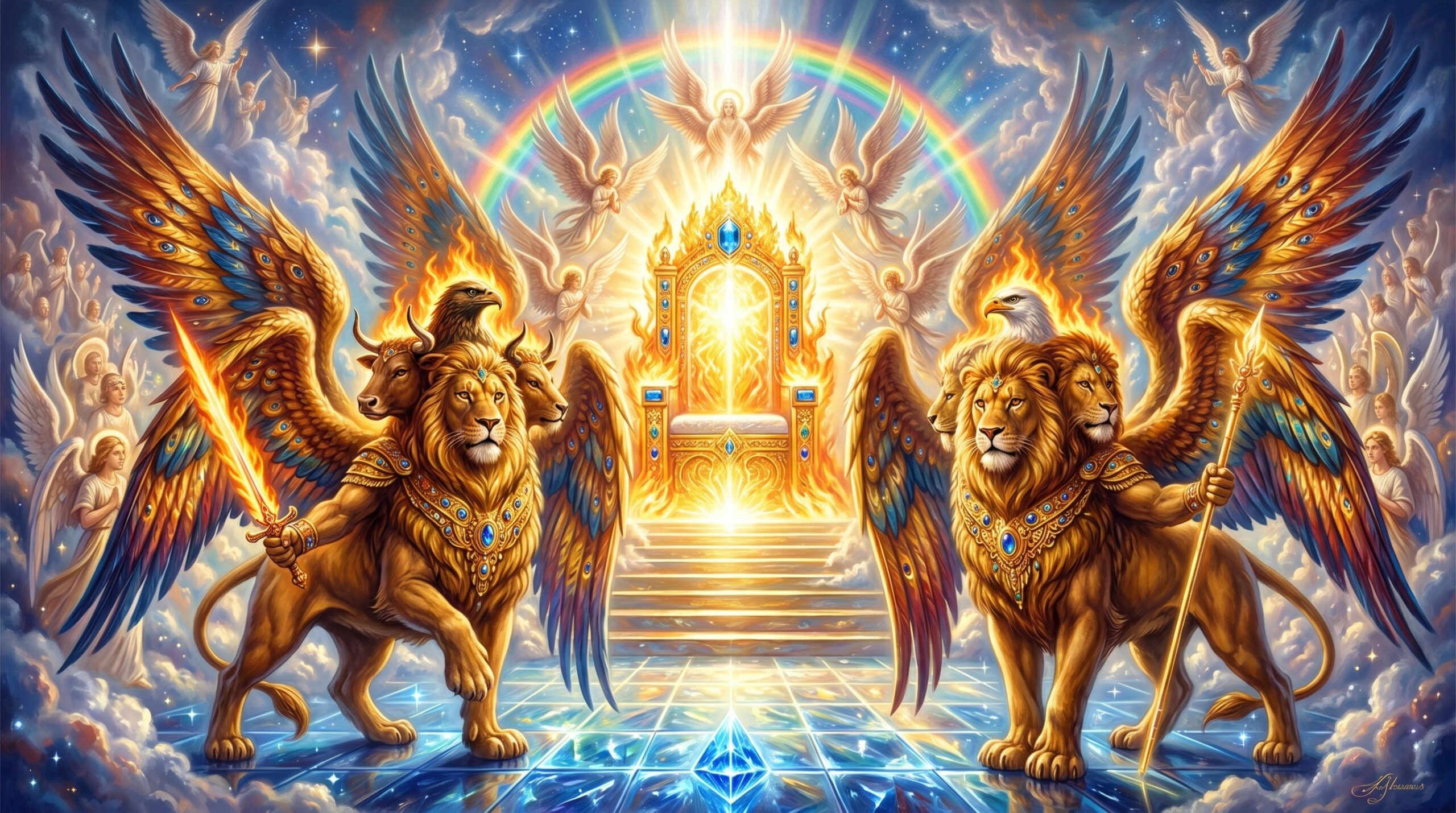
Cherubim – with multiple faces (human, lion, ox, eagle), winged, and full of eyes (Ezekiel 1 and 10). They guard holiness: at the Tree of Life in Eden (Genesis 3:24), on the Ark of the Covenant, and at God’s throne. They move like lightning, uniting heaven and earth. In Jewish mysticism they are throne-bearers, embodying balance and secret wisdom. In Gnosis they are associated with overcoming the Demiurge’s spheres — their many eyes symbolize gnosis that allows one to see through illusions and return to the Pleroma. In the Bible they are dynamic guardians, reminding us that holiness requires protection and reverence.
In Gnosticism, angels (or aeons) are emanations from the Pleroma — God’s fullness. The emanation of Sophia (Wisdom) led to the creation of the Demiurge (Yaldabaoth), who fashioned the material world as a prison. Gnosis helps awaken the soul through the mediation of angels (aeons): they bring light that awakens the inner Christ spark. Key messages for human development:
- Seek gnosis — direct experience, not mere belief.
- Transcend dualism (good-evil) through the consciousness of unity.
- Use angelic assistance for the soul’s ascent, purifying emotions and thoughts (similar to the Seraphim’s fire).
- Recognize that you are a divine spark, not merely the Demiurge’s creation.
- Angels help restore the Pleroma by reuniting fragmented parts of the soul.
These layers — Bible, Kabbalah, Gnosis — emphasize that angels are real forces reflecting God’s multifaceted revelation. Gnosis calls for inner awakening; Kabbalah for energetic work; the Bible for obedience.
Meaning Today: How to Experience God’s Angels in Your Own Life
The presence of angels does not always require dramatic visions. It manifests through attentiveness, unexpected help, inner peace, deep love, or events that feel divinely guided. Michael provides strength in difficulties, Gabriel clarity in decisions, Raphael healing. The Seraphim’s fire purifies fears, the Cherubim’s eyes help see the bigger picture. By living more mindfully, practicing gratitude, justice, and openness, everyday life becomes more sacred. This is a partnership with God — angels remind us that we are not alone and that every moment can be an encounter with heaven.
Extended Prayer for Inviting Angelic Presence:
Beloved God, Creator of heaven and earth, who is surrounded by the glorious majesty of the Seraphim and Cherubim, open my eyes and heart to the presence of Your holy angels. Send Michael with his sword to protect me from evil, Gabriel to bring clarity and messages for my path, Raphael to heal my wounds and guide me safely. Let Uriel illuminate my way with wisdom and let all Your heavenly hosts surround me with love and protection. Purify me with the fire of the Seraphim, open my heart to the wisdom of the Cherubim, so that I may live attentively, in love and obedience to Your will. May the presence of Your angels be my daily companion, guiding me closer to You and helping me fulfill the purpose of my life. Fill my life with Your light and grace, so that I may always feel that I am in Your hands. Amen.

Trough all this I want to declare this is all from God and to God. All Glory to Him!