Views: 35
Free Christianity and Eastern Orthodoxy: What Unites and Divides Them? A Deep Dialogue Between Two Christian Traditions
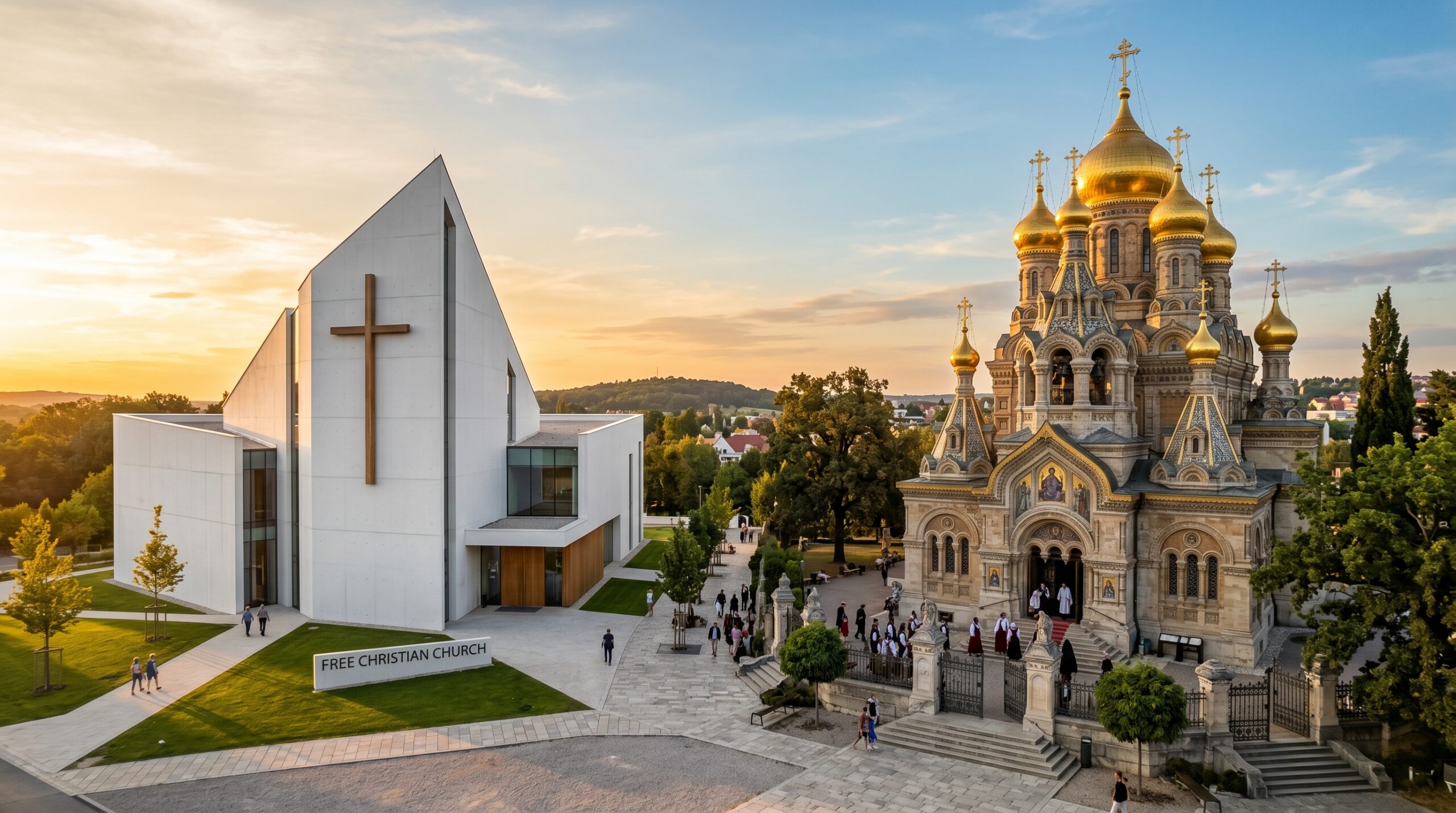
The richness of Christianity lies in unity in diversity. Free Christianity and Eastern Orthodoxy represent two profound ways of following Jesus Christ – one emphasises personal faith and the direct authority of the Bible, the other apostolic continuity and liturgical mystery. The dialogue between them does not need to end in uniformity, but can lead to mutual enrichment, where differences serve a common witness. “Diversity in unity” is not a contradiction, but a beauty that reflects the one essence of the Triune God in manifold expressions.
Trunk: Theological Foundation in the Bible, Church Fathers and Original Languages
The deep root of the dialogue is common: faith in the Triune God and in Jesus Christ as Lord and Saviour. The original languages of the Bible provide a strong foundation for this. The Hebrew ruach (breath, Spirit, wind) in the creation account (Genesis 1:2) and the Greek pneuma hagion in the New Testament (John 3:8) describe God’s life-giving presence, which does not fit into narrow frames. “All Scripture is God-breathed and is useful for teaching, rebuking, correcting and training in righteousness” (2 Timothy 3:16) – this statement forms the basis of Free Christianity’s sola Scriptura, emphasising the high authority of the Bible in faith and life.
Eastern Orthodox theology, drawing on the Church Fathers such as Athanasius of Alexandria, Basil the Great and John Chrysostom, sees salvation as theosis – deification. “That you may participate in the divine nature” (2 Peter 1:4). This is not merely forensic justification (sola fide), but a living communion with God through the sacraments, prayer and asceticism. The Greek theosis (θεώσις) reflects the Christology of the early ecumenical councils: Christ is fully God and fully man. Against the Hebrew background (Psalm 82:6 “You are gods”), the Fathers see here a call to all humanity.
The biblical trunk is firm: “I am the way, the truth and the life” (John 14:6). Free Christianity highlights the personal relationship and the Reformation emphasis on sola Scriptura, which corresponds to the high regard the early Fathers had for Scripture. Orthodoxy, however, stresses that the Bible must be read in the light of the living tradition of the Church, based on apostolic tradition: “So then, brothers and sisters, stand firm and hold fast to the traditions we taught you, whether by word of mouth or by letter” (2 Thessalonians 2:15). Both traditions seek the same Christ – one primarily as personal Saviour, the other also as Liturgical Presence.
Branches: Lesser-Known Aspects, Potential and the Development of Dialogue
Less well known is how Orthodox hesychasm (the prayer of the heart, the Jesus Prayer) and the charismatic experience of the Spirit in Free Christianity can complement each other. The Greek hesychia (ησυχία) refers to the silence of the heart, already found in the Psalms (Psalm 131) and the early Fathers. In Free Christianity this often corresponds to fresh spiritual awakening and personal prayer. These are not opposites, but different ways of participating in the same divine life.
Icon theology offers another important branch. Orthodox Christians do not worship icons as gods, but venerate them (veneration, not adoration). The Seventh Ecumenical Council defended icons precisely because God became flesh – “The Word became flesh and made his dwelling among us” (John 1:14). Jesus took on the form of matter, sanctifying material substance and image. This is not idolatry, but a confession of the mystery of the Incarnation. The caution of Free Christianity regarding icons protects the pure word of the Bible and the direct relationship of the heart. In dialogue, this can lead to a deeper understanding: both word and image point to the same Truth.
Dialogue could develop gradually: first through sharing personal testimonies, then through joint study of biblical texts, followed by theological conversations, and finally common prayers and services. This requires humility – from Free Christians respect for historical tradition, and from Orthodox openness to fresh and personal reading of the Bible. Sola Scriptura does not have to mean the rejection of tradition, but its subjection to Scripture; likewise, tradition can help to understand the Bible better.
The potential is great: Free Christianity brings the vitality of the Bible, personal responsibility, missionary zeal and power of renewal; Eastern Orthodoxy offers deep sacramental communion, liturgical beauty, a sense of mystery and historical continuity. Together they can respond to the fragmentation and spiritual thirst of the contemporary world.
Leaves: Existing Factual Dialogue and Practical Steps
Significant steps have already been taken. The International Lutheran-Orthodox Joint Commission has since 1981 issued joint statements on salvation, grace, synergy (1998) and baptism (2004). Current discussions focus on the Holy Spirit. Both sides participate in the World Council of Churches, and in Estonia local meetings, joint prayers and seminars have shown that prejudices fall through personal encounters.
These “leaves” confirm that dialogue is not a utopia. It grows slowly but surely, strengthening unity in diversity and helping Christians to bear common witness to the world of one Lord.
Prayer on the Dialogue between Free Christianity and Eastern Orthodoxy:
Lord Jesus Christ, You who are the head of one body, which is your Church, look mercifully upon your children who seek You in different ways. Unite the fiery heart of Free Christianity and the liturgical beauty of Eastern Orthodoxy, so that together they may bear witness to the depth of your grace. Remove prejudices, open eyes to true communion in your body and blood. Grant us wisdom to listen to one another, humility to learn, and love that overcomes differences. May your Spirit be the guide in every conversation, so that our dialogue may bring glory to your name and fulfil your prayer that all may be one. Grant that sola Scriptura and holy tradition may meet not in opposition but in mutual enrichment in the light of your Truth. May icons and the word, liturgical beauty and personal prayer, the silence of hesychia and charismatic joy – all these be parts of your one body. Lead us into deep communion, so that the world may see your love in our unity in diversity. Amen.
Trough all this I want to declare this is all from God and to God. All Glory to Him!