Views: 32
Ukraine Claims Pochaiv Lavra Belongs to the Russian Orthodox Church — A Major Step Toward Banning the Historic Monastery
Meta description: Ukraine’s state authority DESS has ruled that Pochaiv Lavra is affiliated with the Russian Orthodox Church. Read the facts, the history, and the background behind the fate of one of Orthodoxy’s holiest sites.
Introduction
On July 22, 2026, Ukraine’s State Service for Ethnopolitics and Freedom of Conscience (DESS) published the findings of its examination: the Holy Dormition Pochaiv Lavra — one of the oldest and most revered monasteries in the Eastern Orthodox world — remains affiliated with the Russian Orthodox Church (Moscow Patriarchate), whose activity is banned by law in Ukraine. It is the most direct step yet in a broader process that could end with Pochaiv Lavra’s activity in the country being terminated altogether.
What Exactly Happened
DESS head Viktor Yelenskyi told Ukrinform that the agency will issue Pochaiv Lavra a formal order requiring it to sever its ties with the Russian Orthodox Church. If the monastery fails to comply, DESS will file a lawsuit seeking the termination of the religious organization’s activity.
According to the agency’s findings:
- Pochaiv Lavra functions as a structural subdivision of the Ukrainian Orthodox Church and belongs to its Kyiv Metropolia — a body Ukrainian authorities have already designated as affiliated with the Russian Church.
- The Russian Orthodox Church’s own charter provides for the head of Pochaiv Lavra to sit among the ROC’s governing bodies — a direct canonical and institutional link, in DESS’s assessment.
- Severing this tie, Yelenskyi noted, does not require changing liturgical traditions, the church calendar, or the language of worship, nor does it require joining the Orthodox Church of Ukraine (the autocephalous church recognized by the Ecumenical Patriarchate) — only a formal decision by the Kyiv Metropolia’s competent bodies to withdraw from the Russian Church.
If the monastery complies, the agency has stated it will be free to continue operating in Ukraine. If it does not, the matter proceeds to court, with the possibility of the religious organization being forcibly dissolved.
Pochaiv Lavra — One of Orthodoxy’s Holiest Sites
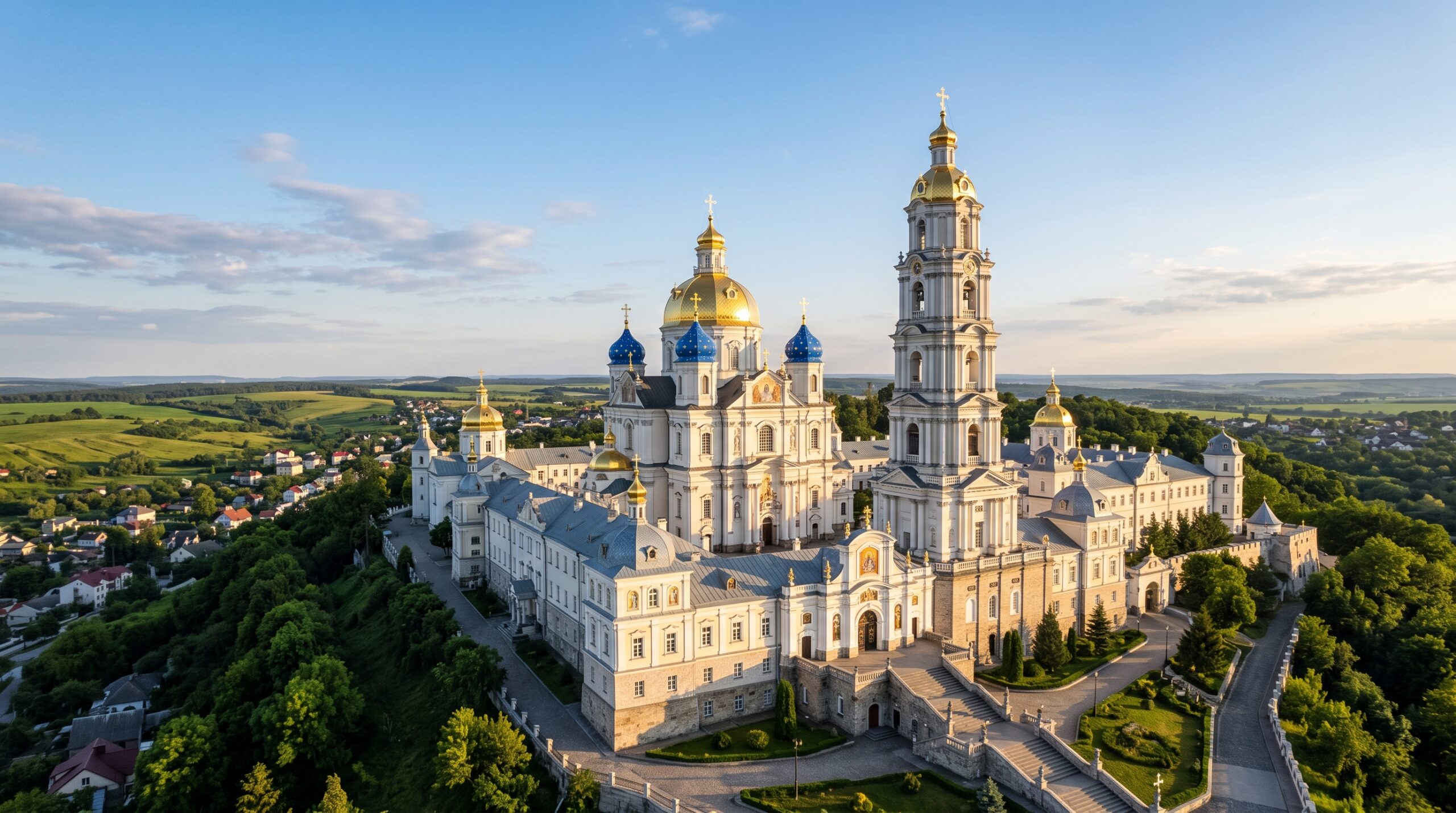
Pochaiv Holy Dormition Lavra sits in the Ternopil region of western Ukraine and is regarded in Orthodox tradition as one of its greatest shrines, second in stature only to the Kyiv Pechersk Lavra.
Tradition traces the monastery’s founding to the 13th century, when monks fled there to escape the Mongol invasion of Kyiv and reported a vision of the Mother of God on the mountain — leaving, according to the legend, a footprint in the rock from which a spring arose, still venerated today as miraculous. The Pochaiv Icon of the Mother of God, housed at the monastery, is one of the most celebrated wonder-working icons in the Orthodox world, drawing pilgrims from across the region for centuries.
The monastery’s history has itself been shaped by shifting political power: in the 1720s, under Polish-Lithuanian rule, it passed into the Uniate (Greek Catholic) Church, returning to Orthodoxy only in 1831 after the Russian Empire suppressed a Polish uprising. That layered history — a shrine repeatedly reassigned across confessional lines as political power changed hands — echoes through today’s dispute.
Legal Background: The 2024 Law and Its Enforcement
The current development traces back to August 2024, when President Volodymyr Zelensky signed the Law “On the Protection of the Constitutional Order in the Sphere of Activities of Religious Organizations.” The law gives courts broader authority to act against religious organizations tied to Russia and set a nine-month window for the Ukrainian Orthodox Church (the branch affiliated with the Moscow Patriarchate) to formally sever its ties with Moscow.
As early as January 2023, a DESS religious examination had already concluded that the church remained, in practice, a structural unit of the Russian Orthodox Church, despite a formal “declaration of independence” issued in the spring of 2022. In the years since, Ukraine’s Security Service (SBU) has carried out numerous searches at Pochaiv Lavra, Kyiv Pechersk Lavra, and other church properties, reporting finds of pro-Russian literature and individuals holding Russian citizenship. According to the SBU, more than a hundred clergy have faced criminal proceedings, with several convictions — including for treason and for passing the locations of Ukrainian forces to the enemy.
Reactions
The Ukrainian Orthodox Church (the Moscow Patriarchate–affiliated branch) has repeatedly denied the allegations, maintaining that it is in practice independent of Russia. Some of its clergy have publicly urged parishioners to resist attempts to “seize” church buildings.
Internationally, the developments have drawn mixed responses. In August 2024, immediately after the law was signed, Pope Francis voiced concern for religious freedom, telling the crowd at his weekly prayer in St. Peter’s Square that “no Christian church may be abolished directly or indirectly” and that “the churches must not be touched.” Ukrainian authorities, for their part, insist this is not a question of religious freedom but of national security in wartime, pointing to the Russian Orthodox Church leadership’s public support for Russia’s war against Ukraine.
Key Facts at a Glance
- July 22, 2026: DESS published its examination finding that Pochaiv Lavra is affiliated with the Russian Orthodox Church.
- DESS will issue the monastery a formal order to sever those ties; failure to comply will trigger a lawsuit to terminate the organization’s activity.
- DESS classifies Pochaiv Lavra as part of the Ukrainian Orthodox Church’s Kyiv Metropolia, already designated as Moscow-affiliated.
- The Russian Orthodox Church’s charter seats the head of Pochaiv Lavra among Moscow’s own governing bodies — DESS’s central piece of evidence.
- The legal basis is the August 2024 law permitting the banning of Russia-affiliated religious organizations in Ukraine.
- A January 2023 DESS examination had already found the church was not, in practice, separated from Moscow, despite its 2022 declaration.
- Over 100 clergy have faced criminal proceedings; dozens have been convicted.
- Pochaiv Lavra is one of the oldest and holiest monasteries in Orthodoxy, known for its wonder-working Icon of the Mother of God and its holy spring.
- Kyiv Pechersk Lavra has already undergone a similar process, with clergy required to vacate parts of the monastery complex.
- The Vatican has expressed concern over religious freedom; the Ukrainian government emphasizes the national-security rationale.
A Theological and Spiritual Perspective
Church history is no stranger to the entanglement of political power and ecclesial affiliation — Pochaiv’s own history, shifting between Orthodoxy and Uniate status according to whichever ruler held sway, is a vivid case in point. Across the centuries, the Church has learned that outward institutional affiliation and inward spiritual life are not always the same thing — and that God’s people have preserved their faith even as borders, rulers, and even church structures have changed around them.
Yet that truth should not be used to excuse indifference to genuine spiritual responsibility. If an institutional tie lends support to one Christian nation’s war against another — as Ukrainian authorities allege of the Russian Orthodox Church’s leadership — every believer faces a serious moral question: where does the line fall between ecclesial belonging and political complicity? That is not a question the law alone can settle; it calls for conscience and spiritual discernment, exercised by individual believers and church institutions alike.
At the same time, the mountain at Pochaiv, its spring, and its icon remain, for many, a holy place regardless of which institution holds formal authority over it. The prayers offered there across the centuries belong to no state and to no church structure.
Prayer
Merciful God, Father of the Ukrainian people and of the whole Orthodox world,
We bring before You Pochaiv Lavra and all the holy places of Ukraine, caught in the midst of war and division. You know what lies hidden in every human heart — those who govern, and those who pray. Grant wisdom to those entrusted with deciding the fate of churches and congregations, that they may not mistake justice for vengeance, nor security for injustice.
Protect the people of Ukraine from the horrors of war, and remind those who rule that peace is more than the defeat of an enemy. Purify the hearts of Your Church — in the East and in the West alike — of anything that serves earthly power before Your truth. Where the Church has been made to justify violence, remove the falsehood and let Your light shine through.
Be near to the monks and nuns who live in fear for the fate of their monastery, and grant them a peace that does not depend on walls or deeds of ownership. Keep alive the prayer that has been offered on the mountain of Pochaiv for centuries, whatever roof it is spoken beneath.
Grant peace to the land of Ukraine, healing to those who have lost loved ones, and wisdom to all who bear responsibility for its people and its churches. May Your will be done, not the ambitions of men — now and forever.
Amen.
Trough all this I want to declare this is all from God and to God. All Glory to Him!