Views: 181
September 1: The Beginning of the Ecclesiastical New Year, or the Indiction — The First Day of the Orthodox Liturgical Year
An in-depth look at the September 1 feast in the Orthodox Church — the historical roots of the Byzantine indiction, its transformation from a tax-administration cycle into a symbol of the church’s new year, and the theological significance of Christ’s reading in the synagogue at Nazareth. Why does the Orthodox spiritual year begin when the civil year is already eight months old?
Introduction: Two Calendars, Two Beginnings
For most people, the year begins on January 1 — a date whose roots reach back to the cult of Janus, the ancient Roman god of all beginnings. Yet the Orthodox Church has for centuries lived by a different rhythm: its liturgical year begins on September 1, a day known as the Beginning of the Indiction (Greek ta indikta, Latin indictio). This is not some minor peculiarity of a handful of churches — it is still observed today by all Orthodox Churches, whether they follow the new or the old calendar (in the old-calendar churches, the same observance falls on September 14).
The question this date raises is more interesting than a mere calendrical technicality: how did an administrative cycle for Roman imperial tax collection come to serve as the spiritual new beginning of the Christian Church? And what does it mean for a believer today that their spiritual year begins not around the winter solstice, amid the mystique of a new calendar year, but in autumn, at the time of harvest and nature’s decline?
The Indiction: From Tax Cycle to Church Chronology
The word indiction comes from the Latin indictio, meaning “imposition” or “proclamation.” Originally it referred to a Roman administrative practice of periodically reassessing the tax burden tied to land ownership. Already at the end of the third century, under Emperor Diocletian, a five-year tax cycle was established in Egypt; by the early fourth century this had grown into a fifteen-year cycle that spread throughout the empire. Every fifteen years, land values were reassessed and a new tax burden set for the following period — a practical, secular, economic procedure that initially carried no religious meaning whatsoever.
According to tradition, the wider adoption of the system is linked to Emperor Constantine the Great, who in the year 312 saw the sign of the cross in the sky and won a decisive victory over his rival Maxentius — an event that marked the rise of Christianity as the religion of the Roman state. It was from his reign onward that the indiction cycle came to be used more broadly for dating documents, not only for tax purposes. In the Byzantine (Eastern Roman) calendar, September 1 became fixed as the starting date of the cycle — earlier, a similar role had been played by September 23, the birthday of Emperor Augustus, which shows how the Christian calendar gradually drew its symbolism from the old pagan state cult, filling it with new, Christian content.
Over time the indiction cycle lost its direct connection to taxation and simply became a way of marking time — much as today we speak of a “fiscal year” without it necessarily referring to taxes at all. The Byzantine Emperor Justinian I (sixth century) made dating by indiction mandatory for all official documents, and the practice spread to the Church of Rome as well — from the time of Pope Pelagius II (late sixth century) until the year 1097, the Western Church too used the indiction cycle for dating documents.
Why September 1 Became the Beginning of the Church Year
To understand why September 1 came to carry ecclesiastical significance, one must look at the rhythm of life in Mediterranean agrarian society. In the East — in Palestine, Syria, Egypt — the end of summer, the turn from August to September, marked the completion of the harvest and the beginning of the new agricultural year. The “end” and “beginning” of the year there marked the cycle of nature: crops harvested, storehouses filled, land readied for new sowing. In Christian thought, this agrarian symbolism merged with a spiritual message: just as the field prepares to bear fruit again after the harvest, so the soul prepares for new spiritual labor at the start of the church year.
Alongside this, the Church Fathers have, through the centuries, pointed to a third and theologically most important reason: on September 1, according to tradition, Jesus entered the synagogue in Nazareth and read aloud from the book of the prophet Isaiah words proclaiming the beginning of his own mission. According to the Gospel of Luke (4:16–21), Jesus opened the scroll and read: “The Spirit of the Lord is upon me, because he has anointed me to preach good tidings to the poor… to proclaim release to the captives… to proclaim the acceptable year of the Lord.” When he had finished reading, he told the congregation, “Today this scripture has been fulfilled in your hearing.” This scene — Christ’s own public proclamation of his mission — is why the Byzantine Church read this day not merely as a calendrical starting point but as a theological one: the proclamation of a new, “acceptable year of the Lord,” one that concerns every Christian personally.
Cyril of Alexandria, one of the earliest interpreters of this scene, wrote that the “acceptable year” theologically signifies the time in which Christ allowed himself to be crucified for our sake, for it was then that we became acceptable before God the Father, as fruit borne by him. Seen in this light, September 1 is not merely a marker of a new year but an annual reminder of that one great “acceptable year” toward which the entire liturgical cycle of the church year moves.
The Reckoning of the World’s Creation and Byzantine Chronology
In the Byzantine tradition, and later in the Russian Church, years were counted not from the birth of Christ, as in the West, but from the creation of the world — in Greek, Etos Ktiseos Kosmou, in Latin, ab origine mundi. According to this reckoning, the world was created on September 1, 5509 BC by the Julian calendar, a calculation based on the Greek translation of the Old Testament, the Septuagint. The Ecumenical Patriarchate of Constantinople used this system officially from the late seventh century until 1728, when Russian Emperor Peter the Great decreed by edict that the civil new year be moved to January 1 — although in ecclesiastical circles September 1 continued to be observed as the new year for a long time afterward.
This double significance — September 1 as both the beginning of nature (creation) and the beginning of the story of salvation (the proclamation of Christ’s mission) — gives the date a special weight: it unites cosmological and soteriological chronology into a single day. The beginning of the world and the beginning of the story of salvation coincide in liturgical consciousness, as though confirming one another: the same God who created the world also enters that world to save it.
Liturgical Observance Today
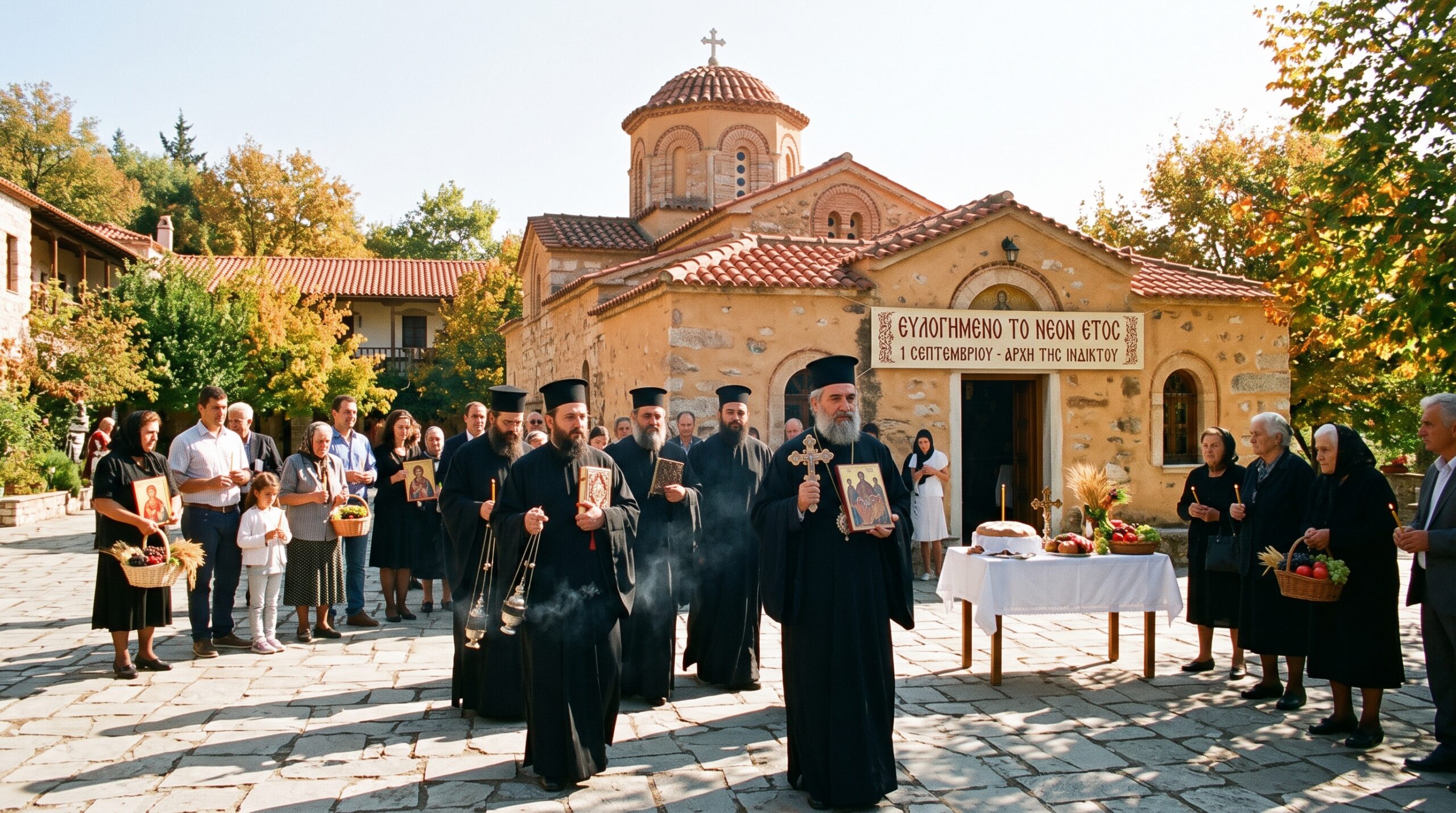
At the Ecumenical Patriarchate in Constantinople, a solemn ceremony is still held on September 1: the Ecumenical Patriarch, together with members of the Holy Synod, gathers at the Patriarchal Church of St. George the Great Martyr in the Phanar district, celebrates the Divine Liturgy, venerates the Panagia Pammakaristos icon, and proclaims the new year — a tradition that preserves a direct line back to the Constantinian-era proclamation of the indiction. Since 1989, the Ecumenical Patriarchate has also dedicated September 1 as a day of thanksgiving and prayer for the protection of creation — a modern addition that logically continues the day’s ancient connection to the agricultural and creation cycle.
Liturgically, the Gospel reading for the day remains Luke chapter 4, recounting Jesus’s speech in the Nazareth synagogue, and the church’s prayers ask God’s blessing on the coming year — for a good harvest, health, peace, and an enlightened mind, that the faithful may live out the year in purity and with a good conscience.
Existential and Spiritual Meaning for the Modern Believer
Why should a modern Christian, who lives by the civil calendar and marks the new year in January, know or care about a church year that begins in September at all? The answer lies precisely in this doubled rhythm of time.
First, it is a reminder that a Christian’s sense of time need not fully submit to the rhythm of the secular world. Where society marks its new beginning in winter, in the darkest part of the year, with a focus on consumption and resolutions often forgotten by February, the Church calls its members to a different kind of beginning — at the time of harvest and quiet preparation, where the emphasis lies not so much on new resolutions as on gratitude for what has passed and humble readiness for what is to come.
Second, the history of the indiction — its journey from a tax cycle to a spiritual meaning — is a reminder that even the most secular, bureaucratic structures can take on deeper significance when illuminated by faith. The Church did not scorn the Roman administrative system as too “profane” — it took it over and filled it with new content. This is itself an instructive pattern: not everything secular need be rejected by the Christian; it can instead be learned how to be sanctified.
Third, Christ’s own words in the Nazareth synagogue — “today this scripture has been fulfilled” — invite every new year to be seen not as a calendrical formality but as a personal calling: each new church year is, on its own smaller scale, an invitation to live out that “acceptable year” of which Isaiah and Jesus spoke — a year in which the poor hear good news, captives are set free, and the blind see. This is not merely a historical event but a calling renewed with every September 1.
Conclusion
September 1 carries an extraordinary layering of history and theology: the technical cycle of Roman imperial tax administration, the harvest rhythm of agrarian society, the Byzantine cosmological reckoning of the world’s creation, and Christ’s own proclamation of the beginning of his mission all converge on a single date. It is precisely in this layering that a characteristic feature of Orthodox liturgical thought is found: time itself, even in its most secular — administrative, economic — form, is capable of bearing holiness, when illuminated by the faith that all time belongs to God and moves toward him.

Trough all this I want to declare this is all from God and to God. All Glory to Him!