Views: 72
God-Man – The Bible Reveals: The Secret of Human Creation No One Talks About
An in-depth study of human creation — through a synthesis of the Bible, Gnostic texts, and patristic theology. Why is the imago Dei not a possession we lost in the Fall, but a calling we are still fulfilling? Bible quotations from the Piibel.net 1968 Estonian translation.
Introduction: What Most People Miss
Most people read the Bible’s creation story with one assumption already in place: that creation is finished. God created, man came into being — full stop. But read Genesis closely, alongside the deeper reading offered by the New Testament and the Church Fathers, and a different picture opens up. The Bible does not proclaim that man already is, in finished form, the image of God. It proclaims something bolder: man was created in order to become the image and likeness of God — and that process is not yet complete. This is a secret most sermons pass over in silence, because facing it means giving up the comfortable idea of a human being as a finished product, and taking up instead the idea of a human being as a journey still underway, though carefully directed.
Part I: Two Creation Accounts, One Deeper Truth
According to the Piibel.net 1968 Estonian translation, the first account of creation reads:
“And God said: Let us make man in our image, after our likeness, that they may rule over the fish of the sea, the birds of the air, the cattle, and over all the earth, and over every creeping thing that creeps on the earth! And God created man in his own image, in the image of God he created him; male and female he created them!” (Genesis 1:26–27)
The second account, a few chapters later, moves in an entirely different rhythm:
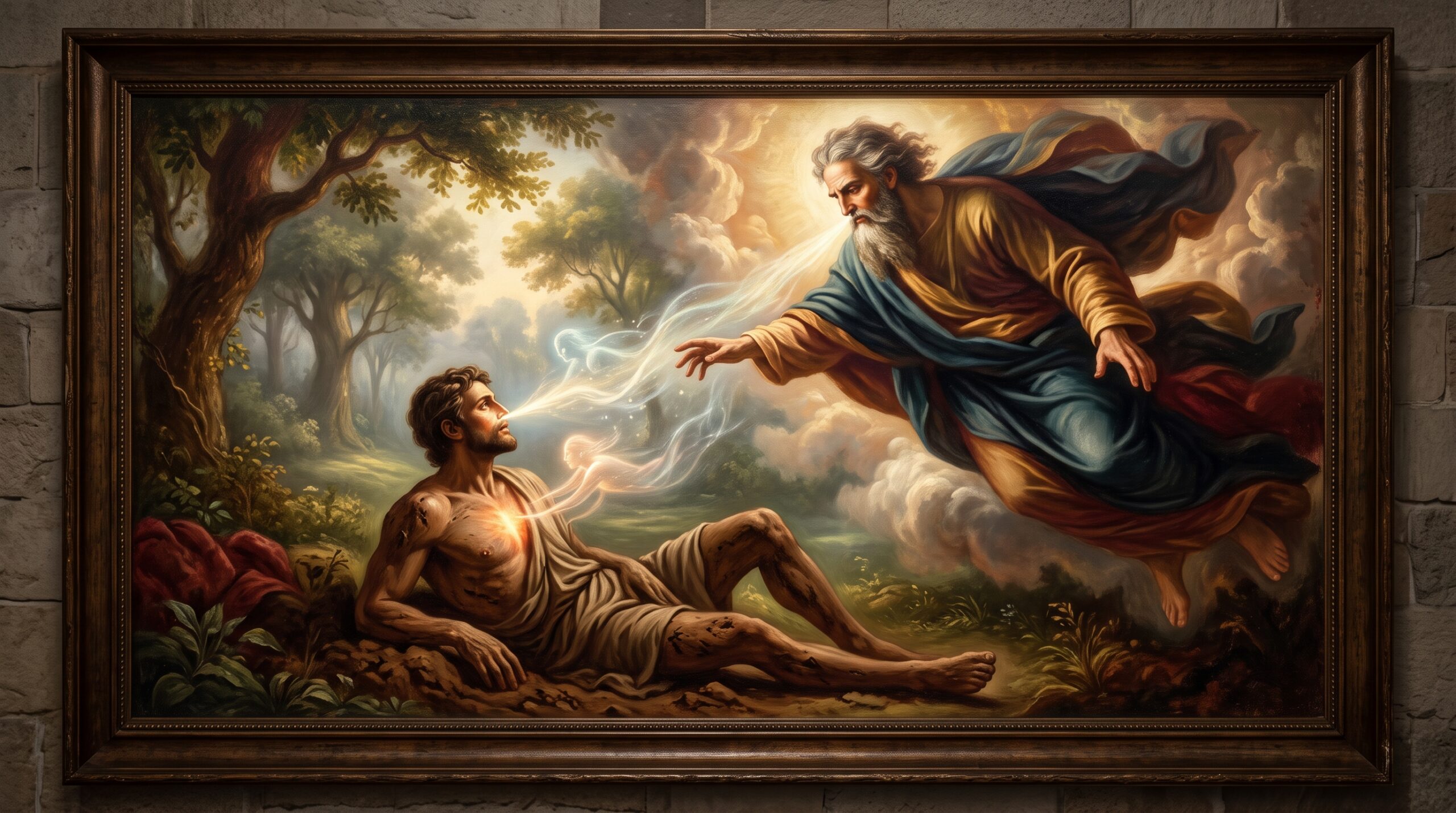
“And the Lord God formed man, who is dust, from the ground, and breathed into his nostrils the breath of life: and man became a living soul.” (Genesis 2:7)
Biblical scholarship has argued for centuries over whether these are two conflicting traditions. Theologically, though, something more important than a source-critical question is at stake here: the two accounts do not contradict one another — they complete one another, each in a different register. The first chapter speaks of man’s destiny — image and likeness, the mandate to rule, a place at the summit of all creation. The second chapter speaks of man’s material — earth, dust, a breath of air that alone turns dust into a living soul. According to the Bible’s own testimony, man is a paradoxical being: drawn from the ground, yet called into divinity; confined to a body, yet open toward infinity.
The Greek Old Testament, and the patristic tradition that followed it, gave this paradox a precise formulation, distinguishing two terms that stand side by side in the Hebrew text (tselem and demut): eikon (image) and homoiosis (likeness). It was this very distinction — first developed systematically by the second-century Church Father Irenaeus of Lyon — that opens the door to what this article calls the Bible’s hidden secret.
Part II: A Heresy That Reveals the Truth by Contrast
To understand what the Bible actually proclaims, it helps to look at what was being fought against in the second century. One of the most influential Gnostic texts, the Apocryphon of John (the Secret Book of John), discovered in 1945 among the Nag Hammadi manuscripts, offers a radically different account of creation.
According to this teaching, the true maker of the world was not the Most High God at all, but a lesser, mistaken being named Yaldabaoth — a false god born of the fall of Sophia (Wisdom), who wrongly believed himself to be the only god: “I am God, and there is no other beside me” — Yaldabaoth declares in the text, ignorant of the true divinity above him. Yaldabaoth and his archons (rulers) made man, Adam, in the likeness of their own false-divine image — but the body remained lifeless until Sophia, by a ruse, tricked Yaldabaoth into breathing into it his own stolen divine spark. In this way, according to Gnostic teaching, the human body became a prison in which the divine spark is trapped, and salvation consists in escaping this body and the material world through secret knowledge (gnosis).
The Church rejected this teaching decisively and with good reason — it is not a reliable source for interpreting the Bible, but rather a radical distortion of it. Still, it is worth understanding why this distortion felt so compelling, because that is precisely what shows what the heretics glimpsed correctly and then interpreted entirely wrongly.
The Gnostics saw correctly that there is a real tension within the human being — between body and spirit, between limitation and longing. They recognized that something in a human being reaches beyond what the eye can see. But their error was catastrophic: from this tension they concluded that the material world and the body are inherently evil, that the Creator himself is mistaken or malicious, and that salvation means escaping from creation rather than fulfilling it.
The Bible teaches the exact opposite. When God made the world, Genesis says again and again: “And God saw that it was good.” The body is not a prison — it is, as Irenaeus stressed in his argument against the Gnostics, part of the human being’s whole nature, together with soul and spirit. Salvation does not mean escape from the body; it means the cooperation of body, soul, and spirit moving in the direction for which they were originally made.
Part III: Irenaeus and a Discovery That Changes Everything
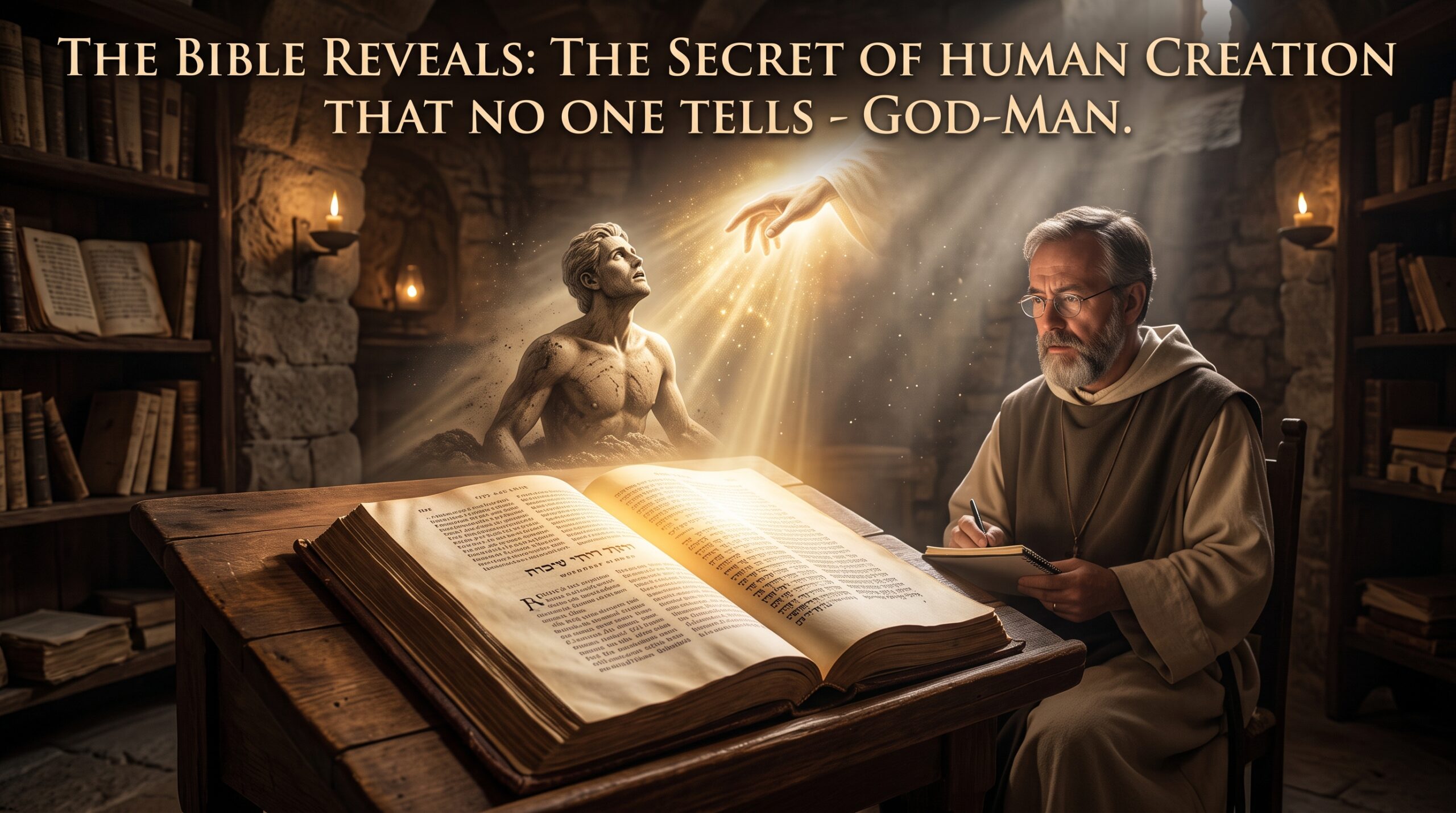
Here lies what this article considers the Bible’s real, rarely spoken secret. Irenaeus, who knew the Gnostic texts very well, wrote against them in his major work, Against Heresies (c. AD 180). In it, he made an observation about the text that most casual readers pass right by: Genesis 1:26 says, “Let us make man in our image, after our likeness,” yet 1:27 repeats only half of that sentence — “God created man in his own image.” The word “likeness” (Greek homoiosis) drops out of the verse describing the actual act.
According to Irenaeus’s reading, this was no accidental variation in repetition. It reflected a deep truth about human nature: image (eikon) was given to man at the moment of creation, as an unshakeable gift — it is the structure, the reason, the freedom that even fallen man does not lose. But likeness (homoiosis) — a full, living, growing correspondence to God — is not yet a completed gift, but a goal, toward which man moves across the whole of his existence, in cooperation with God’s Spirit. Irenaeus described Adam as one who needed to grow and mature, not as an adult, finished being from the start. The Fall did not destroy the image — it interrupted the growth toward likeness. Man’s fall in the garden of Eden hindered and interrupted that growth toward the likeness of God — a growth that culminates in the Theanthropos, the God-Man.
This is the first layer of the secret: the creation of man was not a completed act, but the beginning of a process.
Part IV: Gregory of Nyssa and Infinite Growth
Two centuries later, the Cappadocian theologian Gregory of Nyssa took up this thought and carried it further still, with one of his boldest theological concepts: epektasis — infinite growth toward God that never ends, not even in heaven. This is also one of the cornerstones of the patristic striving toward holiness: man strives and grows toward God in every way, in order to attain fullness. In our own time, the fruit of such illumination — the soul’s reaching toward light — can be nothing less, on this earth, than the God-Man, the Theanthropos, who carries within himself that epektasis, the eternal beauty of striving toward God.
For Gregory, the imago Dei was not merely a static quality given to man at creation, but an open future. Since God is infinite, no finite being can ever be “finished” with him — every fulfillment opens the door to a further, deeper communion. Human perfection, then, is not a static state but a continuous, eternal movement, ever deeper into goodness and into the source of goodness.
This thought is already quietly present within the Bible itself, though most readers miss it: when Genesis says man was created after the image of God, the Greek preposition (kata) signals direction, not final correspondence. Man was not created as a copy of God — he was created to move toward God, through a living, unbroken, infinite growth. This is one of the secrets that a close study of the Bible’s own language uncovers.
Part V: Freedom as the Hidden Core of Creation
Why is this spoken of so rarely? Because it forces us to acknowledge something dangerous and beautiful at once: at the center of man’s creation stands freedom, not submission.
When God commanded Adam not to eat from the tree of the knowledge of good and evil, this was not an arbitrary restriction — it was the very condition that made love possible at all. A command that cannot be broken is not a command, but a mechanism. A love that cannot refuse to be given is not love, but instinct. In creating man, God gave him something granted, according to the Bible’s own testimony, to no other created being: a real possibility of saying “no” — for only in this way could “yes” be something more than a programmed reaction.
Here lies yet another layer of the secret: the creation of man was not merely an act, but a partnership. God did not create man as a puppet automatically fulfilling a preset role, but as a free participant, whose choices are themselves part of the process of creation. This is not the false freedom of Gnosticism, in which a divine spark of spirit escapes an evil material prison — it is the freedom of the Bible, in which the whole human being, body and soul together, is called to respond freely to God’s love.
Part VI: Created Anew — the New Testament’s Radical Proclamation
If the first creation was a beginning, the New Testament proclaims something no Gnostic myth could ever have imagined: that God himself entered into creation, to fulfill and renew it from within. Christ became the first God-Man, the Theanthropos.
The Gospel of John, according to the Piibel.net 1968 translation, says:
“In the beginning was the Word, and the Word was with God, and the Word was God. The same was in the beginning with God. All things were made through him, and without him nothing was made that was made. In him was life, and the life was the light of men.” (John 1:1–4)
This is a theological restatement of the first creation account, but with a new, deeper disclosure: the one “in whose image” man was created in the book of Genesis was already the Word — Christ. Paul proclaims the same truth in his letter to the Colossians, calling Christ “the image of the invisible God” (Colossians 1:15) — using the same word the Septuagint uses in the Genesis creation account. The creation of man “in the image of God” therefore means, read theologically, that man was created after the pattern of Christ, before Christ himself appeared in history. Man is created after the pattern of Christ, and is given the freedom and the calling to grow toward the divine Light, in the Holy Spirit.
This casts new light on Jesus’s words to Nicodemus. According to the 1968 Bible translation:
“Jesus answered him: Truly, truly I say to you, unless one is born from above, he cannot see the kingdom of God! […] Truly, truly I say to you, unless one is born of water and the Spirit, he cannot enter the kingdom of God!” (John 3:3, 5)
Being “born from above” is not a moral improvement or a new resolution — it is a new act of creation, taking place within the human being, akin to the first creation, but now accomplished through the Spirit. Paul expresses the same thought even more directly, proclaiming that the one who is in Christ is a new creation — not a repaired version of the old, but a truly new beginning, belonging to the same category of creative act as Genesis’s original one.
Part VII: Theosis — the Unveiling of the Bible’s Ultimate Purpose
All these threads converge on a single point, which the Eastern Church tradition calls theosis — deification. This is not a Gnostic escape from the body and the material world, but its opposite: the deepening of the whole of human nature, body included, into communion with the life of God.
The Church Father Athanasius the Great put this into a single sentence in the fourth century, one that has remained among the most famous summaries in all of patristic theology: “God became man, so that man might become God.” This sentence does not mean that man becomes God in essence — it means that the human nature Christ bore in his incarnation was opened, through him, to a communion with the life of God that had not been possible before.
The 1968 Bible translation carries the same proclamation in the second epistle of Peter:
“…by which have been given to us the most precious and greatest promises, that through these you might become partakers of the divine nature, having escaped the corruption that is in the world through lust.” (2 Peter 1:4)
This is the Bible’s own testimony to what this essay calls its hidden secret: the ultimate purpose of man’s creation was never merely to exist alongside God, but to share in God’s own life — not in pantheistic dissolution, but in a loving, freely chosen, ever-growing communion that honors the human person’s distinctness as strongly as it honors his calling.
Part VIII: A Higher Level of Consciousness — What This Means in Practice
When a human being understands himself in the light of this deeper story, his own self-awareness becomes radically different from ordinary, surface-level self-understanding.
He no longer sees himself as a finished product, whose worth depends on whether he meets some externally imposed standard. Nor does he see himself as a prisoner, held captive by a material body and world, as the Gnostics taught. He sees himself as on the way — drawn from dust, yet called into communion with eternity; limited, yet not closed off; fallen, yet not abandoned.
This shift in consciousness is not a philosophical abstraction or a form of “spiritual escapism.” It is a practical reorientation that reshapes three basic relationships:
- Limitation is no longer condemnation or final failure, but a place where growth happens. Limitation becomes the space in which humility, endurance, and genuine maturity can take shape.
- Freedom is not a burden or an endless chaos of options, but the very condition that makes love possible. Without real freedom, there is neither real giving nor real responsibility.
- The body is not a prison to be escaped, but a temple. This corresponds directly to the language of the Bible itself (e.g., 1 Corinthians 6:19–20), where the body is the dwelling place of the Holy Spirit, not an obstacle to it.
And most importantly: a higher consciousness does not mean stepping outside the material world. It means seeing that world more deeply, in a healed way — a seeing that is open, not closed. Not an escape from nature, from the body, or from history, but a re-seeing of them in the light of Christ.
This is exactly the shift the New Testament describes when it speaks in terms of “new creation,” “renewal of the mind,” and “opening of the eyes.” Not an abstract “higher vibration,” but a concrete, embodied way of seeing that makes love possible.
Conclusion: A Secret That Is No Longer Hidden
The creation of man is not a static “state of readiness.” Genesis 1:26–27 says that man is created in the image (tselem) and likeness (demut) of God, but this does not mean he is already, in full, everything he is called to be. Rather, he is set upon an open path:
- image is given (an essential relationship, the capacity to commune with God, responsibility, freedom);
- likeness is a goal, realized in a free response, despite the Fall, in redemption and in the Spirit’s ongoing work.
This is at once humbling and bold. Humbling, because man is never “finished” or independently perfect. Bold, because the goal is nothing less than a living, complete likeness to God — not a merging of essence, but a personal, loving communion that deepens forever.
The New Testament carries this forward with great clarity:
- we are created anew in Christ (2 Corinthians 5:17; Ephesians 4:24);
- we are changed “from glory to glory” by the same Holy Spirit (2 Corinthians 3:18);
- the goal is “the measure of the stature of the fullness of Christ” (Ephesians 4:13);
- and this process does not stop with death, or even with resurrection — communion only continues to deepen.
Man, then, is not a static “image of God,” but a dynamic, freely responsive, continually open process, whose goal is a living likeness. And this is exactly why the limitation, freedom, and embodiment discussed above matter so much: these are the very places where this growth happens — not in spiritual escape, but in embodied, historical, loving response.
A Long Prayer on Understanding Human Nature and Illumination
Almighty God, who formed me from dust and breathed into me your own living breath, I thank you for the twofold truth written into my being from the very beginning: that I am dust and ashes, and yet at the same time a bearer of your own face and image. Help me carry this duality without shame for the first and without arrogance for the second.
Open my eyes to see that who I am created to be has not yet been fully revealed. I have seen how your Son became flesh, to show me who I am called to become, and to give me the strength to fulfill that calling. Awaken in me a longing not to remain fixed in what I already am, but to grow every day more deeply into your likeness — not by my own strength, but through your Spirit, who does in me a work I could never accomplish on my own.
Lord, free me from the false idea that my body and my material existence are obstacles to my spiritual life. You created both my body and my soul and saw that it was good. Teach me to sanctify my body, not to despise it; to care for my earthly life, not to abandon it on account of any false teaching that claims salvation means escaping what you yourself have made and sealed as good.
Grant me a right understanding of freedom: not freedom to do whatever I wish, but freedom to respond to your call deliberately and lovingly. When I fall, when I choose wrongly, do not let me forget that your image in me remained even through the fall — for it is your gift, not my achievement, and it cannot be destroyed by my failures.
Let your Spirit give birth to me anew, every day, again and again, until this rebirth you began reaches its fullness. Grant me a share in your divine nature, as your Word has promised — not so that I forget who I am, but so that I might at last become fully who you intended me to be from the beginning.
And when I look within myself and find that longing which nothing on earth fully satisfies — that steady, quiet, unquenchable hunger for something greater — help me recognize that this hunger itself is the testimony of your image within me, the mark you left so that I would not forget where I came from and where I am called to go. Awaken me to watchful awareness of your presence in every moment, every breath, every moment of silence where I stop speaking and begin to listen.
Triune God, Father, Son, and Holy Spirit, in whose image I am created and toward whose likeness I am moving, be my guide on this path — a path that never ends in exhaustion, but only in ever deeper, and ever deeper still, communion with you. Amen.

Trough all this I want to declare this is all from God and to God. All Glory to Him!