Views: 7
The God-Man: The Sanctification of Matter in Orthodoxy – Metropolitan Stefanus’s Church in Focus
Meta description: A deep reading of the God-Man’s nature, the sanctification of matter through the Incarnation, and Orthodoxy’s autonomous ecclesial tradition in Estonia – theosis, the singularity of consciousness, and the spiritual challenge of the age of artificial intelligence.
There is a question Orthodox theology has posed for twenty centuries without ever quite exhausting it — simple to state, and yet among the hardest the human mind can frame: how did the boundless God become bounded matter without ceasing to be God, and what happened to matter itself once it came into contact with Him? This is not merely a dogmatic abstraction from the minutes of ancient councils. It is a question that touches every stone, every body, every piece of bread and drop of water — and today, unexpectedly, it also touches the question of what distinguishes human consciousness from a machine’s computation. This essay tries to draw these threads together, working from Orthodox patristic tradition and from the lived experience of the Estonian Apostolic Orthodox Church (EAOC), an autonomous body led since 1999 by Stefanus (Charalambides), Metropolitan of Tallinn and All Estonia.
Who Is the God-Man? The Hypostasis of Christ and the Singularity of Consciousness
At the centre of Orthodox Christology stands the formula of the Council of Chalcedon (451): in Jesus Christ two complete natures — divine and human — are united in one person (hypostasis) “without confusion, without change, without division, without separation.” This is no philosophical nicety; it is the very foundation of salvation. Had Christ possessed only one blended nature, human nature would not truly have been saved — it would simply have been absorbed and effaced by the divine. Had the two natures instead remained wholly separate, God would not truly have become man, but only accompanied man from the outside.
Here we touch directly on what the question calls the “singularity of consciousness.” In the person (hypostasis) of Christ there are not two consciousnesses competing for one body, nor a single hybrid consciousness blending the two. There is one Person — God the Son, the Logos — possessing two wills and two modes of activity (as Maximus the Confessor insisted in the seventh century against monothelitism), yet who always acts in a single, undivided way. The “singularity” of the God-Man is thus not one nature’s absorption of the other, but the miracle of personal unity, in which the divine and the human each remain fully themselves and, precisely for that reason, become fully one. This is the exact opposite of any fusion or dissolution.
The Context of the Estonian Apostolic Orthodox Church’s Autonomy
This theological weight cannot be separated from the concrete ecclesial body in which it is worked out. On 7 July 1923, the EAOC received, by tomos of the Ecumenical Patriarchate of Constantinople, autonomous — that is, partially self-governing — status: the right to order its own inner life while remaining in spiritual communion with the wider Orthodox centre. That autonomy was extinguished under occupation in the 1940s and restored by Ecumenical Patriarch Bartholomew in 1996. Since 1999 the Church has been led by Metropolitan Stefanus, through whom Estonia’s small, historically battered Orthodox community — “a remnant according to the election of grace,” as he has himself put it — has become a witness to the wider Orthodox world.
This structure of autonomy is no incidental analogy to the teaching on the God-Man; it is its direct ecclesial reflection. Just as in Christ the divine and human natures remain unconfused with one another precisely within their complete union, so an autonomous local Church remains whole in its own particular life precisely because it stands in communion with the wider body of Orthodoxy, rather than being cut off from it. The Church herself is a visible icon of the sanctification of matter — a concrete people, a concrete history, concrete stone churches in Tallinn and Petseri that carry within them something exceeding their bare physical existence.
The Sanctification of Matter Through the Incarnation
The core sentence of John’s Gospel — “And the Word became flesh and dwelt among us” (John 1:14) — is, for Orthodoxy, less a historical datum than a cosmological turning point. When the eternal Logos assumed real human flesh, real blood, real bone and a real human soul, this touched not one man alone but matter as such. The Apostle Paul extends this with sweeping scope: in Christ “it pleased the Father that in him should all fullness dwell; and, having made peace through the blood of his cross, by him to reconcile all things unto himself” (Colossians 1:19–20). “All things” (ta panta) means here, quite literally, the whole of creation — visible and invisible, matter and spirit alike.
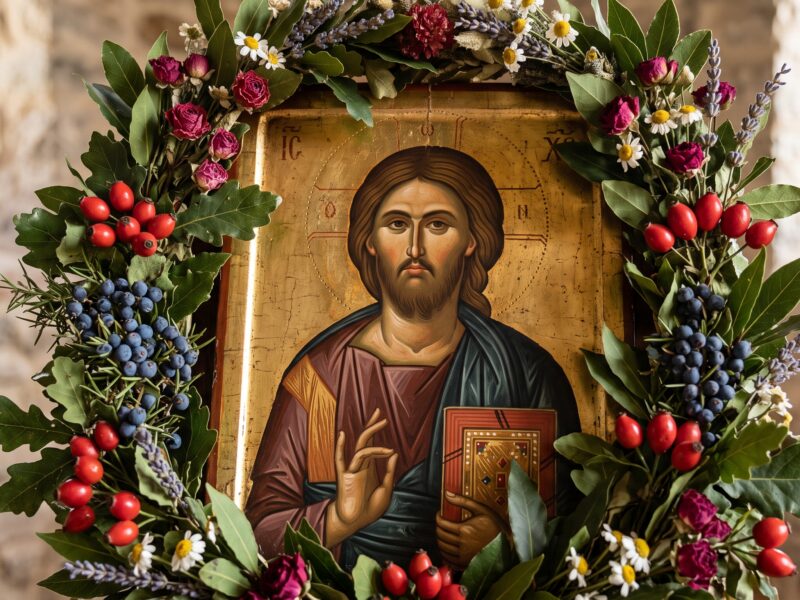
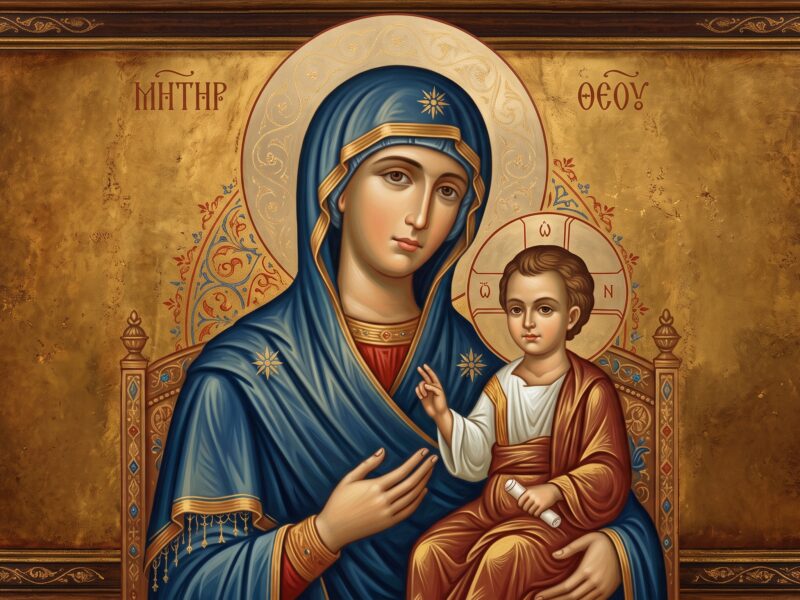
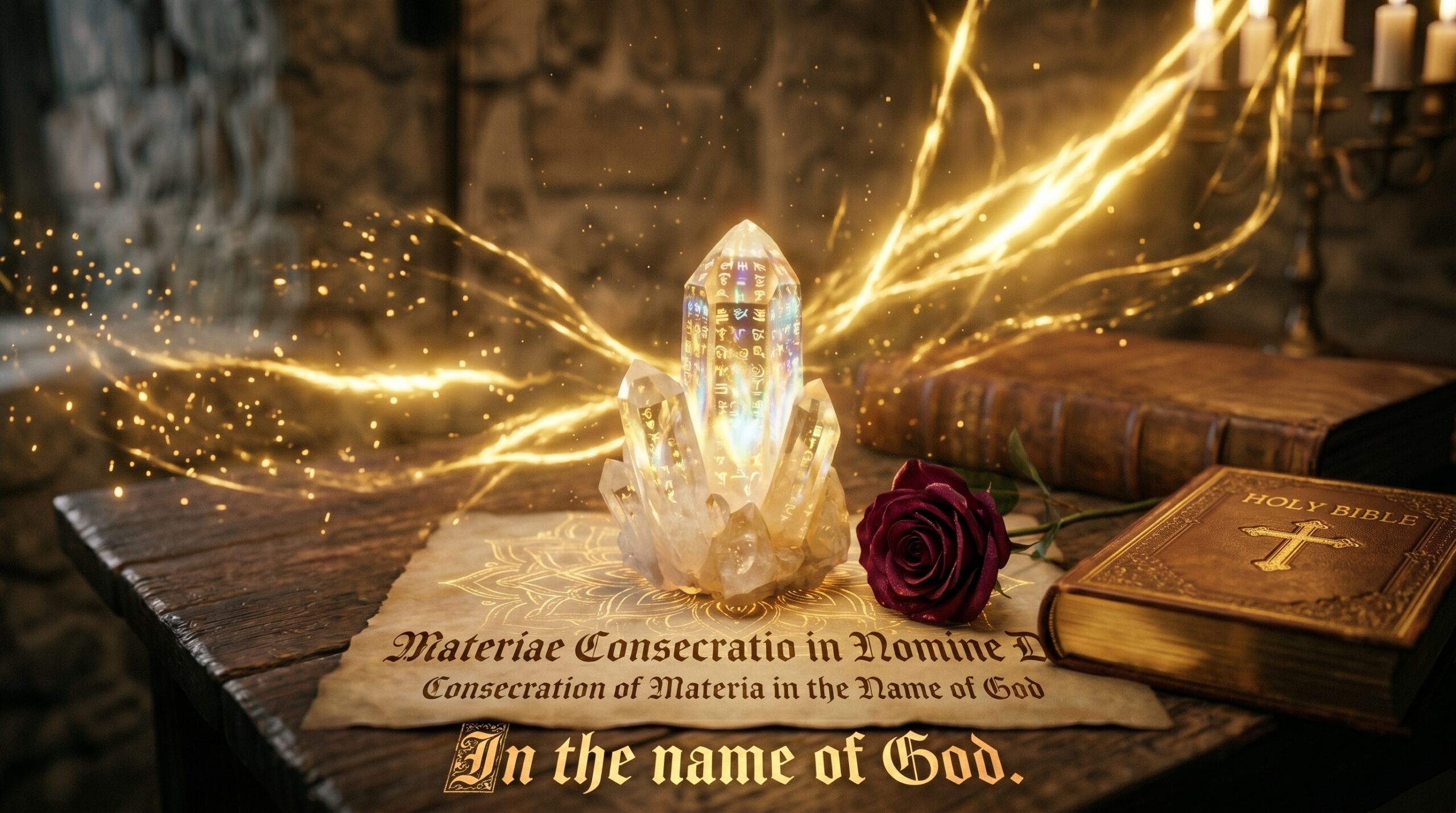
It was on this very ground that John of Damascus, in the eighth century, defended the sanctity of icons against the iconoclasts, in a line that has remained one of the central statements of Orthodox theology: he does not worship matter, but the Creator of matter, who became matter for his sake and consented to work his salvation through matter. From this a logical, though radical, conclusion follows: if the Incarnation is real, then matter is no longer neutral or unfit to bear divine grace. The wood from which an icon is painted, the water of baptism, the bread and wine of the Eucharist, the oil of anointing — none of these are symbols pointing to something distant. They have themselves genuinely become bearers of grace, because the very body of Christ was matter, and it was through matter that divinity worked.
What Happened to Sanctified Matter? Why Does the World Not Appear Holy?
Here we come to a question that troubles many sincere seekers: if matter was decisively sanctified in Christ’s Incarnation, why is this not visibly and permanently so? Why does the world still suffer, decay, and die?
The Orthodox answer operates on two levels, and neither may be overlooked. First, objectively, matter’s ontological potential has changed irreversibly: the risen body of Christ, which still bears real flesh (Luke 24:39), is the first-fruits and proof that created matter is capable of bearing the fullness of divine glory without being destroyed. This has already happened; it is guaranteed and irreversible. Second, however, the cosmos as a whole still lives in the tension between “already” and “not yet.” Paul describes this with precision: “the whole creation groaneth and travaileth in pain together until now” (Romans 8:22), waiting for “the glorious liberty of the children of God” (Romans 8:21). The holiness of matter has not been revoked — it is hidden, as a seed is hidden in the soil, awaiting its final manifestation.
This means the sanctified has not “disappeared”; rather, its full disclosure depends on the cooperation (Greek: synergeia) of created free will with divine grace. Human sin does not reverse what happened in Christ, but it veils, distorts, and obstructs its becoming visible in our perception and in our personal and social life. Just as the sun does not cease to shine merely because clouds hide it from the ground, matter does not cease to be sanctified merely because our fallen perception and moral disorder hide this from our experience.
Can Matter Be Sanctified Mentally?
In contemporary spirituality — often under the influence of New Age thought and certain psychological currents — a view has spread that matter, or circumstances, can be “sanctified” by mental effort alone: positive intention, visualisation, or the conscious “direction of energy.” Orthodox theology treats such a purely mentalist account with fundamental caution, without thereby denying the importance of thought and intention as such.
Patristic tradition — above all the spiritual practice of hesychasm, systematised by Gregory Palamas in the fourteenth century — teaches that the human being is not intellect (nous) alone, set apart from the body, but a whole: body, soul, and spirit together. Prayer that remains confined to the head, Palamas holds, remains incomplete; true prayer is “prayer of the heart,” in which the mind descends into the heart and the whole person — including the body, in its posture and breathing — takes part in turning toward God. Likewise, the sacraments — baptism, the Eucharist, anointing — are not “mental” symbols whose meaning depends on the subjective conviction of the participant, but objective channels of grace, working through real matter (water, bread, wine, oil) by way of a real spiritual act performed by the priest.
In other words: matter is not sanctified by human thought alone, but by divine energy, with which a person may cooperate with their whole being — body, will, love, humility — but which cannot be produced by willpower or imagination alone. This distinction matters: sanctification is a gift (of grace), not a technique (a mental achievement).
Theosis or Enlightenment? The Different Paths of the God-Man and of Man
The question of whether “the God-Man must come through theosis or enlightenment” needs careful unpacking, since for Orthodoxy these run in two different directions that must not be conflated.
Christ, the God-Man, did not “attain” divinity through theosis — He is God from eternity, true God from true God, as the Nicene Creed confesses. His becoming man (kenosis, “self-emptying,” Philippians 2:6–7) is not a path upward but a path downward: God humbling Himself to become man, so that man might rise toward God. Athanasius the Great’s famous formula captures this precisely: God became man so that man might become divine (theosis).
Theosis itself — the deification of the human being — is not, however, “enlightenment” in the Eastern religious sense. In Buddhist or Vedantic enlightenment, the goal is to see through the illusion of the personal “self” and to be dissolved into an impersonal Absolute or emptiness (nirvana, moksha) — personhood ultimately ceases to remain distinct. Orthodox theosis is the precise opposite: the human being is not dissolved into God but comes to share in His energies (energeiai), while remaining forever a distinct person (hypostasis). In the language of Scripture, the human being becomes a “partaker of the divine nature” (2 Peter 1:4), yet remains a created being who is in communion with, rather than identical to, the Creator. Palamas’s distinction between the divine essence — which can never be known or shared — and the divine energies — in which the human being may truly partake — safeguards exactly this: union without erasure.
The God-Man, then, comes through neither theosis nor enlightenment, for He is their source. The human being, however, is called to theosis, which differs fundamentally from enlightenment precisely in that personhood is preserved and a loving, personal relationship with God is deepened, rather than transcended or extinguished.
AI Singularity Versus Human Divinity
Here the ancient theology opens onto an unexpectedly contemporary question. In technological discourse, “the singularity” names the moment when artificial intelligence’s computational power surpasses the human mind and begins to improve itself at an accelerating pace. This term borrows, knowingly or not, from religious vocabulary — transcendence, surpassing, even “becoming divine” — yet its content runs structurally counter to theosis.
First: AI “singularity” is quantitative — more data, faster processing, greater power. Theosis is qualitative — a deepening of love, humility, and freedom in communion with a Person. Second: a computational system, however sophisticated, is not a hypostasis; it lacks what patristic tradition calls personhood — a free, responsible, loving, unrepeatable “I” standing in relation before another “I.” Christian anthropology (Genesis 1:26–27) affirms that the human being is made in the image and likeness of God precisely in this sense: as a relational, free, morally responsible person, not as an information-processing mechanism, however intricate that mechanism may become.
Third, and perhaps most important: the human path toward God runs through metanoia — a change of mind, repentance, humility, and freely chosen love — not through an increase in power. The “development” of artificial intelligence is oriented toward greater control and efficiency; theosis is oriented toward a lesser “self” and a greater love — a kenotic, not an expansive, movement. When humanity stands before a technology that mimics thought, it becomes strikingly clear what is truly Godlike in the human being: not computational capacity, which a machine may well exceed, but the capacity to love, to repent, to forgive, to give oneself, and to enter a free, personal relationship with the Creator — something no algorithm can do by its very nature, since it possesses no hypostasis, no one there to do the loving.
Practical Application: Sanctifying Matter in Everyday Life
From this theology grows a concrete call. The Christian is not summoned to flee matter for the sake of spirit, as certain Gnostic or dualist currents once taught, but to sanctify matter through a concrete, embodied, loving life: honouring food with thanksgiving, honouring the body as a temple of the Holy Spirit (1 Corinthians 6:19), honouring the work of one’s hands, and honouring the other person as one who bears the face of God. In every sacrament, every good deed, every humble act of daily life done in love, the same movement continues that began in the manger at Bethlehem — the meeting of the Divine and the human, the spiritual and the material, a meeting that extinguishes neither but sanctifies both.
A Prayer for Sanctification
Lord Jesus Christ, God-Man, who took upon Yourself our flesh and sanctified all creation through Your Incarnation — open our eyes to see Your glory hidden in simple things: in bread and water, in labour and rest, in our neighbour and in nature. Help us to be fellow-workers with Your grace, rather than exalting our own strength or intellect. Amen.
A Prayer for Humility and Clarity in the Age of Technology
Lord, Creator and Giver of all life, guard our hearts from the vanity and pride that seek to replace personhood with machinery and love with computation. Grant us wisdom to use the work of our hands and minds with humility, never forgetting that our worth lies not in our efficiency, but in Your face, which we bear. Amen.
Martinus Vaicarius’s mission is to:
- Provide spiritual support and guidance to people seeking peace and hope
- Create prayer texts that bring God’s peace to hearts suffering under fear and anxiety
- Promote deep understanding of the power of the
- God of Sabaoth and the protection of the heavenly hosts
- Help people enter the spiritual sphere where God’s peace reigns over all
AICortex Invest OÜ