Views: 37
The 40-Day Fast of Jesus Christ: What It Teaches Us Today
Biblical and theological foundations, a deep reading of the wilderness temptations, and the meaning of satan’s fall in light of Christ’s first great victory
Introduction: The Wilderness as a Theological Stage
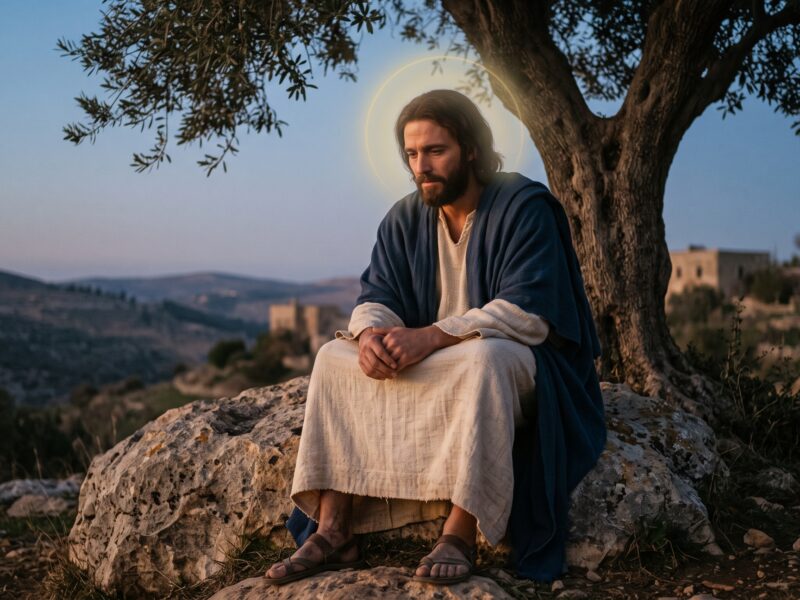
Before Jesus Christ preached a single public sermon, before He touched one sick body or called one disciple, He was led by the Spirit into the wilderness. Matthew states it plainly: “Then was Jesus led up of the Spirit into the wilderness to be tempted of the devil” (Matthew 4:1). Luke adds a crucial detail: Jesus was “full of the Holy Ghost” when the Spirit led Him from the Jordan into the desert (Luke 4:1). This detail is not incidental — it is the theological key to the entire episode. The journey into the wilderness was neither the devil’s initiative nor Jesus’s own retreat from the world; it was the Spirit’s deliberate, purposeful direction. The wilderness here is not a place of punishment or escape, but a battlefield the Messiah enters voluntarily, beginning His public ministry not with triumph, but with combat.
The forty days and nights of fasting, followed by three temptations, form one of the densest passages in the entire New Testament. In this single scene, creation theology, Israel’s desert wandering, the prophetic tradition, Christology, and soteriology — the doctrine of redemption — all converge. This article seeks to open up the episode not as pious anecdote but as sustained theological analysis: why exactly forty days, what each temptation actually meant, how this connects to Jesus’s own statement about satan falling “as lightning” from heaven, and finally — what Christ actually won in the wilderness, before He ever reached Golgotha.
Biblical and Theological Foundations: Why Forty?
The number forty is not an arbitrary unit of time in Scripture. It is a recurring structural sign marking testing, preparation, and transition in the life of God’s people.
In Genesis, the flood lasts forty days and forty nights (Genesis 7:12) — the world passes through a purifying judgment and receives a new beginning. Israel wanders in the wilderness for forty years (Numbers 14:33-34) because they did not trust God at Kadesh-Barnea; the wandering itself becomes a trial in which one generation dies and another is born into faith. Moses remains with God on Mount Sinai forty days and nights, eating no bread and drinking no water, before receiving the tablets of the Law (Exodus 34:28). The prophet Elijah, collapsed and terrified of Jezebel, travels forty days and nights toward Horeb, sustained by a single meal an angel provided (1 Kings 19:8).
These are not coincidental repetitions but a typological pattern that the patristic tradition has always taken seriously. Jesus’s wilderness fast gathers up all these prefigurations at once: He is the new Adam, who faces temptation but, unlike the first Adam in the garden of Eden, does not fall; He is the new Israel, who passes through the wilderness but, unlike the old Israel, neither grumbles nor rebels; He is the new Moses, who fasts before God but Himself brings the fulfillment of the Law, not merely its tablets. Irenaeus of Lyon described this as the principle of recapitulatio — Christ retraces the journey of human history, but does so in obedience, thereby undoing the consequences of Adam’s fall. The wilderness temptation is one of the clearest expressions of this recapitulation: where humanity lost, there Christ wins.
Theologically, it also matters that the fast follows immediately upon the baptism in the Jordan, where the Father’s voice is heard: “This is my beloved Son” (Matthew 3:17). Directly after this supreme affirmation, the Spirit leads Jesus not into glory but into hunger and temptation. This sequence is itself a theological teaching: the Father’s pleasure in the Son does not exempt Him from trial — it is the precondition for it. Just as Israel, freshly delivered from Egypt, was immediately set on the desert road, so Jesus, immediately after heavenly confirmation, receives the wilderness temptation. The confirmation of divine love does not remove trial; it supplies the strength by which trial is met.
How the Forty-Day Cycle Works: Embodiment, Hunger, and the Spirit’s Leading
The fast itself — complete abstinence from food for forty days and nights — brings forward something modern piety tends to forget: the genuine human embodiment of Jesus. Matthew states directly that “afterward he hungered” (Matthew 4:2). This is no rhetorical flourish. The human body the Word had taken on (John 1:14) experienced real hunger, real exhaustion, real physical vulnerability. It is precisely into this moment of vulnerability that the tempter steps.
This is the first theological pattern of the wilderness-temptation cycle: temptation does not arrive at the moment of fullness, but at the moment of lack. The devil did not come to Jesus on the first day of the fast, while strength remained, but only when hunger had reached its peak. This mirrors a recurring insight of the spiritual life that the Church Fathers — especially the Desert Fathers of the Apophthegmata Patrum and John Climacus in his Ladder of Divine Ascent — described again and again: temptation most often strikes a person not in strength but in weakness, fatigue, and want. From this comes the first practical lesson the wilderness offers: spiritual discipline is not an illusion of self-protection, but a conscious entry into vulnerability in God’s presence — for it is precisely where human strength runs out that trust in God is proven or found wanting.
The second pattern is the structure of the cycle itself: three temptations moving from the bodily (bread) through the spiritual-religious (leaping from the temple parapet, putting God’s promise to the test) to the cosmic-political (the kingdoms of the world and their glory). This is no accidental sequence but an escalating assault on the three fundamental axes of human desire that the First Epistle of John later names “the lust of the flesh, and the lust of the eyes, and the pride of life” (1 John 2:16). The tempter tests Jesus along exactly the same lines on which he tested Eve in Eden — good for food (bread), pleasing to the eye (the dramatic spectacle of the temple heights), and desirable to make one wise, or powerful (the kingdoms of the world). The wilderness temptation is thus a repetition of the scene in Eden — and its reversal.
The Three Wilderness Temptations: A Theological Reading
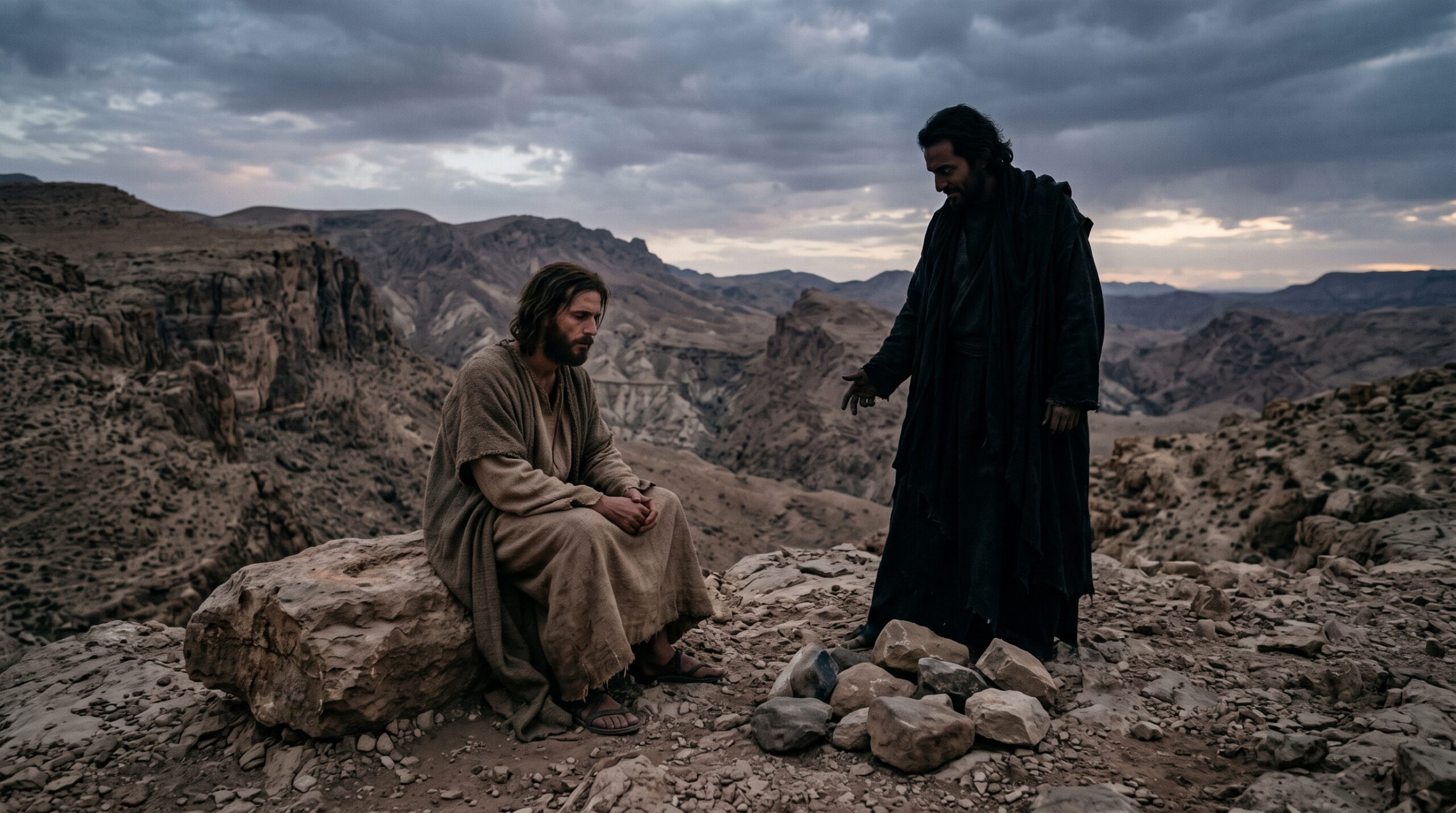
The first temptation — stones into bread (Matthew 4:3-4; Luke 4:3-4). The devil says: “If thou be the Son of God, command that these stones be made bread” (Luke 4:3). Here Jesus is tempted not by something evil, but by something inherently neutral and legitimate — food. This is precisely what makes the temptation theologically so sharp: vice does not always wear the costume of obvious evil; more often it wears the costume of justified need. But the conditional clause — “if thou be the Son of God” — exposes the core of the temptation: the devil is attempting to make Jesus prove His divine identity by satisfying His own will and need, rather than the Father’s will. Jesus’s answer — “Man shall not live by bread alone, but by every word that proceedeth out of the mouth of God” (Matthew 4:4, citing Deuteronomy 8:3) — is not merely an ascetic slogan but a Christological manifesto: the Son’s identity does not rest on the satisfaction of bodily need, but on complete dependence on the Father’s word. This is the first victory over what the Church Fathers called gastrimargia — the appetite of the belly, whose subjugation the Desert Fathers of Egypt considered the foundation for mastering every other passion.
The second temptation — leaping from the temple parapet (Matthew 4:5-7; Luke 4:9-12). The devil takes Jesus to the pinnacle of the Jerusalem temple and invites Him to throw Himself down, himself quoting Scripture: “he shall give his angels charge concerning thee” (citing Psalm 91:11-12). This is the second and subtler layer of temptation: the devil turns Scripture itself into a weapon. It exposes an important theological principle — the letter of the text, stripped of spirit and context, can be made to serve false theology as readily as true. The content of the temptation is no longer bodily need but spiritual ambition: to force God’s hand into a miracle, turning trust into performance and God’s promises into a test. Jesus’s answer — “Thou shalt not tempt the Lord thy God” (Matthew 4:7, citing Deuteronomy 6:16) — answers what theologians call the instrumentalization of faith: God must never be made a means of confirming one’s own will, even when this is done in religious language. This temptation speaks with particular force to the present age, where spirituality can so easily be turned into a vehicle for self-validation and public performance.
The third temptation — the kingdoms of the world (Matthew 4:8-10; Luke 4:5-8). The devil takes Jesus to a high place, shows Him all the kingdoms of the world and their glory in a moment, and says: “All this power will I give thee, and the glory of them: for that is delivered unto me” (Luke 4:6). This is the crown of the temptations and, at the same time, the most candid moment in the whole scene — here the devil reveals his own pretension: he claims dominion, as “the prince of this world” (cf. John 14:30), over the kingdoms of humanity, a dominion he holds by usurpation. The offer is a shortcut: global dominion without the cross, a kingdom without suffering, glory without humiliation — for the price of one act of worship before the devil. This is the temptation of messianic expectation in its purest form: the version in which the Messiah arrives through force, political power, and worldly glory rather than through the suffering of the cross and the resurrection. Jesus’s answer is the shortest and most categorical of the three: “Get thee hence, Satan: for it is written, Thou shalt worship the Lord thy God, and him only shalt thou serve” (Matthew 4:10, citing Deuteronomy 6:13). In this answer stands the entire heart of Christian kingship theology: the Kingdom of God does not come by conquest, but by worship and by service.
All three of Jesus’s answers are drawn from Deuteronomy, and it is no accident that they follow the very sequence of Israel’s own wilderness trials — hunger, the testing of God at Massah and Meribah, idolatry. Jesus, unlike the old Israel, answers every trial not with His own wisdom but with Scripture itself, showing that true freedom in the face of temptation is rooted deeply in the Word of God, not in cleverness about the situation.
Satan’s Fall “As Lightning” from Heaven
Somewhat later than the wilderness scene, when the seventy sent out by Jesus return with joy and report that even the demons submit to them in His name, Jesus responds with a statement that reads as almost visionary: “I beheld Satan as lightning fall from heaven” (Luke 10:18). This statement deserves separate theological attention, for although it belongs to a different episode than the wilderness temptation, it is intrinsically bound up with it.
The Greek verb form (ἐθεώρουν, etheōroun) is imperfect — “I was seeing,” in the sense of “I was watching it happen,” not a single glance at a completed event. It points to a continuous, ongoing vision from God’s own vantage point: satan’s fall is not a single, isolated historical event buried in the past, but something the Son beholds from an eternal perspective, something that keeps manifesting itself in history every time the Kingdom of God breaks through in human proclamation and deed. When the seventy disciples cast out demons in Jesus’s name, that visible miracle is an outward sign of the very thing Jesus saw on the cosmic plane — the breaking of satan’s dominion.
Theologically, this statement ties back to the wilderness temptation in two ways. First — the tempter, who in the wilderness offered Jesus “all the kingdoms of the world and their glory,” claimed that this authority had been given to him (Luke 4:6). Jesus’s image of lightning falling from heaven is an implicit answer to that very claim: the devil is not the original source of light or glory, but a fallen being whose “glory” is borrowed and whose dominion is usurped, not properly his own. Second — lightning is swift, sudden, momentary light that falls rather than rises. It is an iconic picture of hubris, of pride that reached for the heights only to plummet as quickly as it rose. Early Christian and later Western tradition connected this saying to the prophet Isaiah’s oracle of the fallen morning star (Isaiah 14:12), reading in it satan’s own original rebellion and fall before the creation of humanity.
A point of theological precision matters here: Luke 10:18 does not describe a new event, but rather sheds light on an already accomplished reality that keeps re-entering history whenever the Kingdom of God actively confronts the dominion of evil. In the wilderness temptation, Jesus faced satan’s claim in person and answered it directly through resistance; in Luke 10 we see the fruit of that resistance — the disciples Jesus has sent out carry the same victory forward, and evil retreats before them because it has already, in principle, been broken by the One who did not fall in the wilderness.
What Did Jesus Actually Win in the Wilderness?
This is the sharpest of the article’s central questions: what did Christ actually win in the wilderness, and what did satan have to offer Him in the first place?
The answer to the second question is paradoxical: satan had nothing genuine to give Jesus — only a counterfeit shadow of what was already His. Everything the devil offered — bread, a proof through miracle, the kingdoms of the world — already belonged to the Creator (John 1:3; Colossians 1:16). The essence of the temptation was therefore not the offer of a real good, but the offer of a false shortcut to something already promised by another, harder road — the road of suffering and humiliation. Satan offered a kingdom without a cross, proof of divinity without obedience, satisfaction without trust. Every offer was a detour around the Father’s will.
So what did Jesus win? First — He won on behalf of humanity itself. This was not simply a divine being who brushed temptation aside with effortless ease, but a genuine human being who, in genuine weakness, hunger, and solitude, chose obedience. The author of Hebrews writes that Jesus was tempted in every way as we are, yet without sin (Hebrews 4:15), and this wilderness experience is the historical ground of that claim. Christ did not overcome temptation from a distance, but from within human vulnerability itself — and this is what makes His victory accessible to us as an example, not merely an object of admiration.
Second — He won back what the first Adam lost. Where Adam and Eve, in the fullness and abundance of Eden, fell into desire, Jesus, in the emptiness and hunger of the wilderness, remained obedient. The recapitulation theology articulated by Irenaeus, and later by Athanasius, sees in this exactly that reversal: where the old Adam lost, the new Adam wins — and this victory is not yet the victory of Golgotha, but its precondition. Without the victory in the wilderness there could be no victory on the cross that was theologically whole — for had Christ already fallen to temptation before reaching the cross, He would have had nothing whole left to offer, nothing the cross could shape into redemption.
Third — He won the authority with which He proclaims the gospel. Immediately after the wilderness, Jesus begins His public ministry with the words: “The time is fulfilled, and the kingdom of God is at hand” (Mark 1:15). This proclamation is not empty rhetoric — it carries weight, because the One speaking has already, before uttering a single word of it, proven His obedience in the silence of the desert. The authority with which Jesus later commands unclean spirits and calms storms is rooted in this first, invisible victory.
And finally — what kind of victory was this, before Golgotha? It was a victory that opened the way to the cross, not one that replaced it. The wilderness victory was not the endpoint of redemption — redemption still required Gethsemane, the scourging, the cross, and the tomb. But the wilderness victory was its necessary precondition: had the Son fallen in the desert, He would have had nothing pure and whole left to offer as sacrifice. The wilderness victory makes Golgotha possible the way a foundation makes a house possible — it is not yet the roof, but without it, nothing else could stand. This is why liturgical tradition, in both the Western and Eastern churches, has always bound the season of fasting that echoes these forty days directly to the expectation of Easter. Fasting is not an end in itself, but a preparation — just as it was for Christ Himself.
What This Teaches Us Today
The story of the wilderness temptation is no ancient curiosity, but a structural map of the anatomy of human temptation that holds true for every age. The three temptations — bodily (bread), spiritual-instrumental (leaping from the temple height), and the lust for power and glory (the kingdoms of the world) — describe, again and again, the very axes along which every person, not only Christ, is tested. For people today, living within a culture of abundance, instant self-justification, and visibility, this story speaks with particular sharpness: temptation rarely arrives clearly masked as evil; far more often it arrives dressed as legitimate need, religious justification, or an ambitious good.
The wilderness teaches that resistance to temptation is not born of improvisation but of prior, deepened familiarity with the Word of God — Jesus did not invent His answers in the moment; He drew them from Scripture He knew through and through. This is a practical lesson for every spiritual life: discipline is not improvisation conjured at the moment of temptation, but the fruit of a seed sown long before.
A Prayer for the Forty-Day Fast
Almighty God, who led Your Son by the Spirit into the wilderness before He stepped into the light,
grant me the grace to understand that the wilderness is not abandonment but preparation; that hunger is not loss, but the place where Your word becomes my only bread.
When the tempter comes to me in my own moment of emptiness, clothed in justified need, in religious performance, or in coveted glory, grant me the memory to recognize Your Word as Your Son recognized it, and the strength to answer not with my own wisdom, but with what You have already spoken.
Show me that every time Your kingdom advances against the dominion of evil, something falls whose glory was never its own, only borrowed and usurped; and grant me the faith to know that what I lose for Your sake is smaller than what I find.
Teach me to worship You alone, to serve You alone, and to await Your kingdom not by the shortcut, but by the road of obedience — knowing that every true victory passes first through the wilderness, and only then to Golgotha, and only then to the dawn.
Amen.

Trough all this I want to declare this is all from God and to God. All Glory to Him!