Views: 35
Monastic Life on Mount Athos and Our Time: Is Less Actually More Today?
An in-depth look at Orthodox monastic life on Mount Athos — the daily routine, prayer practice, hesychasm, and the Jesus Prayer — and its existential relevance for a modern culture of consumption and speed. Is ascetic “less” actually humanly “more”?
Introduction: A Headland Where Time Has Stopped
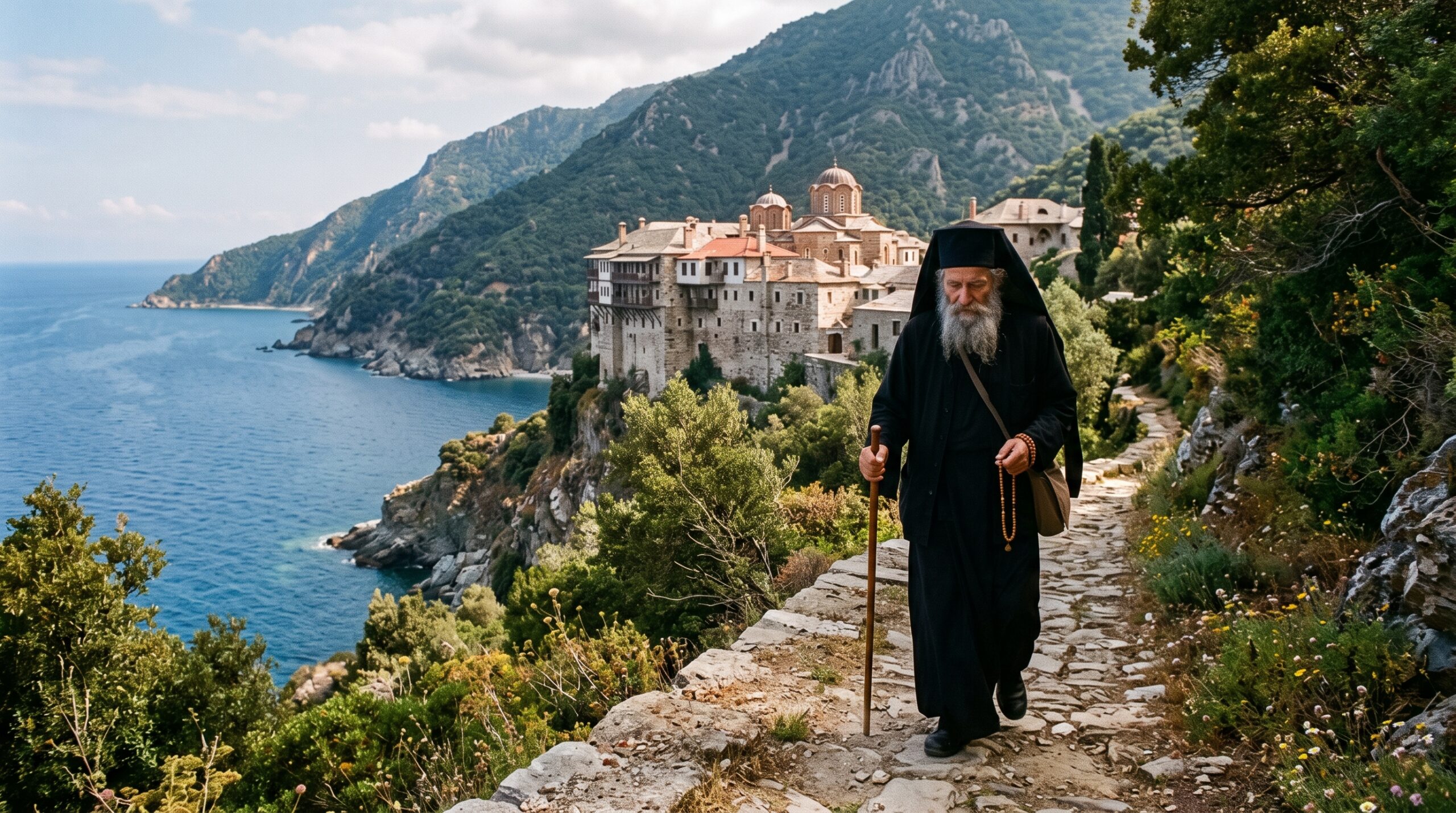
On the eastern tip of Greece’s Halkidiki peninsula runs a rocky headland where, for over a thousand years, almost nothing has fundamentally changed. Mount Athos — the Autonomous Monastic State regarded by more than 220 million Orthodox Christians as the holiest place in the Orthodox Christian world — is one of the few places on the planet where time itself keeps a different pace. The monks still live by Byzantine time, in which the day begins at sunset, and by the Julian calendar, thirteen days behind the Gregorian. Women and female animals have been barred from the peninsula for roughly a thousand years — a rule many today find anachronistic, yet one of the very reasons this landscape has preserved such extraordinary natural and spiritual integrity: ten centuries of ungrazed forest, undisturbed ecosystems, an unbroken liturgical rhythm.
But this essay is not merely a historical or touristic description. The question Athos poses to the modern person is far sharper and more personal: if our entire civilization is built on the principle of “more” — more consumption, more information, more choice, more speed — what does it mean that nearly two thousand men have voluntarily chosen the opposite path? Could their “less” actually be a deeper “more,” a question our hurried world has forgotten to ask?
A Monk’s Day: Routine as Freedom, Not a Prison
A Night That Begins with Prayer
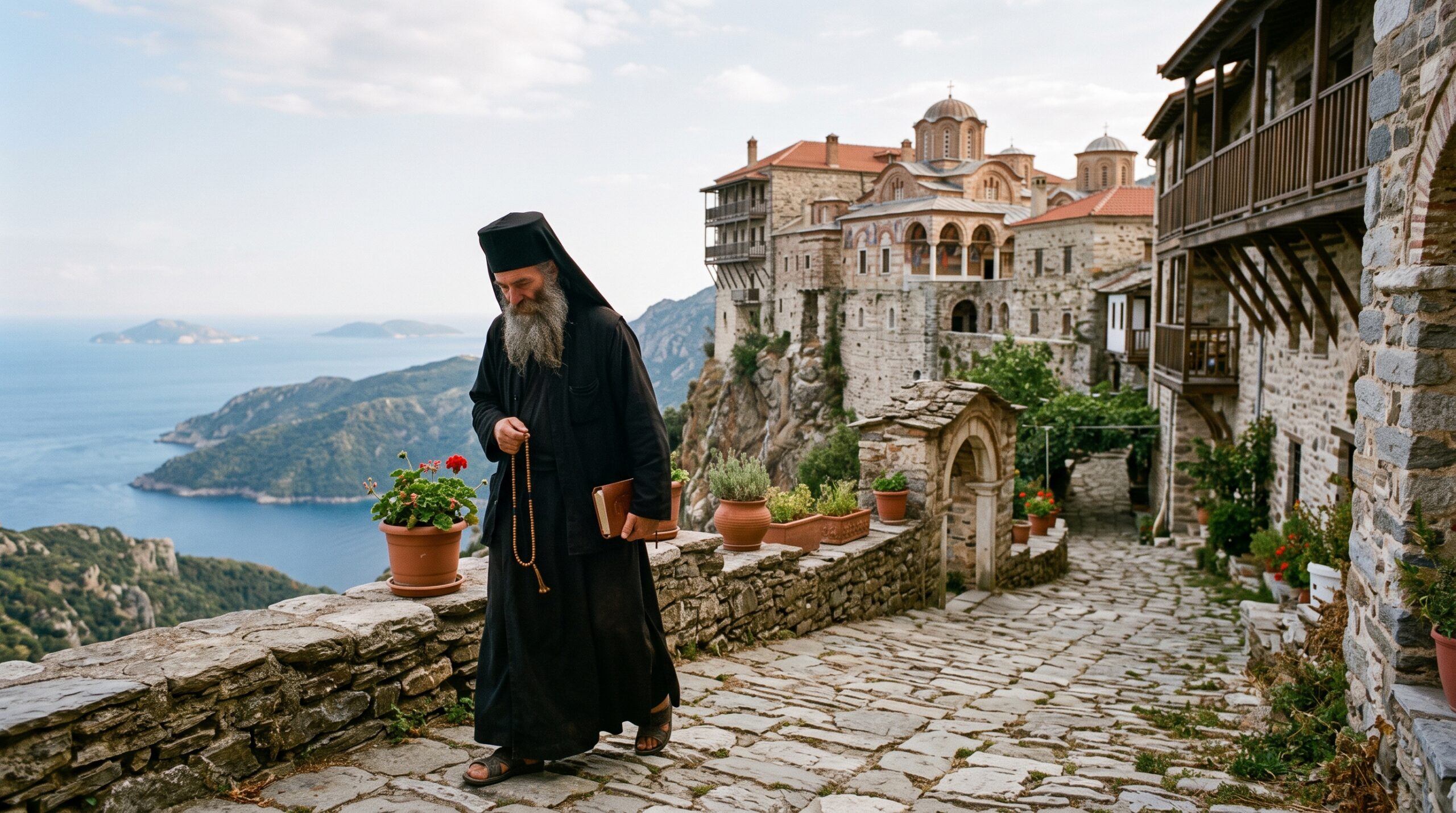
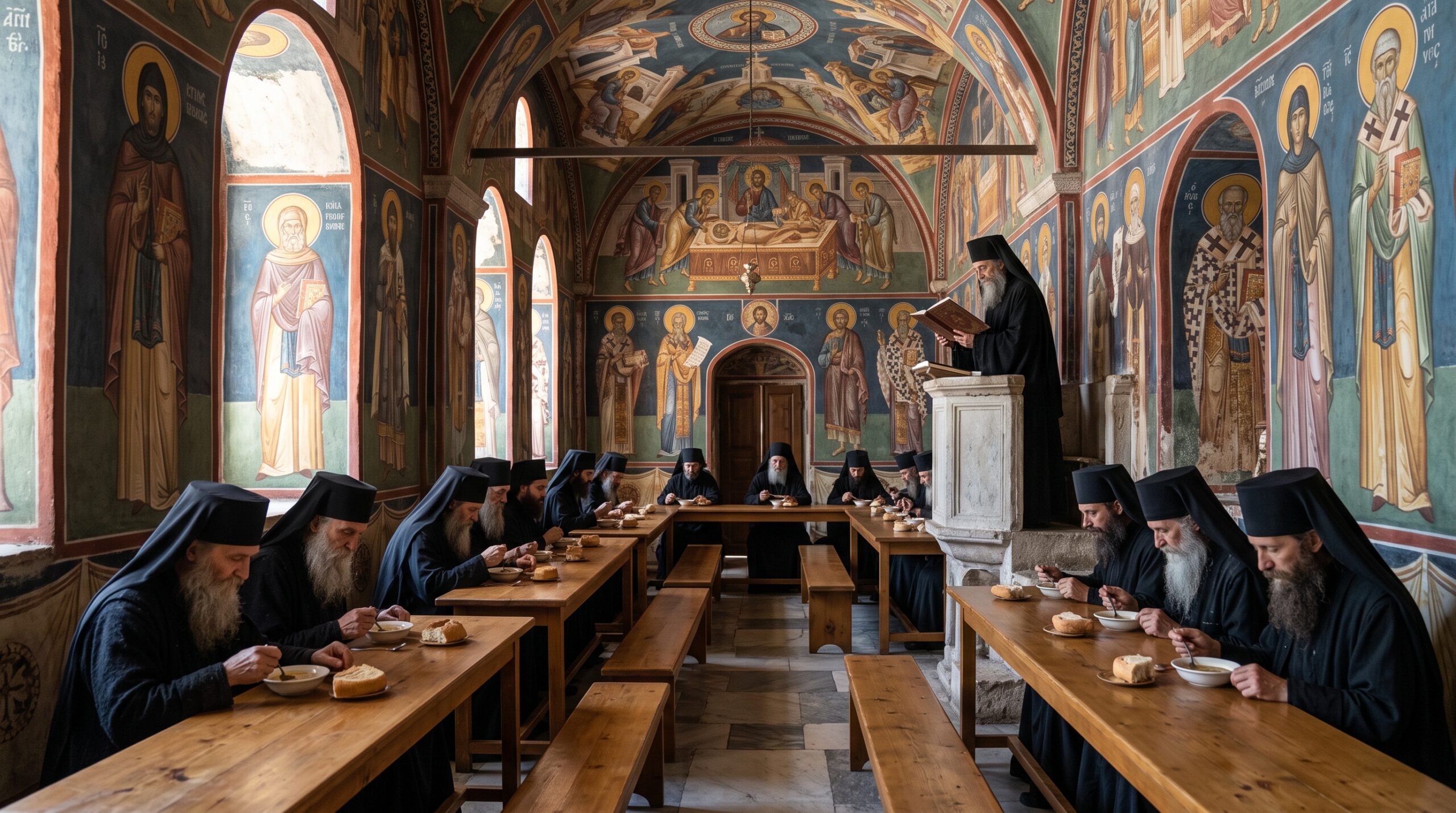
A typical day on Athos begins at three or four in the morning, when the semantron — the rhythmic striking of a long wooden beam, older than church bells — or the ringing of bells calls the monks to orthros, morning prayer. This lasts two to three hours, followed by the Divine Liturgy. Only afterward do the monks sit down together in the trapeza, the monastery refectory, where the words of the Church Fathers are read aloud in silence — eating itself is here subordinated to the word, not the other way around.
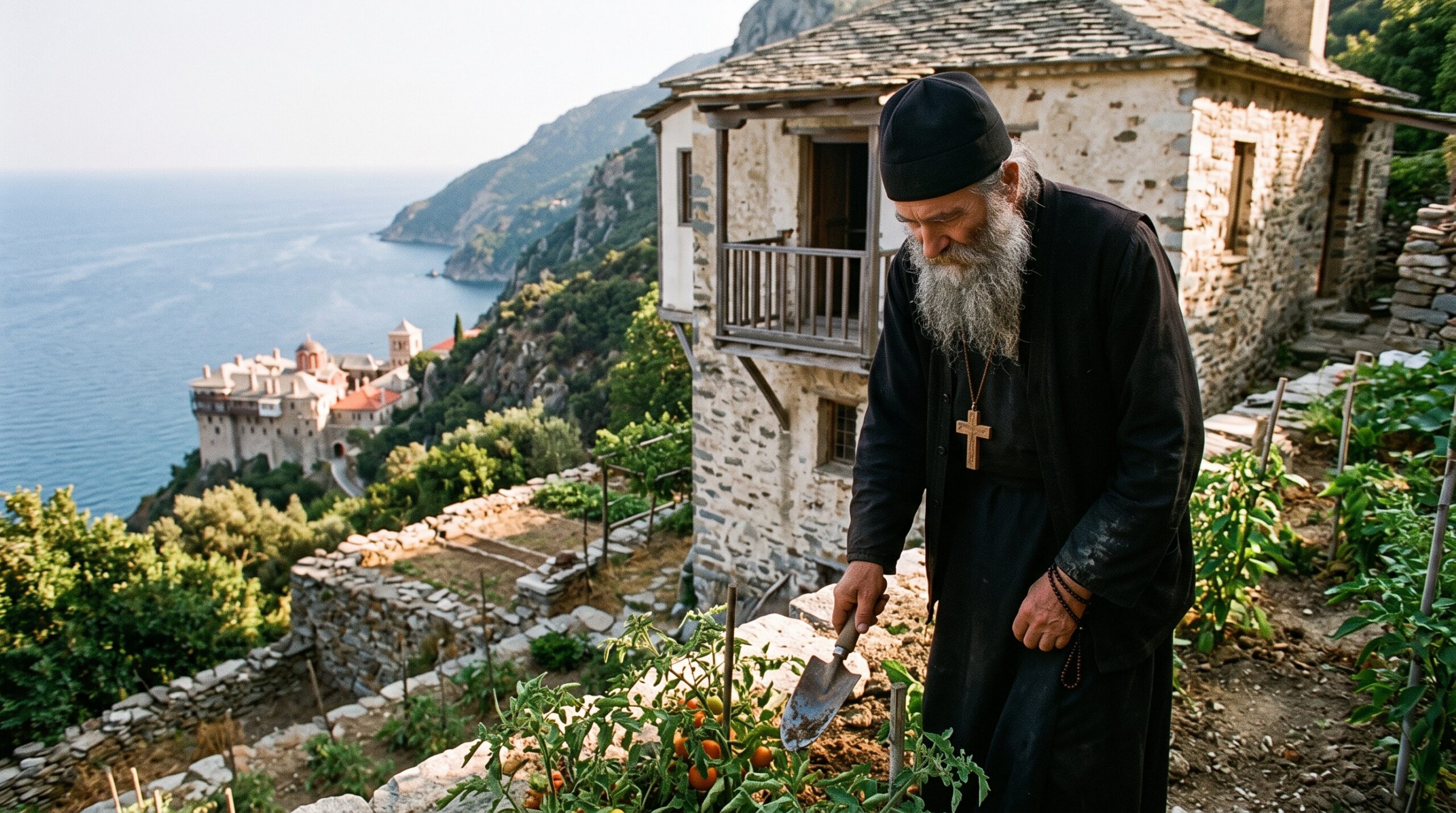
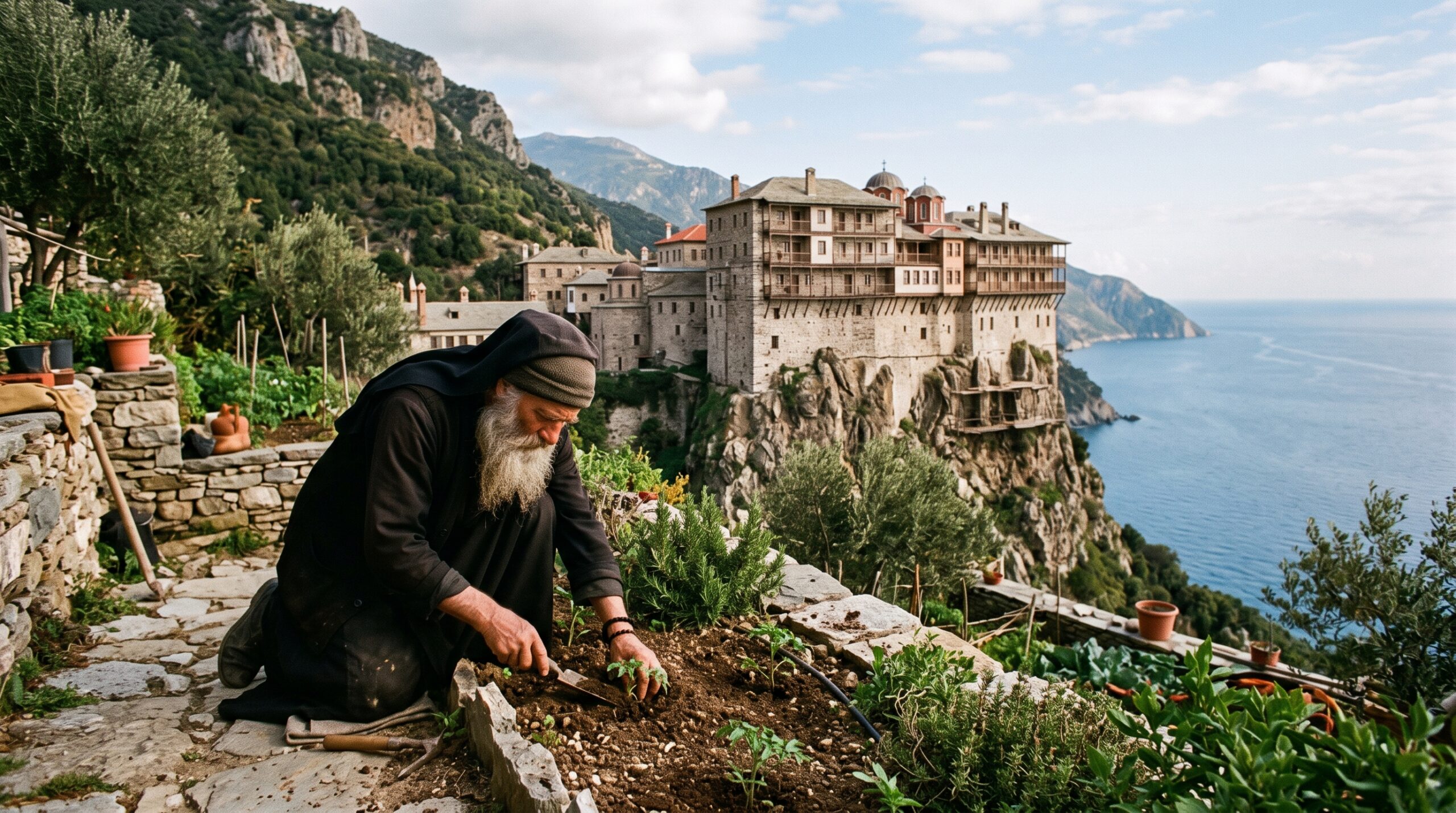
A monk’s day is traditionally divided into three eight-hour blocks: eight hours of prayer, eight hours of work (gardening, icon-painting, woodworking, fishing, handicrafts), and eight hours of rest. This geometric symmetry is not accidental — it reflects the conviction that a human being is a whole, whose spirit, body, and will each need their share, without one swallowing up the others. Manual labor here is not a supplementary activity alongside prayer, but prayer’s continuation: it preserves humility and prevents the spiritual life from becoming an abstract intellectual exercise.
Food as a School of Asceticism
The Athonite table is simple and austere: meat is never eaten, dairy rarely, and the diet consists mainly of fish, vegetables, olive oil, bread, and wine — and on fasting days, which are frequent and strict on Athos, even less than that. This is not starvation for the sake of health, nor a lifestyle trend — it is training aimed at weakening the body’s dictatorship over the soul. The Church Fathers called monastic life the “angelic way of life” (Greek angelikos bios) precisely for this reason: not because the monks deny their bodily nature, but because they strive to live in a way where the body’s appetite no longer dictates the direction of will or mind.
The Guest in the Monastery
Athos is not closed to the outside world — pilgrims are welcome, and how they are received reveals something essential in itself. Guests are housed free of charge in the archondariki, the monastery guesthouse, but in return they are expected to respect the monks’ rhythm: attending services, dressing modestly, and refraining from alcohol and tobacco. A guest does not come to Athos to consume a spectacle — he steps into a different rhythm of time and adapts to it, rather than the reverse. This is itself already a small lesson for the modern person, accustomed to having the environment adapt to him rather than the other way around.
Hesychasm: A Theology of Silence and the Purification of the Mind
To understand why the monks do all this, one must go deeper than the rhythm of prayer — into hesychasm itself. The Greek word hesychia means silence, stillness, inner peace, and it already appears in the Psalms (Psalm 131) and in the tradition of the Desert Fathers. At the heart of hesychastic practice lies “the prayer of the mind” (noera proseuche), better known as the Jesus Prayer or the prayer of the heart: “Lord Jesus Christ, Son of God, have mercy on me, a sinner.”
This short sentence, repeated hundreds and thousands of times a day, is not a mechanical mantra — it is a method whose purpose is to gather the scattered mind into a single point and let it descend from the head into the heart. The Desert Fathers — Evagrius Ponticus, John Climacus (author of The Ladder), and Diadochos of Photiki — placed central emphasis in this process on nepsis: watchfulness, sobriety, the constant guarding of one’s thoughts. The idea is simple, though difficult to practice: before a person can be united with God, he must first learn to recognize the inner chaos of his own mind — the unwanted images and thoughts (logismoi) that constantly intrude on consciousness and scatter attention.
The fourteenth-century theologian Gregory Palamas defended hesychastic practice with a theological argument, distinguishing between God’s inaccessible essence (ousia) and his experienced energies (energeiai): in stillness, a person participates in God’s energies, not in his essence itself — and it is precisely in this communion that theosis, deification, consists. A passionate, scattered mind, Palamas said, cannot be united with God. This is why the entire rhythm of Athos — prayer, work, fasting, silence — is one continuous exercise in disciplining the mind and purifying the heart.
Existential Tension: Asceticism Meets Modern Psychology
Logismoi and the Modern “Noise of Thoughts”
It is hard not to see a parallel between the Desert Fathers’ logismoi — constantly intruding, attention-fragmenting thoughts — and the modern experience of a mind kept in a state of perpetual agitation by the endless stream of notifications, social media, and boundless choice. The Desert Fathers described this centuries before psychology existed as a spiritual affliction with a known remedy: watchfulness, sobriety, the return of attention to a single point. They understood their own experience not as “attention deficit” in a measurable sense, but as spiritual warfare — against the passions (pathe) that seek to enslave the mind.
Here lies one of Athos’s deepest lessons for the modern person: contemporary psychology speaks of “overload,” “information-overload anxiety,” and “attention deficit” as something new, specific to the technological age. Monastic tradition, however, has known the same phenomenon for a millennium and a half — described as acedia, the “noonday demon” (daimon meridianos), a spiritual listlessness and restlessness that strikes a person precisely when external stimulus disappears and he is left alone with himself. Acedia is not laziness in the ordinary sense — it is rather a description of a state in which a person cannot bear silence or the simplicity of being, and so constantly seeks activity that will help him flee from it. It sounds familiar.
The Paradox of Abundance: The False Opposition of Asceticism and Hedonism
In Estonian culture, the poet Hasso Krull has captured an important point in his book Contemporary Asceticism (Tänapäeva askees): the opposition between abundance and scarcity, between asceticism and hedonism, which seems self-evident at first glance, turns out on closer inspection to be illusory. Asceticism is not merely renunciation — it is a path leading to a denser, more concentrated way of being. The monks of Athos, too, do not live in poverty in order to punish themselves, but in order to free up space for something that simply has no room in a life filled with consumption. The sociologist Jean Baudrillard has described consumer society as a system built on a person’s perpetual sense of lack, one that ensures this sense of lack never disappears — objects are designed from the outset to become obsolete quickly, desire built to reproduce itself endlessly. Where consumer society continually manufactures the feeling that “there is never enough,” ascetic monasticism does the direct opposite: it proclaims that less is already enough — and it is precisely in this proclamation that its radicalism lies.
Freedom Within Routine
Western individualism tends to see routine as freedom’s opposite — rules, schedules, repetition feel constraining. Yet Athonite monastic life offers a counterargument: a routine built around something ultimate does not constrain but liberates. Once the time for eating, sleeping, working, and praying has been decided, a person no longer has to decide anew each day where to direct his attention and energy — that energy remains free for deeper work. Existentialist philosophy, especially in the tradition of Sartre and Kierkegaard, has described the burden of freedom of choice — “man is condemned to be free,” said Sartre, and this freedom brings with it anxiety (angst). Seen in this light, the monastic path is a peculiar kind of answer: not a denial of freedom, but a redirection of it — freedom not to “choose among everything,” but freedom to “choose one thing completely” and remain steadfast in it.
What the Monks of Athos Actually Do — and Why It Is a Radical Act
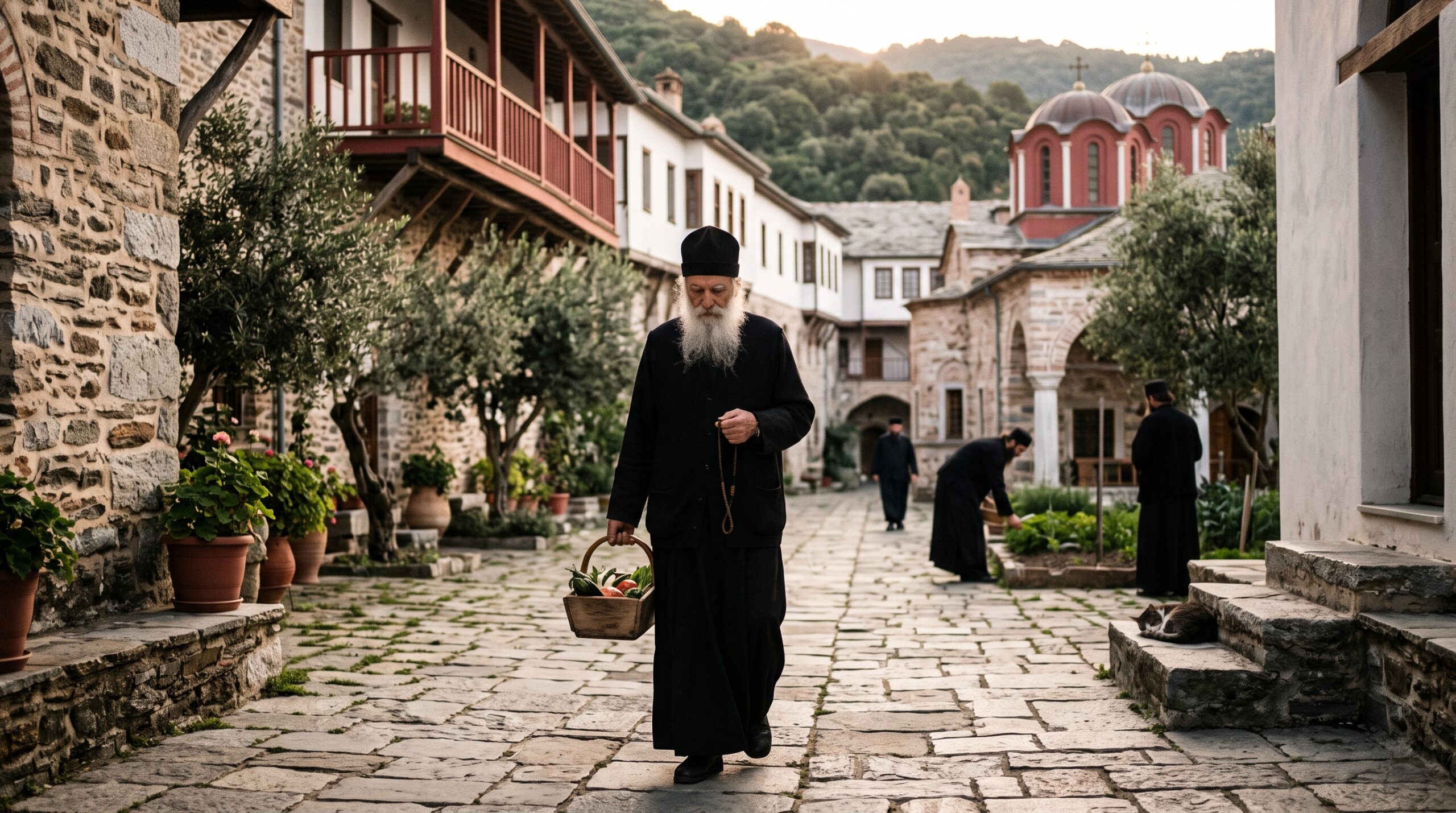
Seen from the outside, an Athonite monk’s ordinary day seems strangely modest: he washes dishes, waters vegetables, paints icons, weaves prayer ropes, attends church, reads spiritual texts, sleeps little, and eats even less. None of these acts, taken individually, seems heroic. Yet the repetition of these acts across decades, without interruption, without recognition, without a visible “outcome” in the modern sense — this is precisely the radical act, in a world that measures worth by visibility, productivity, and advancement.
A monk builds nothing the world can consume. He produces no content, grows no brand, gathers no following. His “output” is invisible — a purified heart, a watchful mind, unceasing prayer. In this sense, the Athonite monk stands as a direct rejection of the modern cult of productivity: he is proof that a human life can be fully justified even without a single measurable output, provided it is directed toward the right object. This is an existential claim that transcends the religious framework — it touches the question of what gives life weight, if not productivity.
Is Less Actually More?
The answer Athos offers is not a simple slogan. It does not say that poverty is inherently good or that technology is evil. The question monastic tradition poses is more refined: the reduction of what, exactly, frees space for what? The Desert Fathers did not withdraw from the world because the world was evil — they withdrew from what scattered the mind, in order to concentrate attention on what they held to be of ultimate value. Their “less” is not emptiness for its own sake — it is emptied space, filled with something denser and more stable.
To the modern person, surrounded by endless choice, information, and stimulation, Athos does not offer the solution “go join a monastery.” It offers something more modest, yet no less provocative: the question of whether all this abundance actually nourishes anything, or whether it simply keeps us awake and scattered, so that we never have to stand before silence and our own inner depths. The Church Fathers held that it is precisely in silence, not in activity, that a person meets reality — his own, others’, and God’s. Seen in this light, Athos’s “less” is not an ascetic renunciation of life, but an attempt to live more densely, more concentrated, without distraction. And it is precisely in this paradox — where less of what does not matter opens room for more of what does — that the answer to the question this essay opened with is found.
Two Longer Monastic Prayers
A Night Prayer of Watchfulness (an extension of the hesychastic prayer of the heart)
Lord Jesus Christ, Son of the living God, have mercy on me, a sinner. Behold, I stand before you amid the silence of night, where the noise of the world has quieted and the restlessness of my own mind appears more clearly than by day. Purify my heart of the intruding thoughts that draw me away from myself and further from your presence. Grant me nepsis, watchful sobriety, that I may recognize the images that present themselves as truth, though they are but shadows. Gather my scattered mind, my Lord, into a single point, and let it descend from the head into the heart, where you already dwell and wait. I do not ask of you great visions or wondrous experiences — I ask only for silence, in which to hear your voice, and for perseverance, to remain standing in that silence even when it seems empty and barren. As the Desert Fathers before me walked through the darkness of night toward your light, help me too to walk, step by step, not fearing my own weakness, but trusting your strength, which is made perfect in my weakness. Lord Jesus Christ, Son of God, have mercy on me, a sinner — now, and at every hour, and forever. Amen.
A Prayer of Ascetic Renunciation and Thanksgiving
Almighty God, who formed for me a body and a soul and know my needs before I confess them myself, help me to distinguish what I truly need from what I merely desire. My flesh’s thirst is often louder than my soul’s thirst, and the voices of the world cry out more loudly than your quiet call. Grant me courage to let go of what burdens me, without fearing the emptiness that renunciation leaves behind — for I know, Lord, that this emptiness is not abandonment, but space, which you yourself fill with your grace. Teach me to see that little food, plain clothing, and a modest dwelling are not loss, but freedom — freedom not to be a slave to my possessions, but their master, giving thanks for every crust of bread and every breath. Grant me the patience of the Desert Fathers, who found riches where the world saw only want, and who were filled with your presence precisely when their hands were emptiest. Lord, I thank you for all you have taken from me, for every place you have emptied is now free for you. Help me to live so that my little may always be your much, and that my scarcity may bear witness to your abundance. Triune God, Father, Son, and Holy Spirit, be praised forever in my silence and in my labor, in my fasting and in my thanksgiving. Amen.

Trough all this I want to declare this is all from God and to God. All Glory to Him!
- God-Man – The Bible Reveals: The Secret of Human Creation No One Talks About - 23. Aug 2026
- September 1: The Beginning of the Ecclesiastical New Year, or the Indiction — The First Day of the Orthodox Liturgical Year - 21. Aug 2026
- Mother of God, September 8, 2026: The Nativity of the Theotokos — Celebrating the Birth of the Virgin Mary - 20. Aug 2026