Views: 21
The question seems simple, but it conceals three entirely different questions. Are we looking for history’s first Christian community — the people who first gathered in Christ’s name? Or the first space where Christians regularly held worship? Or the first building constructed from the outset to be a church?
The answers are three different dates, three different continents, and three different kinds of evidence — and at times they sit in outright tension with one another. That is what makes this question far more than a dry historical fact: it forces us to ask what a church actually is.
What Does “Church” Mean? Ekklēsia and the Idea of Community
In New Testament Greek, the word ekklēsia never means a building. It means a summoned assembly, a gathering, a convened community. In classical Athens, the ekklēsia was the city’s full citizen assembly. The Septuagint used it to translate the Hebrew qāhāl — the congregation of Israel standing at the foot of Mount Sinai.
When Jesus says in Matthew 16:18, “You are Peter, and on this rock I will build my church,” he is not speaking of a structure. He is speaking of people.
The English word “church” comes from a different root entirely — the Greek kyriakon, “belonging to the Lord,” which reached English through the Germanic languages (German Kirche). That word designated a building from the start. So English, like Estonian, has compressed two concepts that early Christianity carefully distinguished: community and church building. The community was born as “church” roughly 1,900 years before the first church building existed, and everything that follows depends on that distinction.
History’s First Christian Community: Jerusalem and Pentecost
If we mean community by “church,” the answer is fairly clear and unanimously supported by the ancient sources: Jerusalem, around the year 30.
Acts 1–2 describe a gathering in an upper room (hyperōion), where about a hundred and twenty people assembled after the resurrection and ascension. On Pentecost the Holy Spirit descended on them, and on that same day, by Luke’s account, about three thousand people were baptized. “They devoted themselves to the apostles’ teaching and fellowship, to the breaking of bread and the prayers” (Acts 2:42) — this sentence is, in fact, the earliest description of Christian worship we possess: teaching, fellowship, a shared meal, and prayer.
This community’s leader was not Peter but James the Just, Jesus’s brother. Acts 15 shows him presiding over the Jerusalem council, which decided the terms on which Gentiles would be received into the faith — Christianity’s first great council, where it was agreed that Gentile Christians would not be bound by the Jewish ceremonial law.
Later tradition called the Jerusalem church “Zion, mother of all churches” (mater omnium ecclesiarum). This title was not architectural but genealogical: every later community considered itself descended from it.
Antioch: where the name “Christians” was born. Yet Jerusalem was not the city where the movement got its name. Acts 11:26 states that it was in Antioch that the disciples were first called Christians. There the first genuinely mixed community took shape, including both Jews and Gentiles, and from there Paul’s missionary journeys began. If Jerusalem was the mother-house of the early church, Antioch was its first international port.
The First Churches Were Homes: Domus Ecclesiae
For nearly two centuries, Christians built no churches at all. They gathered in homes. The New Testament names these house churches directly: Priscilla and Aquila’s community in Rome and Ephesus (Rom. 16:5; 1 Cor. 16:19), Nympha’s house in Laodicea (Col. 4:15), Philemon’s house in Colossae (Phlm. 2), Lydia’s house in Philippi (Acts 16:15, 40), and Gaius’s house in Corinth (Rom. 16:23). Notably, in several of these a woman is head of the household. The early church was organized around households, and the running of a household was a domain in which women held real authority in the ancient world.
Why did Christians avoid building for so long? The standard explanation is persecution. That is partly true but insufficient — persecution was, for most of this period, local and intermittent rather than constant. The more important reason was theological. Early Christianity made the provocative claim that people themselves were now the temple: “Do you not know that you are God’s temple and that God’s Spirit dwells in you?” (1 Cor. 3:16). Peter writes that believers are “living stones” out of which a spiritual house is built (1 Pet. 2:5). The third-century apologist Minucius Felix, in the dialogue Octavius, has a Christian answer a pagan who accuses Christians of lacking temples and altars: Christians need none, because their offering is a pure heart. This was not an excuse born of poverty — it was a programmatic claim. The house church, then, was not early Christianity’s “primitive stage” but a deliberate theological choice. The appearance of buildings in the third century marked not merely an architectural shift but a spiritual one.
Capernaum: The House of Peter as the Earliest Venerated Holy Site
On the shore of the Sea of Galilee at Capernaum lies a site Franciscan archaeologists call the insula sacra — the “sacred block.” Fathers Virgilio Corbo and Stanislao Loffreda excavated a layered structure there beginning in 1968. At the bottom was a simple courtyard house from the early Roman period. Within it was a single room distinct from every other house in the village: its floor, walls, and ceiling had been plastered and replastered repeatedly — a feature found nowhere else in a village that otherwise used unworked basalt.
Scratched into the plaster were graffiti: the name and monogram of Jesus, liturgical acclamations, the name of Peter — in Greek, Aramaic, and Syriac, dating back to at least the second century. In the fourth century the room was expanded into a domus ecclesia and walled off from the rest of the village. In the second half of the fifth century everything was demolished and an octagonal martyrium church was built in its place. The pilgrim Egeria described a “house of the prince of the apostles” in the fourth century, noting that the walls had been deliberately left intact. A pilgrim from Piacenza wrote around 570: “in domo beati Petri, quae est modo basilica” — “in the house of blessed Peter, which is now a basilica.”
A critical caveat: veneration is documented from the second century onward. The claim that the room was already a Christian gathering place in the first century is an archaeologically reasonable inference, not direct proof. But if it holds, Capernaum is the oldest known site where Christians prayed regularly.
The Megiddo Mosaic: The World’s Oldest Known Prayer Hall (c. 230)
The most sensational find lies, paradoxically, beneath one of the least accessible places imaginable — a prison floor. Between 2003 and 2005, Israel Antiquities Authority archaeologist Yotam Tepper led salvage excavations at Megiddo Prison in Kefar ʿOthnay, near Legio, the base of the Roman Sixth Legion, Ferrata. Beneath a room roughly five by ten meters, an extraordinarily well-preserved mosaic emerged. Pottery, coins, and the paleography of the Greek inscriptions date the floor to approximately 230. The room was deliberately covered with roof tiles and plaster and abandoned around 305, coinciding with the onset of the Diocletianic persecution.
The Akeptous inscription: the earliest attestation of Jesus’s divinity carved in stone. The mosaic bears three Greek inscriptions. The most significant reads: “The god-loving Akeptous has offered the table to God Jesus Christ as a memorial.” The last three words are written as abbreviations marked with a horizontal line above them — a nomina sacra convention for sacred names, and the earliest known example of its kind. Theologically, this is striking: the text calls Jesus God (Θεῷ Ἰησοῦ Χριστῷ) outright, roughly ninety-five years before the Council of Nicaea. The historical claim that Christ’s divinity was a Constantinian-era invention does not survive this evidence.
A second inscription names Gaianus, also called Porphyrius, a Roman centurion called “our brother” who paid for the pavement out of his own pocket. A third names four women by name, requesting to be remembered. At the center of the mosaic are two fish — ichthys, a pre-crucifixion Christian symbol. Not every scholar accepts the dating; some argue for the fourth century, but Tepper and epigrapher Leah Di Segni maintain their original date. Context matters here: the room stood inside a Roman military residential complex, likely state property rather than a private home — this was not an underground martyrs’ hideout, but a congregation operating in the heart of the empire, one that included army officers. Since 2024 the mosaic has been on exhibit at the Museum of the Bible in Washington, D.C., with its run extended through the end of 2026, after which it is slated to return to a planned visitor center at Megiddo.
Dura-Europos: The World’s Oldest Surviving Church Building (c. 233–256)
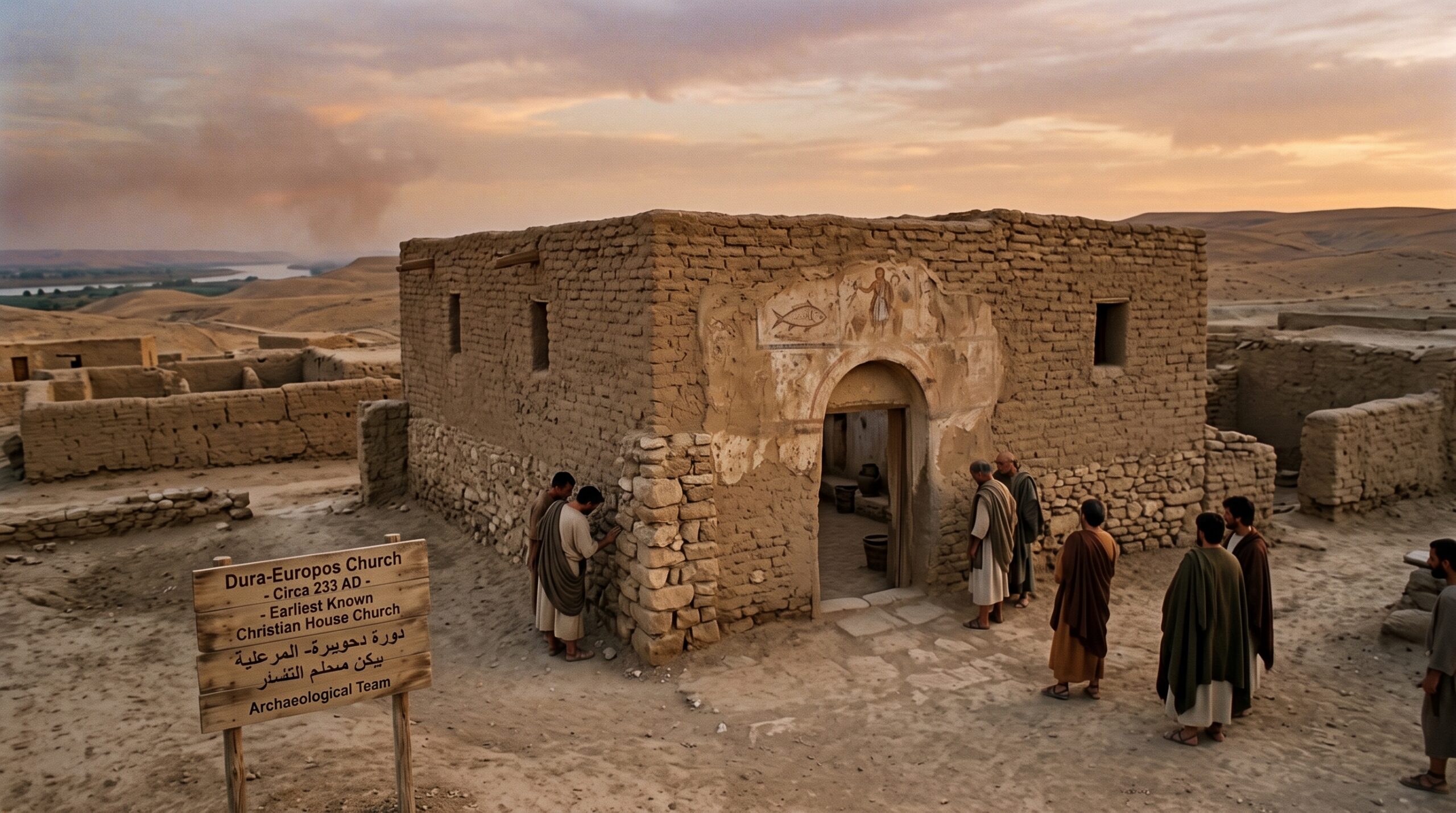
If Megiddo gives us the oldest known prayer-hall floor, Dura-Europos gives us the oldest surviving walls. This Roman frontier city on the Euphrates was excavated in the 1920s and 1930s by French and Yale University expeditions. The city’s life ended abruptly: it fell to the Sasanians in 256. In preparing their defenses, the Romans piled an enormous earthen rampart against the wall — and in doing so accidentally buried the lower floors of entire buildings. One of these was a Christian building, whose renovation is dated by inscription to roughly 233–241.
Its most important room was the baptistery. It preserves the world’s oldest known images of Christ: Christ and Peter walking on water, the Good Shepherd, the healing of the paralytic, and a scene of women approaching the empty tomb. Beside one female figure the name Hera is scratched into the plaster. On the same street stood a temple of Mithras, a synagogue, and several pagan shrines — Christianity grew here in a religiously crowded environment, not an empty one. A 2025 study published in the Journal of Roman Archaeology by Camille Leon Angelo and Joshua Ritter showed that the building, during its renovation, lost every feature necessary for domestic use while gaining features a home does not need. Their conclusion: the label “house church” is misleading — this was a purpose-converted congregational building. The frescoes are now held at the Yale University Art Gallery; the ruins of Dura-Europos have suffered severe damage during the Syrian civil war.
Aqaba: The World’s Oldest Purpose-Built Church (293–303)
On the Red Sea in Jordan, at the site of ancient Ailana, S. Thomas Parker of North Carolina State University excavated in 1998 a building considered the oldest known structure designed and built from the outset to be a church. The date comes from pottery in its foundations, including Tunisian red-slipped tableware: late third century or the very start of the fourth, roughly 293–303. The grounds for identifying it as a church: an eastward orientation, a basilica plan with a central nave, an apse and a baptismal site, fragments of glass oil lamps, and an adjacent cemetery with twenty-four burials, one containing pieces of a bronze cross.
Built of mud brick, the structure was modest. But its timing is radical: it was raised before the Edict of Milan, apparently just before — or even during — the Diocletianic persecution. Guinness World Records recognizes it as the world’s oldest purpose-built church.
Disputed and Lesser-Known Candidates
Rihab, Jordan. In 2008, Abdul Qader al-Husan, director of Jordan’s Rihab Centre for Archaeological Studies, announced that a cave found beneath St. Georgeous Church (c. 230) had served as a Christian place of worship as early as 33–70 CE, sheltering seventy disciples who had fled Jerusalem. The reaction was sharp: former director-general of Jordan’s Department of Antiquities Ghazi Bisheh called the interpretation ridiculous, and archaeologist Boaz Zissu noted that, for first-century Jewish Christians, one would expect to find vessels conforming to kosher dietary law — none were found. Current consensus holds that the cave was likely a storeroom or cellar only later consecrated in the Byzantine period.
Lullingstone, Kent. A Roman villa converted a room into a house church in the fourth century, where a chi-rho monogram and six figures in the orans posture were found — the earliest surviving depictions of this raised-hands prayer stance, and the closest parallel to Dura-Europos.
Etchmiadzin, Armenia (301–303). Armenia became the first nation in the world to adopt Christianity as its state religion; St. Gregory the Illuminator founded a cathedral that has remained continuously in use and is considered the world’s oldest cathedral.
Kerala’s “seven and a half churches.” The St. Thomas Christian community on India’s Malabar coast holds that the apostle Thomas founded their churches in the year 52. The tradition is ancient, but archaeological evidence from the first century is absent — here one must distinguish religious memory from documented fact.
The Church of Zion, Jerusalem. Epiphanius of Salamis wrote in the fourth century that during Emperor Hadrian’s visit (c. 130), a “little church of God” stood on Mount Zion. The Bordeaux Pilgrim (333) and Cyril of Jerusalem (348) mention the same site. Franciscan scholars Bagatti and Testa built a theory of an unbroken Jewish-Christian community from this evidence, but it remains contested.
Constantine and the Birth of Church Architecture
In 313, Constantine and Licinius granted Christianity legal status through the Edict of Milan. Christians did not model their buildings on the pagan temple, which housed a deity and was not meant to hold a crowd inside — instead they borrowed a secular architectural form: the basilica, the Roman marketplace and courthouse hall. The milestones are the Lateran Basilica in Rome (consecrated 324, the city’s oldest public church and the oldest basilica in the West), the Church of the Holy Sepulchre in Jerusalem (335), and the Church of the Nativity in Bethlehem (c. 327–339). Across three generations, Christianity moved from a plastered room in Capernaum to imperial basilicas.
A Summary Answer
| Sense of “first” | Answer | Date |
|---|---|---|
| First community | The Jerusalem church, the Upper Room | c. 30 |
| First named house churches | Priscilla and Aquila, Nympha, Philemon | 50s–60s |
| Earliest venerated holy site | House of Peter, Capernaum | 1st–2nd c. |
| Oldest known prayer hall | Megiddo (Kefar ʿOthnay) | c. 230 |
| Oldest surviving church building | Dura-Europos, Syria | c. 233–256 |
| Oldest purpose-built church | Aqaba, Jordan | 293–303 |
| Oldest cathedral | Etchmiadzin, Armenia | 301–303 |
| Oldest public church in Rome | Lateran Basilica | 324 |
In one sentence: history’s first Christian church was the Jerusalem community in the year 30; the first known space dedicated solely to Christian worship was the Megiddo prayer hall around 230; and the first surviving church building is the Dura-Europos church in Syria.
What This Means for Christians Today
Three things stand out. First: the church was people before it was walls. This is not an argument against buildings — Megiddo, Aqaba, and Etchmiadzin show that Christians began building beautiful sanctuaries the moment they were able to. But the order matters: where a building exists and a community does not, there is no church. The reverse was normal for two centuries. Second: the early church was built by ordinary people whose names we actually know — Akeptous, who gave the table; Gaianus, the centurion who paid for the floor; Brutius, who made it; Hera, whose name is scratched onto the wall of the Dura-Europos baptistery. None of them was a bishop or a martyr we would otherwise have heard of. Third: the visibility of women in the evidence is striking — four women are named on the Megiddo mosaic, and its donor is a woman; the New Testament’s house churches bear the names of Priscilla, Nympha, and Lydia; the dominant image in the Dura-Europos baptistery is five women approaching the empty tomb.
Prayer
Lord Jesus Christ, who said that on this rock you would build your church, and that the gates of hell would not prevail against it — thank you for those who believed before us. Thank you for the hundred and twenty in the upper room, for Akeptous and Gaianus, for the unknown hands that scratched your name into the plaster at Capernaum, and for all who gave what they had, not knowing we would remember them still. Teach us to understand that your temple is not made of stone but of living stones; that the church is not a place we go to, but a people we belong to. In the name of the Father, and of the Son, and of the Holy Spirit. Amen.

Trough all this I want to declare this is all from God and to God. All Glory to Him!