Views: 43
The Ascension of Isaiah: Antichrist, Beliar, and the Vision of the Seven Heavens
Few texts outside the biblical canon open a more direct window onto early Christian cosmology than the Ascension of Isaiah (Latin Ascensio Isaiae; Greek Ἀναβατικὸν Ἠσαΐου). This apocryphal work weaves together two stories: the martyrdom of the prophet Isaiah under King Manasseh, and his spiritual journey through seven heavens, in which he foresees Christ’s incarnation, crucifixion, and resurrection long before these events occurred. Where the canonical Book of Isaiah speaks of Israel’s history and the coming Messiah in prophetic language, the Ascension goes a step further — it shows what the prophet saw when his spirit was carried up into heaven, and who stood in his way.
This essay examines the text’s formation history, its strange and influential embodiment of evil — Beliar, who bears the marks of the Antichrist before that figure had fully taken shape in later Church tradition — the prophet’s vision of the seven heavens and their angelic hierarchy, and finally why it is the Ethiopian Orthodox Tewahedo Church, above all, that has preserved this work in its entirety and woven it into its spiritual life.
Formation History: Three Layers in One Book
The Ascension of Isaiah is not the work of a single author, nor even of a single century. Textual critics established over a century ago that the book consists of at least three originally independent layers, later stitched together into one continuous narrative.
The first layer, chapters 1–5 (excluding 3:13–4:22), is known as the Martyrdom of Isaiah (Martyrium Isaiae). This is a Jewish text that expands on a brief notice in 2 Kings concerning the wickedness of King Manasseh (2 Kings 21:16). In the story, Isaiah warns the dying Hezekiah that his son Manasseh will turn away from God. So it comes to pass: Manasseh takes the throne, restores pagan cults, and a false prophet at his court named Belkira — incited by the demon Beliar — accuses Isaiah of treason. The prophet flees into the desert and hides inside a tree, but he is discovered, and Belkira oversees his execution; according to old Jewish tradition, Isaiah is sawn in half while still alive. This legend is very likely the background to the author of Hebrews’ reference to those “sawn in two” for their faith (Hebrews 11:37).
The second layer, known as the Testament of Hezekiah (3:13–4:22), is a Christian addition that interrupts the narrative to open a brief apocalypse. It speaks of the Church’s coming flourishing, the apostasy that will follow it — led by church leaders and elders who reject the Holy Spirit and the prophetic word — and finally the arrival of Beliar in the form of a king. This is the passage that presents the clearest early portrait of the Antichrist figure, discussed in more detail below.
The third and longest layer, chapters 6–11 (excluding 11:41–43), is the Vision of Isaiah (Visio Isaiae) in the narrower sense — the section to which the book’s Latin title, Ascensio, properly refers. Here Isaiah’s spiritual journey through the seven heavens is recounted, set in the twentieth year of Hezekiah’s reign, before Manasseh’s rise to power and Isaiah’s execution.
The question of dating remains open among scholars. Most place the composition of the Vision in the late first or early second century CE, based partly on the description of Beliar as “the slayer of his mother” (4:2) — an allusion widely read as pointing to Emperor Nero’s notorious matricide of his mother Agrippina, and to the Nero redivivus legend, the belief that Nero would return from the dead, which circulated widely in Christian circles after his death in 68 CE. The complete book as we now have it likely reached its final form in the second half of the second century, when an unknown Christian editor combined the three layers into a single narrative.
The Greek original is largely lost and survives only in fragments — including a shortened Greek legend, along with Coptic and Latin fragments concerning mainly the Vision section. An independent version also survives in Church Slavonic. But the work has come down to us in its entirety, with all three parts intact, only in Ge’ez — classical Ethiopic. It is this fact above all that binds the Ascension inseparably to the Ethiopian Christian tradition, discussed toward the end of this essay.
Beliar and the Figure of the Antichrist: The Ruler of Evil before the End of the Age
If anything sets the Ascension of Isaiah apart within early Christian literature, it is the precision and system of its demonology. Evil operates in the text under more than one name — Sammael, “the prince of this world,” who appears in the Vision section leading the rebellious angels who war against one another in the “firmament” between earth and heaven; and Beliar, the demon who directs Isaiah’s persecution in the Martyrdom section and who, in the Testament of Hezekiah, takes on a clearly eschatological, Antichrist-like form.
The name Beliar itself derives from the old Hebrew expression “man of worthlessness” (beliya’al) and already appears as a personification of evil in the Qumran scrolls and in the Testaments of the Twelve Patriarchs. In the Ascension of Isaiah, however, the name becomes something more than a simple designation for a demon — it becomes the title of a future ruler, a deceiver of the world.
The central prophetic chapter of the Testament of Hezekiah (4:2–14) describes how, after Christ’s resurrection and ascension, the Church at first flourishes, but apostasy then spreads within it: shepherds and elders abandon the utterances of the Holy Spirit and the prophetic word — including Isaiah’s own prophecy. It is at that point that “Beliar, the great prince, the king of this world” descends — evil incarnate in human form, appearing as “a lawless king, the slayer of his mother.” This allusion to Nero’s matricide is no accident: the author uses the figure of Nero as a coded reference through which the Christian community made sense of imperial brutality and its own persecutions within an eschatological framework.
Beliar, the text continues, performs miracles like Christ, demands to be worshipped, has an image of himself erected, and institutes sacrifices in his honor — a motif that echoes directly in 2 Thessalonians (2 Thess. 2:3–4) and in the beast of the Book of Revelation (Rev. 13). His reign is said to last “three years, seven months, and twenty-seven days” — a figure corresponding to Daniel’s 1,290 or 1,335 days (Daniel 12:11–12), confirming how deliberately the Ascension situates itself within the Jewish apocalyptic tradition.
Finally, as the Vision section has already foretold, the Lord himself comes “with the glory of the seventh heaven,” accompanied by his angels and the armies of the saints, and “drags Beliar and his hosts into Gehenna” — an image that draws a direct line between the final victory of Revelation and later Eastern Christian eschatological thought. In this way, the Ascension of Isaiah offers one of the earliest and most fully developed Christian portraits of the Antichrist: a figure who falsely claims divinity, demands worship, and ultimately embodies the rebellion of “the prince of this world” against God — before being destroyed at Christ’s second coming.
Isaiah’s Vision: A Journey through the Seven Heavens
The Vision section (chapters 6–11) describes an event that takes place at Hezekiah’s court. Isaiah falls into a prophetic trance; his breathing continues, but his mind is “taken up,” and before his eyes opens a vision that — as the text repeatedly emphasizes — “no one who was to return again into a body of that world” has ever seen. He is accompanied by an angel who belongs not to this world’s heaven, but comes directly from the seventh heaven.
The journey begins in the firmament, the region between earth and the heavens — the only place in the entire vision where wickedness holds sway. There Isaiah sees Sammael and his hosts locked in conflict and envy, “just as it has been on earth since the world began.” The angel explains that this strife will continue “until the one whom you are to see comes, and he will destroy him.”
From there Isaiah ascends through the first six heavens, each containing a temple, or throne, surrounded by worshipping angels. Each heaven duplicates the one before it, yet with every ascent the glory, light, and number of worshipping angels increase — and with each heaven, Isaiah’s own form grows “ever more glorious,” until he comes to resemble the angels among whom he stands. This is one of the Ascension’s characteristic theological principles: spiritual ascent is at once a cognitive and a transformative process, in which to behold is to become like what one beholds.
In the sixth heaven there is no longer a throne, nor angels positioned to left and right — everything there is directed by the power of the seventh heaven, and Isaiah joins the other angels in worshipping the Father, the Christ, and the Holy Spirit together. As he moves to ascend into the seventh heaven, he is briefly stopped by the angel in charge of praise in the sixth heaven, who asks, “How far shall he who dwells among aliens go up?” — but another voice from the seventh heaven answers that “the holy Isaiah is permitted to come up here, for his robe is here.”
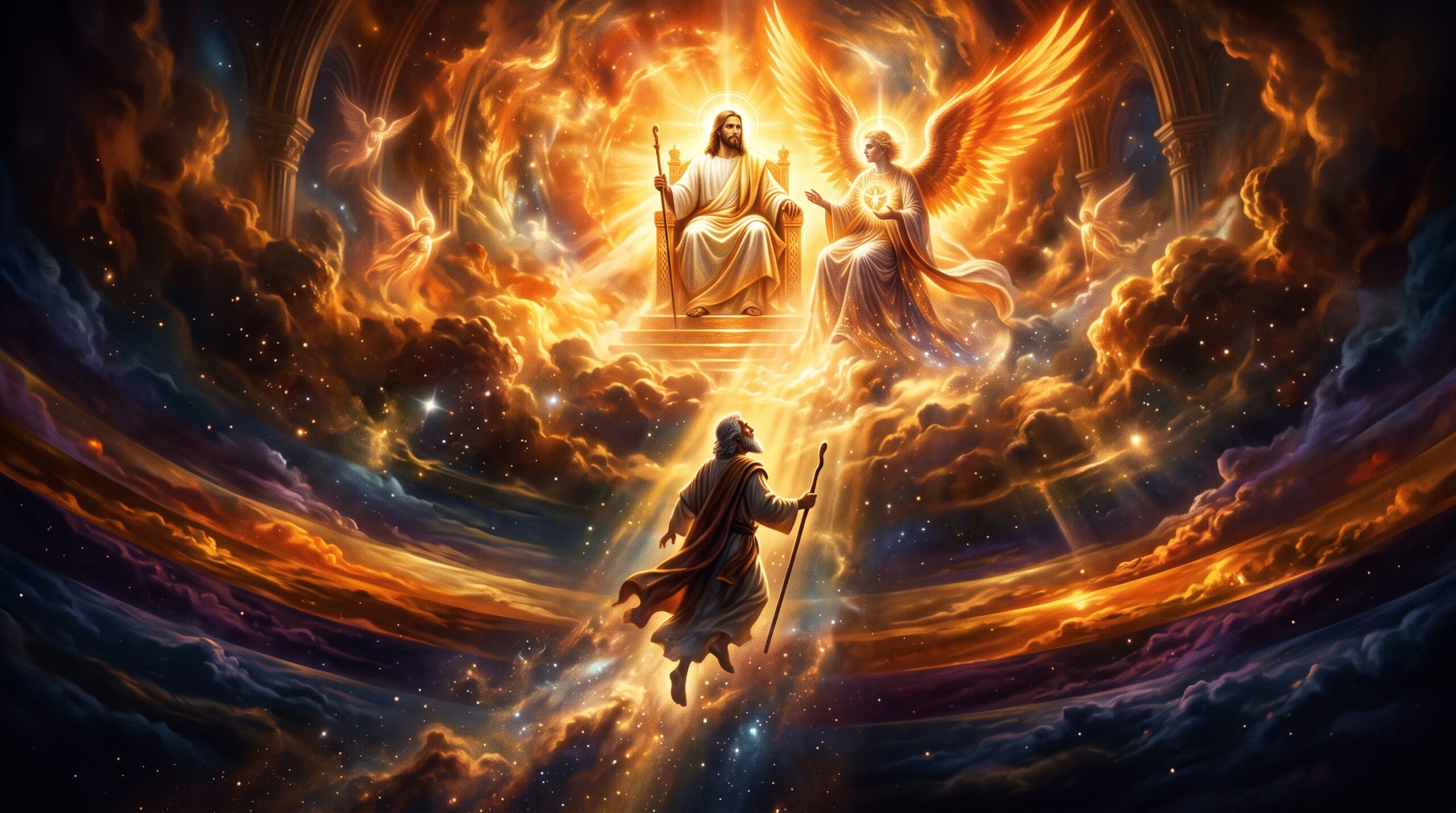
In the seventh heaven, Isaiah beholds something the text explicitly calls unique: all the righteous from Adam onward — Abel, Enoch, and all who were with him — stripped of their garments of flesh and clothed instead in “higher garments,” resembling the angels who stand there in great glory. He sees crowns, thrones, and robes awaiting those who are still suffering for their faith on earth. At the center of it all is the Great Glory (God the Father, never named directly), with the Beloved — Christ, whose name has not yet been revealed — at his right hand, and beside him the angel of the Holy Spirit. The Father commands Christ — whose true nature he progressively conceals as he descends through the seven heavens, taking on the form of the angels of each heaven in turn so that his enemies will not recognize him — to descend into the world, to become human, to suffer, die, rise again, and overthrow the rulers of death and Sheol. The vision ends with Isaiah’s return to his own body, carrying knowledge he is forbidden to reveal to anyone but Hezekiah.
The Angelic Hierarchy of the Seven Heavens
The Ascension of Isaiah is one of the earliest and most systematic attempts in Christian literature to describe the structure of heaven as a graded, hierarchical order. Unlike later Christian angelology — Pseudo-Dionysius the Areopagite’s nine choirs of angels, for instance — the Ascension does not assign each rank a separate name, but instead describes the hierarchy through degrees of light, glory, and nearness to God:
- The firmament — the domain of the rebellious angels and Sammael; the only place of evil and strife in the entire vision.
- The first through fifth heavens — each contains a throne at its center, flanked by worshipping angels to the left and right; glory increases at each level, yet the underlying structure repeats unchanged.
- The sixth heaven — here there is no throne and no angels positioned to the left; everything is directed instead by the power of the seventh heaven. It is here that Isaiah joins, for the first time, in direct worship of the Triune God — the Father, the Christ, and the Holy Spirit. This heaven is overseen by a dedicated “angel of praise,” who controls who may proceed further.
- The seventh heaven — the summit of the hierarchy: here dwell the Great Glory, the Beloved (Christ) at his right hand, the angel of the Holy Spirit, the souls of the righteous patriarchs and saints with their crowns and thrones, and the angel who guards over death and Sheol.
At each stage of ascent, Isaiah himself is “transformed” — his face and form grow ever more glorious, until in the seventh heaven he fully resembles the angels. This image — the simultaneity of spiritual ascent and transformation — is one of the Ascension’s most distinctive theological emphases, and it links the text to the later Eastern Christian doctrine of theosis, according to which the human person participates ever more fully in divine glory and light without ever dissolving into the essence of the Creator.
The same hierarchical logic governs the description of Christ’s descent: as he passes through the seven heavens on his way into the world, he “is transformed” at each level to resemble the angels of that heaven, so that no heavenly power recognizes him — this occurs so that “the prince of this world” and his forces will not understand who is truly coming among them until it is too late. After the crucifixion and resurrection, Christ retraces the same heavens in reverse, but this time in his true glory, so that the powers of every heaven, and the “Satans,” see him and worship him.
Influence on the Ethiopian Orthodox Tradition
As noted above, the Ascension of Isaiah survives in complete form in only one language — classical Ethiopic, or Ge’ez, under the title Ergata Isaiyas. This is no accident, but part of a broader phenomenon: the Ethiopian Orthodox Tewahedo Church has historically preserved a large body of early Christian and Jewish apocalyptic texts that were lost, or set aside, in the West and in most other Eastern traditions alike — including the Book of Enoch, the Book of Jubilees, and the Books of Meqabyan. Under this so-called broader canon, the Ethiopian Bible contains as many as 88 books, making it the largest canon in all of Christianity.
The Tewahedo Church’s attitude toward the Ascension is nuanced. Historically, several Western scholars claimed that the book was regarded as fully canonical in Ethiopia — some earlier sources list it, alongside the Shepherd of Hermas (Herma Näbiy), among the canonical books. More recent scholarship has refined this picture: today the Ascension is generally treated as part of a broader, more “commentary-like” body of scripture — a text carrying real authority, yet holding a status below that of the strictly canonical books. This distinction between a narrower and a broader canon is characteristic of the Ethiopian tradition specifically, where the boundaries of scripture have historically been wider and more fluid than in the West.
In substance, however, the Ascension’s influence on Ethiopian spirituality runs deep and takes several forms. First, the book confirms Ethiopian Christianity’s broader tendency to hold prophetic and apocalyptic texts — works that speak of the structure of the heavens, the ranks of angels, and the events of the last days — in especially high regard; this is the same spiritual impulse that has sustained the preservation of Enoch and Jubilees. Second, the portrait of Beliar and the Antichrist, with its detailed account of a deceiver who presents himself as divine before being cast down into Gehenna, has left a mark on Ethiopian popular eschatological imagination, which is often closely interwoven with liturgical and hagiographical texts. Third, the text’s structured account of the seven heavens and the angelic hierarchy has fed into Ethiopian angelology and art — in the Tewahedo tradition, angels and their ranks have always held a central place in spiritual life and church art, and the Ascension’s ordered vision of heaven fits naturally within that larger framework.
Finally, it is worth remembering what today’s church historians emphasize: the Ethiopian Church did not “add” these books to the Bible — it preserved them, carrying forward the textual richness of the Jewish and early Christian world at a time when the Western and later Byzantine canons were gradually narrowing. In this sense, the Ascension of Isaiah stands as living testimony to the diversity of the Christian scriptural tradition — a text born in a Jewish-Christian milieu near Palestine in the first centuries of our era, whose complete voice has reached us only through the care of Christians on the Horn of Africa.
Conclusion
The Ascension of Isaiah offers a unique window onto early Christian cosmology and demonology — a text that fuses a Jewish martyrdom story, a Christian eschatology of the Antichrist, and a detailed vision of the heavens into a single whole. Its portrait of Beliar anticipates the later doctrine of the Antichrist; its account of the seven heavens and their angelic hierarchy shaped Christian angelology long after its composition; and its survival, specifically within the Ethiopian Orthodox tradition, is a reminder of how much of the Christian heritage’s richness has been kept alive on the margins rather than at church history’s self-evident centers. For readers seeking to understand how the early Church imagined the structure of the heavens, the nature of evil, and Christ’s hidden yet victorious passage through creation, this text remains an irreplaceable source.
Troparion to the Prophet Isaiah
Tone 4
You who beheld the Most High Glory within the seventh heaven, and the Beloved at His right hand, O Prophet Isaiah, who suffered for the truth and were broken neither by Belkira’s lie nor by Beliar’s wrath — intercede with Christ, King of all, that He keep us watchful against the deceit of false prophets and the Antichrist, and that He raise our souls too, after our earthly journey, to that higher garment which you beheld upon the righteous in the seventh heaven, where reigns eternal light and unceasing praise to the Father, and the Son, and the Holy Spirit.

Trough all this I want to declare this is all from God and to God. All Glory to Him!