
Views: 31
What Is the Lord’s Prayer? Its Meaning, Text, and Practice
Two Gospels present the Lord’s Prayer at different lengths. This detail helps answer the question “what is the Lord’s Prayer” more precisely: it is not merely a text to be memorized, but a framework Jesus gave for turning toward God, seeking His kingdom, asking for daily help, and forgiving others.
Matthew 6:9–13 contains the longer form, and Luke 11:2–4 the shorter one. Both lead the one praying in the same direction: first God’s name and will, then human needs, sin, temptation, and protection from evil.
Key Takeaways
- The Lord’s Prayer originates in Jesus’ own teaching.
- The Matthean and Lukan versions differ in length.
- The prayer places God’s will ahead of human wants.
- “Daily bread” encompasses more than food.
- Forgiveness binds God’s mercy to human life.
- The Orthodox tradition reads the prayer as a complete spiritual path.
What does the Lord’s Prayer mean, and where does it come from?
The Lord’s Prayer is the prayer Jesus taught, with its core texts found in Matthew 6:9–13 and Luke 11:2–4. In Matthew’s Gospel, Jesus gives it as part of the Sermon on the Mount; in Luke, it is set within a scene where the disciples ask, “Lord, teach us to pray.” The prayer therefore comes from Jesus’ own teaching, not from a later ecclesiastical composition.
Matthew’s text opens with “Our Father, who art in heaven.” This address unites closeness with reverence. God is a Father to whom a person may turn, yet He is not a servant of human wishes. “Our” also signals that the prayer is not merely a private accomplishment but the shared prayer of the whole people of God.
The structure of the Lord’s Prayer moves in two directions. The first petitions focus on the hallowing of God’s name, the coming of His kingdom, and the doing of His will. Then come bread, forgiveness, temptation, and deliverance from evil. Jesus teaches the one praying to place God first, without setting aside genuine human needs.
The prayer is not a magic formula. Repeating its words does not compel God toward a particular decision. Rather, the prayer reshapes the attention of the one praying: a person begins to view their life in light of God’s kingdom, responsibility, and mercy.
Jesus’ teaching arose against a backdrop of criticism toward empty wordiness. In Matthew 6, He warns against both hypocritical display and meaningless heaping up of words. The Lord’s Prayer is short, yet each of its petitions opens onto a whole spiritual theme.
The text of the Lord’s Prayer according to Matthew and Luke
The text of the Lord’s Prayer is most fully known through Matthew 6:9–13. Luke 11:2–4 is shorter, and in some translations it lacks part of Matthew’s formulaic ending. The difference does not signal a contradiction; rather, it shows that Jesus may have taught the same prayer on different occasions.
The longer form in Matthew 6:9–13
Matthew’s version contains an address, three petitions directed toward God, and three petitions concerning human need. It closes with a petition for deliverance from evil. Many churches add a doxology: “For thine is the kingdom, and the power, and the glory, for ever.” This ending does not appear in the same form in the base text of every Bible translation.
When examining the biblical text, it is worth distinguishing two things: the verses of the Gospel itself, and their later liturgical use. The doxology is widely known within church prayer tradition and forms a fitting close, but the textual-critical status of Matthew 6:13 is more complex across the various manuscripts.
The shorter form in Luke 11:2–4
Luke’s version contains several shorter lines. It asks for the hallowing of God’s name, the coming of the kingdom, daily bread, forgiveness of sins, and being kept from falling into temptation. The text fits directly within the context of the disciples’ request to be taught how to pray.
Luke’s form is a reminder that the Lord’s Prayer need not be understood through one fixed liturgical length alone. What matters is the direction Jesus gave. The texts of Matthew and Luke together help us see the prayer’s content, rather than competing over which form is “more correct.”
“Our Father, who art in heaven, hallowed be thy name.” (Matthew 6:9)
The differences between the Gospels become clearer when both passages are read together with their surrounding context. In Matthew, Jesus speaks about prayer within the Sermon on the Mount; in Luke, He responds to the disciples’ specific request to learn how to pray. In both cases the aim is the same: prayer must proceed from God and shape a person’s life.
How do the parts of the Lord’s Prayer work?
The Lord’s Prayer functions as a spiritual ordering. It draws the mind toward God’s identity, His will, a person’s daily needs, and relationships with others. The sequence of the prayer is meaningful: a person does not begin with their own wishes, but with God.
“Our Father” and the name of God
The words “Our Father” express trust, but also belonging. The one praying does not say “my Father” in a merely private sense, but joins a community that turns to the same God. In the Orthodox tradition, this prayer therefore resounds within a shared liturgical life, not only as a solitary personal exercise.
“Hallowed be thy name” does not mean that a person makes God more holy. God’s name is already holy in itself. The one praying asks that God’s holiness shine more clearly in their life and in the world — touching speech, choices, honesty, and one’s attitude toward other people.
God’s kingdom and will
“Thy kingdom come” is a prayer that God’s reign would become visible. It is not a call to establish a political system, but a longing for truth, mercy, and justice to shape human life. In the Christian faith, God’s kingdom is tied both to Christ’s presence and to a future fullness.
“Thy will be done, on earth as it is in heaven” does not mean passive indifference. The one praying asks for strength to order their own will, so that they do not automatically follow anger, greed, or fear. The purpose of the prayer is not to change God’s will, but to open the person to God’s will.
Bread, forgiveness, and protection
“Give us this day our daily bread” concerns food and other necessities, but its meaning is not limited to material supply. Bread can be understood as the whole of what sustains life from God. In Christian and Orthodox interpretation, it also recalls dependence on God and carries a connection to the spiritual meaning of the Eucharist.
The petition for the forgiveness of sins binds God’s mercy to human responsibility. Matthew’s wording speaks of debts, Luke’s of sins. The point is the same: a person needs forgiveness, and must learn to forgive those who are in debt to them or who have caused them harm.
“Lead us not into temptation” does not mean that God entices a person toward evil. The petition expresses a desire that a person would not fall in a trial, nor let temptation take the lead. “Deliver us from evil” turns attention both to the power of evil and to the personal choices that give rise to it.
Why is the Lord’s Prayer not mere repetition of words?
Mechanical repetition of the Lord’s Prayer can happen when the mouth speaks the words but the mind and heart do not take part. Jesus did not forbid repetition as such. He warned against praying in a way that expects results from many words alone.
The words of the prayer work better when the one praying pauses over their meaning. For instance, the word “forgive” makes the prayer uncomfortably concrete when a specific name comes to mind. “Thy will be done” touches decisions a person would rather control themselves.

A practical rhythm for prayer can be simple:
- Read one petition slowly.
- Pause on its meaning for at least a moment.
- Connect it to a specific situation in your day.
- Ask God for strength to act accordingly.
- Close with thanksgiving, rather than a fresh list of requests.
One prayer read attentively can shape a day more than ten distracted repetitions. This is not a measurable spiritual scorecard, but a matter of attention and the disposition of the heart.
When the one praying says “give us this day our daily bread,” they may be thinking of a family’s food, work, health, or inner strength. When they say “forgive us,” they should ask whether they are acknowledging real guilt or simply using the word out of habit.
In Orthodox spirituality, prayer is often connected to the attentive gathering of the nous — mind and heart together. The goal is not to produce an emotion, but the person’s inner turning toward God. Sometimes the feeling remains dry; the value of the prayer does not depend on a strong experience being felt each time.
The Lord’s Prayer in Orthodox tradition
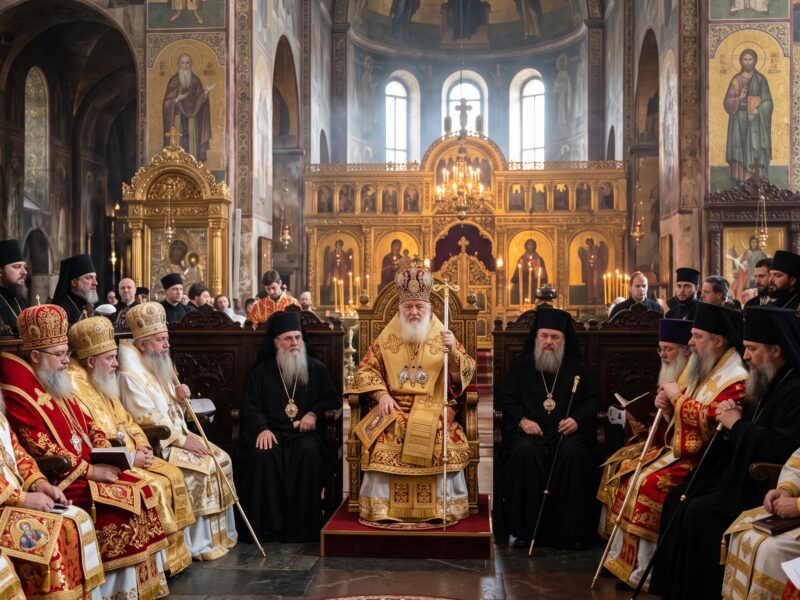
In the Orthodox tradition, the Lord’s Prayer is part of both personal prayer life and the church’s shared liturgical order. Its text is heard in the liturgy just before the preparation for Communion. This placement shows that human needs belong within the wider framework of God’s kingdom and forgiveness.
Liturgical and personal use
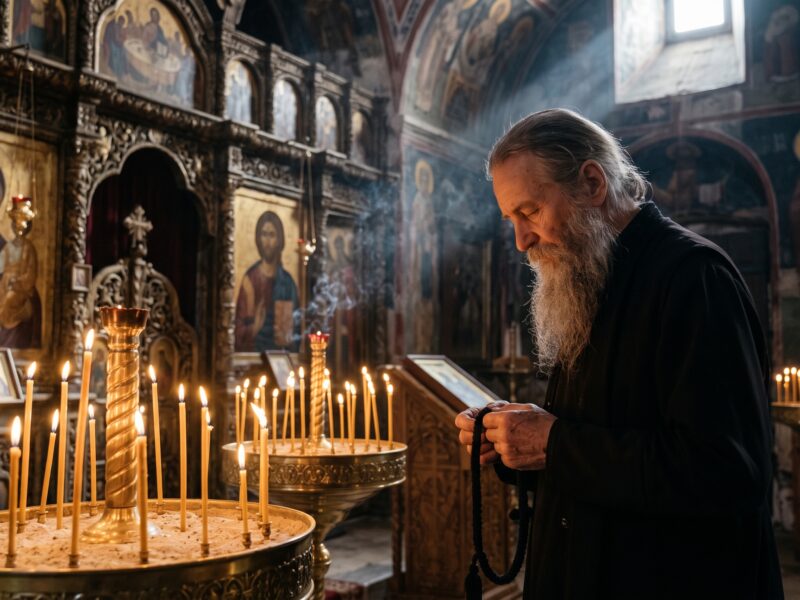
An Orthodox Christian may pray the Lord’s Prayer in the morning, in the evening, or before meals. The prayer does not depend on a fixed hour, but a steady rhythm helps a scattered mind settle. A five-minute morning prayer, for example, might begin with one slow reading and continue with quiet reflection.
In communal prayer, one says “we,” not “I.” This expresses that the one praying also carries the needs of others. A hungry person, a sick family member, and someone with whom a conflict has arisen — all fit within this single prayer.
Forgiveness as spiritual work
In Orthodox interpretation, forgiveness is not merely a feeling. A person may have been deeply wounded and need time to let go of the desire for revenge. “As we forgive” does not command a person to deny wrongdoing or to remain in a harmful relationship; it calls one to stop feeding hatred.
This distinction matters in everyday life as well. Forgiving does not mean that mistreatment becomes acceptable, or that a dangerous relationship must continue. The prayer shapes the heart, while practical boundaries may still remain necessary.
The whole of human need
Orthodox interpretation does not strictly divide a person into material and spiritual halves. Bread means actual food, but a person also needs God’s word, communion, wisdom, and grace. In this way the prayer becomes whole: it touches body, mind, will, and relationships.
This wholeness can be seen in the prayer’s core petitions:
| Petition | Direct Meaning | Spiritual Direction |
|---|---|---|
| Our Father | Turning toward God | Trust and belonging |
| Thy kingdom come | Asking for God’s reign | Hope and obedience |
| Daily bread | Asking for the day’s need | Gratitude and dependence |
| Forgive us | Acknowledging guilt | Repentance and mercy |
| Deliver from evil | Asking for protection | Watchfulness and steadfastness |
The prayer does not replace work, medical care, a reconciling conversation, or a responsible decision. It gives those actions a spiritual direction. A person who prays for forgiveness, for instance, should also, where possible, set right their own words or actions.
How should the Lord’s Prayer be read according to the Bible?

A Bible-based reading begins with the text, not with assumption. Open Matthew 6:9–13 and Luke 11:2–4, read both passages, and note the differences. Then consider which verses Jesus speaks before and after the prayer.
In Matthew 6, the prayer is set alongside teaching on almsgiving, fasting, and prayer. Jesus stresses that outward piety is not meant to draw others’ attention. This context helps explain why the Lord’s Prayer must not be used to create an impression.
In Luke 11, the prayer is followed by teaching on persistence in asking. This does not mean God fails to hear before the repetition. Rather, persistent asking shapes a person’s trust, patience, and readiness to receive an answer that may differ from what was expected.
Four questions are worth asking when studying the biblical text: Who is speaking? To whom is it addressed? Which word recurs? What change does this prayer require in my behavior today? Reading in this way keeps the prayer from both superficial reading and overly loose interpretation.
Bible-based prayer guides can help connect the reading of the text to a daily rhythm of prayer. A good guide does not replace the Gospel itself, but helps notice connections that are easy to miss when reading in haste.
Reading the Lord’s Prayer might well end with one concrete step. If you prayed about daily bread, notice your gratitude and your consumption. If you prayed about forgiveness, choose one honest conversation, or let go of at least one vengeful thought.
Common misunderstandings about the Lord’s Prayer
The first misunderstanding is that the prayer is only a fixed sequence of words. The text matters because Jesus gave it to His disciples. But its purpose is to teach how a person lives before God — not to offer a formula that works automatically.
A second point of confusion concerns Matthew’s longer form and Luke’s shorter one. Some readers assume the difference proves one text is incorrect. In fact, the evangelists present the same teaching within their own narrative context, and church practice has shaped Matthew’s form into the more widely known one.
A third misunderstanding concerns daily bread. It is not only a prayer for breakfast or for wages. It includes a person’s real material need, but also a prayer that God would give the strength, wisdom, and grace necessary for life.
A fourth problem arises around forgiveness. Some assume that forgiving requires denying the suffering involved. Christian forgiveness names evil as evil, yet it does not grant anger the right to govern a person’s entire inner world.
Likewise, “lead us not into temptation” does not mean that God drives people toward evil. It is a prayer for protection and watchfulness. If a person knows they tend, for example, to respond in anger, they might take a deliberate pause after this prayer before sending a message.
The most practical question the Lord’s Prayer raises is not “Did I say all the words correctly?” but “What way of life do these words call me toward today?” The answer may be small: an apology, more moderate consumption, honest work, or a quiet decision to let go of revenge.
Conclusion
Today, read Matthew 6:9–13 slowly, once through. Choose one line that touches your present situation, and pray over it for five minutes. If the question concerns forgiveness, write down one safe and honest next step. The Lord’s Prayer comes alive when its words reach into a person’s decisions.

Frequently Asked Questions
Must the Lord’s Prayer be recited word for word?
Not necessarily, if the goal is to reflect on the prayer’s meaning — though in church and communal prayer, a fixed text matters. In personal prayer, each line may be expanded in one’s own words, for instance by naming a specific person or situation.
Why does the prayer say “we” when I am praying alone?
“Our” is a reminder that the Christian faith does not treat a person as an isolated unit. Praying alone, you still carry, in your mind, your family, your church, and those in need. This makes the prayer less self-centered, without erasing personal concerns.
Is Luke’s shorter version less correct?
No. Luke 11:2–4 and Matthew 6:9–13 are different presentations of the same teaching. Matthew’s text is longer and is therefore used in many churches as the customary liturgical text.
What should I do if I cannot forgive someone?
Begin with an honest prayer acknowledging your inability. Forgiveness can be a process rather than an instant feeling. It does not require denying the harm done or continuing a damaging relationship, but it directs you toward letting go of revenge and hatred.

Trough all this I want to declare this is all from God and to God. All Glory to Him!