
Views: 31
Introduction
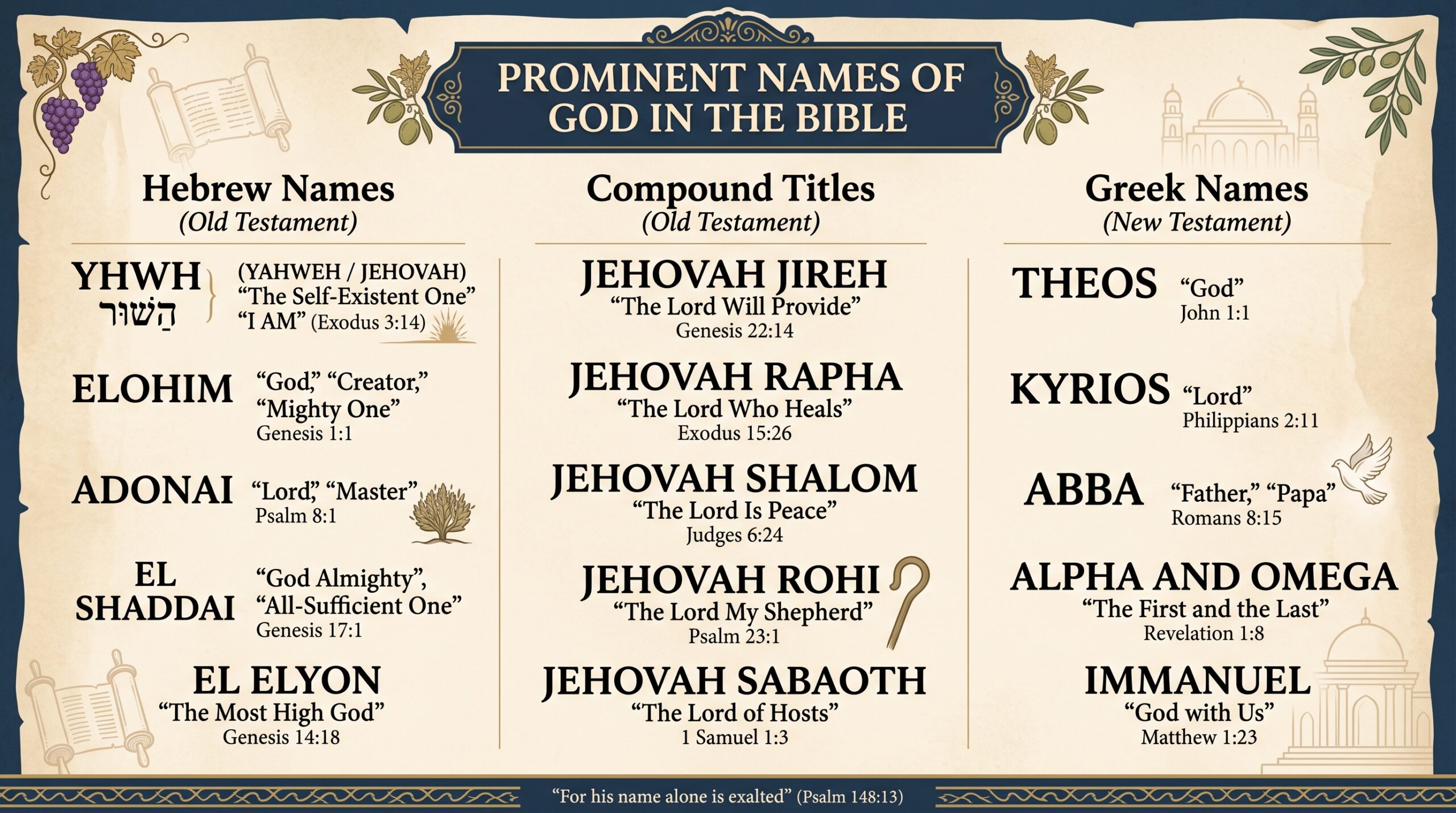
The names of God are among the richest themes in all of Scripture. The Bible does not speak of God through a single name. It uses many Hebrew, Aramaic and Greek names, titles and descriptions. These do not refer to different gods. Each reveals a different facet of the one God’s nature.
In the biblical world, a name means far more than a label. A name can express a person’s character, authority, actions and relationships. For this reason, studying the names of God helps us understand how God reveals himself in Scripture.
The most central Old Testament names are YHWH, Elohim, El and Adonai. Alongside them are compound names such as El Shaddai, El Elyon, El Olam and El Roi, as well as YHWH-names such as YHWH Jireh, YHWH Shalom and YHWH Rohi. In the New Testament, the revelation of God’s name continues through the Greek terms Theos, Kyrios and Pantokratōr, and, for Christ, through names and titles such as Immanuel, Son of God, Lord and Savior.
It is also important to note that the Bible gives no single official, numbered list of God’s names, whether of 50 or 100. What follows is a collection of the most important and theologically meaningful names, titles and designations that Scripture uses.
The Names of God and Their Meaning
1. YHWH – יהוה – Yahweh / LORD
Meaning: “He who is,” “I AM,” or “The One who is.”
Origin: Hebrew. The tetragrammaton YHWH is God’s most distinctive personal name in the Old Testament. It is tied to God’s self-revelation to Moses and to the Hebrew verb hayah, “to be.”
Scripture: Exodus 3:14–15 – “I AM WHO I AM.”
Significance: YHWH expresses God’s eternal, self-existent being and his unique covenant relationship with Israel. English Bibles usually render it “LORD.” In Jewish tradition, Adonai is often read aloud in place of YHWH.
2. Elohim – אֱלֹהִים – God
Meaning: “God,” “Mighty God,” “Creator.”
Origin: Hebrew. Elohim is grammatically plural, but when it refers to the God of Israel it usually takes a singular sense.
Scripture: Genesis 1:1 – “In the beginning, God created the heavens and the earth.”
Significance: Elohim emphasizes God as Creator, mighty and sovereign ruler. The first name of God in the Bible appears in the very first verse, showing that the whole universe is his creation.
3. El – אֵל – God, Mighty One
Meaning: “God,” “Mighty One,” “Powerful One.”
Origin: An ancient Semitic and Hebrew form of the word for God.
Scripture: Deuteronomy 10:17 – “The LORD your God is God of gods and Lord of lords, the great, the mighty, and the awesome God.”
Significance: El emphasizes God’s power, authority and supremacy. It also appears in many compound names, such as El Shaddai and El Elyon.
4. Eloah – אֱלוֹהַּ – God
Meaning: “God.”
Origin: A Hebrew word generally regarded as the singular form of Elohim.
Scripture: Job 33:12 – “God is greater than man.”
Significance: Eloah appears especially in the Book of Job and stresses God’s greatness, transcendence and difference from humanity.
5. Adonai – אֲדֹנָי – Lord
Meaning: “Lord,” “My Lord,” “Master.”
Origin: Hebrew adon means lord or ruler.
Scripture: Genesis 15:2 – “O Lord GOD, what will you give me?”
Significance: Adonai expresses God’s sovereignty and ruling authority. In Jewish reading tradition it was often spoken in place of YHWH, which later shaped the traditional vocalization of the divine name.
6. El Shaddai – אֵל שַׁדַּי – God Almighty
Meaning: “God Almighty.”
Origin: Hebrew. El means God, and Shaddai is traditionally translated “Almighty,” though its exact etymology is disputed among scholars.
Scripture: Genesis 17:1 – “I am God Almighty; walk before me, and be blameless.”
Significance: El Shaddai emphasizes God’s power, faithfulness and ability to fulfill his promises. In the story of Abraham, this name is linked to the covenant and the promised offspring.
7. El Elyon – אֵל עֶלְיוֹן – God Most High
Meaning: “God Most High.”
Origin: Hebrew Elyon means “highest” or “supreme.”
Scripture: Genesis 14:19 – “Blessed be Abram by God Most High, Possessor of heaven and earth.”
Significance: El Elyon presents God as the highest being, ruling over all creation. No earthly or spiritual power stands above him.
8. El Olam – אֵל עוֹלָם – Everlasting God
Meaning: “Everlasting God,” “God of eternity.”
Origin: Hebrew olam relates to long or unbounded time and to eternity.
Scripture: Genesis 21:33 – “Abraham … called there on the name of the LORD, the Everlasting God.”
Significance: El Olam shows that God is not bound by time. He is eternal, and his existence does not depend on the duration of the created world.
9. El Roi – אֵל רֳאִי – The God Who Sees
Meaning: “The God who sees me.”
Origin: Hebrew, related to the verb ra’ah, “to see.”
Scripture: Genesis 16:13 – “You are a God of seeing.”
Significance: Hagar discovers that God sees her suffering and loneliness. El Roi presents God as personally caring and attentive to each individual.
10. El Bethel – אֵל בֵּית־אֵל – The God of Bethel
Meaning: “The God of Bethel.”
Origin: Hebrew El + Bethel, “house of God.”
Scripture: Genesis 35:7 – “He called the place El-bethel, because there God had revealed himself to him.”
Significance: The name recalls God’s revelation and presence in Jacob’s life.
11. El Elohe Israel – אֵל אֱלֹהֵי יִשְׂרָאֵל – God, the God of Israel
Meaning: “God, the God of Israel.”
Origin: Hebrew.
Scripture: Genesis 33:20 – “He called it El-Elohe-Israel.”
Significance: The name expresses God’s covenant relationship with Israel and ties the history of salvation to a specific people.
12. YHWH Jireh – יהוה יִרְאֶה – The LORD Will Provide
Meaning: Traditionally “The LORD will provide.”
Origin: Hebrew, from the verb ra’ah, “to see.”
Scripture: Genesis 22:14 – “The LORD will provide.”
Significance: For Abraham, this means that God sees the need and supplies what is necessary. This is why the Christian tradition has translated the name “The LORD will provide.”
13. YHWH Nissi – יהוה נִסִּי – The LORD Is My Banner
Meaning: “The LORD is my banner.”
Origin: Hebrew nes means a sign, standard or banner.
Scripture: Exodus 17:15 – “The LORD is my banner.”
Significance: God is the protector of his people and the giver of victory. The name arose after Israel’s victory over the Amalekites.
14. YHWH Rapha – יהוה רֹפְאֶךָ – The LORD Your Healer
Meaning: “The LORD, your healer.”
Origin: Hebrew rapha means to heal or restore.
Scripture: Exodus 15:26 – “I am the LORD, your healer.”
Significance: God reveals himself as healer and restorer. In the Bible, healing encompasses the body, the soul and a person’s relationship with God.
15. YHWH M’Kaddesh – יהוה מְקַדִּשְׁכֶם – The LORD Who Sanctifies
Meaning: “The LORD who sanctifies you.”
Origin: Hebrew qadash, “to sanctify, to make holy.”
Scripture: Exodus 31:13 – “I am the LORD, who sanctifies you.”
Significance: God does not merely call people to holiness. He is the one who makes them holy and sets them apart for himself.
16. YHWH Shalom – יהוה שָׁלוֹם – The LORD Is Peace
Meaning: “The LORD is peace.”
Origin: Hebrew shalom means peace, wholeness, well-being and completeness.
Scripture: Judges 6:24 – “The LORD is Peace.”
Significance: God’s peace is more than the absence of conflict. It means inner wholeness, security and reconciliation.
17. YHWH Tsidkenu – יהוה צִדְקֵנוּ – The LORD Our Righteousness
Meaning: “The LORD our righteousness.”
Origin: Hebrew tsedeq, righteousness or justice.
Scripture: Jeremiah 23:6 – “The LORD is our righteousness.”
Significance: God is the source of his people’s righteousness and right standing. In Christian theology, this is closely tied to justification and Christ’s work of redemption.
18. YHWH Rohi – יהוה רֹעִי – The LORD Is My Shepherd
Meaning: “The LORD is my shepherd.”
Origin: Hebrew ro’eh, shepherd.
Scripture: Psalm 23:1 – “The LORD is my shepherd; I shall not want.”
Significance: God leads, protects, feeds and seeks out his people as a shepherd does his sheep. In the New Testament, Jesus applies this image to himself: “I am the good shepherd” (John 10:11).
19. YHWH Shammah – יהוה שָׁמָּה – The LORD Is There
Meaning: “The LORD is there.”
Origin: Hebrew sham, “there.”
Scripture: Ezekiel 48:35 – “THE LORD IS THERE.”
Significance: The name expresses God’s presence among his people. One of the central themes of the biblical story of salvation is God’s desire to dwell with his people.
20. YHWH Sabaoth – יהוה צְבָאוֹת – The LORD of Hosts
Meaning: “The LORD of hosts” or “The LORD of armies.”
Origin: Hebrew tsebaoth, hosts or armies.
Scripture: Isaiah 6:3 – “Holy, holy, holy is the LORD of hosts.”
Significance: God is the sovereign Lord of all heavenly and earthly hosts.
21. Qedosh Yisrael – קְדוֹשׁ יִשְׂרָאֵל – The Holy One of Israel
Meaning: “The Holy One of Israel.”
Origin: Hebrew qadosh, holy.
Scripture: Isaiah 12:6 – “Great in your midst is the Holy One of Israel.”
Significance: God’s holiness means his complete purity, uniqueness and separateness from all creation.
22. El Qanna – אֵל קַנָּא – Jealous God
Meaning: “Jealous God” or “God who demands faithfulness.”
Origin: Hebrew qanna, jealous or zealous.
Scripture: Exodus 20:5 – “I the LORD your God am a jealous God.”
Significance: This does not mean petty human envy. It refers to God’s faithfulness to his covenant and his demand that people not worship idols.
23. El Hannun – אֵל חַנּוּן – Gracious God
Meaning: “Gracious and merciful God.”
Origin: Hebrew ḥannun, gracious.
Scripture: Deuteronomy 4:31 – “The LORD your God is a merciful God.”
Significance: God is not only a just judge but also a merciful and gracious God, who gives people the opportunity to turn back to him.
24. Tsur – צוּר – Rock
Meaning: “Rock,” “Fortress,” “Refuge.”
Origin: Hebrew tsur, a rock or solid stone.
Scripture: Deuteronomy 32:4 – “The Rock, his work is perfect.”
Significance: The Rock portrays God as unchanging, strong and a trustworthy protector.
25. Go’el – גֹּאֵל – Redeemer
Meaning: “Redeemer,” “Deliverer.”
Origin: Hebrew. Go’el originally denoted a family’s redeemer or protector.
Scripture: Isaiah 41:14 – “Your Redeemer is the Holy One of Israel.”
Significance: God is the one who saves, delivers, protects and restores. In Christian faith, this concept becomes especially important through Christ’s work of redemption.
26. Elohim Chayyim – אֱלֹהִים חַיִּים – The Living God
Meaning: “The living God.”
Origin: Hebrew chayyim, life, living.
Scripture: Joshua 3:10 – “The living God is among you.”
Significance: The God of the Bible is unlike the idols that people make. He lives, speaks, acts, hears and saves.
27. Father – Abba / Patēr
Meaning: “Father.”
Origin: Aramaic Abba and Greek Patēr.
Scripture: Matthew 6:9 – “Our Father in heaven, hallowed be your name.”
Significance: Jesus teaches his disciples to address God as Father. The name expresses God’s fatherly love, care and closeness.
28. Theos – Θεός – God
Meaning: “God.”
Origin: Greek; the New Testament’s main word for God.
Scripture: John 1:1 – “The Word was God.”
Significance: Theos continues the Old Testament revelation of God in the New Testament and is used of God and of his divine nature.
29. Kyrios – Κύριος – Lord
Meaning: “Lord,” “Master.”
Origin: Greek. In the Septuagint, Kyrios was often used to translate YHWH.
Scripture: Romans 10:9 – “Jesus is Lord.”
Significance: In the New Testament, Kyrios carries profound weight, because calling Jesus “Lord” connects his authority to the Old Testament title of the LORD God.
30. Pantokratōr – Παντοκράτωρ – Almighty
Meaning: “Almighty,” “Ruler of all.”
Origin: Greek pan, “all,” + kratos, “power, might.”
Scripture: Revelation 4:8 – “Holy, holy, holy, is the Lord God Almighty.”
Significance: Pantokratōr expresses God’s supreme authority over all creation and history.
31. Immanuel – עִמָּנוּאֵל – God With Us
Meaning: “God with us.”
Origin: Hebrew Immanu-El, “God is with us.”
Scripture: Matthew 1:23 – “Immanuel,” which means “God with us.”
Significance: The central message of the Christian faith is that God did not remain distant from humanity but came to us in Christ.
32. Savior – Sōtēr – σωτήρ
Meaning: “Savior,” “The one who saves.”
Origin: Greek.
Scripture: Luke 2:11 – “For unto you is born this day in the city of David a Savior, who is Christ the Lord.”
Significance: God is the source of human salvation, redemption and eternal life.
33. Son of God
Meaning: Jesus’ unique relationship with God the Father.
Origin: A Christological title of the New Testament.
Scripture: Matthew 16:16 – “You are the Christ, the Son of the living God.”
Significance: In Christian teaching, this title expresses Jesus’ unique divine nature and his relationship with the Father.
34. Alpha and Omega – Α and Ω
Meaning: “The Beginning and the End.”
Origin: The first and last letters of the Greek alphabet.
Scripture: Revelation 1:8 – “I am the Alpha and the Omega … the Almighty.”
Significance: God is the beginning of time, the Lord of history and the final fulfillment of all things. Nothing exists outside his sovereignty.
Conclusion
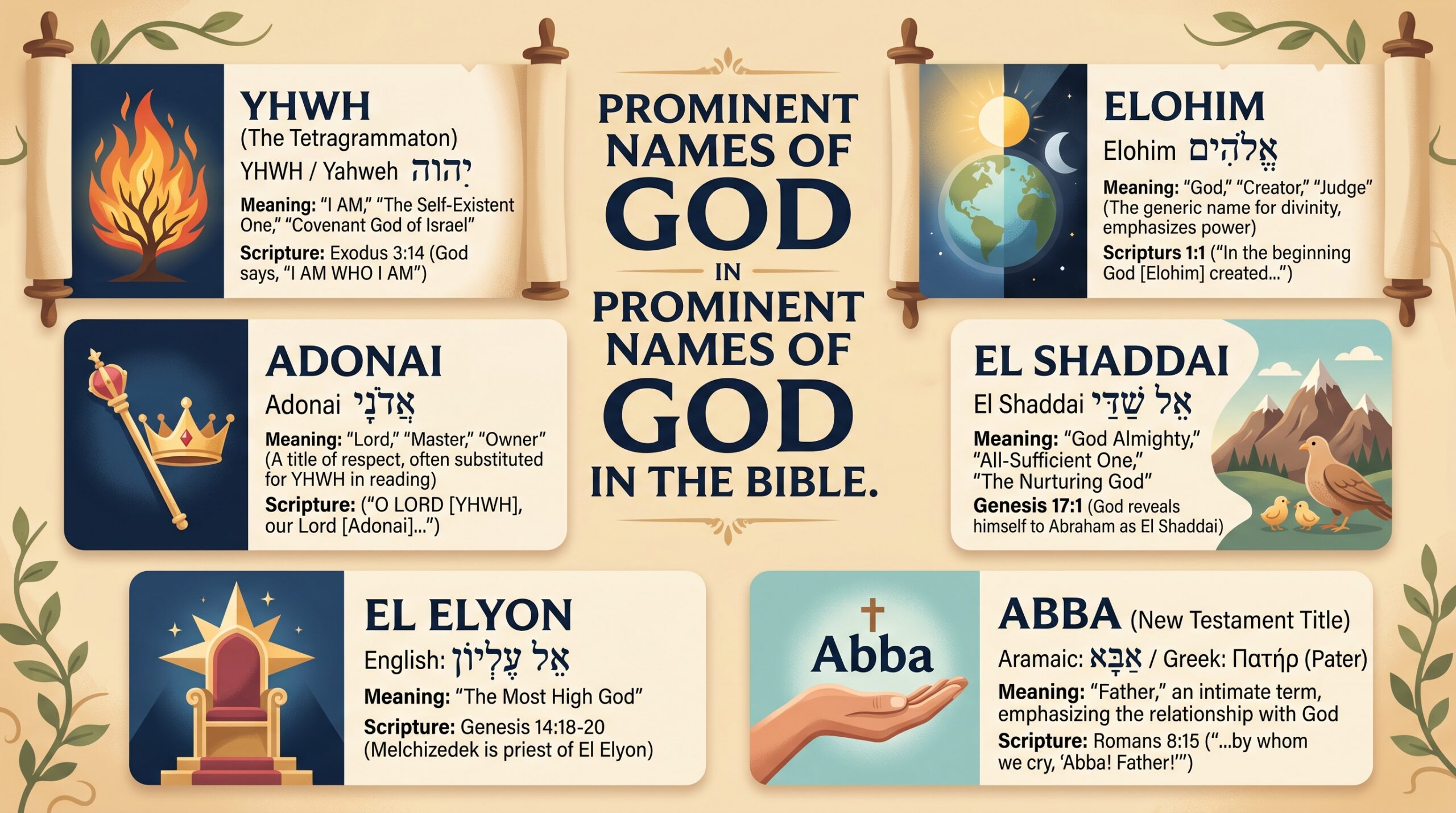
The names of God in the Bible together form one great, unified picture of who God is.
- YHWH shows God as the eternally existing one.
- Elohim shows him as Creator.
- El Shaddai shows him as Almighty.
- El Elyon shows him as Most High.
- El Olam shows him as Everlasting.
- El Roi shows him as the God who sees us.
- YHWH Jireh shows him as the one who provides.
- YHWH Rapha shows him as Healer.
- YHWH Shalom shows him as the source of peace.
- YHWH Rohi shows him as Shepherd.
- YHWH Tsidkenu shows him as our righteousness.
- YHWH Shammah shows him as the ever-present God.
- YHWH Sabaoth shows him as Lord of all hosts.
- The Living God shows that he is no idol or human invention.
- Father shows God’s loving and personal relationship with us.
- Kyrios shows him as Lord and Ruler.
- Pantokratōr shows his almighty power.
- Immanuel proclaims the heart of the Christian message: God is with us.
- Alpha and Omega shows that God is the beginning and the end.
God’s names are therefore not merely different labels. Together they form a kind of theological map through which the Bible teaches us who God is.
Knowing the names of God should not end with memorizing words. The aim of Scripture is that we move from knowing his name to knowing God himself, from knowledge to faith, and from faith to a living relationship with him.
A Prayer for Understanding the Names of God
Almighty and eternal God,
YHWH, Elohim, El Shaddai, El Elyon and El Olam, open our hearts to understand your holy name.
Be our Shepherd when we do not know where to go.
Be our Rock when our lives are shaken.
Be our Peace when our hearts are restless.
Be our Healer when we are broken.
Be our Redeemer when we have gone astray.
Be our Refuge when we are afraid.
Be our Father when we need love and closeness.
Teach us not only to know your name, but to know you yourself.
Help us to honor your name in our words, thoughts and deeds. Give us wisdom to understand Scripture, humility to admit what we do not yet understand, and faith to trust you even when we cannot see the answers.
Lord Jesus Christ, Son of God, Savior and Lord, have mercy on us and lead us to the Father.
For you are the Alpha and the Omega, the beginning and the end, who was, and is, and is to come.
Amen.

Trough all this I want to declare this is all from God and to God. All Glory to Him!