Views: 28
The Hierarchy of Angels: 9 Ranks, Names, and Duties Explained
A synthesis of the Christian, Jewish, and Ethiopian traditions — the nine choirs of angels, the names and duties of the archangels, the seven heavens of the Ascension of Isaiah, and the Ethiopian Bible’s witness concerning the ranks of angels.
Introduction: Why Angels Need a Hierarchy
Christian tradition has never pictured the angelic world as a formless mass. Already the Old Testament speaks of God as the Lord of Hosts (Sabaoth), whose throne room is surrounded by heavenly hosts arranged in graduated order — Isaiah sees Seraphim calling to one another, “Holy, holy, holy” (Isa 6:2–3); Ezekiel sees cherubim, wheels, and radiant beings around God’s throne-chariot (Ezek 1 and 10); and Daniel sees thousands upon thousands ministering before the Ancient of Days (Dan 7:9–10). The New Testament adds its own vocabulary — “thrones,” “dominions,” “powers,” and “rulers” — terms the apostle Paul uses to describe Christ’s supremacy over all things (Col 1:16; Eph 1:21). Out of this scattered but consistent testimony grew one of the most enduring theological constructions in church history: the doctrine of the nine ranks of angels.
This essay attempts three things at once. First, it systematizes the hierarchy most widely received in both the Western Church and Orthodoxy — the nine orders of Pseudo-Dionysius the Areopagite — together with each rank’s function and scriptural basis. Second, it sets alongside this the ranks of the Jewish tradition, which differ from the Christian classification and are reflected, in indirect traces, even in the Estonian Bible translation on piibel.net. Third — and this is the essay’s centerpiece — it deepens the picture through the apocryphal text known as the Ascension of Isaiah, which describes seven heavens and the graduated splendor of their angels, and which survives in its entirety only in the Ge’ez language, within the broader, 88-book biblical canon of the Ethiopian Orthodox Tewahedo Church. These three sources — Christian scholasticism, Jewish mysticism, and Ethiopian apocalyptic literature — are not in conflict; they are three vantage points on a single reality: heaven is not a flat space but a graduated nearness to God.
The Nine Choirs of Angels: The Hierarchy of Pseudo-Dionysius the Areopagite
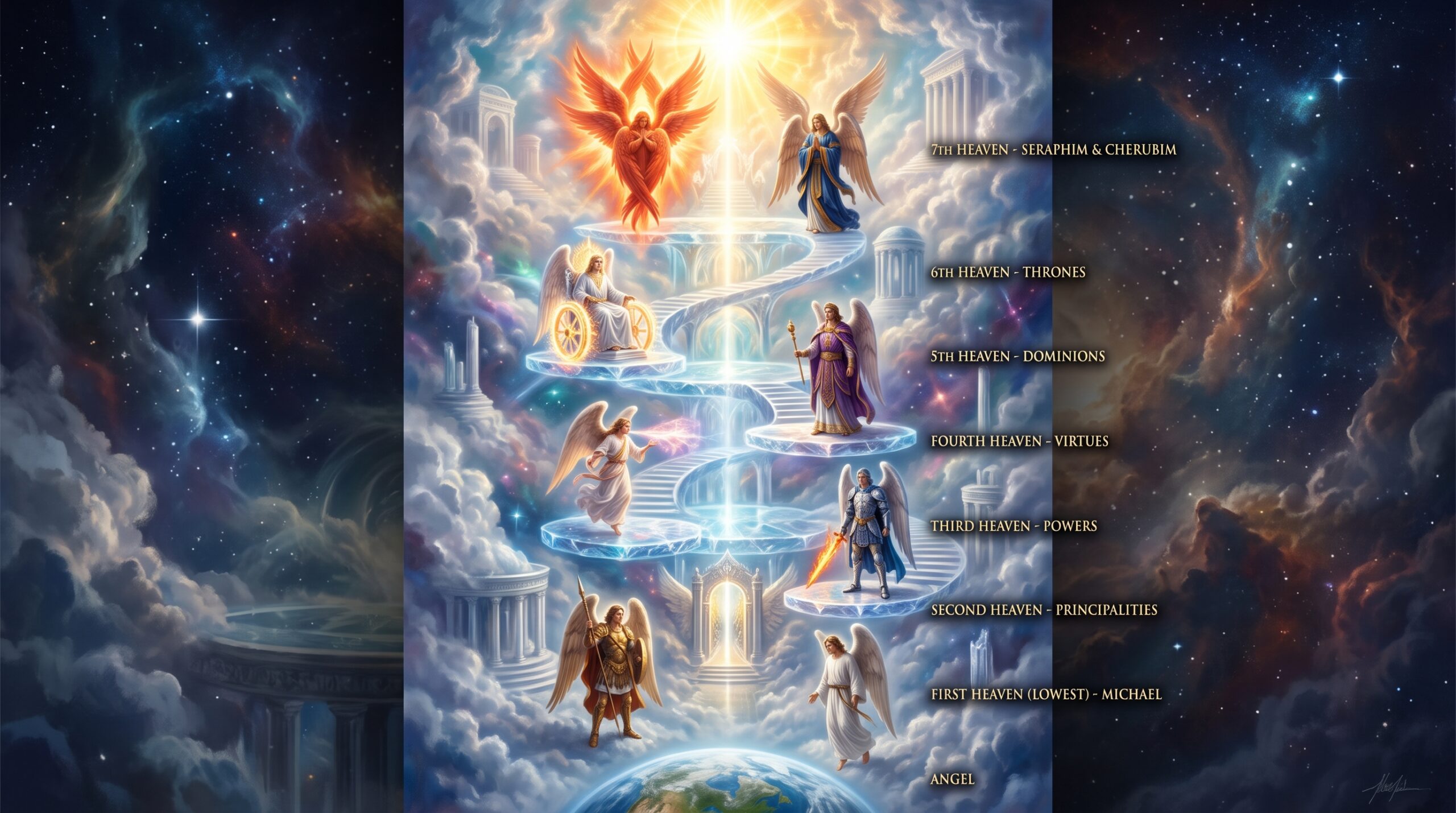
The most influential system, embraced equally in East and West, comes from the fifth- or sixth-century treatise De Coelesti Hierarchia (“On the Celestial Hierarchy”), written by an unknown author under the name of Dionysius the Areopagite — the Athenian judge mentioned in Acts 17:34, for which reason its true author is known as Pseudo-Dionysius. His system divides the angels into three triads of three ranks each — nine in total.
The First Triad — Closest to God
Seraphim. The name derives from the Hebrew word “to burn,” signifying burning love for God. In Isaiah’s vision they have six wings and stand around God’s throne, ceaselessly crying, “Holy, holy, holy” (Isa 6:2–3). Tradition regards them as embodiments of purification and divine love — those nearest to God who “burn” with the fire of His presence.
Cherubim. They already appear in the story of Eden, guarding the way to the tree of life with a flaming sword after the fall of man (Gen 3:24), and in Ezekiel’s vision as bearers of God’s chariot-throne, their bodies covered with eyes and each possessing four faces (Ezek 1 and 10). Tradition associates them with perfect wisdom and knowledge — they “see” God most fully of all created beings.
Thrones. Named explicitly in the Letter to the Colossians (Col 1:16), these are beings said to bear God’s judgment and justice — hosts regarded as the very embodiment of God’s throne, through whom divine righteousness and stability are made manifest.
The Second Triad — The Governing Middle Rank
Dominions (Kyriotetes). Mentioned in Ephesians (Eph 1:21) and Colossians (Col 1:16). Their task is to order the activity of the lower choirs, serving as mediators between the splendor of the higher triad and the action of the lower.
Virtues (Dynameis). Associated with miracles and the divine power that runs through creation — through them God’s might is manifested in concrete interventions in history and nature.
Powers (Exousiai). Their task is to maintain spiritual order and restrain the forces of evil spirits — these are the “authorities” of whom Paul speaks as the powers against which the Christian wages spiritual warfare (Eph 6:12).
The Third Triad — Closest to Humanity
Principalities (Archai). Charged with the care of nations, states, and institutions — guardian spirits who direct the greater movements of history and the destiny of peoples on a broader scale.
Archangels. The rank best known to ordinary believers, since it is here that the named angels belong — Michael, Gabriel, Raphael, and others discussed in more detail below. The term itself (“chief angels”) appears in the New Testament (Jude 1:9; 1 Thess 4:16) and earlier still in the Book of Enoch.
Angels. The lowest rank, yet the one closest to humanity — the everyday messengers and guardians responsible for most of the angel-stories in Scripture: the angel announcing the good news to the shepherds at Bethlehem (Luke 2:9–14), the angel who frees Peter from prison (Acts 12:7–10), the guardian angel of every person (Matt 18:10).
It is important to understand the inner logic of this nine-tiered structure: it is not rank in a military sense but a degree of nearness to God. The “higher” the rank, the more directly and constantly the angel stands before divine glory; the “lower” the rank, the more it is turned toward creation, including humanity. This logic — hierarchy as the distribution of light rather than a ladder of power — is precisely what we encounter in a much older source: the Ascension of Isaiah.
The Ranks of the Jewish Tradition: A Different Reckoning
Before turning to the Ascension of Isaiah, it is worth noting that the Jewish tradition, from which Christian angelology partly derives, never knew a single fixed system of nine ranks. The medieval Jewish philosopher Moses Maimonides classified the angels named in Scripture into ten ranks — Chayot ha-Kodesh (holy living creatures, Ezek 1 and 10), Ophanim (wheels, Ezek 1:15–21; Dan 7:9), Erelim (the valiant ones, Isa 33:7), Hashmalim (the radiant being, Ezek 1:4), Seraphim, Malakim (the ordinary Hebrew word for “angels”), Elohim, Bene Elohim (“sons of God”), Cherubim, and Ishim. This list still exists within the Estonian Bible translation (piibel.net, the 1997 edition), though hidden — since Estonian renders most of these terms simply as “angel” or “living creature,” the Hebrew nuances disappear in translation. Only by studying the original language does the richness of the Old Testament’s own angelic vocabulary come into view.
This difference — nine Christian ranks versus ten Jewish ones — is not a contradiction but two distinct attempts, from two distinct traditions, to systematize the same phenomenon: both try to organize scattered biblical texts (chiefly Ezekiel, Isaiah, and Daniel) into one coherent whole. It is precisely this need for systematization that leads us to one of the most systematic texts in Jewish-Christian apocalyptic literature: the Ascension of Isaiah.
The Ascension of Isaiah: Seven Heavens as the Graduated Splendor of Angels
The Ascension of Isaiah (Latin Ascensio Isaiae, Greek Ἀναβατικὸν Ἠσαΐου) is an apocryphal work probably dating from the late first or early second century, and it survives complete — with all three of its originally separate parts — only in classical Ethiopic (Ge’ez), under the title Ergata Isaiyas. The text’s central section — the Vision of Isaiah (chapters 6–11) — describes the prophet Isaiah’s spiritual journey through seven heavens, undertaken at the court of King Hezekiah.
Unlike the later, terminologically precise nine-tiered system of Pseudo-Dionysius, the Ascension gives no separate name to each heaven, but instead describes the hierarchy through the growth of light, glory, and nearness to God:
- The firmament, between earth and heaven, is the one place in the entire vision where strife and wickedness reign — there Isaiah sees the fallen angel Sammael and his hosts, envious and warring with one another, “as it has been from the beginning of this world.”
- From the first through the fifth heaven, the same structure repeats: in each heaven stands a throne-temple surrounded by worshipping angels standing to the right and left, and with every successive heaven the glory and light increase in degree — much as, in the Dionysian system, each triad stands nearer to God than the one before it.
- In the sixth heaven, the hierarchical distinction between the angels standing right and left disappears — here the might of the seventh heaven rules directly, and Isaiah, for the first time, joins in the direct worship of the Triune God — the Father, the Son, and the Holy Spirit. This heaven is watched over by an “angel of praise,” who determines who may ascend still higher.
- In the seventh heaven — the summit of the hierarchy — dwells the Great Glory (God the Father), with the Beloved (Christ, still unnamed) at His right hand, and the angel of the Holy Spirit, surrounded by the souls of all the righteous — Adam, Abel, Enoch, and others — clothed in “the higher garment” and awaiting the crowns and thrones destined for all who still suffer in faith on earth.
With each heaven Isaiah passes through, he himself is transfigured — his form grows ever more radiant, until in the seventh heaven he becomes wholly like the angels among whom he stands. The same logic governs the description of Christ’s own descent: as He passes through the seven heavens on His way into the world, Christ “is transformed” at each level into the likeness of that heaven’s angels, so that His adversaries do not recognize Him — but after the crucifixion and resurrection, He passes back through the same heavens in the opposite direction, this time in His true glory, so that the hosts of every heaven see Him and openly worship Him.
This image — hierarchy as graduated likeness to God rather than a graduated distribution of power — carries the same theological core as the later Eastern Church doctrine of theosis: humanity (and, in Isaiah’s vision, the angels themselves) participate ever more fully in divine light, without dissolving into the being of the Creator.
The Ethiopian Bible: The 88-Book Witness to the Ranks of Angels
It is no accident that the Ascension of Isaiah survives in its entirety only in Ethiopic. The Ethiopian Orthodox Tewahedo Church has historically preserved the largest biblical canon in all of Christianity — according to its broader canon, up to 88 books in total — including texts that were lost or excluded from the canonical collections of the West, and even from most other Eastern traditions: the Book of Enoch, the Book of Jubilees, the Books of Meqabyan, and the Ascension of Isaiah itself. The Tewahedo Church’s stance toward the latter has historically been nuanced — some earlier sources treated it as directly canonical, while contemporary theological understanding places the text within a broader, authoritative body of scripture that is nonetheless distinct from the strictly canonical tier.
This broader canon has carried forward the Jewish and early Christian treatment of angelic ranks in a way the Western Church never fully knew. In Ethiopian spirituality and church art, angels and their ranks have always occupied a central place — the Book of Enoch’s descriptions of the Watchers (Hebrew Irin) and of the archangels, the seven-heaven structure of the Ascension of Isaiah, and the Old Testament’s own throne-visions (Ezekiel, Isaiah, Daniel) together form one continuous spiritual inheritance, according to which heaven is not a single plane but a graduated and living expression of God’s glory. It is worth emphasizing: the Ethiopian Church did not “add” these books to the Bible — it preserved them, carrying forward the richness of the Jewish-Christian heritage at a time when the Western and later Byzantine canons were gradually narrowing.
The Names and Duties of the Archangels
The canonical Bible names only two angels outright — Michael and Gabriel. A third, Raphael, is known to us from the deuterocanonical Book of Tobit; a fourth, Uriel, from the apocryphal Book of Enoch and 4 Ezra, both texts recognized more broadly within the Ethiopian tradition.
- Michael (“Who is like God?”) — leader of the heavenly host, who in Revelation fights against the dragon (Satan) and his angels, and who in the Book of Daniel defends the people of Israel amid the conflicts of the end times (Dan 10:13, 21; 12:1; Rev 12:7–9). Tradition holds him to be the escort of souls at the hour of death and the protector of churches and nations.
- Gabriel (“God is my strength”) — the messenger archangel, who reveals to Daniel the prophecy of the end times (Dan 8:16; 9:21–27), announces to Zechariah the birth of John the Baptist (Luke 1:11–20), and brings Mary the news of Jesus’s birth (Luke 1:26–38). He is the bearer of divine revelation and hope.
- Raphael (“God has healed”) — in the Book of Tobit, Tobias’s guide and healer, who describes himself as one of seven holy angels who stand before the glory of God (Tob 12:15). Tradition associates him with healing and protection on the journey.
- Uriel (“Fire of God”) — in apocryphal tradition, the archangel of illumination and understanding, who in the Book of Enoch guides the patriarch through the heavens and reveals to him the mysteries of the cosmic order.
- Sammael/Beliar — the fallen angel described in the Ascension of Isaiah as “the prince of this world,” whose activity in the firmament is the only place of evil and strife in the entire vision; later Christian tradition associates him with the features of the Antichrist figure.
Behind these names and duties lies the same foundational truth that runs through this entire essay: every angel — seraph, cherub, throne, or simple messenger — exists in relation: in relation to God’s glory, to divine order, and to human salvation. Hierarchy is not an end in itself for the angels; it is a way of serving.
Conclusion and Practical Meaning
Three sources — the systematic nine ranks of Pseudo-Dionysius, the ten of Jewish tradition, and the seven heavens of the Ascension of Isaiah, whose Ge’ez text, preserved within the 88-book Tewahedo canon, opens to us the depths of early Christian cosmology — speak the same truth in three different tongues: the heavenly realm is not flat, but a graduated nearness ordered by God’s glory. For the Christian who reads this teaching, it is not an abstract cosmological curiosity but an invitation: just as Isaiah was “transfigured,” growing ever more radiant with each heaven he passed through, so too is the spiritual life of faith a journey of growing nearness to God’s glory — not a static state, but a continual movement from grace to grace, from glory to glory (2 Cor 3:18).
The angels — whether seraphim before God’s throne or the simple guardian angel beside every person — remind the Christian that behind the visible world stands an invisible, yet entirely real, ordered spiritual reality, serving a single purpose: the glory of God and the salvation of humanity.
A Prayer for the Intercession and Protection of the Angels
Almighty God, Lord of Hosts, whose throne room is surrounded by the Seraphim with their ceaseless cry of “Holy, holy, holy,” and at whose command the Cherubim, Thrones, Dominions, Virtues, Powers, Principalities, Archangels, and Angels stand, each in its own rank, faithfully fulfilling Your will — I come before You in thanksgiving for this unseen yet living order which You have made, that Your glory might be carried from heaven down to earth.
I thank You for the Archangel Michael, who stands watch against the powers of evil and defends those who cry out to You. I thank You for Gabriel, who brought the world the word of hope, and who reminds even me that Your promises are never left unfulfilled. I thank You for Raphael, who as a guide accompanies those who have lost their way, and who heals what is broken in my own life and in the lives of those I love. I thank You for Uriel, who enlightens the mind and opens the heart to the understanding of Your truth.
Just as the prophet Isaiah, in his vision, was transfigured into ever greater radiance with each heaven he passed through, so I ask You, O Lord: transform my heart too, making it ever more like Your own — not that I might dissolve into Your Being, but that I might participate ever more fully in Your light and love, as do Your saints and the righteous, whose souls in the seventh heaven await their crowns and thrones.
Lord, send Your angels to those who now suffer fear, sickness, loneliness, or darkness — let them be their protectors, healers, and bearers of hope, just as an angel once strengthened Your Son in the garden of Gethsemane in His hardest hour. Be thanked for every unseen hand of help You have extended to us through Your heavenly hosts, and help us to live in such a way that one day, at the end of our earthly pilgrimage, we may join all the righteous and Your holy angels before Your glory, worshipping the Father, the Son, and the Holy Spirit, now and forever and unto ages of ages. Amen.

Martinus Vaicarius’s mission is to:
- Provide spiritual support and guidance to people seeking peace and hope
- Create prayer texts that bring God’s peace to hearts suffering under fear and anxiety
- Promote deep understanding of the power of the
- God of Sabaoth and the protection of the heavenly hosts
- Help people enter the spiritual sphere where God’s peace reigns over all
AICortex Invest OÜ
- Spiritual Warfare: From the Abyss to Glory — A Practical Guide to Overcoming Satan - 27. Jul 2026
- The Hierarchy of Angels: 9 Ranks, Names, and Duties Explained - 25. Jul 2026
- HCHC Launches “The Catechist: The Art of Listening and Teaching” — New Orthodox Certificate Program for 2026–2027 - 24. Jul 2026