Views: 15
The Life of Jesus Christ: What Do We Know About His Birth, Teachings, and Death?
An in-depth analysis of the life of Jesus Christ — the historical evidence, the birth narratives in light of the Gospels, his central teachings, the place of the Gospel of Thomas and the apocrypha, and the Orthodox soteriological view of his death and resurrection.
Introduction: Who Was Jesus of Nazareth?
Few figures in history have been debated as intensely, for two thousand years, as Jesus of Nazareth — his life, his death, and his words. More has been written about him than about any other individual in history, and yet what can be established with historical certainty about him remains surprisingly sparse: almost all the material that has reached us comes from within the circle of his own followers. This essay tries to be honest in both directions — showing what historical scholarship and textual criticism can actually establish, while also opening up what the Christian Church, and the Orthodox tradition in particular, has again and again recognized in the person and death of Jesus as something more than history alone.
The Historical Jesus: What Do Sources Outside the Gospels Say?
Jesus himself left behind no writings. His teaching first circulated orally, and the written Gospels were not completed until decades after his death. This does not mean, however, that his historical existence is in doubt — quite the opposite: on this question, scholarly consensus is remarkably unanimous.
The Jewish historian Flavius Josephus mentions Jesus twice in his work Antiquitates Judaicae (c. AD 93–94). The longer passage, known as the Testimonium Flavianum, contains later Christian additions, but its probably genuine core describes Jesus as a teacher of wisdom whom Pilate condemned to the cross and whose followers remained loyal to him. A second, less disputed passage (Book 20) refers to James, executed in Jerusalem, as “the brother of Jesus, who was called Christ.” The Roman historian Tacitus, in turn, writes in his Annals (c. AD 117) that the man who gave the Christians their name — Christus — was executed under Pontius Pilate during the reign of Tiberius, a passage generally regarded as authentic, since Tacitus, who had no sympathy for Christianity, had no reason to invent it. Suetonius and Pliny the Younger likewise refer, in early second-century Roman sources, to the Christian movement and to Christ as its founder.
Estonian theologian Ain Riistan, among others, has pointed out that the silence of ancient sources about a given figure is not in itself evidence that the figure did not exist — ancient sources are similarly silent about a number of undoubtedly historical figures, such as Rabbi Hillel. The German New Testament scholar Gerd Theissen, together with Annette Merz, concludes in his book Der historische Jesus that scholarly consensus holds there is no serious basis for doubting Jesus’s historicity. Both Josephus and Tacitus, though writing as outsiders to — or critics of — Christianity, confirm the same basic framework: in first-century Judea there was active a teacher named Jesus, whom Pontius Pilate had executed, and whose movement of followers did not disappear but grew.
The Birth of Jesus: Bethlehem, Nazareth, and the Gospels’ Differing Testimony
Two Birth Narratives, Two Emphases
Of the four Gospels, only two — Matthew and Luke — speak of Jesus’s birth at all. Mark shows no interest in it whatsoever; his narrative begins only with Jesus’s baptism. For John’s Gospel, the birth is theologically central already in the prologue (“And the Word became flesh,” John 1:14), yet John too knows nothing of Bethlehem — on the contrary, John 7:41–42 shows Jesus’s opponents using his Galilean origin as an argument against him, since the Messiah was expected to come from Bethlehem.
Matthew’s and Luke’s birth narratives are independent of one another and differ considerably: in Matthew, magi arrive from the East and the family flees to Egypt; in Luke, the central elements are a Roman census, shepherds in the fields, and a song of praise from the heavenly host. Both accounts nonetheless agree on two core claims: that Jesus was born in Bethlehem, and that he was born of the Virgin Mary, without the causal involvement of a human father (Matthew 1:18–25; Luke 1:26–35).
Bethlehem or Nazareth?
New Testament scholarship has examined this question extensively. Most Gospel passages call Jesus “the Nazarene” — even unclean spirits address him this way (Mark 1:24) — and Mark and John both silently assume that his hometown was also his birthplace. Theissen and Merz conclude in their research that throughout the entire Gospel tradition, Jesus’s hometown is Nazareth, and that the Bethlehem birth narrative may be an interpretation arising from the prophecy of Micah (Micah 5:2) that the Messiah would be born in the city of David. On the other hand, there is no small case for the Bethlehem tradition: only Matthew shows a clear interest in grounding Bethlehem scripturally, yet Luke — who does not use this argument — independently confirms the same birthplace. Bethlehem is further supported by Jesus’s Davidic genealogy, and by the fact that the birth cave in Bethlehem was already identified as such by the second-century Christian apologist Justin Martyr — the earliest and most consistent local tradition, with no rival site proposed anywhere in antiquity.
An honest theological answer is well put by an article in the newspaper Eesti Kirik on the historical-critical method: from the standpoint of Christian faith, Jesus remains the Christ even if his exact birthplace can never be established with historical certainty. What matters is not the geographical detail but the core of the confession: the Word became flesh, God became man, and redeemed humankind.
The Date of Birth: Why Do We Celebrate Christmas on December 25?
No Gospel gives Jesus’s date of birth. The earliest firmly attested reference to December 25 dates to AD 336, though traces of calculations linking Christ’s “genesis” to early January already appear in early third-century sources (Hippolytus). The Church Father Augustine later confirms that, according to tradition, Christ was born on December 25. Most modern scholars regard this date as symbolic — tied to the winter solstice and the victory of light over darkness — rather than as historical-astronomical fact.
According to the Piibel.net 1968 Estonian translation, Luke describes the scene with simplicity: the shepherds “came with haste, and found Mary, and Joseph, and the babe lying in a manger” (Luke 2:16). Having received the revelation, the shepherds returned, “glorifying and praising God” (Luke 2:20) for all they had seen and heard. On the eighth day, as Jewish custom required, the child was named Jesus — the name the angel had appointed even before his conception (Luke 2:21).
In sum: most scholars find credible the historical core of Jesus’s birth — that he was born in Palestine toward the end of Herod the Great’s reign, that he came from Nazareth, and that he was connected to the Davidic line. His exact birthplace and birth date, however, remain open questions, requiring us to distinguish historical reconstruction from theological testimony — just as the evangelists themselves did when they wove Old Testament prophecy into the story of Jesus.
The Main Teachings of Jesus
The Kingdom of God as the Central Message
Running through all three Synoptic Gospels (Matthew, Mark, Luke) is the proclamation of the Kingdom of God (Greek basileia tou theou). Jesus did not teach an abstract philosophy; he called people to repentance and to faith in the good news that God’s reign was already at hand, and yet still to come in its fullness. He proclaimed this through parables — the mustard seed, the lost sheep, the prodigal son, the ten virgins — parables that spoke to ordinary people in images and left room for reflection rather than offering a doctrinal summary.
The Sermon on the Mount and the Love Commandment
The Sermon on the Mount, gathered in Matthew 5–7, is the core of Jesus’s ethical teaching: the Beatitudes (the poor in spirit, those who mourn, the meek, those who hunger for righteousness, the merciful, the pure in heart, the peacemakers), the command to love not only one’s neighbor but even one’s enemy, warnings against judging others, and the call to store up treasure not on earth but in heaven. When asked which was the greatest commandment, Jesus answered by summarizing two commands: to love the Lord your God with all your heart, and to love your neighbor as yourself (cf. Matthew 22:37–39; Mark 12:29–31) — thereby condensing the Torah’s 613 commandments into two sentences that have remained a cornerstone of Christian ethics to this day.
Miracles and Authority
The Gospels record numerous healings, exorcisms, and acts of authority over nature (calming a storm, walking on water). Historical-critical scholarship treats these accounts with varying degrees of confidence, but even more skeptical scholars generally acknowledge that Jesus was regarded by his contemporaries as a miracle-worker and exorcist — an aspect of his reputation attested even in hostile Jewish sources, which accused him of “sorcery” rather than denying that he had done anything at all.
The Last Supper Before the Crucifixion
Shortly before his arrest, Jesus shared a Passover meal with his disciples, during which he identified the bread and wine with his own body and blood and gave the instruction: “Do this in remembrance of me.” This event became the foundation of the Christian Eucharist and has, throughout church history, remained one of the oldest and most consistent markers of Christian identity — archaeological finds, such as the Megiddo mosaic (c. AD 230), confirm the central place of eucharistic practice already in earliest Christianity.
Teachings Outside the Canon: The Gospel of Thomas and the Apocrypha
An important caution before citing these texts: the Gospel of Thomas and the other apocryphal gospels are NOT reliable historical or ecclesiastically authoritative sources for the life or words of Jesus. They were excluded from the New Testament canon for good reason — they were written considerably later than the four canonical Gospels and outside the chain of apostolic testimony.
The Gospel of Thomas itself is a collection of 114 sayings attributed to Jesus, with no narrative framework — it does not recount Jesus’s life, crucifixion, or resurrection at all. The text was discovered in 1945 near Nag Hammadi, Egypt, in a Coptic manuscript, and probably dates to the mid-second century — a century after the canonical Gospels. It was translated into Estonian from Coptic by Uku Masing as early as 1971, though the translation was not published until 2005, by the Johannes Esto Society, with an introduction by Jaan Lahe. Roughly half of Thomas’s sayings parallel material found in the Synoptic Gospels; the other half differ substantially and carry a mystical-sapiential tone, partly close to Gnostic thought — for example, the view that the Kingdom of God is not so much a future event as a reality already present within. Estonian theologian Jaan Lahe has studied extensively whether, and to what extent, the text is Gnostic, and finds no clear, unambiguous answer — scholars remain divided on the question.
The other apocrypha stray even further from credible history. The Protoevangelium of James narrates invented details about Mary’s own birth and childhood, promoting the idea of her perpetual virginity in ways that go beyond the canonical material. The Infancy Gospel of Thomas portrays a five-to-twelve-year-old Jesus performing implausible and morally troubling miracles — including legends in which the child Jesus blinds or even kills companions who have angered him — utterly at odds with the Jesus of the canonical Gospels. The Gospel of Peter, for its part, exonerates Pilate and offers a fantastical description of the resurrection.
Why study these texts at all, then? Because they reveal the genuine diversity of early Christianity and help us understand what the Church was reacting against when it defined the canon. But the content of the apocryphal texts must never be treated as equal in authority to the canonical Gospels — doing so would be poor source criticism, against which serious scholarship consistently warns.
Redemption and Death: A Soteriological Chapter in Orthodox Perspective
The Cross as Victory, Not Only Sacrifice
Western theology — especially after Anselm of Canterbury and the Reformation — has often understood Christ’s death primarily in juridical terms: as satisfaction, or as the bearing of a substitutionary penalty before God’s justice. The Orthodox tradition does not deny that Christ’s death has a sacrificial dimension, but its emphasis is different, and older: a patristic understanding often interwoven with the motifs of Christus Victor and recapitulatio (restoration), rooted in the second-century theology of Irenaeus of Lyon and, later, Athanasius.
Irenaeus taught that Christ “recapitulated” — that is, repeated and set right, in his own humanity — the entire history of the human race from Adam onward: where the first Adam was disobedient unto death in injustice, the second Adam (Christ) was obedient unto death in righteousness, thereby restoring what had been lost. This is not merely the cancellation of a debt, but the healing and restoration of human nature itself, from within.
Theosis: Salvation as Deification
The central concept of Orthodox soteriology is theosis (θέωσις) — deification. This does not mean that a human being becomes God in essence, but that one comes to share in God’s grace and life, growing into likeness with God through grace and human cooperation (synergy). Athanasius the Great’s famous formula — often cited as a summary of the whole patristic theology of the incarnation — expresses this paradox: God became man so that man might become divine, not in essence, but through communion in grace. In the Orthodox view, salvation is therefore not merely acquittal from guilt as a juridical act, but the healing, renewal, and communion of the human person with God in Christ through the Holy Spirit.
The Incarnation as the Precondition for Redemption
The Council of Chalcedon (451) defined Christ as one person in two natures — truly God and truly man, without confusion and without division. Orthodox theology emphasizes that it is precisely this union of two natures that makes redemption possible at all: only what was assumed in Christ — human nature in its entirety, mind, will, and body — could also be healed and saved. Jesus experienced hunger, weariness, sorrow, and death, while remaining without sin; his divine nature remained unchanged, while his human nature underwent real suffering and real death.
The Resurrection as Victory Over Death Itself
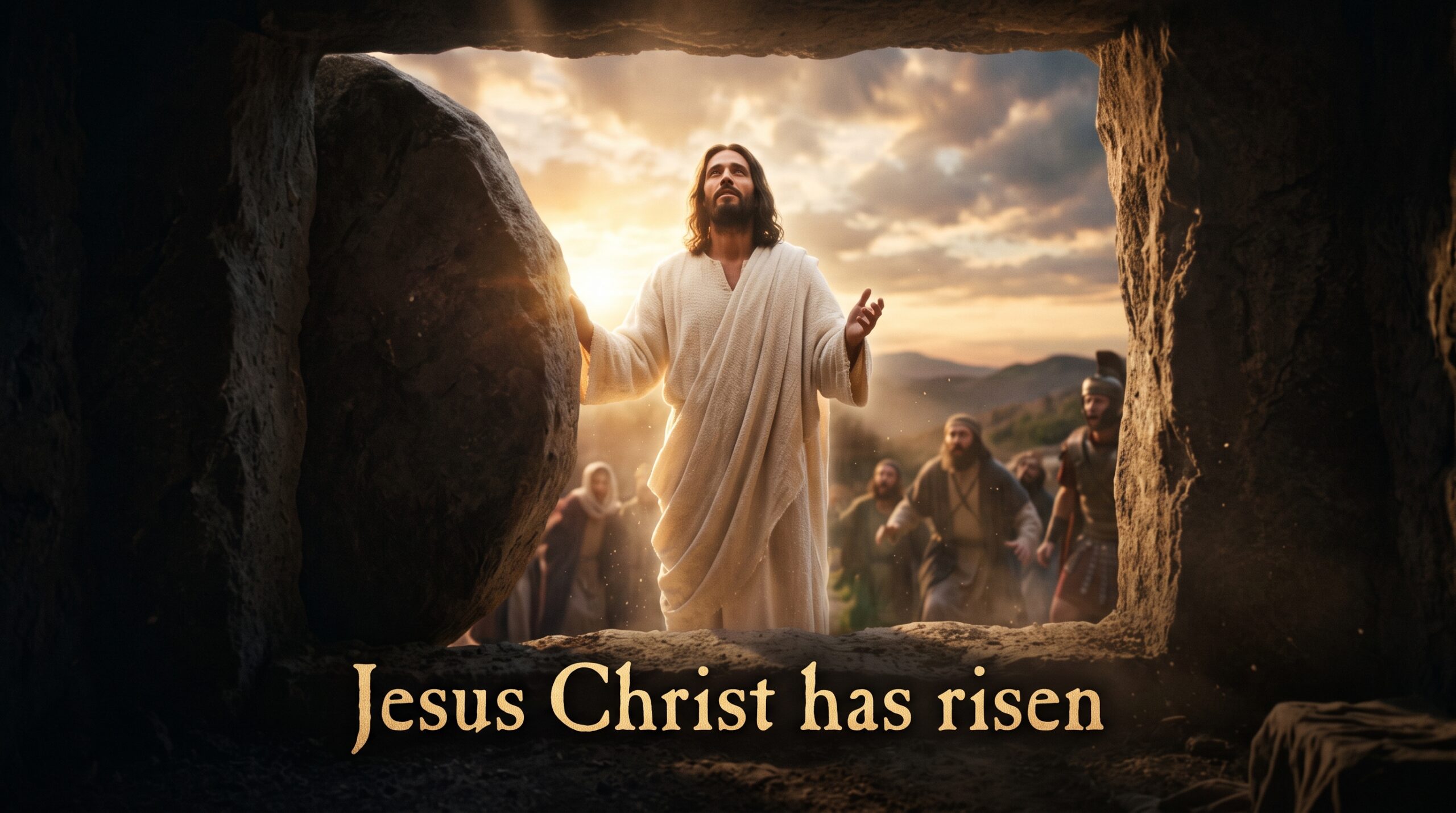
Where Western emphasis often comes to rest on the cross — on Christ’s sacrifice for sin and evil — Orthodox liturgical and theological attention moves quickly toward the resurrection: Christ rose again to mark a victory over death itself, not merely to settle the debt of sin. This is not a contradiction between the two traditions but a difference of emphasis: both affirm the inseparability of cross and resurrection, but Orthodoxy sees salvation primarily as an ontological — that is, essential — change within human nature itself, which is freed from the grip of death, rather than solely as juridical justification. Theosis begins at baptism, continues through the Eucharist, and grows throughout the whole of life — through prayer, fasting, almsgiving, and liturgical communion.
According to the Piibel.net 1968 translation, Jesus cried out on the cross with a loud voice: “Father, into thy hands I commend my spirit” — and “gave up the ghost” (Luke 23:46). The Roman centurion, seeing what had happened, testified: “Certainly this was a righteous man” (Luke 23:47). This brief scene carries the whole weight of the soteriological tension within it: a real, human death that is at the same moment also a moment of confession — even on the lips of a Roman.
Practical Application for the Christian Today
Studying the life of Jesus is not merely an academic exercise. The meeting point of historical and theological truth calls for movement in three directions:
- Honesty with the sources. A Christian need not fear historical inquiry or the existence of apocryphal texts — an honest assessment of them strengthens, rather than weakens, confidence in the canonical Gospels, whose early dating and closeness to eyewitnesses are, on textual-critical grounds, clearly stronger than those of the later apocrypha.
- Living the teaching, not merely knowing it. The ethics of the Sermon on the Mount — love for one’s enemy, humility, mercy — remains a calling that cannot be exhausted by intellectual knowledge alone, but demands practice in daily life.
- The path of theosis. The Orthodox view of salvation as growth into the likeness of God means that the spiritual life does not end with confession of faith but begins there — through prayer, fasting, and sacramental communion, one moves ever more deeply into communion with Christ, who recapitulated the history of humankind and opened the way to life.
Two Prayers
A prayer on the birth of Christ:
Lord Jesus Christ, who humbled yourself and became man of the Virgin Mary, help me to recognize the wonder of your coming even in my ordinary days. Grant me the humility of the shepherds, who hurried to seek you, and the perseverance of the wise men, who did not tire of searching for you. Let your truth be born anew in my heart, every day. Amen.
A prayer on the crucified and risen Christ:
Christ, who on your cross and in your resurrection restored what was lost, and opened for us the way into communion with God, draw me nearer to your truth. Cleanse me of fear and unbelief, strengthen me in bearing suffering, and lead me on the path of theosis toward likeness with you, in the unity of the Father and the Holy Spirit. Amen.

Trough all this I want to declare this is all from God and to God. All Glory to Him!
- God-Man – The Bible Reveals: The Secret of Human Creation No One Talks About - 23. Aug 2026
- September 1: The Beginning of the Ecclesiastical New Year, or the Indiction — The First Day of the Orthodox Liturgical Year - 21. Aug 2026
- Mother of God, September 8, 2026: The Nativity of the Theotokos — Celebrating the Birth of the Virgin Mary - 20. Aug 2026