Views: 43
Who Wrote the Book of Revelation in the Bible? The Truth About John the Apostle
Meta description: Who really wrote the Book of Revelation? A historical look at the Apostle John, his scribe Prochorus, Revelation’s symbolism, and the antichrist theme — including Vladimir Solovyov’s 1900 short story of the antichrist.
Introduction
The Book of Revelation, or the Apocalypse, is the final and most mysterious book of the New Testament — filled with blazing skies, seven seals, horned beasts, and a voice described as “like the sound of many waters.” The question of who wrote it is more than academic curiosity. It shapes how we read the book itself: as the vision of a towering theologian, Christ’s beloved disciple, and the last living witness of the apostolic generation — or as a later work written under a borrowed name. This article examines both the well-known and the lesser-known testimonies about John’s authorship, his traditional scribe on Patmos, the logic behind Revelation’s symbolism, the antichrist theme, and its striking echo in Russian literature exactly nineteen centuries later.
Who Was John? The Well-Known Case for Authorship
The earliest and strongest testimony credits the Book of Revelation to the Apostle John, son of Zebedee, Jesus’s “beloved disciple” and later elder of the church at Ephesus. Irenaeus of Lyon (c. 130–202), who was personally acquainted with Polycarp — himself a disciple of John — states directly in Against Heresies that the Apostle John received the Revelation near the end of Domitian’s reign. This is the closest living chain of testimony back to John’s own era.
Justin Martyr (c. 100–165), who lived and taught in Ephesus itself, held the same view, as did Tertullian, Clement of Alexandria, and Origen. Until the mid-third century, the early church held an almost unanimous conviction: the same John who wrote the fourth Gospel and three epistles also wrote Revelation.
The Lesser-Known Dispute: Was There a “Second John”?
The authorship controversy did not begin until the mid-third century, and its root was theological rather than historical. Dionysius, bishop of Alexandria (d. c. 264), rejected John’s authorship because he opposed the thousand-year kingdom described in Revelation 20 (millenarianism), and he noted that Revelation’s Greek style differed from that of John’s Gospel. In the fourth century, the historian Eusebius of Caesarea picked up Dionysius’s doubt and linked it to a single ambiguous line from Papias (c. 60–130) mentioning “John the Elder” — concluding from this that a second, non-apostolic John must have existed, to whom Revelation could be attributed.
The problem is that neither Papias nor any other early source ever states that this “second John” wrote Revelation — that conclusion belongs to Eusebius, arrived at three centuries later and for a clear theological motive. The church fathers of Asia Minor, who stood closest to John’s own tradition, never mention a second John at Ephesus and are unanimous on Johannine authorship. “John the Elder” therefore remains a historical construction rather than solid evidence — a lesser-known but important nuance that popular treatments often omit.
John’s Scribe on Patmos: Prochorus
A less familiar but well-preserved Eastern tradition names John’s scribe and assistant: Prochorus. Prochorus first appears in Acts 6, as one of the seven original deacons appointed by the apostles in Jerusalem. Tradition holds that he later accompanied John into exile on Patmos and wrote down the visions as John dictated them — the traditional Cave of the Apocalypse still displays the shelf said to have been Prochorus’s writing desk.
This tradition is not canonical Scripture but derives from the later, fifth-century apocryphal work The Acts of John by Prochorus, and should be read accordingly — historically unconfirmed, yet theologically suggestive. It vividly illustrates something John’s own Gospel hints at (John 21:24): that more than one hand may stand behind the final text, even while the vision and the message remain John’s own.
Bible Passages and Historical Evidence About John (Piibel.net, 1968 Translation)
The Book of Revelation offers several direct clues to its own authorship. Its opening verses state that God gave the revelation to His servant John through Jesus Christ (Revelation 1:1-2, Piibel.net 1968). The author identifies himself directly as “your brother and companion in tribulation,” saying he was on the island of Patmos because of the word of God and the testimony of Jesus (Revelation 1:9, Piibel.net 1968). Near the book’s close, the writer again affirms that he, John, was the one who saw and heard these things (Revelation 22:8, Piibel.net 1968).
These self-references are reinforced by the closing note of John’s Gospel, which states that this is the disciple who testifies of these things and has written them, and that his testimony is true (John 21:24, Piibel.net 1968) — echoing the same personal-witness motif that runs throughout Revelation. Together, these passages form an internal, text-based chain of evidence, reinforced by the external patristic witness of Irenaeus, Justin Martyr, and Tertullian.
Revelation’s Symbolism: A Brief Overview
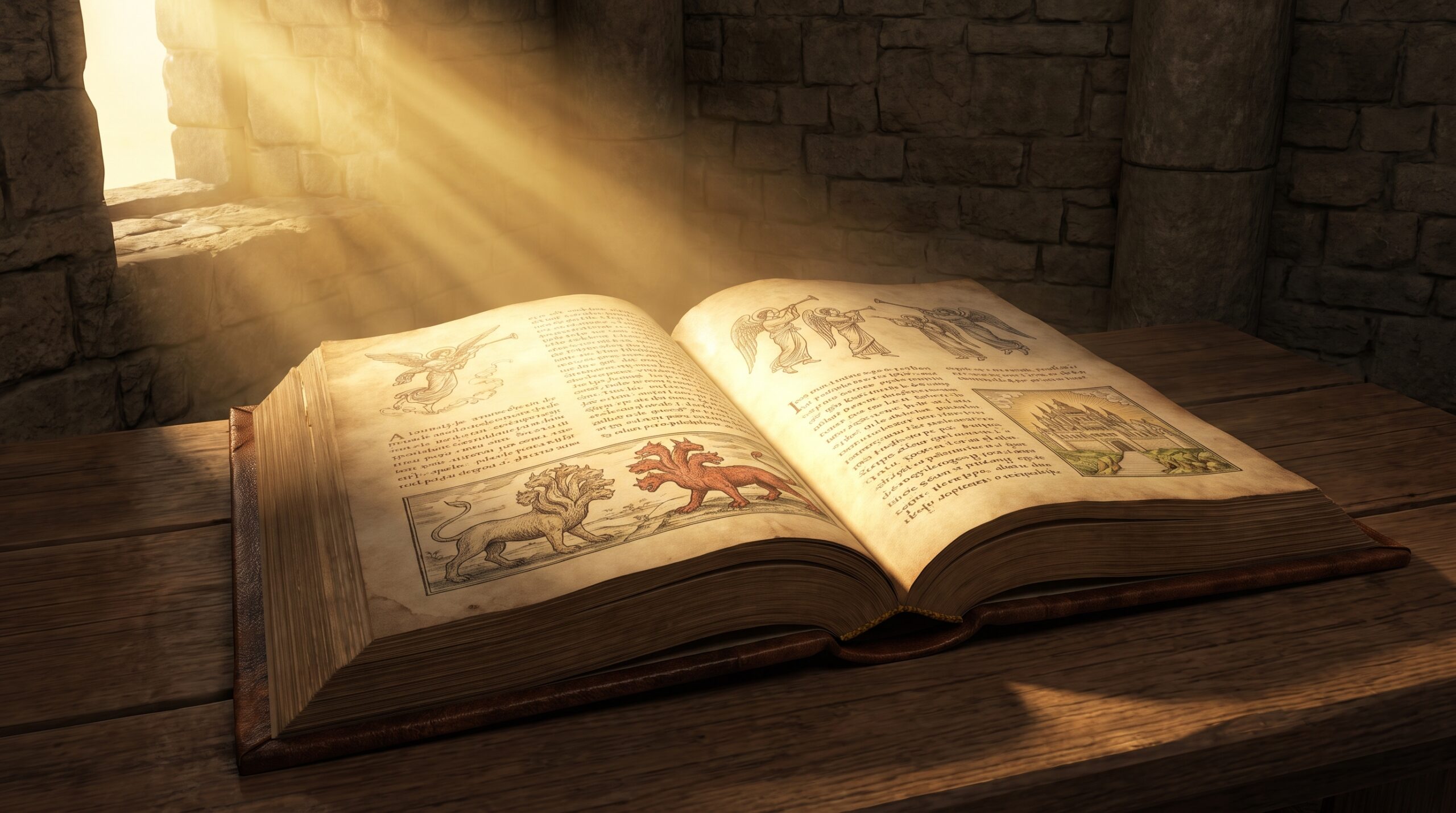
Revelation speaks almost entirely in the language of images and numbers: seven churches, seven seals, seven trumpets, seven bowls — seven signifying completeness and the fullness of God’s work. The number twelve (twelve apostles, twelve tribes of Israel, the twelve gates of the New Jerusalem) signifies the fullness of God’s people. The number 666, attached to the beast, is the most disputed symbol of all, linked throughout history — via gematria, the numeric value of names — to various Roman emperors and later rulers, without the church ever settling on one final interpretation.
White clothing signifies victorious holiness; the red dragon, destructive power and rebellion against God; the Whore of Babylon, corrupt worldly power structures; and the New Jerusalem, restored creation and the fullness of God’s presence among humanity. The four living creatures around the heavenly throne (lion, ox, a being with a human face, eagle) carry ancient symbolism already found in the prophet Ezekiel, representing the whole of creation’s worship.
Why This Style of Writing?
Revelation belongs to the genre of apocalyptic literature, well known in both Jewish and early Christian circles (compare the Book of Daniel in the Old Testament). This choice of style was not accidental, nor merely a taste for mystery: symbolic language allowed Christians living under Roman emperor-worship and persecution to speak forbidden truths in a way fellow believers could understand while imperial censors could not. At the same time, apocalyptic imagery conveys something plain prose cannot — it opens a vantage point where history is seen as the reflection of a heavenly drama, not merely a sequence of political events.
The Antichrist — and Why John Wrote About It
Interestingly, the word “antichrist” never appears in the Book of Revelation itself — it occurs in the New Testament only in John’s epistles. John writes that his readers have heard the antichrist is coming, and that even now many antichrists have already appeared — a sign, he says, that it is the last hour (1 John 2:18, Piibel.net 1968). He specifies that the antichrist is anyone who denies that Jesus is the Christ (1 John 2:22, Piibel.net 1968), and that every spirit that does not confess Jesus is the spirit of antichrist (1 John 4:3, Piibel.net 1968). In his second letter, he warns against deceivers who do not confess Jesus Christ as having come in the flesh, calling them antichrists as well (2 John 1:7, Piibel.net 1968).
John did not write about the antichrist to provoke abstract fear, but out of pastoral concern: teachings were spreading in his own congregations that denied Christ’s true incarnation — early docetism and gnosticism — and these teachings were fracturing the community from within. For John, the antichrist is above all a theological warning signal, a tool for discerning true testimony about Christ from false testimony, rather than a prediction about a single future figure.
A Short 1900 Writing on the Antichrist — and Its Connection to Biblical Truth
In 1900, shortly before his death, Russian philosopher and theologian Vladimir Solovyov published Three Conversations, whose closing section — the short story known as A Short Story of the Antichrist — imagines a future ruler: brilliant, humanitarian, and peace-loving, who presents himself as almost Christlike, yet inwardly refuses to confess Christ as the Son of God. Solovyov’s antichrist is no crude tyrant; he is persuasive and outwardly benevolent — precisely the kind of deception John warned against in his epistles.
This is where the short work’s theological connection to biblical truth lies: Solovyov gives artistic form to what John stated as doctrine — the antichristian spirit is not recognized by its brutality but by its apparent goodness, which withholds the one essential thing: the confession that Jesus has come in the flesh as the Christ. Solovyov’s story carries no scriptural authority, but it illustrates how the warning of 1 John still applied at the turn of the twentieth century in Europe — and, arguably, in every age since.
The Book of Revelation as a Whole
Revelation consists of seven letters to the churches of Asia Minor, a vision of the heavenly throne room, seven seals, trumpets, and bowls depicting judgment upon the world, and closes with the fall of Babylon, Christ’s victory, and the description of a new heaven and a new earth. The book’s message is not primarily a detailed map of the future, but an assurance: history unfolds under God’s control, suffering is not without meaning, and Christ’s victory is already certain, even where it is not yet fully visible. This message of hope explains why the book still speaks to suffering churches in every age — not only in first-century Asia Minor, but in every later season of persecution and crisis.
Synthesis
Three lines of evidence — the book’s own internal testimony (Revelation 1:1-2, 1:9, 22:8), the external patristic witness (Irenaeus, Justin Martyr, Tertullian), and the Eastern Prochorus tradition — converge on a single core claim: behind the Book of Revelation stands a living, personal witness whom the church has recognized from the beginning as the Apostle John. The later doubt raised by Dionysius and Eusebius arose from theological motives rather than new historical evidence, and it produced no early testimony to the contrary. Weighing this material a third time, it is worth stating plainly: nothing in this account justifies fear-mongering or speculative end-times calculation. In light of John’s own letters, the antichrist theme is above all a call to clarity and to the confession of Christ — not to anxiety. This reading is consistent with Christian ethics: a book that closes with the hope of a new heaven and a new earth calls its readers to vigilance in love, not in fear.
A Short Prayer for Understanding the Book of Revelation
Lord, open my heart and mind to understand Your revealed word. Give me wisdom to discern truth from error and light from darkness, that I may recognize You in Christ, whatever form that truth takes. Strengthen in me the hope that Your victory is already certain, and keep me watchful and loving until the day when all things are made new. Amen.

Trough all this I want to declare this is all from God and to God. All Glory to Him!