Views: 40
An in-depth analytical guide to what actually separates Orthodox Christianity from Western Christianity — and what does not. Doctrine, history, practice, Scripture, ecumenical dialogue, and the lesser-known controversies most comparisons leave out.
Introduction: The Question Needs Rephrasing
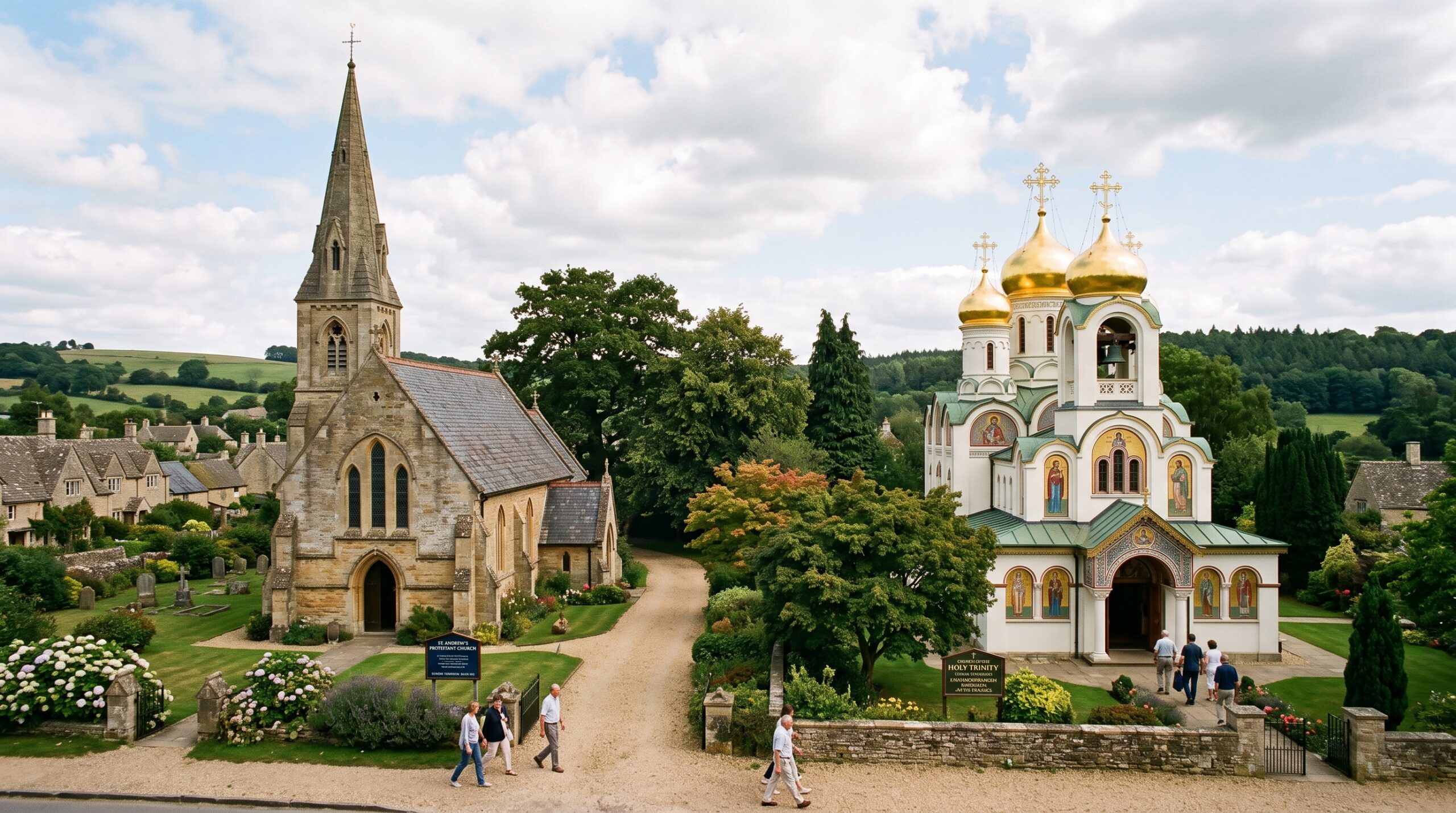
The search phrase “Christianity vs. Orthodox Christianity” contains a hidden category error. Orthodoxy is not an alternative to Christianity, nor a branch off to one side of it. It is one of Christianity’s three great historical streams, alongside Roman Catholicism and the Protestant churches. An Orthodox Christian does not stand beside Christianity but within it — while claiming, at the same time, that his communion has preserved the apostolic faith unchanged. Rome and the heirs of the Reformation each make a version of the same claim.
There is therefore only one theologically sound way to pose the question: how does Eastern Christianity (Orthodoxy) differ from Western Christianity (Catholicism and Protestantism), and what holds them together? That is the question this article answers.
The numbers: there are an estimated 2.4–2.6 billion Christians worldwide. Roughly 1.4 billion are Catholic, somewhere between 800 million and one billion are Protestant or Evangelical, and about 220 million are Eastern Orthodox. A further 60 million or so belong to the Oriental Orthodox churches — Coptic, Armenian, Ethiopian, Syriac, Malankara — and a smaller number to the Assyrian Church of the East. In Estonia, Orthodoxy is the second-largest Christian tradition after the Evangelical Lutheran Church.
I. Common Ground: What All Christians Share
Theological honesty requires establishing the common ground before the differences, because it is far larger than polemical literature suggests.
1. The Triune God and the Nicene Creed
All three traditions confess one God in three hypostases — Father, Son, and Holy Spirit — and use the Nicene-Constantinopolitan Creed (325/381) liturgically or confessionally. Christ’s divinity, his true incarnation, his death on the cross, his bodily resurrection, ascension, and second coming form the shared core of all Christianity.
“And the Word became flesh and dwelt among us, and we have seen his glory, glory as of the only Son from the Father, full of grace and truth.” (John 1:14)
2. Scripture as the Word of God
“All Scripture is breathed out by God and profitable for teaching, for reproof, for correction, and for training in righteousness, that the man of God may be complete, equipped for every good work.” (2 Timothy 3:16–17)
The disagreements concern the extent of the canon and the authority that interprets it — never its divine origin.
3. Baptism, Creed, and the Law of Love
Baptism in the name of the Trinity is, with few exceptions, mutually recognised. The Great Commandment (Matthew 22:37–40), the Lord’s Prayer (Matthew 6:9–13), and the Great Commission (Matthew 28:19–20) belong to everyone.
4. Unity as a Theological Obligation
“that they may all be one, just as you, Father, are in me, and I in you, that they also may be in us, so that the world may believe that you have sent me.” (John 17:21)
“There is one body and one Spirit — just as you were called to the one hope that belongs to your call — one Lord, one faith, one baptism, one God and Father of all, who is over all and through all and in all.” (Ephesians 4:4–6)
No tradition can defend division as a permanent condition. This is the scriptural ground of all ecumenical work.
II. History: How One Church Divided
The Apostolic Period and the Pentarchy
The Church of the first centuries was a communion of local churches, and five great sees emerged as its centres: Rome, Constantinople, Alexandria, Antioch, and Jerusalem — the pentarchy. Rome held a primacy of honour (primus inter pares). What that primacy actually contained — an order of precedence, or universal jurisdiction — later became the principal cause of schism.
The Seven Ecumenical Councils (325–787)
Orthodoxy recognises seven ecumenical councils: Nicaea I (325), Constantinople I (381), Ephesus (431), Chalcedon (451), Constantinople II (553), Constantinople III (680–681), and Nicaea II (787). The Catholic Church counts twenty-one, adding later Western councils through Vatican II (1962–1965). Protestant churches generally accept the first four, or all seven, as confessionally binding but not infallible.
Here lies the first structural difference: for Orthodoxy, doctrinal development is essentially complete by the eighth century. In the West, doctrinal definition continues through the centuries that follow.
The Divisions in Sequence
- 431 and 451 — After Ephesus and Chalcedon, the Assyrian Church of the East and the Oriental Orthodox churches separate. Modern scholarship shows that much of the quarrel was terminological: the Oriental churches’ miaphysite teaching (“one incarnate nature of the Word”) is not the monophysitism of Eutyches, which both sides condemned. The Chambésy joint statements (1989, 1990) established a shared Christological faith.
- 867 and 1054 — The Photian controversy, then the mutual excommunications between the Roman legates and Patriarch Michael Cerularius. Historians stress that 1054 was not experienced by contemporaries as “the date of the schism” but as one episode in a long estrangement.
- 1204 — The Fourth Crusade and the sack of Constantinople. Psychologically a far deeper rupture than 1054.
- 1274 (Lyon) and 1438–39 (Ferrara-Florence) — Reunion councils that were signed but never received by the Eastern faithful. Mark Eugenikos, Metropolitan of Ephesus, refused to sign.
- 1453 — The fall of Constantinople; the centre of gravity of Eastern Christianity shifts to the Slavic world.
- 1517 — The Reformation produces a third Western stream. An instructive episode follows between 1573 and 1581, when Lutheran theologians at Tübingen correspond with Patriarch Jeremias II, who welcomes the tone but rejects sola fide and sola Scriptura.
- 1596 (Brest) — The Eastern Catholic (Uniate) churches emerge, a wound that remains sensitive for centuries; the Balamand statement of 1993 rejects uniatism as a method of unity.
- 20th–21st centuries — In 1965 Paul VI and Athenagoras I lift the anathemas of 1054; in 2016 the Holy and Great Council meets in Crete, with four churches absent; in 2018–19 the Ukrainian autocephaly question ruptures communion between Moscow and Constantinople.
The Estonian Case
Orthodoxy has been present in Estonia since at least the eleventh century. The Estonian Apostolic Orthodox Church was recognised as autonomous within the Ecumenical Patriarchate on 7 July 1923 by patriarchal and synodal tomos, and the earliest written evidence of Orthodoxy reaching Estonian lands dates to the eleventh century. After the Soviet occupation the community split into two jurisdictions. The church linked to the Moscow Patriarchate, now named the Estonian Christian Orthodox Church, serves 32 parishes and is estimated to have some 150,000 members, drawn largely from the Russian-speaking population. In the summer of 2026, amendments to the Churches and Congregations Act came into force prohibiting religious associations from being subordinate to a foreign spiritual leader who poses a threat to Estonian security, and the Ministry of the Interior gave the church six months to bring its activity into compliance.
The lesson is sobering: ecclesiastical divisions are never purely theological. They are always also political and cultural.
III. The Principal Doctrinal Differences
1. The Filioque
The original text of the Constantinopolitan Creed says that the Holy Spirit “proceeds from the Father.” The West later added Filioque — “and the Son” (the Councils of Toledo from 589 onward; the Roman liturgy from 1014).
“But when the Helper comes, whom I will send to you from the Father, the Spirit of truth, who proceeds from the Father, he will bear witness about me.” (John 15:26)
The Orthodox objection is twofold: canonical (the text of an ecumenical council may not be altered unilaterally) and theological (the monarchy of the Father within the Trinity). The Western reply distinguishes eternal procession from temporal mission and argues that the Filioque safeguards the unity of Son and Spirit. A Vatican clarification in 1995 conceded that the Greek ekporeuesthai and the Latin procedere are not synonyms, and the Filioque is not inserted in Greek-language Catholic liturgy. Some Orthodox theologians — Bulgakov, Zizioulas — consider the matter soluble; others, notably Lossky, regard it as a watershed.
2. Papal Primacy and Infallibility
Everything turns on the reading of Matthew 16:18 — “you are Peter, and on this rock I will build my church.”
- Catholic reading: the office given to Peter passes to the Bishop of Rome; Vatican I (1870) defined infallibility for ex cathedra teaching and universal jurisdiction.
- Orthodox reading: the rock is Peter’s confession, and every bishop is Peter’s successor in his own local church. Infallibility belongs to the Church as a whole, expressed through councils and their reception by the faithful (sobornost).
- Protestant reading: varies widely, but rejects any divine right attaching to the papal office.
This remains the single hardest question.
3. Original Sin: Guilt or Sickness
Here lies one of the most illuminating and least-known points in the whole comparison — a problem of translation.
“Therefore, just as sin came into the world through one man, and death through sin, and so death spread to all men because all sinned—” (Romans 5:12)
The Greek eph’ hō pantes hēmarton most plausibly means “because all sinned.” The Latin Vulgate rendered it in quo omnes peccaverunt — “in whom all sinned” — which Augustine read as inherited guilt in Adam.
The consequences:
- The West (following Augustine, and intensified in the Reformation): human beings inherit both the guilt of sin and a thoroughly corrupted nature.
- The East: human beings inherit the consequences of sin — mortality, subjection to the passions, a wounded nature — but not personal guilt. Sin is understood as a sickness the Church exists to heal rather than a case at law for which one is punished.
Nearly every remaining soteriological difference grows from this one root.
4. The Logic of Salvation: Juridical Satisfaction vs. Theosis
Western theology after Anselm (Cur Deus Homo, eleventh century) is dominated by the model of satisfaction and substitution: sin offends God’s infinite honour, and only a God-man can repay it. In the East the central category is theosis — deification, participation in God.
“by which he has granted to us his precious and very great promises, so that through them you may become partakers of the divine nature” (2 Peter 1:4)
“You therefore must be perfect, as your heavenly Father is perfect.” (Matthew 5:48)
Athanasius put it axiomatically: God became man so that man might become god — by grace, not by nature. Irenaeus, Gregory of Nyssa, Maximus the Confessor, and Gregory Palamas develop the same line. The theme is not absent in the West — Augustine’s deificari, Aquinas’s participatio divinae naturae, Wesley’s doctrine of perfection — but it has not been the organising centre.
5. The Divine Essence and the Uncreated Energies
In the fourteenth century Gregory Palamas defended the hesychast monks against Barlaam of Calabria and articulated the distinction between God’s essence (ousia, inaccessible) and the uncreated energies (energeiai, in which God is genuinely communicated). The Constantinopolitan councils of 1341, 1347, and 1351 endorsed it. On this view the light of Tabor (Matthew 17:2) is genuine uncreated divine light, neither a symbol nor a created effect.
Western scholasticism works instead with divine simplicity and created grace. This is among the deepest differences, and among the least discussed in popular comparisons — yet it governs how prayer, mystical experience, and the lives of the saints are understood.
6. Scripture and Tradition
“So then, brothers, stand firm and hold to the traditions that you were taught by us, either by our spoken word or by our letter.” (2 Thessalonians 2:15)
“the church of the living God, a pillar and buttress of the truth.” (1 Timothy 3:15)
- Orthodoxy: Scripture is the heart of Holy Tradition, which also comprises councils, the Fathers, the liturgy, the icons, and the canons. The Bible is not external to the Church; it was born within her.
- Catholicism: Scripture and Tradition, authentically interpreted by the magisterium.
- Protestantism: sola Scriptura — Scripture is the supreme and norming authority; tradition is a witness, not a source.
7. The Canon
- Protestant Old Testament: 39 books (the Hebrew canon); 66 in total.
- Catholic: 46 + 27 = 73, including the deuterocanonical books (Tobit, Judith, Wisdom, Sirach, Baruch, 1–2 Maccabees).
- Orthodox: follows the Septuagint, adding 1 Esdras, 3 Maccabees, and the Prayer of Manasseh, with 4 Maccabees in an appendix. These are called anagignoskomena — “those to be read.”
- The Ethiopian Tewahedo canon is the broadest of all, including Enoch and Jubilees.
8. The Holy Mysteries (Sacraments)
East and West both confess seven sacraments, but Orthodoxy fixed the number at seven only in the Middle Ages, under Western influence, and remains wary of the count: the whole life of the Church is sacramental. The practical differences:
| Practice | Orthodox | Catholic | Protestant (broadly) |
|---|---|---|---|
| Baptism | triple full immersion | pouring permitted | pouring or immersion; believer’s baptism in some bodies |
| Chrismation / confirmation | immediately after baptism, by the priest with myron | later, usually by a bishop | not a sacrament in most bodies |
| Communion of infants | yes, from infancy | after first confession | varies |
| Bread | leavened | unleavened | varies |
| Moment of consecration | the epiclesis (invocation of the Spirit) | the words of institution | symbolic, spiritual, or real presence |
| Marriage | crowning; divorce by oikonomia in exceptional cases | indissoluble; annulment possible | divorce permitted |
| Clergy | married priests, celibate bishops | celibacy in the Latin rite | marriage permitted |
9. Purgatory, Toll Houses, and the Life to Come
Purgatory became Catholic dogma at the Council of Florence (1439). Orthodoxy prays for the dead but rejects the quantification of punishment and the system of indulgences. Vatican II considerably reduced the emphasis in Western practice.
In the East there exists the popular image of the aerial toll houses (telōnia), the soul’s passage through demonic checkpoints. This is not dogma but a contested theologoumenon; some Orthodox theologians in the line of Georges Florovsky treat it with strong reservation, while others, such as Seraphim Rose, propagated it.
10. Mary and the Saints
All traditions confess Mary as the mother of Christ; the Council of Ephesus (431) confirmed the title Theotokos, God-bearer. Orthodoxy and Catholicism ask the intercession of the saints; most Protestants do not.
An important nuance: Orthodoxy rejects the dogma of the Immaculate Conception (1854) — not because it honours Mary less, but because the dogma presupposes an Augustinian doctrine of inherited guilt that the East does not share. The East celebrates the Dormition liturgically but has not dogmatised it as Rome did in 1950.
The veneration of icons was confirmed at Nicaea II (787) and celebrated as the Triumph of Orthodoxy in 843. The argument, framed by John of Damascus and Theodore the Studite, is Christological: because God became visible in the flesh, he can be depicted. Veneration (proskynesis) passes to the prototype; worship (latreia) belongs to God alone.
IV. Practice, Time, and the Liturgical Life
The calendar. Nicaea (325) set the rule for Pascha. The divergence does not arise from any denial of Nicaea, but from the West adopting the Gregorian calendar in 1582 while Orthodoxy continues to reckon Pascha on the Julian. In 2026 the Western computation falls on 5 April and the Orthodox on 12 April; the Orthodox rule further requires that Pascha follow the Jewish Passover, a requirement the West no longer observes. Some Orthodox churches use the Revised Julian calendar for fixed feasts while retaining the old reckoning for Pascha.
Fasting. The Orthodox calendar contains roughly 180–200 fast days a year: four major fasts (Great Lent, the Apostles’ Fast, the Dormition Fast, the Nativity Fast) plus Wednesdays and Fridays. Fasting is not a diet but ascetic therapy for the passions.
Worship. The centre of Eastern worship is the Liturgy of St. John Chrysostom (with the Liturgy of St. Basil ten times a year): prayer standing, the iconostasis, unaccompanied choral chant, incense engaging the senses. The Western Mass has passed through liturgical reform (1969); Protestant worship is centred on preaching and the word.
Spiritual direction. The East is shaped by the relationship with a spiritual father (starets) and by the Philokalic tradition: the Jesus Prayer, watchfulness (nepsis), the descent of the mind into the heart. Western mysticism knows the same depth in other forms — Teresa of Ávila, John of the Cross, the Ignatian exercises.
V. Lesser-Known Positions and Internal Controversies
Theological integrity requires naming what the popular comparison tables leave out.
- Apokatastasis. Gregory of Nyssa, and on some readings Isaac the Syrian, hoped for the final restoration of all creatures. Constantinople II (553) condemned Origenism; the relation of that condemnation to Nyssa himself remained complicated. Today the theme is discussed again in East and West alike, as a theology of hope rather than a dogma.
- Ethnophyletism. The local Council of Constantinople in 1872 condemned ethnophyletism — the primacy of ethnic principle in church organisation. It is Orthodoxy’s sharpest piece of self-criticism, and acutely relevant whenever church and national politics fuse.
- The Third Rome. The image coined by the monk Philotheus in the sixteenth century was never dogma, yet it has shaped a political theology that many Orthodox theologians regard as damaging to the Church’s own freedom.
- Sophiology. Sergius Bulgakov’s doctrine of Divine Wisdom was condemned in 1935 by both Moscow and Karlovtsy, though never at the level of an ecumenical council; his influence on the Russian diaspora remained considerable.
- Name-glorification (imiaslavie). The Athonite dispute of 1913 over whether the Name of God is God himself. Officially suppressed, theologically never quite resolved.
- Old Calendarists. The calendar reform of 1924 produced a schism in the Greek world that persists.
- Western Rite Orthodoxy. Small parishes within Orthodox jurisdictions use an adapted Western liturgy — evidence that rite and dogma are not the same thing.
- The boundaries of the Church. Is there grace outside the canonical boundaries? Cyprian of Carthage said no; Augustine distinguished the validity of a sacrament from its efficacy. Orthodox practice works with the tension between akribeia (strictness) and oikonomia (merciful exception): depending on the church, converts are received by baptism, by chrismation, or by confession of faith alone. That the same church answers the same question differently shows the decision to be pastoral rather than dogmatic.
- The reception of Augustine in the East. Augustine is a saint on the Orthodox calendar, but he is read selectively: his standing as a Father is acknowledged while his teaching on predestination and inherited guilt is not followed.
- The Oriental churches. Christological agreement between the pre-Chalcedonian churches and Byzantine Orthodoxy has been established, yet full communion has not been restored, chiefly over the mutual recognition of councils and saints. It is a living demonstration that formulation can divide for centuries people who believe the same thing.
VI. How Plurality Can Exist in Synchrony
This is the theological heart of the matter. Is difference necessarily division?
1. The New Testament’s Own Model Is Unity in Diversity
“Now there are varieties of gifts, but the same Spirit; and there are varieties of service, but the same Lord; and there are varieties of activities, but it is the same God who empowers them all in everyone.” (1 Corinthians 12:4–6)
Paul does not aim at uniformity but at organic order: the difference between the members of a body is a sign of health, not disease. Division begins when difference becomes exclusion — “I follow Paul,” “I follow Apollos” (1 Corinthians 1:12).
2. The Council of Jerusalem as the Founding Pattern
“For it has seemed good to the Holy Spirit and to us to lay on you no greater burden than these requirements” (Acts 15:28)
The apostles did not require Gentiles to become Jews. They distinguished the necessary from the secondary. This is the prototype of the hierarchia veritatum, the hierarchy of truths: the Trinity and the Resurrection do not sit on the same plane as calendrical computation or liturgical language.
3. Liberty in Secondary Things
“One person esteems one day as better than another, while another esteems all days alike. Each one should be fully convinced in his own mind.” (Romans 14:5)
Paul’s instruction is strikingly contemporary: disputes over calendars must not break the community. From this grows the later maxim — unity in what is necessary, liberty in what is doubtful, charity in all things.
4. The Historical Evidence: Plurality Was the Norm
In the Church of the first millennium the Roman, Alexandrian, Antiochene, Jerusalemite, Gallican, and Hispanic rites coexisted; East and West fasted differently, baptised with different customs, and computed Pascha differently even before 325 — while remaining in full communion. The conclusion matters: differing practice has never in itself caused schism. Schism came when a practice was elevated to the status of dogma, or when jurisdiction became a question of power.
5. Synchrony in Practice Today
Synchrony means neither fusion nor relativism. It means four concrete disciplines:
- Terminological honesty — never attributing to the other what he does not teach. Most “differences” in popular accounts are caricatures.
- Respect for reception — unity is not decreed from above, as Florence demonstrated.
- The ecumenism of martyrs — the twenty-one Coptic martyrs killed in Libya in 2015 entered the memory of traditions far beyond their own. Blood does not ask about jurisdiction.
- Diakonia and the care of creation — works of mercy, aid to refugees of war, environmental responsibility are fields in which common action is already a reality.
VII. The Dialogue: Where It Stands and Where It Can Go
Where the Dialogue Has Reached
The Joint International Commission for Catholic-Orthodox theological dialogue began work in 1980. Its landmarks: Munich (1982) on eucharistic ecclesiology; Bari (1987) on faith and the sacraments; Balamand (1993) rejecting uniatism as a method of unity; Ravenna (2007) on the relation of primacy and conciliarity; Chieti (2016) taking the first millennium as a shared reference point; Alexandria (2023) on the second millennium and primacy.
In November 2025, Pope Leo and Ecumenical Patriarch Bartholomew met in Türkiye to mark the 1,700th anniversary of the First Council of Nicaea, and both primates recited the Nicene-Constantinopolitan Creed together. In parallel, a group of Orthodox theologians has argued that the calendar question is pastoral rather than doctrinal: adjusting the computation of Pascha would not alter any core belief about the Resurrection, only how the Church applies the rule laid down at Nicaea. The obstacles they name are internal divisions among the Orthodox churches, insufficient explanation of how the date is calculated, and institutional reluctance to revisit long-standing practice.
On the Protestant side, the Orthodox churches have been members of the World Council of Churches since 1961, and Lutheran-Orthodox dialogue has produced joint documents on Scripture, Tradition, and the sacraments. In Estonia, practical cooperation runs through the Estonian Council of Churches.
Five Concrete Ways to Take the Dialogue Further
- A common date for Pascha. The most tangible step available. Eastern and Western Easter coincided in 2025 and will coincide again in 2028 — a natural window for a decision, since the change would then be experienced not as submission to someone else’s calendar but as the consolidation of an alignment already occurring. The technical solution exists: an astronomically accurate vernal full moon reckoned at the meridian of Jerusalem, which preserves the substance of the Nicene rule.
- Rethinking primacy on both sides. The logic of Ravenna can be extended so that the West takes synodality more seriously — as Rome itself has been emphasising in recent years — and the East acknowledges that a coordinating primacy at the universal level is necessary, not merely honorific. Both then move toward the first-millennium model.
- Extending the method of terminological reconciliation. The resolution of the Chalcedonian dispute (miaphysitism ≠ monophysitism) proved that a translation can generate a schism lasting centuries. The same method deserves application to the Filioque, to created grace, and to justification — as it was applied in the Lutheran-Catholic Joint Declaration on Justification (1999).
- Ascetic and liturgical exchange before doctrinal agreement. Shared prayer, shared fasting, and a shared reading of the Fathers create the language in which doctrinal agreement becomes thinkable at all. The Philokalia crossed confessional lines long ago.
- A common answer to secularisation and technological anthropology. The real fault line of the twenty-first century no longer runs between Rome and Constantinople but through the question: what is a human being? In an age of artificial intelligence, bioethics, and digital identity, defending the Christian account of the person — made in the image and likeness of God, called into communion — is more urgent than relitigating the eleventh century.
What the Dialogue Must Not Be
Dialogue is not compromise at the expense of truth. Paul’s warning stands:
“But even if we or an angel from heaven should preach to you a gospel contrary to the one we preached to you, let him be accursed.” (Galatians 1:8)
Honest ecumenism therefore means naming differences clearly while refusing to caricature them. A false unity that passes over doctrinal substance in silence is not unity but indifference.
VIII. Practical Conclusions
- If you are discerning where to belong: do not choose a tradition by its aesthetics. Ask what this community teaches about sin, grace, Christ, and the Church — and whether you could pray inside it for decades.
- If you already belong to one: the most fruitful step is not to criticise another but to read your own tradition’s sources — the Fathers, the liturgy, Scripture — more deeply. Most inter-confessional grievance is born of a shallow knowledge of both sides.
- If you are in a mixed marriage: this is now the most common ecumenical workbench of all. Shared prayer at home and clarity about raising children matter more than either side winning.
- If you write or teach: verify every claim against the other side’s own sources, not against a summary written by its critics.
“So then let us pursue what makes for peace and for mutual upbuilding.” (Romans 14:19)
A Prayer for Unity and Truth
Lord Jesus Christ our God, who on the eve of your Passion prayed that all might be one, as you are in the Father and the Father in you — look with mercy upon your Church, divided by human passion, by pride, by fear, and by forgetfulness.
Forgive us everything we have done to deepen the divisions: every bitter word, every unjust judgement, every time we have set our nation, our language, or our custom above your truth and your love.
Cleanse our minds, that we may seek not victory over one another but truth before your face. Teach us to distinguish the necessary from the secondary, so that we neither tear your body over what is merely human arrangement, nor surrender what you yourself have given us to believe.
Holy Spirit, Spirit of truth, who proceed from the Father — guide us into all truth. Kindle in our hearts that uncreated light in which the saints have seen you, and make us partakers of the divine nature, not in the pride of intellect but in the humility of repentance.
Mother of God, and all you saints who stand in one glory before all our divisions — pray for us.
Lord, make us instruments of your peace where we actually live: in our homes, our parishes, our country, and our age. And when the day comes that we see you face to face, may you find us at one bread and one cup.
For yours is the kingdom and the power and the glory, Father, Son, and Holy Spirit, now and ever and unto ages of ages. Amen.
Trough all this I want to declare this is all from God and to God. All Glory to Him!