Views: 19
Jerusalem Patriarchate Commemorated the Venerable Fathers Onuphrius the Egyptian and Peter of Mount Athos
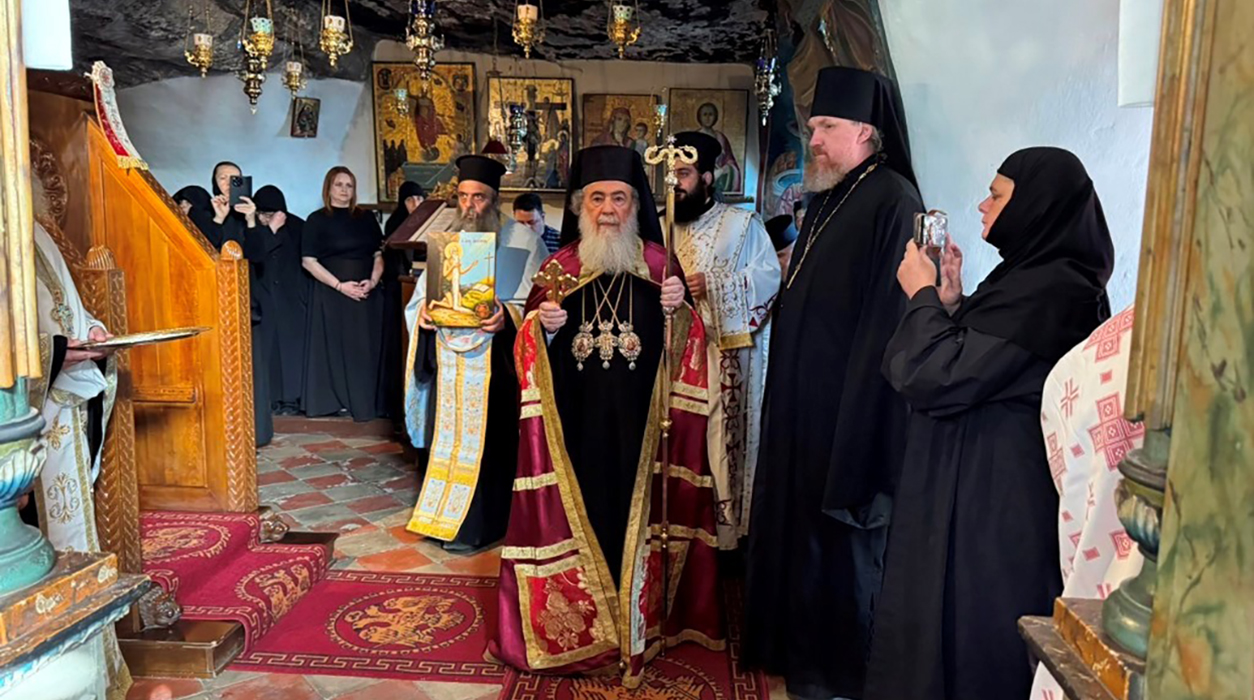
The Holy Patriarchate of Jerusalem, one of the most ancient and revered centres of Christianity, solemnly commemorated the feast of the Venerable Fathers Onuphrius the Egyptian and Peter of Mount Athos. This annual memorial, observed on 12 June (or 25 June according to the New Calendar), unites the rich tradition of Eastern Christianity with the ideals of desert asceticism and the silence of Mount Athos. In the Patriarchate’s monastery near the Pool of Siloam, on the historic Field of the Potter mentioned in the Gospel of Matthew (Mt 27:7–8), the faithful gathered to remember those who renounced the world in order to devote themselves wholly to God. This is not merely a historical event, but a profound invitation to contemporary humanity: is there space in our lives for silence and the pursuit of eternity?
Saint Onuphrius the Egyptian (Greek: Ὀνούφριος, Onouphrios), also known as Onuphrius the Great or the Anchorite of Egypt, lived in the 4th century. His Life is based primarily on the account of Abba Paphnutius, preserved in both Greek and Coptic versions. Paphnutius’s narrative, one of the classic texts of early monasticism, describes how the young Onuphrius grew up in a cenobitic monastery near Hermopolis in the Thebaid (Upper Egypt). There he learned the strict rule of silence, but an inner calling led him into the desert, following the example of the Prophet Elijah and John the Baptist. The Greek texts emphasise his complete surrender to God’s will: he lived 60–70 years in total solitude, sustained miraculously by dates and by the Eucharistic bread brought by an angel every Sunday.
Paphnutius’s Greek Life of Onuphrius is full of theological depth. It is not merely biography but an iconographic depiction of the soul’s journey. Onuphrius appears to Paphnutius in a wild form – his body covered with hair, clothed only in a skirt of leaves – symbolising total renunciation of the world. The Greek vocabulary highlights “erēmos” (desert) as the place where God speaks to the soul. This echoes motifs from the Hebrew Bible: Elijah fed by ravens (1 Kings 17) and John the Baptist living in the desert in camel-hair clothing (Mt 3:1–4). These parallels are intentional – early Christianity saw itself as the fulfilment of the Old Testament, where the desert becomes the site of purification and divine encounter.
Saint Peter of Mount Athos (9th century) represents another great tradition: the beginning of Athonite eremitism. Born a Byzantine soldier, Peter was taken captive by the Arabs. While imprisoned he prayed for deliverance, vowing the monastic life. After a miraculous release through the intercession of Saint Nicholas and Saint Simeon, he went to Rome, became a monk at the tomb of the Apostle Peter, and through an apparition of the Mother of God was directed to Mount Athos. There he lived for 53 years in a cave in complete solitude, battling demonic temptations and sustaining himself on wild herbs. His Life, preserved in Greek hagiographic texts, emphasises the sacred status of Athos as the “Garden of the Theotokos” – a place where hesychasm (the prayer of silence) flourished.
In the light of Orthodox theology, both saints embody theosis – the process of human deification. Greek Church Fathers such as Gregory Palamas (a successor of the Athonite tradition) distinguished between God’s essence (which remains inaccessible) and God’s energies (which can be experienced in prayer). Desert fathers like Onuphrius lived this out in practice: complete renunciation allows the soul to be filled with divine light. In the Hebrew biblical context, this answers Abraham’s call “Go forth from your land” (Gen 12:1) and Moses’ journey through the desert to Mount Sinai. In Greek philosophical terms (with influences from Plato and the Stoics in early Christian texts), it signifies the purification of the soul (katharsis), contemplation (theoria), and union with God.
The Jerusalem Patriarchate’s commemoration of these saints unites the diversity of Eastern Christianity: the rigour of the Egyptian desert and the silent mountain of Athos meet on the soil of the Holy City. This is no coincidence – Jerusalem is the crossroads of the Old and New Testaments, East and West. Patriarch Theophilos III or his predecessors have stressed that such commemorations strengthen peace and prayer amid the region’s complex circumstances. In the contemporary context, this invites reflection: how can we find the “desert” in our daily lives filled with noise and consumption? Orthodox theology teaches that asceticism (askesis) is not punishment but freedom – freedom to love God and neighbour more fully.
The lives of the venerable fathers call us to inner prayer. Onuphrius shows that even in extreme poverty the soul can be rich. Peter of Athos reminds us that a long period of silence transforms a person into an “angelic” being – as the troparion sings: “In the flesh you lived the life of angels, you were citizens of the desert and treasuries of grace.” Greek texts emphasise their connection with angels, reflecting early Christian angelology, in which hermits received angelic nourishment and protection. A similar motif exists in the Hebrew tradition: the Psalms praise God who feeds His people in the desert (Ps 78).
Modern Orthodox theology, influenced by Athonite hesychasts such as Silouan of Athos, emphasises that true prayer is “prayer of the heart” – the constant repetition of the Jesus Prayer (“Lord Jesus Christ, have mercy on me”). Both saints embodied this long before it became widely known. Their commemoration in the Jerusalem Patriarchate reminds us that Christianity is not only doctrine but a lived mystery. It raises the question: does our fast-paced life allow room for such depth? Do we dare to renounce comfort in order to find true peace?
These saints are bridge-builders: Onuphrius connects the Egyptian desert with early monasticism, while Peter links it to the centuries-old tradition of Mount Athos. Their joint commemoration calls for ecumenical respect and personal conversion. In Orthodox liturgy their troparion is sung, uniting them in one witness: God works through those who surrender themselves completely to Him.
In conclusion, may this article serve as an invitation to silence amid the noise. The example of the Jerusalem Patriarchate shows that history lives on in liturgy and prayer. These fathers are not of the past – they are living intercessors who pray for us.
Prayer:
O Lord Jesus Christ, our God, who called Saint Onuphrius into the silence of the desert and Saint Peter to Mount Athos that they might live an angelic life in union with You, hear our prayer! Grant us, Your weak servants, the grace to follow their example – to renounce the emptiness of the world, to seek You in the silence of the heart, and to live in true freedom. As You nourished them miraculously, feed also our souls with Your Word and the Holy Eucharist. Protect us from temptations, strengthen our faith, and lead us to the joy of eternal life. Most Holy Theotokos, Protectress of Mount Athos, and all holy fathers, intercede for us sinners. Amen.

Trough all this I want to declare this is all from God and to God. All Glory to Him!