Views: 155
Mother of God, September 8, 2026: The Nativity of the Theotokos — Celebrating the Birth of the Virgin Mary
An in-depth look at the Feast of the Nativity of the Theotokos — the tradition of Joachim and Anna, the theological significance of Mary as Theotokos, and an honest assessment of the feast’s sources. Two prayers to the Mother of God follow at the end.
Introduction: The Feast That Opens the Church Year
The Orthodox Church begins its liturgical year on September 1, and the first major feast that follows immediately after is the Nativity of the Theotokos — celebrated on September 8 according to the new calendar (the same event falls on September 21 in the old calendar). This is no accident. For centuries, the Church Fathers have held it symbolically significant that the cycle of the church year opens precisely with Mary’s birth: just as dawn announces the coming of the sun, Mary’s birth proclaims, even before Christ’s own birth, what is about to come — that through her the Savior will enter the world. In the Fathers’ own words, today’s feast is “the opening of the doors of salvation”: Mary’s birth is the first link in a chain that leads directly to Christmas, to the birth of Christ.
But this essay does not wish to remain a mere retelling of a liturgical event. The question the Feast of the Nativity of the Theotokos actually raises touches something deeper: how to understand the relationship between barrenness and grace, waiting and gift, human weakness and divine plan — and what it means that the Church calls Mary Theotokos, God-bearer, rather than simply “the mother of Jesus.”
Joachim and Anna: A Story of Barrenness and Grace
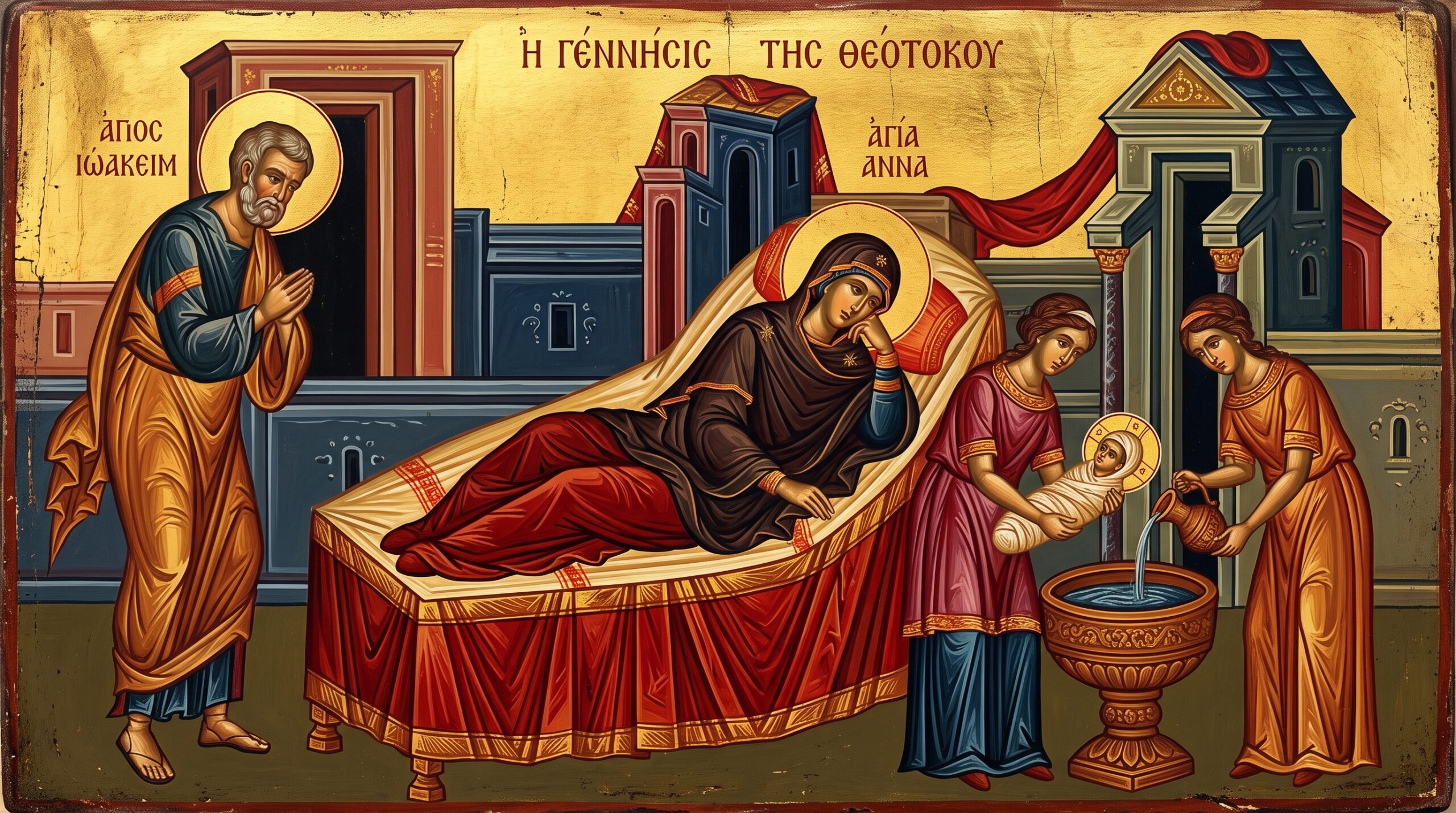
According to tradition, Mary’s parents, Joachim and Anna, were a devout but childless couple who carried into old age the shame and sorrow of being without offspring. The story tells that Joachim once went to the Temple in Jerusalem on a great feast day to bring an offering, but the high priest refused it — in the cultural context of the time, childlessness was read as a sign that God’s blessing was absent. Deeply grieved, Joachim withdrew into the desert, while Anna wept and prayed at home. An angel then appeared to each of them separately, announcing that their prayers had been heard and that a daughter would be born to them of whom the whole world would speak.
It is important here to be honest in matters of source criticism: this story does not appear in the New Testament canon. Its earliest source is the Protoevangelium of James, dating from the latter half of the second century — an apocryphal text that does not belong to the biblical canon and does not carry the same historical reliability as the canonical Gospels. This means that the story of Joachim and Anna, along with the entire account of Mary’s childhood (including her being brought to the Temple at the age of three), belongs to church tradition rather than to direct scriptural testimony. The Orthodox and Catholic Churches have received this tradition into their liturgy and feast calendars since early times — the earliest records of the feast being celebrated date to the sixth century, in Syria or Palestine — but an honest theological reading requires acknowledging that this is traditional, not canonical, history.
Why, then, does the Church hold this tradition in such high regard? Because the story carries a deep theological typology that runs throughout the Old Testament: a barren woman to whom God grants a child by grace is a recurring motif — Sarah and Isaac, Hannah and Samuel, Elizabeth and John the Baptist. The names Anna and Hannah both mean “grace” or “gift of grace,” and this linguistic and theological resemblance is no coincidence: the Church has always read Mary’s birth as the last and most perfect link in this long story of grace, one that culminates in the birth of God’s own Son as man.
Why Mary Is Called the Mother of God — The Theological Meaning of Theotokos
The Greek title Theotokos — literally “God-bearer” or “she who gives birth to God” — is not merely an honorific addition but a Christological claim. In the year 431, at the Council of Ephesus, this title was formally confirmed, in direct response to the teaching of Nestorius, Patriarch of Constantinople, who preferred the term Christotokos (“Christ-bearer”), arguing that Mary gave birth only to Jesus’s human nature, not to his divinity. The Church rejected this as an error that splits Christ’s single person into two — as though his divine and human natures were separable. If Mary is Theotokos, this means that the one she bore was, from the very beginning, truly God and truly man, one undivided person.
This gives the Feast of the Nativity of the Theotokos a deeper dimension than a mere tribute to Mary’s person. Her birth matters not only for her own sake, but because through her birth, the very body and soul are being prepared from which God, having become man, will later be born. The Church Fathers have described Mary as a “living temple” — what was symbolic in the Jerusalem Temple, the presence of God in the Holy of Holies, becomes flesh and reality in Mary. She is also called a “ladder” (an allusion to Jacob’s dream, Genesis 28:12), joining heaven and earth, and a “burning bush” (Exodus 3:2), bearing divine fire without being consumed by it — an image used to symbolize her virginity and her encounter with divinity.
The New Eve: A Theology of Restoration
The Church Fathers, beginning with Irenaeus, have described Mary as the “new Eve,” whose obedience balances the first Eve’s disobedience. Where Eve trusted the serpent and brought about the world’s fall, Mary trusted God’s messenger and brought about the world’s salvation. This is not an independent act on Mary’s part, separate from Christ — on the contrary, it is entirely in service to her Son and grace working through him — yet it shows that God does not accomplish redemption without human participation. Mary’s “yes” (Luke 1:38) is humanity’s representative response to God’s call, and the precondition for that “yes” was her own innocent, sanctified birth, which the Church commemorates today.
Liturgy and Folk Tradition: “Snake Mary’s Day”
In the Estonian folk calendar, September 8 is known as ussimaarjapäev, “Snake Mary’s Day.” According to folk tradition, on this day snakes crawl into their burrows to prepare for winter hibernation, and so people were forbidden to go into the forest that day, so as not to disturb them; weaving and sewing were likewise forbidden, so that the snakes would not bite anyone the following year. This is an interesting example of how a Christian feast became interwoven, among the folk, with local, pre-Christian symbolism — while its ecclesiastical meaning remained clearly Christian: Mary’s birth as the beginning of salvation, not an agrarian calendar date.
Liturgically, the Church marks this day with a troparion proclaiming that Mary’s birth brought joy to the whole world, for from her rose the Sun of Righteousness, Christ our God. This message of joy — not sorrow over barrenness, but thanksgiving for grace — runs through the whole spirit of today’s feast.
Practical and Spiritual Meaning for Today
The Feast of the Nativity of the Theotokos speaks to the modern person in three ways.
First, on the theme of waiting and patience: the story of Joachim and Anna — traditional rather than canonical though it may be — carries within it the universal experience of long, seemingly unanswered prayer. It speaks to anyone who has experienced a long-delayed hope, whether for a child, health, work, or inner peace — calling them not to lose trust, even when the answer comes much later, and in a different form than expected.
Second, on the relationship between humility and grace: Mary was not born because of her own merit, but by grace — like every human being. Her uniqueness does not cancel her humanity but fulfills it. This stands as a counterweight to any mindset that measures a person’s worth by achievement rather than by being.
Third, on the theme of the inner temple: when the Church Fathers saw in Mary a “living temple,” they also call every Christian to ask how their own heart might become a dwelling place for God — not an artificial, constructed one, but a living one, kept through prayer and purity.
Conclusion
The Feast of the Nativity of the Theotokos is not merely a historical day of remembrance — it is a theological claim about how God enters human history: not suddenly or forcefully, but through preparation, human cooperation, and long waiting. Honestly acknowledging that the story of Mary’s birth comes from an apocryphal rather than a canonical source does not diminish the feast’s meaning — rather, it helps distinguish what the Church teaches as tradition from what it holds as scriptural authority, and it calls us to honor Mary for who she truly was: the first and complete recipient of God’s grace among humankind.
Two Prayers to the Mother of God
A Prayer for the Feast of the Nativity of the Theotokos
Most Holy Mother of God, Ever-Virgin Mary, who were born to Joachim and Anna as their long-awaited gift of grace, look upon me with mercy as I stand before you in my own impatience and longing. Just as your parents bore their childlessness for decades without losing hope, teach me too to pray through long nights that seem to bring no answer. Your birth brought joy to the whole world — grant that this same joy may reach my heart as well, a joy that depends not on changing circumstances but on the presence of God. You, who became a temple of God from your mother’s womb, intercede for me, a sinner, that my heart too may be cleansed of all that hinders God from dwelling within me. Bless me with the patience of your parents, the humility of your own example, and a faith that does not grow weary even when the answer is delayed. Most Holy Mother of God, save us. Amen.
A Prayer of Trust and Protection to the Mother of God
O Mother of God, our mother, exalted above all created beings, into whom the power of the Most High descended as a shadow and who bore in your body the Savior of the world, receive this prayer of mine, which comes at times from a weak and doubting heart. The burdens of life are heavy, and I often feel as your parents must have felt before the Temple door — turned away, misunderstood, alone. Yet just as God did not abandon Joachim and Anna, he does not abandon me either. Be my intercessor before your Son, who can deny you nothing, for you are the one who first and fully said “yes” to him. Cover me with the shelter of your intercession, as you have done for countless others before me who have cried out to you in trouble and sorrow. Help me grow in a trust that does not demand an immediate answer but rests securely in the knowledge that God’s timing is always the right timing. Most Holy Virgin, Birth-giver of God, be with me today and all my days, until I reach the place where you already are — in the everlasting light of your Son, our Lord Jesus Christ. Amen.

Trough all this I want to declare this is all from God and to God. All Glory to Him!