Views: 80
Monotheism Beliefs: One God in Christian Theology
For nearly 1,700 years, Christians have confessed one God as Father, Son, and Holy Spirit. This central claim explains why monotheism beliefs in Christianity are more than a statement that only one deity exists. They describe the identity of God and the way God acts to save humanity through Jesus Christ.
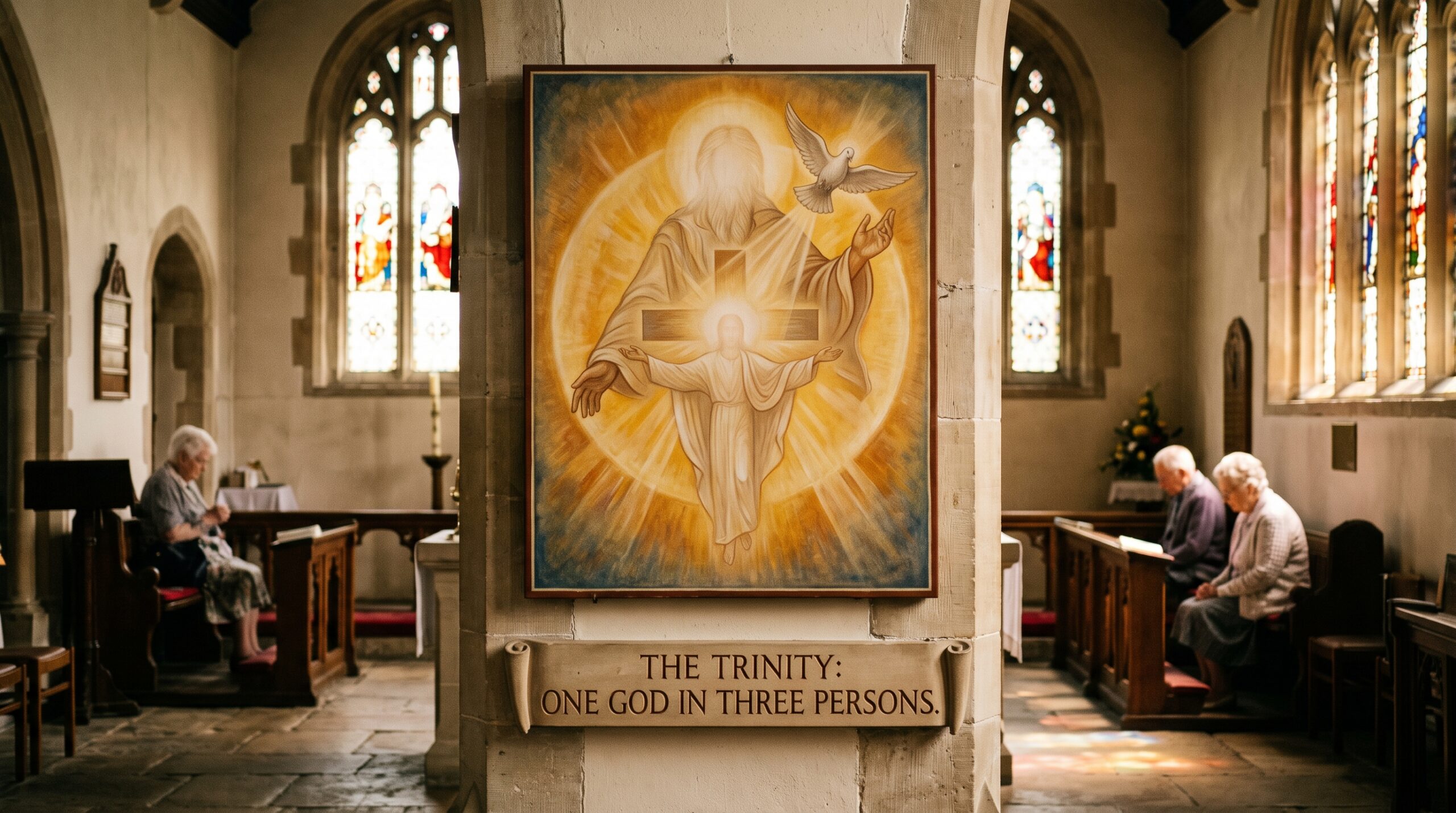
Christian theology therefore holds two truths together: God is one, and the Father, Son, and Holy Spirit are distinct Persons. The doctrine of the Trinity does not divide God into three beings. It explains the biblical revelation of the one God who creates, enters human history, and gives the Holy Spirit.
Key Takeaways
- Christian monotheism affirms one God in three distinct Persons.
- The Father, Son, and Holy Spirit share one divine nature.
- Jesus Christ is fully divine, not a created prophet.
- Salvation reveals God’s character, not only God’s number.
- The Nicene Creed protects biblical teaching about Christ.
- Trinitarian faith differs from both polytheism and modalism.
What Do Christian Monotheism Beliefs Actually Teach?
Christian monotheism teaches that there is one eternal God, the source of creation and the giver of life. This God is not one member of a larger divine family. Nothing exists alongside God as an equal rival. The biblical claim is direct: “The LORD is one” (Deuteronomy 6:4).
Yet Christianity also teaches that the one God is Father, Son, and Holy Spirit. These are not three names for one Person who changes appearances. They are distinct Persons who relate to one another while possessing the same divine nature.
A helpful distinction is the difference between being and person. Christians say God is one in being and three in Person. Human beings are one person and one being, but Christian theology does not apply that human pattern mechanically to God.
“Hear, O Israel: The LORD our God, the LORD is one.” — Deuteronomy 6:4
The word “one” in biblical monotheism rejects idols, rival gods, and divided worship. It does not require Christians to deny every distinction within God’s life. The New Testament identifies the Father as God, presents Jesus Christ with divine authority, and describes the Holy Spirit as acting personally and divinely.
This makes the Christian position precise. Monotheism is not merely belief in one supernatural power. It is worship of the one living God as God has revealed himself through Scripture, the incarnation, the cross, and the gift of the Spirit.
How Does the Trinity Preserve Belief in One God?
The Trinity preserves monotheism by distinguishing divine Persons without dividing divine being. The Father is God, the Son is God, and the Holy Spirit is God, but the Father is not the Son, and the Son is not the Holy Spirit. Christian worship remains directed to one God.
One divine nature
The Father, Son, and Holy Spirit do not possess three separate portions of deity. Each is fully divine. The Son is not one-third of God, and the Spirit is not a lesser force. This is why historic Christianity rejects the idea that the Trinity is simple arithmetic.
The doctrine also avoids a common mistake: treating the Persons as three independent centers of existence, similar to three human individuals. Human persons have separate wills and bodies. The divine Persons share one divine nature and act in perfect unity.
Three distinct Persons
The Father sends the Son. The Son prays to the Father. The Holy Spirit descends at Jesus’ baptism. These relationships show distinction, not temporary role-play. At Jesus’ baptism in Matthew 3, the Son is in the water, the Spirit appears as a dove, and the Father speaks from heaven.
This matters because modalism claims that God is one Person who appears first as Father, then as Son, and later as Spirit. That view cannot account for the simultaneous relationships shown in the baptism of Jesus or in Jesus’ prayer in John 17.
One divine work
Creation, revelation, judgment, and salvation are works of the one God. Scripture often shows the Persons acting together. The Father sends the Son, the Son accomplishes redemption, and the Spirit applies God’s life to believers.
A practical comparison helps:
| Christian claim | What it means | What it does not mean |
|---|---|---|
| One God | One divine being and source of all things | One Person without distinction |
| Three Persons | Father, Son, and Holy Spirit truly relate | Three separate gods |
| Jesus is God | The Son shares the divine nature | Jesus is the Father |
| The Spirit is God | The Spirit acts personally and divinely | The Spirit is only an impersonal energy |
The Trinity is therefore not an extra idea added to monotheism. It is the Christian account of what God’s oneness means after considering the full witness of the Bible.
Biblical monotheism appears throughout Scripture, from Israel’s confession in Deuteronomy to the New Testament’s teaching about Christ and the Spirit. The Bible never presents Christianity as worship of several competing deities. It presents one God whose identity is revealed progressively and fully in Jesus Christ.
Israel’s confession of one God
Deuteronomy 6:4 is the clearest Old Testament confession: “The LORD our God, the LORD is one.” The command that follows is to love God with the whole heart, soul, and strength. Exclusive love requires exclusive worship.
Isaiah also contrasts the Lord with idols. In Isaiah 45:5, God declares, “I am the LORD, and there is no other.” This language rejects polytheism, the belief that several gods possess independent divine authority.
The Old Testament also prepares readers for complexity within God’s revelation. God’s Word creates in Genesis 1, God’s Spirit is present over the waters, and God speaks in ways that later Christian readers understand in light of the Son’s incarnation. These passages do not give a complete formula for the Trinity, but they establish a foundation.
Jesus and the one God
Jesus did not abandon Israel’s monotheism. In Mark 12:29, he repeats the confession that the Lord is one. At the same time, the Gospel of John presents Jesus as the eternal Word through whom all things were made (John 1:1–3).
Jesus forgives sins, receives worship, claims authority over the Sabbath, and speaks of sharing glory with the Father before creation (John 17:5). Historic Christian theology sees these actions as evidence that Jesus is more than a prophet or an unusually inspired teacher.
The New Testament also places Jesus within divine identity without confusing him with the Father. John 10:30 records Jesus saying, “I and the Father are one.” The statement does not erase their distinction. It points to unity that exceeds agreement between two ordinary people.
The Holy Spirit in Scripture
The Holy Spirit is not described only as a mood, force, or symbol. The Spirit speaks, teaches, guides, can be grieved, and distributes gifts according to personal choice. In Acts 5:3–4, dishonesty toward the Holy Spirit is described as lying to God.
The baptismal command in Matthew 28:19 names the Father, the Son, and the Holy Spirit together. The wording places them within one shared pattern of discipleship and worship. Second Corinthians 13:14 likewise blesses believers with the grace of Christ, the love of God, and the fellowship of the Holy Spirit.
A careful reading avoids two extremes. It should not force every Old Testament verse to state the later doctrine in complete form, but it should also not isolate Old Testament monotheism from the New Testament revelation of Christ and the Spirit.
Why Is Jesus Christ Central to Christian Monotheism?
Jesus Christ is central because Christian salvation depends on who Jesus is. Historic Christianity does not describe him as merely a prophet, angel, or created being. It confesses that the eternal Son became truly human while remaining truly divine.
The incarnation means that the Son took human nature from Mary and entered human history. He experienced hunger, fatigue, suffering, and death according to his humanity. His divine nature did not replace his humanity, and his humanity did not reduce his deity.
The Son is eternal
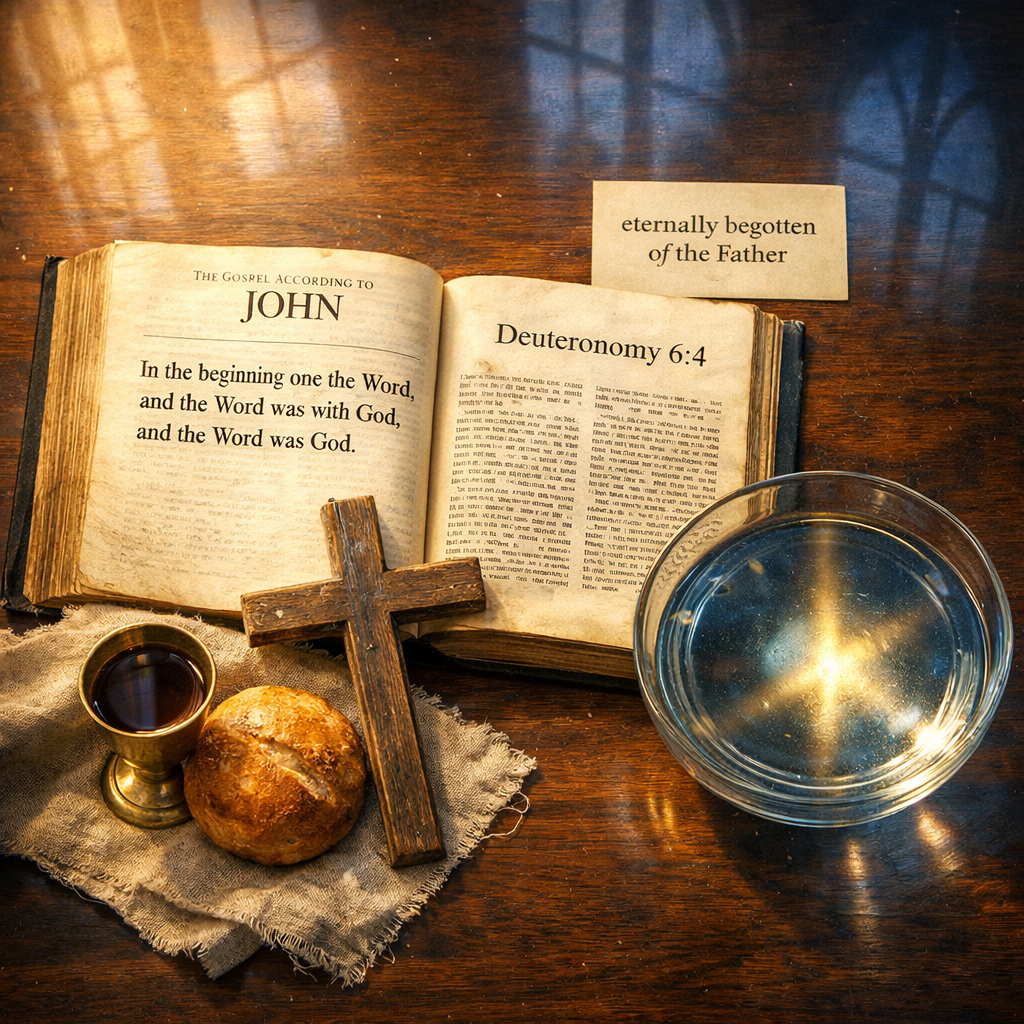
The opening of John’s Gospel calls Jesus the Word and says that the Word was with God and was God. This wording communicates both distinction and deity. The Word is with God, so the Word is not the Father; the Word was God, so the Word is not a created being.
Colossians 1:16 says that all things were created through Christ and for Christ. If everything created came through him, Christ cannot belong to the created order in the same way angels and human beings do.
The Nicene Creed, first formulated at Nicaea in 325 and expanded at Constantinople in 381, calls the Son “of one substance with the Father.” The phrase protects the claim that the Son shares the Father’s divine being.
The cross reveals God’s saving work
Christian monotheism is tied to the cross. God does not remain distant from human suffering. In the Son, God enters human life and gives himself for the salvation of the world.
This does not mean the Father dies or that the divine nature ceases to exist. Jesus Christ dies according to his human nature. The one Person who is the Son truly suffers and dies in the flesh, while remaining divine.
Salvation therefore is more than a legal exchange described without relationship. It is reconciliation with God through the incarnate Son. Grace comes from the Father, through the Son, and is received in the Holy Spirit.
The resurrection confirms his identity
The resurrection is not a return to ordinary earthly life. The risen Christ bears the marks of crucifixion and lives in transformed human existence. In Christian theology, this confirms both his identity and the Father’s vindication of his saving work.
A reader testing the main claim can follow this sequence:
- The Bible teaches that there is one God.
- The Father is identified as God.
- Jesus Christ receives divine titles, works, and worship.
- The Holy Spirit acts with personal and divine authority.
- The Church confesses one God as Father, Son, and Holy Spirit.
Remove the Son’s deity, and salvation becomes the work of a creature reaching toward God. Remove his humanity, and the healing of human nature becomes impossible. Christian salvation requires the one divine Son to become truly human.
How Did the Nicene Creed Clarify Monotheism?
The Nicene Creed clarified Christian monotheism by setting biblical teaching into precise language. It was written during the fourth century, when Christians debated whether the Son was eternal or created. The controversy showed why familiar words needed careful definition.
Nicaea and the Son’s divine status
The Council of Nicaea met in 325. Its central concern was the teaching associated with Arius, who held that the Son was created and therefore not fully equal to the Father. The council rejected this position.
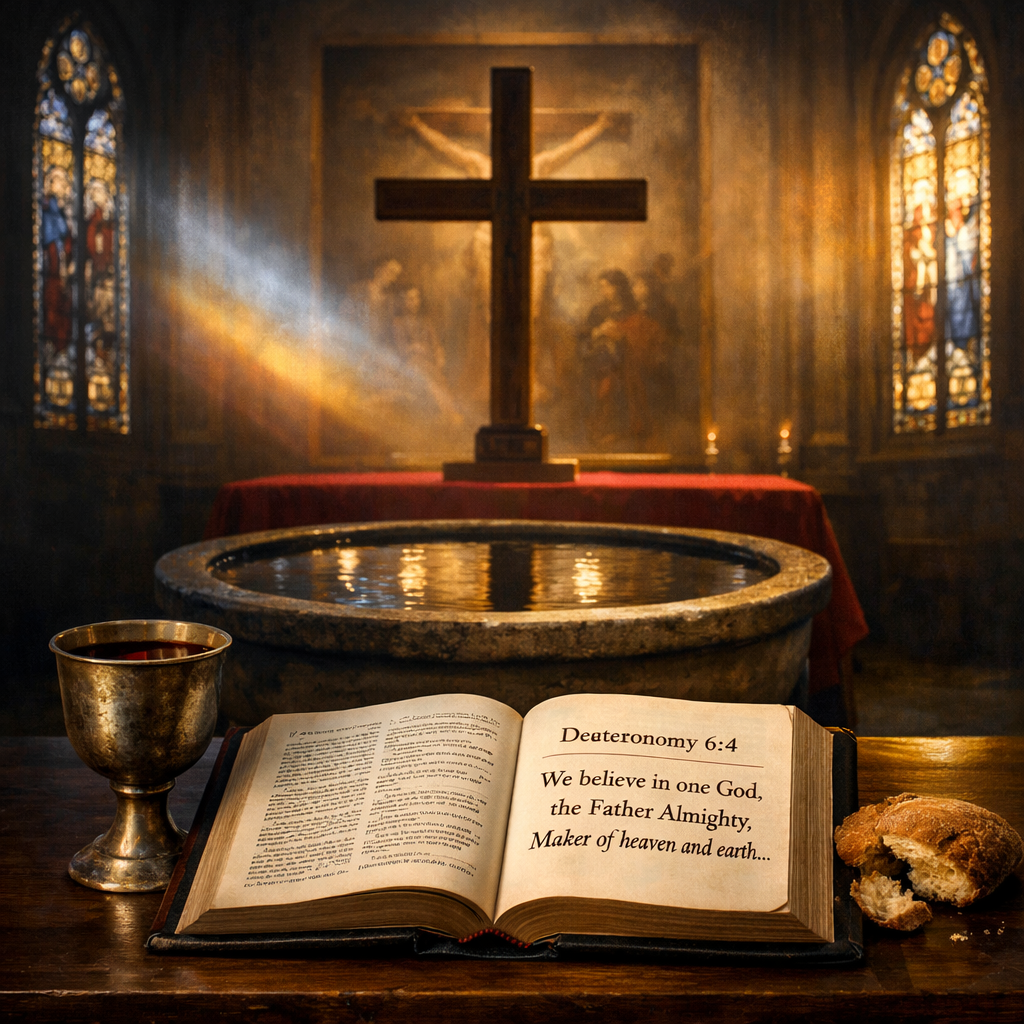
The creed calls Jesus Christ “God from God, Light from Light, true God from true God.” It also says that he was “begotten, not made.” These words distinguish eternal divine generation from the creation of something that did not previously exist.
The term homoousios, often translated “of one substance” or “of one being,” was used to rule out the idea that Christ was a lesser divine being. Arianism could speak of Christ as exalted, but Nicaea required the Church to confess his full deity.
Constantinople and the Holy Spirit
The Council of Constantinople in 381 strengthened the creed’s teaching about the Holy Spirit. The Spirit is confessed as Lord and giver of life, who proceeds from the Father and is worshiped and glorified with the Father and the Son.
This statement protects the Spirit from being reduced to a created messenger. It also keeps Christian worship unified. The same God gives life, reveals truth, and brings believers into communion with divine life.
The creed does not replace the Bible. It functions as a boundary marker for faithful interpretation. When a proposed explanation denies the Son’s eternal deity or turns the Spirit into a force, the creed shows where that explanation departs from historic Christian teaching.
Why precision matters today
A person may say, “I believe in one God,” while imagining a single Person who changes roles. Another may say, “I believe in the Trinity,” while picturing three gods. Both statements need correction.
The Nicene formulation gives Christians a disciplined vocabulary: one God, three Persons, the Son fully divine, and the Spirit fully divine. This vocabulary does not explain every mystery, but it prevents explanations that contradict the biblical pattern.
How Do Monotheism and Salvation Beliefs Fit Together?
Monotheism and salvation belong together because the identity of the saving God determines the meaning of salvation. Christianity does not teach that an unrelated divine helper rescues people from the true God. The Father sends the Son, and the Spirit brings believers into the life of the triune God.
The Father sends the Son
The Father is not a harsh deity opposed to a merciful Jesus. John 3:16 presents the Father as giving the Son because of divine love. The initiative begins in God’s own gracious purpose.
This corrects a common misunderstanding of the cross. Christian faith does not picture Jesus persuading an unwilling Father to show mercy. The Father, Son, and Holy Spirit act together in the work of redemption, though their personal relations remain distinct.
The Son accomplishes redemption
Jesus’ obedience, death, and resurrection address the human condition at its deepest level. Sin is not only a list of broken rules. It is alienation from God, a disorder of human desire, and a power that leads toward death.
Because Jesus is human, he represents humanity. Because he is divine, his saving work is the work of God himself. The cross therefore has universal weight without requiring Christians to imagine a lesser being paying a debt to a greater one.
Salvation includes forgiveness, adoption, healing, and the hope of eternal life. These gifts are received through faith and grace, not earned through moral achievement. Christian practice matters, but it responds to grace rather than purchasing it.
The Spirit applies salvation
The Holy Spirit unites believers to Christ, gives new life, and forms holiness. Romans 8 speaks of the Spirit dwelling in believers and enabling them to live as children of God. The Spirit is therefore active in the present, not only mentioned in a doctrinal formula.
Prayer also reflects this structure. Christians pray to the Father, through the Son, in the Holy Spirit. This pattern is visible in the Lord’s Prayer, in apostolic teaching, and in the worship of historic Christian communities.
A useful test is to ask what a doctrine does to prayer. If monotheism becomes only an abstract count of gods, prayer may become distant and impersonal. If it is understood through the Trinity, prayer addresses the God who creates, redeems, and gives communion.
What Mistakes Should Christians Avoid When Explaining Monotheism?
The most common mistakes arise when people simplify either “one” or “three.” A sound explanation must reject three separate gods, one Person wearing three masks, and a created Jesus who stands outside God’s eternal life.
Mistake one: treating the Trinity as polytheism
Polytheism means belief in multiple gods with separate divine identities. Christianity denies this. The Father, Son, and Holy Spirit do not compete, marry, reproduce, or govern separate parts of nature.
The three Persons share one divine being and one divine will. Their personal relations are real, but they are not three independent deities. Saying “three Gods” is therefore not a rough version of Christian teaching. It changes the doctrine.
Mistake two: treating the Trinity as modalism
Modalism preserves the word “one” by denying the real distinction of Father, Son, and Spirit. On this view, God is one Person who appears in different modes. That conflicts with Jesus praying to the Father and with the Father sending the Son.
The baptism of Jesus in Matthew 3 is a concrete example. The Son is baptized, the Spirit descends, and the Father speaks. The scene does not present one Person acting in three successive costumes.
Mistake three: reducing Jesus to a prophet
Jesus was a Jewish teacher and prophet in his earthly ministry, but historic Christian theology says he is also the eternal Son. Calling him only a prophet removes the foundation of the incarnation and changes the meaning of worship directed toward him.
The same warning applies to claims that Jesus is an angel or the first creature. Such ideas appeared in early Christian disputes, but they do not match the Nicene confession or the New Testament’s language about creation through Christ.
Mistake four: separating doctrine from life
Monotheism beliefs are not complete when they remain a diagram. They shape worship, repentance, moral action, and hope. The God who saves is the God whom Christians are called to love with heart, soul, mind, and strength.
In practice, begin with Scripture, explain the difference between nature and Person, and connect the doctrine to salvation. A short explanation based on Deuteronomy 6:4, Matthew 28:19, John 1:1–3, and the Nicene Creed is clearer than an analogy that accidentally suggests three parts or three roles.
Conclusion
Use one question to test any explanation of Christian monotheism: does it preserve both God’s oneness and the real distinction of Father, Son, and Holy Spirit? If yes, connect that doctrine to salvation. The Father sends the Son, the Son redeems humanity, and the Spirit gives new life. That is the Christian confession in its most practical form.
Frequently Asked Questions
Does Christianity believe in one God or three Gods?
Christianity believes in one God, not three Gods. The one divine being exists eternally as Father, Son, and Holy Spirit. The Persons are distinct, but they do not have separate divine natures, competing wills, or independent territories.
Is Jesus Christ the same Person as God the Father?
No. Jesus Christ is the eternal Son, not the Father. Historic Christian theology distinguishes the Persons while affirming that the Son shares the Father’s divine nature. Jesus’ prayer to the Father in John 17 shows personal distinction within the one God.
Why does the Trinity matter for salvation?
The Trinity explains who acts in salvation: the Father sends the Son, the Son becomes human and gives himself for humanity, and the Holy Spirit unites believers to Christ. If Jesus were only a creature, salvation would not be God’s own saving work.
How can someone explain the Trinity without using a misleading analogy?
State the doctrine directly: one God in three distinct Persons, with one divine nature. Avoid analogies involving water, an egg, or three parts, because they often suggest modalism or partial deity. Scripture and the Nicene Creed provide safer language.

Trough all this I want to declare this is all from God and to God. All Glory to Him!