
Views: 20
What does Orthodoxy teach about the power of prayer, fasting and faith against demons? Prayer rules, the four great fasts, Greek terms and little-known sources analysed.
Orthodox Prayer, Fasting and Faith: The Orthodox Christian Way to Cast Out Demons
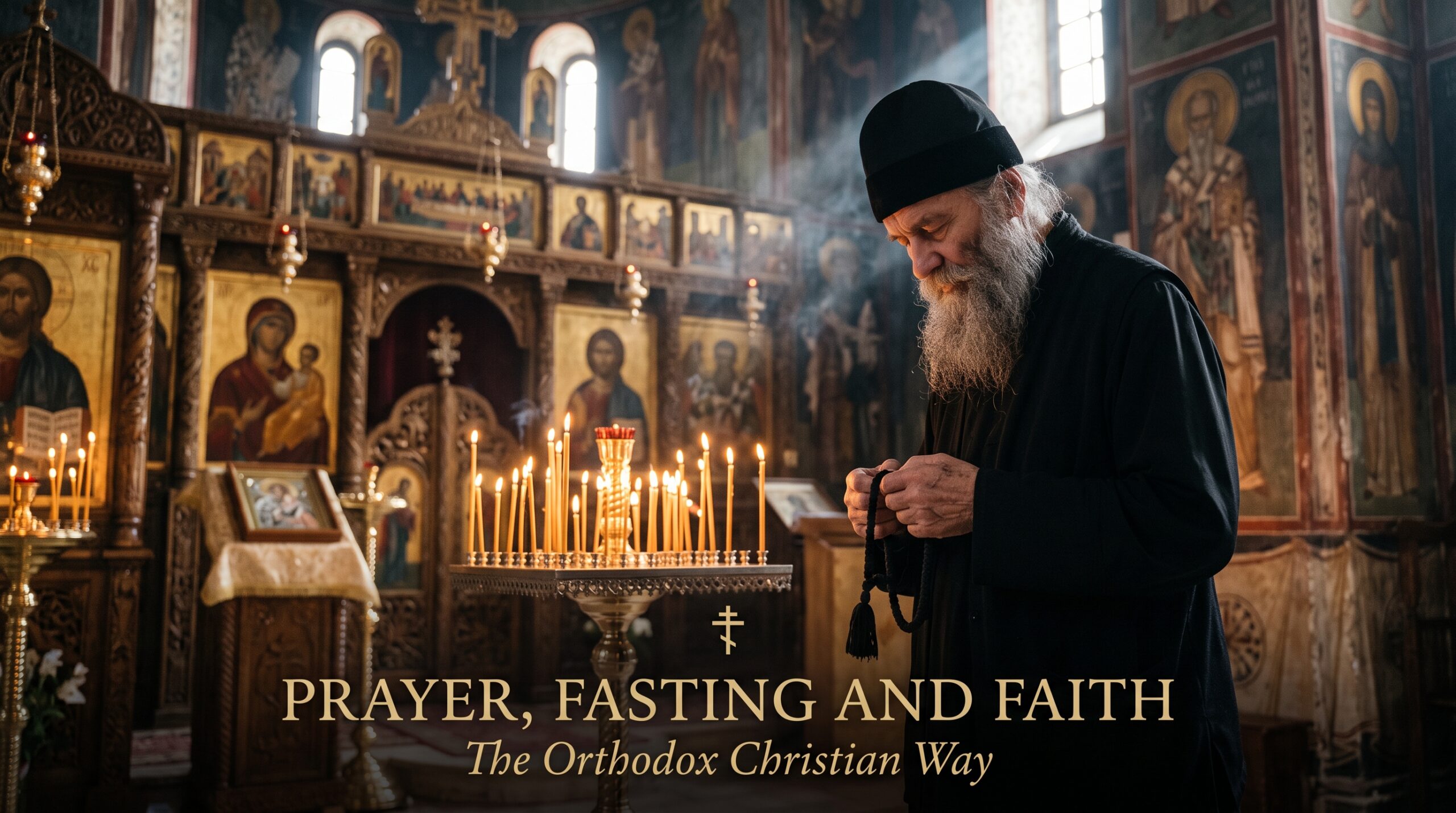
Prayer, fasting and faith are three words that the Orthodox Church has treated as inseparable for two thousand years. The reason lies in the ninth chapter of the Gospel of Mark. When the disciples fail to drive a mute spirit out of a boy, Jesus tells them that “this kind” can come out only by prayer (Mark 9:29). In many manuscripts the words “and fasting” are added: “This kind can come forth by nothing, but by prayer and fasting” (KJV). For Orthodoxy this verse is not a magic formula but a summary of the whole spiritual life: trusting faith (πίστις, pistis), constant prayer (προσευχή, proseuchē) and a fast (νηστεία, nēsteia) that purifies body and soul.
This article explains how Orthodoxy understands the casting out of demons (ἐξορκισμός, exorkismos), what its principal rules of prayer are, what fasting means, and how the four great fasting periods are expressed in the life of the Church. It also examines sources that are rarely quoted: Aphrahat the Persian Sage, The Shepherd of Hermas, Barsanuphius of Gaza, Evagrius Ponticus and others.
In Brief: Key Findings
- Orthodoxy does not treat the casting out of demons as a private “technique.” It is the prayer of the Church, offered within the framework of the sacraments, confession and spiritual guidance.
- The textual-critical problem in Mark 9:29 (“and fasting”) does not diminish the importance of fasting: the tradition confirms it independently through the Book of Tobit, the Didache and the Church Fathers.
- The Orthodox prayer rule (κανών, kanōn) consists of morning and evening prayers, the hours, the Psalms, the Jesus Prayer and liturgical prayer.
- The four great fasts are the Great Fast (Lent), the Apostles’ Fast, the Dormition Fast and the Nativity Fast, together with Wednesdays, Fridays and certain one-day fasts.
- According to the Desert Fathers, a person struggles above all with thoughts (λογισμοί, logismoi), and not only with “visible” demons.
- Orthodoxy sees no conflict between spiritual and medical help: an illness must not be declared demonic without the counsel of a spiritual father and a physician.
1. What Does Casting Out Demons Mean in Orthodoxy?
Orthodox terminology distinguishes several concepts. Ἐξορκισμός (exorkismos) literally means “binding by oath”: a prayer and command of the Church directed against an evil spirit in God’s name. Ἐνεργούμενος (energoumenos) means “one who is acted upon,” that is, a person influenced by an evil spirit. The Gospels often use the word δαιμονιζόμενος (daimonizomenos, “one possessed by a demon”). A third important word is ἐπιτιμᾶν (epitiman, “to rebuke”), which the New Testament uses of Jesus’ own commands and which recurs in the Church’s prayers: “The Lord rebuke you” (cf. Jude 9; Zechariah 3:2).
It is important to note that in Orthodoxy exorcism is not merely an extraordinary event. In the broadest sense it takes place in every baptism. In the baptismal rite the priest reads exorcism prayers over the catechumen, who renounces Satan (ἀπόταξις, apotaxis, “renunciation”) and joins Christ (σύνταξις, syntaxis, “union”). Cyril of Jerusalem (4th century) already speaks in his pre-baptismal catecheses of exorcisms as preparation for the sacrament.
Historically the Church recognised a distinct order of ἐξορκιστής (exorkistēs, “exorcist”). Yet Canon 26 of the Council of Laodicea (4th century) forbids exorcism to anyone not appointed for it by the bishop. The meaning of that canon is clear: the casting out of demons belongs to the Church, not to the private individual. In practice it is carried out today by a priest with the bishop’s blessing, using prayers from the Great Euchologion (Μέγα Εὐχολόγιον, popularly the Trebnik), which tradition attributes to Basil the Great and John Chrysostom.
By contrast, the pseudepigraphal Testament of Solomon (a Greek text generally dated between the 1st and 3rd centuries, with later redaction) presents the subduing of demons as a “technique” involving names, rings and formulas. The Orthodox Church does not use this tradition. The story of the sons of Sceva in Acts 19:13–16, who tried to invoke Jesus’ name without personal faith and were beaten, is a classic warning in Orthodox exegesis: a name without a relationship does not work.
2. The Biblical Foundation: Textual Analysis of Mark 9 and Matthew 17
The principal text appears in all three Synoptic Gospels (Matthew 17:14–21; Mark 9:14–29; Luke 9:37–43). Mark’s version is the longest and psychologically the fullest. The father confesses: “I believe; help my unbelief” (Mark 9:24; Greek: Πιστεύω· βοήθει μου τῇ ἀπιστίᾳ). Here faith is not complete certainty but a trust that is still in progress.
The decisive sentence is Mark 9:29. The Greek text of the Byzantine tradition reads: τοῦτο τὸ γένος ἐν οὐδενὶ δύναται ἐξελθεῖν εἰ μὴ ἐν προσευχῇ καὶ νηστείᾳ. Three analytical points arise:
- The textual variant. The words “and fasting” (καὶ νηστείᾳ) are absent from Codex Sinaiticus (א) and Codex Vaticanus (B), which Western textual criticism regards as the oldest and most important witnesses. They are present in Codex Alexandrinus, Codex Bezae and most Byzantine manuscripts. Because the Orthodox Church uses the Byzantine (ecclesiastical) text tradition in its liturgy, the longer reading is the one proclaimed. One common explanation holds that “fasting” was added under the influence of early Christian asceticism; the opposing view holds that the shorter reading is an abbreviation. Either way, the Orthodox teaching on fasting does not depend on this single verse.
- Matthew 17:21 (the parallel verse in Matthew) is likewise missing from the first hand of Sinaiticus and Vaticanus, but it belongs to the ecclesiastical text. Matthew explains the disciples’ failure with the word ὀλιγοπιστία (oligopistia, “little faith,” Matthew 17:20), whereas Mark uses ἀπιστία (apistia, “unbelief,” Mark 9:19, “O faithless generation”). The difference is notable: for Matthew the problem is the size of faith; for Mark it is the absence of faith, or faith that is still unfinished.
- “This kind” (τοῦτο τὸ γένος). In his commentary on Matthew (Homily 57; the numbering depends on the edition), Chrysostom reads the phrase as an indication that the disciples lacked spiritual preparation, not that Jesus’ authority had failed. Later ascetics such as John Cassian read the same sentence as a distinction between evil spirits of differing “strength.”
Several further passages support the point: Tobit 12:8 (Septuagint, part of the Orthodox canon) commends “prayer with fasting”; Isaiah 58 defines the true fast as justice; Matthew 6:16–18 requires that fasting be hidden; Acts 13:2–3 and 14:23 link fasting and prayer with the appointment of Church ministers; Ephesians 6:12 names the real adversary; and James 4:7 sets the condition: submit yourselves to God; resist the devil.
When quoting Estonian verses, check the wording against the 1997 translation at piibel.net. English quotations here follow the KJV and ESV.
3. What Is Orthodoxy?
Orthodoxy (Greek ὀρθοδοξία, orthodoxia, “right glory” or “right teaching,” from ὀρθός, “right,” and δόξα, “glory; opinion”) is the Eastern Christian tradition that traces itself to the apostles and accepts the first seven ecumenical councils. Its core is not only right teaching (ὀρθοδοξία) but also right living (ὀρθοπραξία, orthopraxia).
Three things are key to understanding Orthodoxy:
- Holy Tradition. Scripture, the liturgy, conciliar decisions and the witness of the Church Fathers form one living whole.
- Sacramental life. Baptism, chrismation (χρίσμα, chrisma), the Eucharist, confession, the anointing of the sick (Εὐχέλαιον, Euchelaion) and the other mysteries (μυστήρια, mystēria).
- Θέωσις (theosis, “deification”). The goal of human life is communion with God. Athanasius of Alexandria expressed it by saying that God became man so that man might become partaker of the divine nature (cf. 2 Peter 1:4).
Within this framework prayer and fasting are not “religious duties” but medicine (ἰατρεία, iatreia). The Church Fathers describe the Church as a spiritual hospital and the priest as a physician of souls.
In Estonia the Orthodox community is present in several jurisdictions (for example the Estonian Orthodox Church and the Estonian Apostolic Orthodox Church). Choices of calendar (Old or New Style) and details of fasting rules can therefore differ from parish to parish; the local priest and the Church calendar have the final say.
4. The Main Orthodox Rules of Prayer
The purpose of the Orthodox prayer rule (κανών τῆς προσευχῆς, kanōn tēs proseuchēs) is not to impose a “norm to be fulfilled” but to provide a framework that protects prayer from the whims of mood. Below are eight basic rules with analysis.
4.1. The Daily Cycle: Morning, Evening and the Hours
The earliest witness is the Didache (Greek Διδαχή, “Teaching,” dated between the late 1st and early 2nd century), which commands the Lord’s Prayer three times a day (Didache 8:3). The Apostolic Tradition attributed to Hippolytus (c. 215; authorship is disputed) lists the times of prayer: on rising, at the third, sixth and ninth hours, before sleep and at midnight. Origen’s treatise On Prayer (Περὶ εὐχῆς, 3rd century) confirms prayer at morning, noon and evening. From this developed the later system of the hours (ὧραι, hōrai): the First, Third, Sixth and Ninth Hours.
4.2. Morning and Evening Prayers
The core of the morning prayers follows a set order: the Trisagion (Τρισάγιον, “Thrice-Holy”: “Holy God, Holy Mighty, Holy Immortal, have mercy on us”), the prayer to the Holy Spirit (“O Heavenly King,” Βασιλεῦ οὐράνιε), the Lord’s Prayer, the Creed (Σύμβολον τῆς Πίστεως, Symbolon tēs Pisteōs) and Psalm 50 (51) as the psalm of repentance. In the evening the Apodeipnon (Ἀπόδειπνον, “after supper,” Latin Completorium, Compline) is read. Rhythm matters: prayer is not a feeling but an action.
4.3. The Jesus Prayer and Cassian’s Formula
The Jesus Prayer (Εὐχὴ τοῦ Ἰησοῦ) runs: Κύριε Ἰησοῦ Χριστέ, Υἱὲ τοῦ Θεοῦ, ἐλέησόν με τὸν ἁμαρτωλόν (“Lord Jesus Christ, Son of God, have mercy on me, a sinner”). Its roots lie in the New Testament: the cry of blind Bartimaeus (Mark 10:47) and the prayer of the tax collector (Luke 18:13).
A less familiar precursor appears in John Cassian’s Conferences (Conference 10, the discourse of Abba Isaac, early 5th century): the short, unceasing prayer “O God, come to my assistance; O Lord, make haste to help me” (Psalm 69:2 in the Septuagint). Cassian recommends using it in every situation, especially in temptation. It is essentially the same “little prayer” structure that later crystallised in the Jesus Prayer.
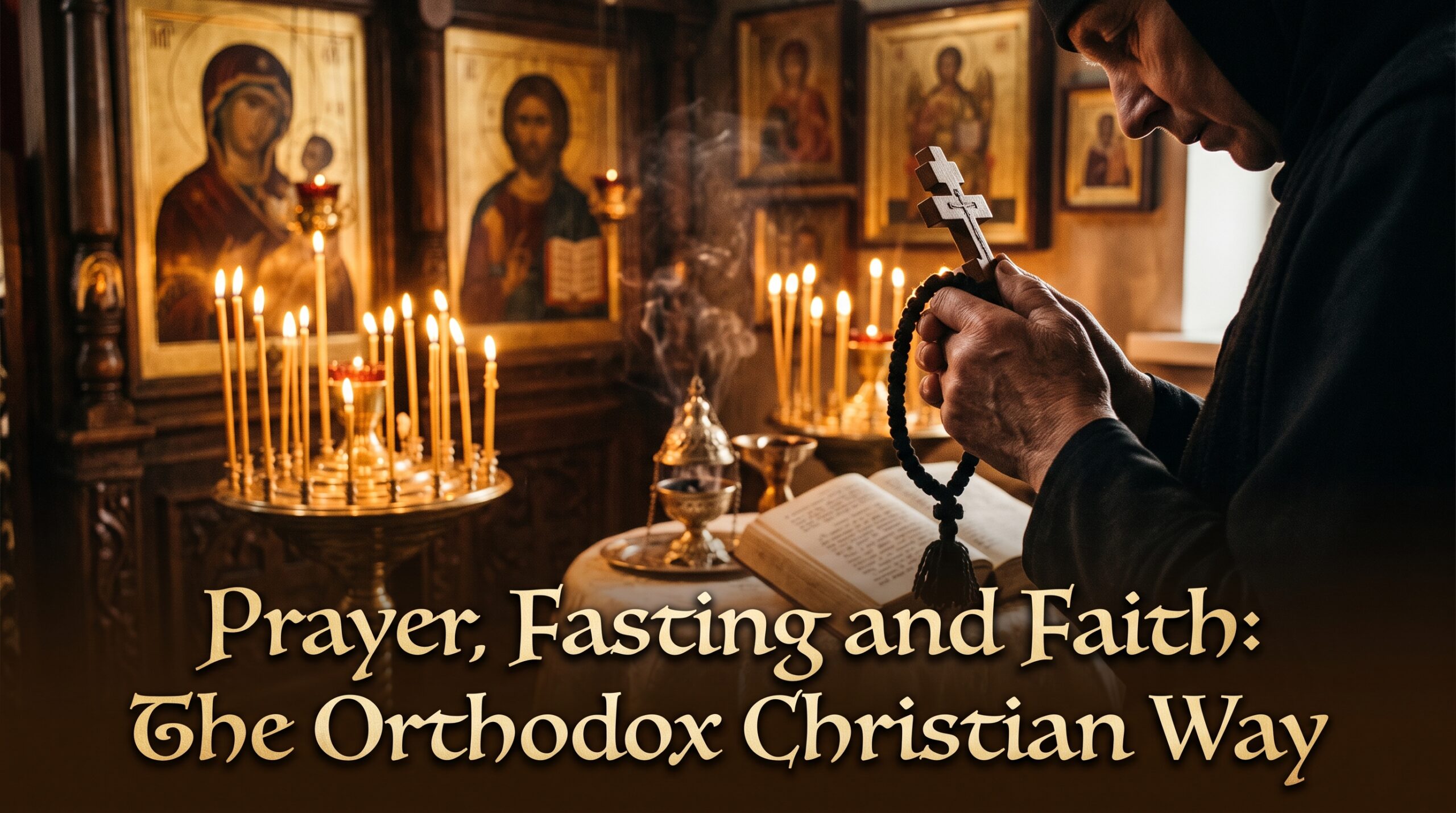
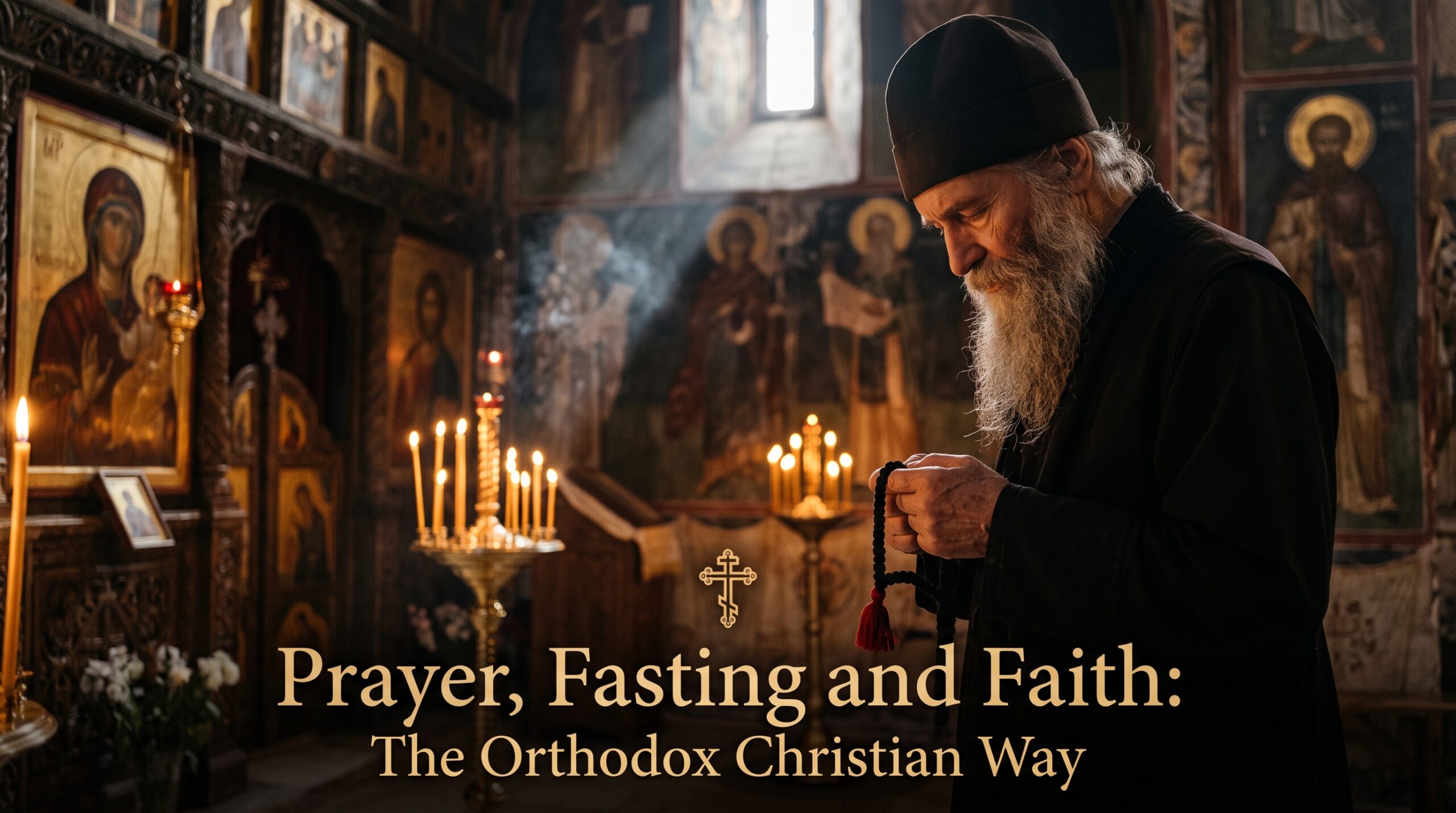
In practice the prayer rope (κομβοσχοίνιον, komboschoinion, “knotted cord”) is used. The rope is not an amulet but an aid to counting and concentration.
4.4. Involving the Body: the Sign of the Cross and Prostrations
Orthodox prayer engages the body as well. The sign of the cross is made with three fingers, from right to left. Μετάνοια (metanoia, “change of mind; a deep bow or prostration”) is the bodily expression of the word “repentance.” Posture also matters: during Great Lent prostrations are repeated especially often.
4.5. The Psalter and the Kathismata
The Psalter is the Orthodox prayer book. It is divided into twenty kathismata (Καθίσματα, “sittings”), which are normally read through once a week and, during Great Lent, twice a week. The Psalms contain direct language of battle against evil (for example Psalm 90 (91), “He that dwelleth in the secret place of the Most High”), which Orthodoxy associates especially with prayers for protection.
4.6. Liturgical Prayer
In Orthodoxy personal prayer is always an extension of the Church’s prayer, never a replacement for it. The centre is the Divine Liturgy (Θεία Λειτουργία), together with Matins (Ὄρθρος), Vespers (Ἑσπερινός) and, in fasting seasons, the Liturgy of the Presanctified Gifts (Λειτουργία τῶν Προηγιασμένων). Holy Communion is the central “medicine” of the Church (φάρμακον ἀθανασίας, “medicine of immortality,” Ignatius of Antioch, Ephesians 20).
4.7. The Prayer of St Ephrem the Syrian
The characteristic Lenten prayer (attributed to Ephrem the Syrian, 4th century) asks God not to give us “the spirit of sloth (ἀργία), idle curiosity (περιεργία), lust for power (φιλαρχία) and idle talk (ἀργολογία),” but rather the spirit of “chastity (σωφροσύνη), humility (ταπεινοφροσύνη), patience (ὑπομονή) and love (ἀγάπη).” This is especially relevant to our subject: the Lenten prayer names the spirits against which the struggle is waged, and they are everyday temptations, not only extraordinary manifestations.
4.8. Moderation, Attention and the Spiritual Father’s Blessing
The most important rule is moderation. St Theophan the Recluse (19th century) recommends a short but steady rule rather than a long one that is quickly abandoned. Above all stand προσοχή (prosochē, “attention”) and νῆψις (nēpsis, “sober watchfulness”): prayer is genuine only when the mind is present. In Orthodox practice the basis for composing one’s own prayer rule is the blessing of a spiritual father (πνευματικός, pneumatikos, “spiritual guide”).
5. Fasting in Orthodoxy: Meaning and Food Rules
Νηστεία (nēsteia, “fasting”) in Orthodoxy is threefold: abstinence from food, from sin and from excess. Three classic positions in early Christian literature:
- The Epistle of Barnabas (ch. 3, c. 100) interprets Isaiah 58 to mean that the true fast is the release of the oppressed.
- The Shepherd of Hermas (Similitude V, 2nd century) teaches that a fast is empty unless accompanied by good deeds: the price of the food saved is to be given to the widow, the poor and the orphan.
- Basil the Great (Homilies on Fasting, Περὶ νηστείας, 4th century) stresses that a fast that does not purify speech purifies nothing.
Food rules are typically (though not uniformly) as follows:
- Fasting food excludes meat, dairy products, eggs and fish with backbones; molluscs and crustaceans are traditionally permitted.
- Ξηροφαγία (xērophagia, “dry eating”) denotes a strict fast day: food that is uncooked or at least free of oil and wine.
- Oil and wine are usually forbidden on Wednesdays and Fridays during Great Lent but permitted on Saturdays and Sundays.
- Fish is permitted on great feasts such as the Annunciation (25 March) and Palm Sunday.
The most important spiritual distinction is that between ἀκρίβεια (akribeia, “strictness, exactness”) and οἰκονομία (oikonomia, “economy; pastoral leniency”). The Orthodox fast is not a duty that destroys the sick or the weak. The ill, pregnant women, small children, the elderly and those doing heavy labour relax the fast on the advice of a spiritual father. The principle is ancient: the Council of Gangra (c. 340) condemned the Eustathians, who regarded meat and marriage as unclean in themselves. Fasting is a means, not an end.
6. The Four Great Fasts and How They Are Expressed
Dates are given in the Gregorian calendar; parishes following the Old Style shift by 13 days. The exact rules are confirmed by the local Church calendar.
Additional Fasts
- Wednesdays and Fridays (Didache 8:1; Apostolic Canon 69): Wednesday recalls the betrayal by Judas, Friday the crucifixion of Christ. Fast-free weeks, such as Bright Week, the Twelve Days of Christmas (Δωδεκαήμερον) and the week after Pentecost, are exceptions.
- One-day fasts: the Beheading of John the Baptist (29 August), the Exaltation of the Cross (14 September) and the Eve of Theophany (5 January).
How Fasting Is Expressed in the Life of the Church
Fasting is not a “menu” but a change in the whole liturgical life:
- Liturgical structure. Before Great Lent the Triodion (Τριῴδιον, “Book of Three Odes”) prepares the faithful over several weeks: the Sunday of Zacchaeus, the Sunday of the Publican and the Pharisee, the Sunday of the Prodigal Son, Meatfare Sunday (Ἀπόκρεω, the Last Judgment) and Cheesefare Sunday (Τυρινή), which ends with the Forgiveness Vespers. Then begins Clean Monday (Καθαρὰ Δευτέρα).
- Themes of the Sundays. The Sundays of Great Lent are devoted to the Triumph of Orthodoxy (the restoration of the icons, 843), Gregory Palamas (personal experience of God), the Veneration of the Cross, John Climacus (The Ladder) and Mary of Egypt (a model of repentance).
- Changes in the services. During Lent the Liturgy is celebrated less often, the “Alleluia” is sung, and dark vestments are used. The longer prayers of the Great Compline and many prostrations appear.
- Forgiveness and confession. The fasting season is closely tied to confession and Holy Communion.
- Almsgiving. A fast that does not lead to giving is, from the Orthodox standpoint, incomplete (Hermas, Chrysostom, Basil).
- The communal dimension. The fast is shared, not individual: the parish fasts together, which supports the weaker members.
7. How Fasting and Prayer Work Against Demons: the Teaching of the Desert Fathers
The Orthodox position is that a person meets evil most often in the form of thoughts (λογισμοί, logismoi). Evagrius Ponticus (4th century) classified them into eight: gluttony (γαστριμαργία), fornication (πορνεία), avarice (φιλαργυρία), sadness (λύπη), anger (ὀργή), acedia (ἀκηδία, akēdia, listlessness), vainglory (κενοδοξία) and pride (ὑπερηφανία). Cassian transmitted the scheme to the Western Church, and it became the basis of the later list of seven deadly sins.
The logic of the Desert Fathers is simple:
- Fasting weakens the first thought (gluttony), which is the link to all the others.
- Prayer turns the mind toward God, where a thought cannot endure.
- Faith is the relationship that operates between the two.
The Life of Antony (Vita Antonii, Athanasius of Alexandria, c. 360) portrays Antony teaching that demons fear fasting, vigils, prayer, meekness and the sign of the cross. John Climacus (The Ladder, 7th century) devotes Step 14 to gluttony and Step 28 to prayer, and teaches discernment (διάκρισις, diakrisis) in Step 26. Isaac the Syrian (7th century) adds that humility lies behind every effort. In one saying attributed to Macarius the Great (Apophthegmata Patrum), the devil admits to the monk that he fasts and keeps vigil more than he does, yet is defeated in humility. This story is the classic explanation of why Orthodoxy never turns fasting into a “technique.”
A second principle of the Desert Fathers: the power of demons is limited. They are created beings and cannot break human freedom. Pseudo-Macarius and Diadochus of Photiki discuss at length how divine grace and evil cannot dwell in the same part of the human heart at the same time. Behind this teaching stands the Christian conviction that Christ has conquered, and the struggle is a participation in Christ’s victory, not a clash of two equal powers.
8. Little-Known Sources: an In-Depth Analysis
The following sources are often overlooked in popular treatments, along with their value for the researcher.What These Sources Show Together
- Fasting and prayer are normal practice in the early Church, not an exceptional measure (Didache, Hermas, Barnabas).
- The struggle is waged at the level of thoughts (Evagrius, Cassian), not only at the level of “extraordinary cases.”
- The Syriac and Greek traditions complement each other: Aphrahat stresses the purity of prayer, the Greek fathers the moderation of fasting.
- Awareness of danger: Brianchaninov and Unseen Warfare are pastoral warnings against delusion.
9. Practical Cautions: Delusion, Illness and the Spiritual Father
Orthodox pastoral wisdom is clear and important here.
- Never on your own. Exorcism is an act of the Church, not of a private person. Canon 26 of Laodicea and the long-standing tradition place it under the responsibility of the bishop and priest.
- Not every disturbance is demonic. Depression, anxiety, schizophrenia, epilepsy and other illnesses need medical care. Basil the Great teaches that the medical art is a gift of God to be used sensibly (Long Rules 55). The Gospel itself (Mark 9) describes the boy’s symptoms in terms that modern medicine might interpret in several ways; the Church does not demand, on that basis, that medical help be ignored.
- The danger of spiritual delusion (πλάνη). Brianchaninov warns that the pursuit of “visions” and special experiences is a more serious danger than ordinary temptation.
- The counsel of a spiritual father. Fasting and prayer without spiritual guidance can turn into pride, as the saying of Macarius shows.
- Illness and weakness. The fast is relaxed (οἰκονομία) on the advice of a spiritual father and a physician.
If you or someone close to you is in a serious spiritual or psychological crisis, turn to both a doctor and a priest. In an emergency, call your local emergency number (112 in Estonia and across the EU).
10. Frequently Asked Questions
Can anyone cast out demons in Orthodoxy? Not on their own. Exorcism is a prayer of the Church, performed with the blessing of a priest and bishop. Every Christian, however, struggles against temptation through prayer, fasting, confession and Holy Communion.
Does fasting really help against demons? According to Orthodox teaching, fasting first helps the person by reducing the power of the passions (πάθη, pathē). It is a means of making prayer more honest. Fasting is not a “command” that compels God.
What are the four great Orthodox fasts? The Great Fast (Lent), the Apostles’ Fast, the Dormition Fast and the Nativity Fast. In addition there are Wednesdays and Fridays and several one-day fasts.
What is the Jesus Prayer? A short prayer, “Lord Jesus Christ, Son of God, have mercy on me, a sinner,” repeated continually, often with a prayer rope.
Must a sick or pregnant person fast strictly? No. The principle of οἰκονομία applies; the extent of the fast is agreed with the spiritual father and the physician.
11. Conclusion
The Orthodox answer to the question “How are demons cast out?” is not a technique but a way of life. Faith binds a person to Christ, prayer keeps the mind with God, and fasting frees body and soul from what most makes them dependent. The textual-critical problem in Mark 9:29 does not weaken this teaching; it shows that the tradition grounds fasting in the life of the Church and the witness of the Fathers rather than in a single verse. From the Didache and Aphrahat to Evagrius, Cassian and the Elders of Gaza the idea is the same: the struggle begins with thoughts, continues in prayer and finds its fullness in the life of the Church.
A Prayer for Understanding Orthodoxy, Fasting and Prayer
Lord Jesus Christ, Son of God, You who are the way, the truth and the life, open my mind to understand the faith of Your Church. Teach me to pray so that my words do not remain on my lips but descend into my heart. Teach me to fast so that I abstain not only from food but also from anger, judgment and idle talk.
When I am proud, make me humble. When I am slothful, make me watchful. When I am afraid, make me calm, for You have conquered. Keep me from delusion, and give me a spiritual guide who knows how to counsel me wisely. Deliver me from the deceits of the evil one, yet do not let me forget that Your grace is stronger than every temptation.
Holy Fathers, Desert Fathers and all the saints, pray for us. Theotokos, protect us with your intercession. To You, the Father, the Son and the Holy Spirit, belong glory now and ever and unto the ages of ages. Amen.
Trough all this I want to declare this is all from God and to God. All Glory to Him!